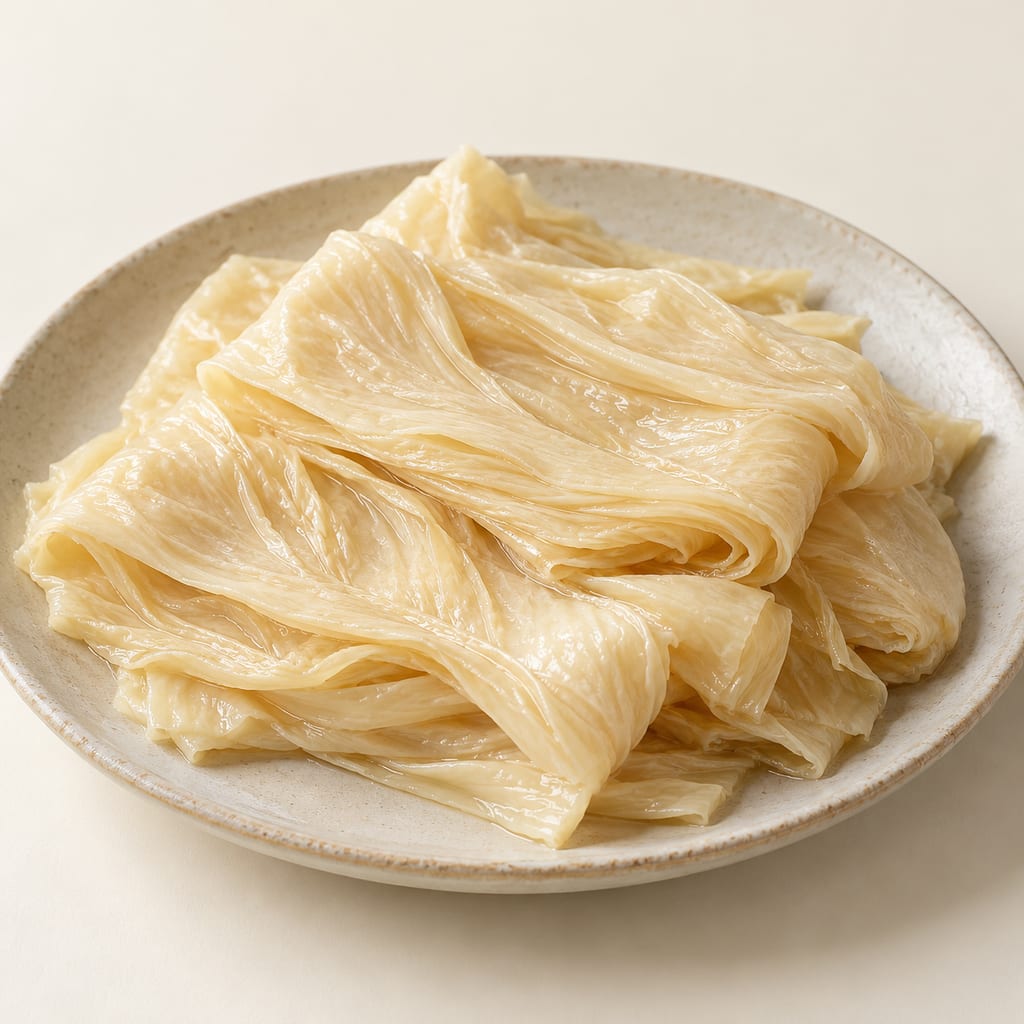
Yuba (soy milk skin)
The protein-lipid film that forms on hot soy milk, lifted sheet by sheet from a wide shallow pan; eaten fresh, or dried for later use.
 FermenteaWhere food goes to change
Equipment · electric-skillets-and-hotplates
electric skillet for yuba · shallow electric hotplate for yuba
A portable electric skillet or shallow hotplate can provide a wide, open heated surface for a modern home adaptation of yuba making. It is not the traditional Kyoto or Minobu yuba pan, and its control dial does not measure the soy milk.
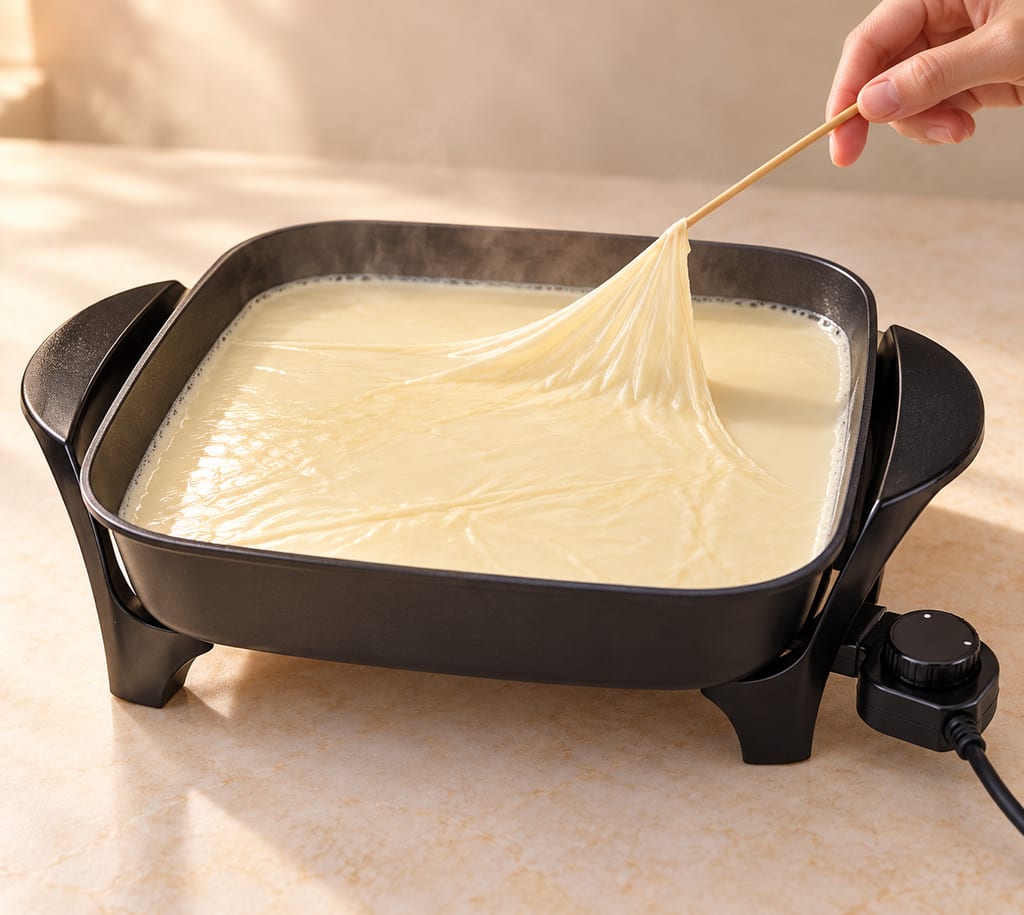
An electric skillet is a portable household appliance in which a broad shallow pan and its electric heater are built into one moveable unit. A shallow hotplate can refer more loosely to a powered cooking surface or pan arrangement; the term does not identify a single standard form. The supplied equipment dossier identifies an electric skillet or hotplate as a simple contemporary home adaptation for lifting yuba from a shallow layer of soy milk. It says to keep the milk surface still while a film develops and lift successive films, but the indexed Japanese electric-cooking publication's full PDF was not retrieved. The page therefore keeps that method narrow: it names the application and its broad pan geometry, not a specific tested model, voltage, dial position, temperature schedule or yield.
That distinction matters because Japanese yuba has documented regional equipment of its own. The Ministry of Agriculture, Forestry and Fisheries (MAFF) describes Kyoto yuba made in a pot surrounded by a square wooden frame, gently heated over a hot-water bath or low heat. Its Minobu account describes a special flat pan and a stick used to lift one sheet at a time. Those are regionally documented traditional methods; this portable electrically heated skillet is described here only as a modern domestic adaptation. A contemporary kitchen appliance should not replace or be mistaken for the forms MAFF documents in Kyoto or Minobu.
Yuba is the delicate film that appears on heated soy milk. MAFF's overview defines it as a surface film formed when soy milk is heated continuously, and notes that it may be eaten fresh or sold dried or molded. A page by William Shurtleff and Akiko Aoyagi at SoyInfo Center likewise describes gently heated soy milk in shallow, open pans, with successive films lifted from the surface and set aside to dry or sell fresh. In functional terms, the appliance offers exposed surface area rather than a sealed fermentation environment. A deep kettle holds more liquid but does not provide the same broad open surface relative to its volume; the relevant feature is a shallow pool exposed to air.
The generated hero shows soy milk and a forming film as an illustrative modern setup. It is not a documentary photo, proof of a product test, or evidence that every electric skillet has an appropriate pan depth. The linked process photograph shows yuba makers lifting films from production pans; those pans are not identified as electric skillets. The separate linked Presto photograph documents a household skillet's shape and detachable control, but its lid is closed and no yuba is shown. Each linked image is attributed to its own source, and each has a distinct evidentiary role.
A current Presto 16-inch skillet is one concrete model example, not a definition of all skillets. Its manufacturer specifies a cast-aluminum base, a ceramic nonstick surface, high sidewalls, a removable heat control and a tempered-glass cover. It lists 120 volts AC and 1500 watts. The product manual describes inserting the heat-control probe and selecting a cooking setting; its indicator lamp turns off when the chosen setting is reached and cycles during operation. This describes control behavior at the appliance, not a direct reading of the soy milk or a proven yuba-making temperature. The archived home method makes the same distinction: the dial controls the heater, so a thermometer in the milk is the appropriate way to know its temperature. No exact dial setting or validated temperature schedule is supplied here.
The open surface is part of the process description. A lid is useful for many ordinary skillet meals, but yuba's film forms on the exposed surface of heated soy milk. The generated illustration leaves the lid off and depicts one film being raised; it does not claim the Presto model has been tested with yuba or that the maker endorses that use. If the pan coating, liquid depth, heating cycle or ambient conditions change, film formation may change too. This page does not set a batch size, recommend a cooking temperature, or promise a repeatable sheet count.
The Presto 06852 product page describes an appliance sold in the United States and gives its own voltage, wattage and surface construction. Those numbers belong to that model, not the international term electric skillet. Some products may have detachable heat probes, thermostats, different shapes or no enclosing walls at all; the category title is intentionally broader than this one example. Before use, a reader should check the rating plate, control, coating, manual and cleaning instructions for the unit at hand rather than assuming that one manufacturer's specifications travel with the name.
Presto's manual says to use its skillet on a dry, level, heat-resistant surface, connect only to the specified 120 VAC outlet, keep the heat control, cord and plug out of liquids, and disconnect and cool the appliance before cleaning. It warns users to handle the hot pan by its handles and not to move it when it contains hot liquid unless necessary and with great caution. These are manufacturer instructions for that model family; a different hotplate may have different safeguards. An electric skillet is simply a portable cooking appliance used as a contemporary yuba aid. Its thermostat is not a fermentation controller, and its performance does not establish that a fresh soy-milk sheet is safe to store or shelf-stable.
The appliance and the food tradition have different geographic records. MAFF lists Kyo-yuba in Kyoto and Minobu yuba in Yamanashi. For Kyoto, the ministry describes a square wooden frame around the pot, low-heat or hot-water-bath warming, and hand or skewer lifting of the film. For Minobu it describes a special flat pan and a stick. The same ministry places yuba within Japan's processed soybean foods, while the SoyInfo Center historical account discusses pan-based yuba across multiple East Asian and Japanese names. This is evidence about yuba and its traditional preparation, not the birthplace of an electric skillet.
The research dossier supplies an indexed Japanese electric-cooking publication as the lead for a modern electric-skillet or hotplate method, but does not identify its title or recover its complete PDF. Its surviving description supports only the cautious home-adaptation account above. The local record also avoids claiming that Japanese yuba makers traditionally used a Presto skillet, that every electric pan can hold the desired heat, or that one region owns the modern appliance form. The current manufacturer model cited here is a United States example; no factory origin or global sales claim for it is made.
A current Presto electric-skillet product page and an instruction manual bearing a 2018 copyright date document a present-day household appliance example. They do not establish when electric skillets were invented or when the generic home-yuba adaptation began.
The appliance heats an open pan of liquid; contact can burn, and wetting the attached electrical control, cord or plug can create an electric-shock hazard.
Hazard sourceUse the model's own manual and rating label, place the unit on a stable dry heat-resistant surface, keep the electric control and cord dry, use the pan's handles, and unplug it before cleaning after it has cooled.
Control sourceA selected skillet setting is not a soy-milk temperature measurement.
The current Presto manual specifies 120 VAC; do not use that rating to determine compatibility for another model.
A skillet thermostat or indicator lamp describes the appliance's control setting; it is not a direct measurement of the soy milk temperature. The supplied research dossier recommends checking the milk with a thermometer, but provides no validated electric-skillet temperature schedule.
Source →The 120 VAC/1500 W specification and 16-inch geometry apply to the cited Presto 06852 model only. Electrical compatibility and usable surface vary by model and country.
Source →The Kyoto and Minobu sources describe traditional wooden-framed or special flat pans, not electric skillets. The domestic electric appliance is a modern adaptation and must not be presented as their historical equipment.
Source →The sources locate traditional Kyo-yuba in Kyoto and Minobu yuba in Yamanashi, and describe a US-market Presto skillet, but do not locate the modern electric-skillet yuba adaptation or establish an origin for this equipment class.
The protein-lipid film that forms on hot soy milk, lifted sheet by sheet from a wide shallow pan; eaten fresh, or dried for later use.

Soft, spreadable Calabrian pork sausage made with a great deal of red chilli and fatty pork, stuffed into natural casings, sometimes smoked and matured while staying soft.

A way to add independent temperature logging to an existing food dehydrator without changing its built-in controls or protections. It is a monitoring method, not a rewiring plan.

Pleurotus cystidiosus is the abalone mushroom, a cultivated oyster-type fungus with dark brown caps that grows more slowly and is more demanding than other Pleurotus species.

A dark, balanced vinegar from Emilia-Romagna made by combining cooked or concentrated grape must with wine vinegar, then acetifying and refining it in wood under a protected specification.

A living dairy inoculum that starts controlled cream fermentation, developing acidity and aroma before sour cream or cultured butter is finished.

A small electric incubator holds jars at a selected temperature for yogurt and other documented warm food preparations. Controls, capacity and vessel arrangement vary by model.

Adygean salt is a seasoned table salt associated with Adygea and the wider North Caucasian culinary tradition. Salt is blended with garlic and a variable selection of herbs and spices; the exact mix depends on the named style and maker.

The African Caesar-group mushroom, Amanita masasiensis, is a wild ectomycorrhizal species of central and southern African woodlands, eaten locally. The genus contains deadly poisonous species, so identification needs care.
No community contributions have been published for this entry yet.
Sign in to contribute. Published comments and photos are free to read.
Ministry of Agriculture, Forestry and Fisheries, JapanYuba definition · Process context · Regional context
Processed bean products | Traditional Foods in JapanMAFF defines yuba as the film formed on soy milk when it is heated continuously; it describes yuba as made only from soybeans and notes fresh, dried and molded forms.
The official overview lists Minobu yuba in Yamanashi and Kyo-yuba in Kyoto as regional Japanese soybean foods.
Cited in: Why a wide open surface matters; A geographic note on yuba
Ministry of Agriculture, Forestry and Fisheries, JapanTraditional equipment · Traditional method · Geography
京湯葉(きょうゆば)|にっぽん伝統食図鑑MAFF describes Kyoto yuba made in a pot enclosed by a square wooden frame; soy milk is gently heated over a hot-water bath or low heat and the forming film is lifted by hand or skewer.
The Kyoto account distinguishes fresh yuba from dried yuba.
Cited in: A modern pan, not a traditional yuba vessel; A geographic note on yuba
Ministry of Agriculture, Forestry and Fisheries, JapanTraditional equipment · Traditional method · Geography
身延ゆば(みのぶゆば)|にっぽん伝統食図鑑MAFF locates Minobu yuba in Minobu, Yamanashi, and describes soy milk heated in a special flat pan with its surface film lifted one sheet at a time using a stick.
The source describes fresh and dried forms and the regional method; it does not identify an electric skillet as traditional equipment.
Cited in: A modern pan, not a traditional yuba vessel; Household example, model-specific limits; A geographic note on yuba
SoyInfo CenterYuba process · Surface area context · History
History of YubaThis historical account describes soy milk gently heated in shallow open pans, the successive removal of surface films, and fresh or dried yuba forms.
The cited 80–90 °C refers to the account's yuba-making description, not an electric skillet setting or a guaranteed food temperature.
Cited in: Why a wide open surface matters; A geographic note on yuba
National Presto Industries, Inc.Modern model example · Materials · Power · Dimensions
16-inch Electric Skillet with glass coverPresto describes model 06852 as a household 16-inch electric skillet with high sidewalls, cast-aluminum base, ceramic nonstick surface, detachable heat control and tempered-glass cover.
The manufacturer lists 120 volts AC and 1500 watts for this model and says its heat control maintains the selected cooking temperature automatically.
The product page identifies a particular US-market example and does not establish universal specifications for electric skillets.
Cited in: The dial is for the pan, not the milk; Household example, model-specific limits
National Presto Industries, Inc.Operation · Safety · Care · Model variation
Electric Skillet with glass cover: instruction manual for models 06626 and 06852The manual instructs users to insert the heat-control probe fully, use a 120 VAC outlet, and place the skillet on a dry, level, heat-resistant surface.
It says the indicator lamp cycles as the control maintains the selected temperature; the dial indicates the appliance control setting, not the temperature of soy milk in the pan.
The manual says not to immerse the heat control, cord or plug and to disconnect and cool the appliance before cleaning.
Cited in: The dial is for the pan, not the milk; Household example, model-specific limits