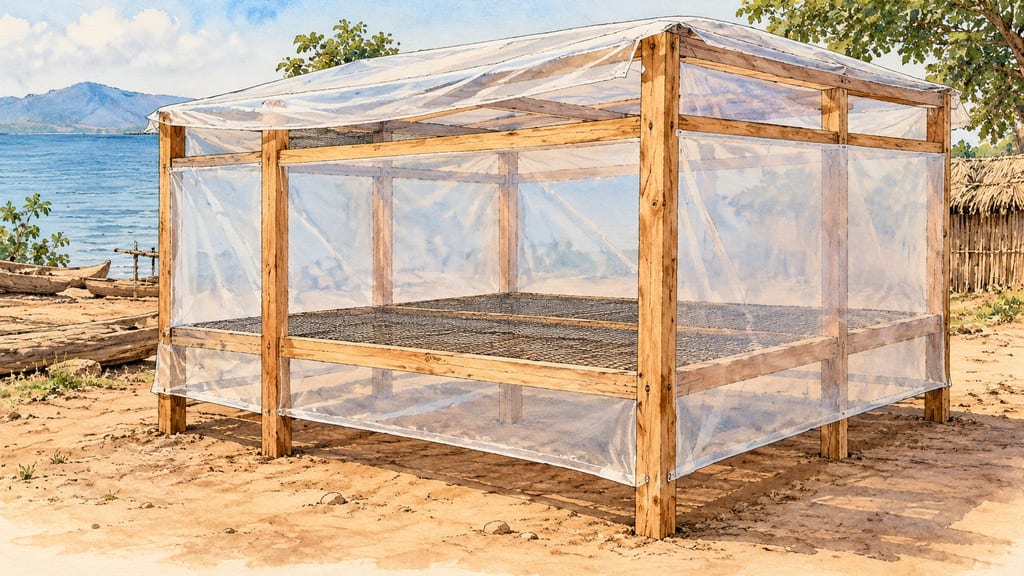
Solar tent dryer (Lake Malawi)
A UV-treated polythene sheet over a wooden frame shelters internal drying racks, with low inlets and high side vents for natural airflow during fish drying.
 FermenteaWhere food goes to change
Built structures · Drying kilns and dryers
A low-cost, direct solar tent with a black back and ground, a clear front and roof, a raised mesh platform and high exhaust holes. The FAO manual for Afghanistan describes its construction.
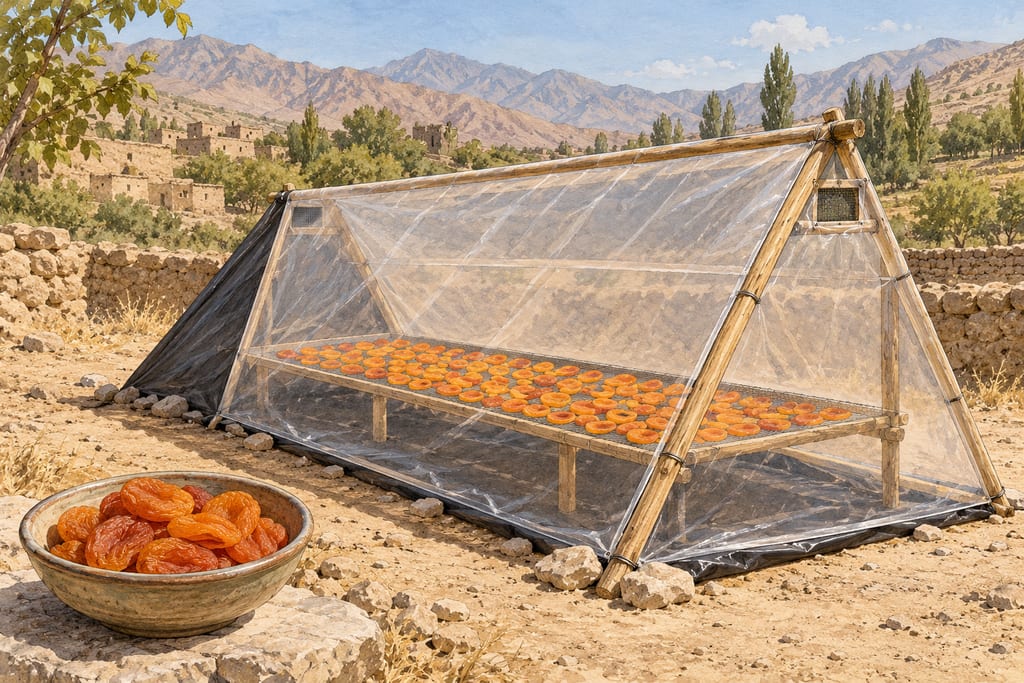
The FAO A-frame solar tent is a light direct solar dryer. A black sheet forms the back and the ground, a clear sheet covers the sun side and the roof, and the product sits on a raised mesh platform inside. Air enters under a roll-up rail and leaves through high holes in the end panels, so the tent is ventilated by its own shape.
It is one member of the tent family. The FAO manual describes it for Afghanistan's fruit and vegetables, and the Lake Malawi fish dryer is another build in the same family. The two are separate records, because the same frame is not the same as a process for a given food.
Sunlight passes through the clear sheet and warms the black back and ground, which warms the air inside. Warm air rises and leaves through the high exhaust holes, and cooler outside air enters the low inlet under the rail. The moisture from the product leaves with the exhaust air.
The manual warns that without this ventilation, condensation forms and the produce will not dry. The inlet and the exhaust are therefore the working parts of the design, not decoration. FAO's small-scale dryer guidance notes that the light structure is not suited to strong wind and that a mud-walled dryer is a different type.
The FAO sequence is to cross and bury the side beams, fix the black sheet to the rear and ground, fix the clear sheet to the front and sides, leave the roughly 10 cm gap under the rolling rail, cut the high exits, and assemble the platform. The manual does not specify fasteners, saws, drilling, film tension or anchorage, so those are the builder's choices.
The manual gives a 1.3 m side beam but no footprint, ridge height, pitch, vent area, mesh opening or film thickness. The illustration shows the form and is not a drawing to scale. A build guide needs a measured example, or a labelled adaptation with its own dimensions.
The lightweight A-frame tent is described in Home-based Fruit and Vegetable Processing in Afghanistan, a manual edited for the FAO and the Ministry of Agriculture, Irrigation and Livestock. A later FAO page treats the tent as one of several small-scale dryers.
A build is made where it stands: moving it means building it again.
Without ventilation, condensation builds up and produce does not dry, according to the FAO manual.
Hazard sourceThe light structure is not suited to strong winds, so it can be damaged or blown over.
Hazard sourceKeep the low inlet open and cut the high exhaust openings
Control sourceShelter the tent or choose a sturdier design in windy sites
Control sourceThe FAO manual covers fruit and vegetables. Its architecture does not validate a fish or meat process.
Use food-contact mesh for the platform. A light frame does not excuse a non-food-contact mesh.
The manual is written for fruit and vegetable processing in Afghanistan. It does not establish that every tent in the country follows this design.
A UV-treated polythene sheet over a wooden frame shelters internal drying racks, with low inlets and high side vents for natural airflow during fish drying.

Soft, spreadable Calabrian pork sausage made with a great deal of red chilli and fatty pork, stuffed into natural casings, sometimes smoked and matured while staying soft.

A way to add independent temperature logging to an existing food dehydrator without changing its built-in controls or protections. It is a monitoring method, not a rewiring plan.

Pleurotus cystidiosus is the abalone mushroom, a cultivated oyster-type fungus with dark brown caps that grows more slowly and is more demanding than other Pleurotus species.

A dark, balanced vinegar from Emilia-Romagna made by combining cooked or concentrated grape must with wine vinegar, then acetifying and refining it in wood under a protected specification.

A living dairy inoculum that starts controlled cream fermentation, developing acidity and aroma before sour cream or cultured butter is finished.

A small electric incubator holds jars at a selected temperature for yogurt and other documented warm food preparations. Controls, capacity and vessel arrangement vary by model.

Adygean salt is a seasoned table salt associated with Adygea and the wider North Caucasian culinary tradition. Salt is blended with garlic and a variable selection of herbs and spices; the exact mix depends on the named style and maker.

The African Caesar-group mushroom, Amanita masasiensis, is a wild ectomycorrhizal species of central and southern African woodlands, eaten locally. The genus contains deadly poisonous species, so identification needs care.
No community contributions have been published for this entry yet.
Sign in to contribute. Published comments and photos are free to read.
FAOMethod · Safety · History
Home-based Fruit and Vegetable Processing in Afghanistan: A Manual for Field Workers and Trainers, Annex 2 Solar dryingLightweight A-frame tent with a 1.3 m side beam and crossed upright beams; black rear and ground, clear sun side and roof, raised mesh platform.
Inlet about 10 cm above ground under a roll-up rail; exit holes high in the triangular side panels.
Without ventilation, condensation builds and produce does not dry.
Cited in: What it is; How it dries; Building it and what it does not give
FAOSafety · History
FAO small-scale dryersThe light tent should not be used in strong winds; a mud-wall dryer is a separate family.
Cited in: How it dries