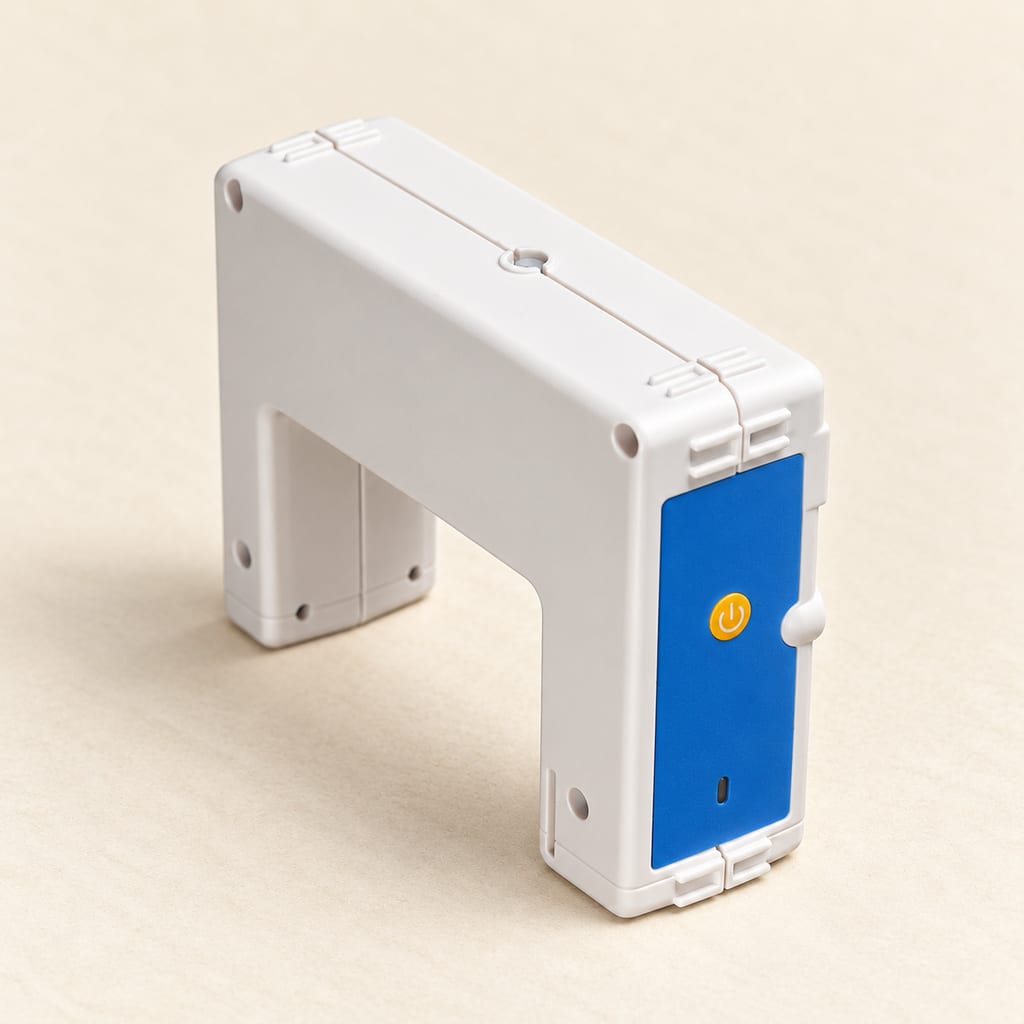
Bubble counter
An infrared beam counter registers bubbles crossing a defined liquid column. Counts can track change over time, but do not measure gas volume or establish alcohol or residual sugar.
 FermenteaWhere food goes to change
Equipment · Instruments
Gas sensor · Alcohol gas sensor
An ethanol-vapour gas sensor responds to alcohol in air, not directly to alcohol by volume in fermented liquid. Different gas sensors and bubble counters measure distinct signals.
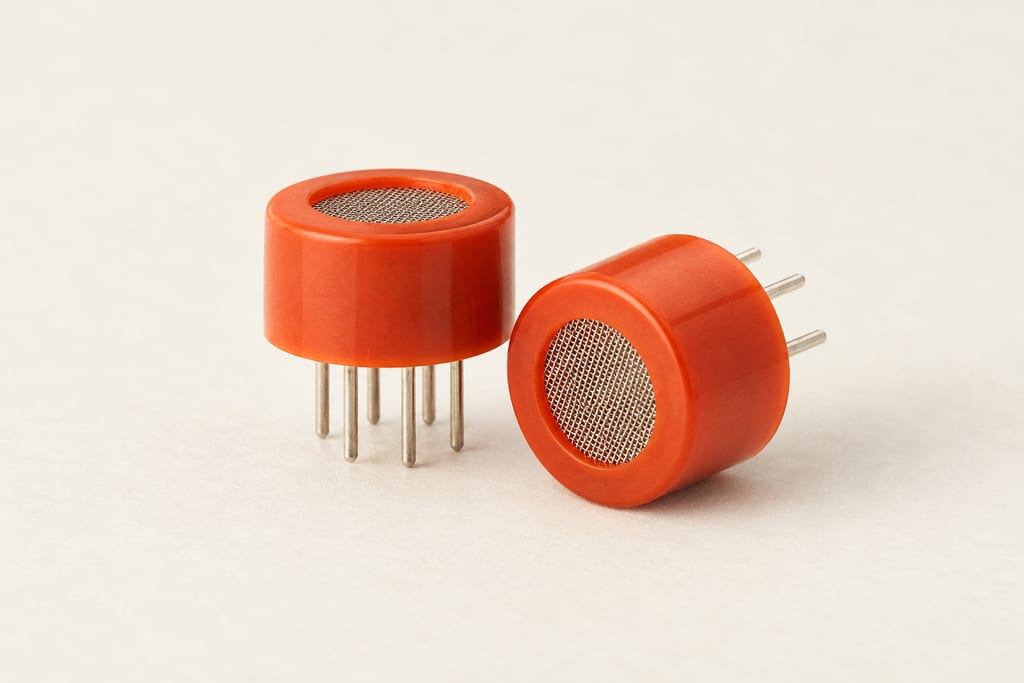
An ethanol-vapour gas sensor is an electronic instrument that responds to alcohol present in air. It belongs to gas sensing: its target is in the surrounding gas phase, such as vapour in a headspace, rather than ethanol measured directly in a beverage sample. The source material that motivated this entry flags low-cost gas sensors as possible process monitors while warning that they do not directly determine liquid alcohol by volume.
The equipment name covers more than one sensor design. Winsen's MQ-3B and Figaro's TGS2620 are contemporary manufacturer examples marketed for alcohol or organic-vapour detection. They show how a small component may serve in a detector circuit, but neither manufacturer's product information establishes a validated kombucha ABV test or a common design for every alcohol gas sensor.
In the MQ-3B example, Winsen identifies tin dioxide as the sensitive material. The manufacturer's manual describes its conductivity changing when alcohol gas reaches the sensing element; supporting electronics turn that change into an output related to gas concentration. Figaro documents another alcohol-vapour sensor, with its own target range, package and application guidance. These examples are useful for recognizing the equipment class, not for assuming that a low-cost module is selective to ethanol under every condition.
A sensor signal is shaped by the model and the surrounding sample environment. The cited manufacturer documentation reports temperature and humidity dependencies, and Winsen warns that some contaminants can affect performance. In fermentation-related use, other volatile compounds, the composition and exchange of the headspace, and calibration for the intended matrix further affect what a response can mean. The reading is therefore a model- and context-dependent gas-phase signal.
A carbon-dioxide probe measures CO₂; it is not an ethanol sensor. A bubble counter instead registers individual bubbles interrupting an optical beam as they pass through a liquid column. Those are different observations: gas composition, gas concentration and bubble count should not be treated as interchangeable measurements. A [bubble counter](/equipment/bubble-counter) can be compared with a vapour sensor as a separate measurement approach, but neither signal by itself states beverage alcohol by volume.
For kombucha, a validated analytical method is a different category of evidence. Chan and colleagues validated headspace gas chromatography with mass-spectrometric detection for quantifying ethanol in kombucha. That is a laboratory assay for beverage ethanol, whereas an inexpensive semiconductor component reports its gas-phase sensor response. Do not convert the latter to a drink's ABV, or use it to infer safety, unless the complete measurement method has been validated for that beverage and purpose.
The MQ-3B product image shows a small packaged sensor element with a perforated cap and electrical pins; that one component is not a complete fermentation control system. The manufacturer's 2018 manual version documents a modern model, but it does not establish when alcohol gas sensors first appeared. The inspected sources also do not identify the MQ-3B's manufacturing site or establish a traditional regional use of the instrument. This page therefore records an unknown origin rather than treating a manufacturer name or a source website as proof of where the product was made.
Winsen's MQ-3B manual version 1.5 is valid from 2018. This dates that documented manual version, not the invention of alcohol gas sensing or the wider sensor class.
The inspected manufacturer's product page and manual identify the MQ-3B but do not verify where this model is manufactured or where alcohol gas sensors originated or are used in traditional fermentation; no geography is inferred.
An infrared beam counter registers bubbles crossing a defined liquid column. Counts can track change over time, but do not measure gas volume or establish alcohol or residual sugar.

Soft, spreadable Calabrian pork sausage made with a great deal of red chilli and fatty pork, stuffed into natural casings, sometimes smoked and matured while staying soft.

A way to add independent temperature logging to an existing food dehydrator without changing its built-in controls or protections. It is a monitoring method, not a rewiring plan.

Pleurotus cystidiosus is the abalone mushroom, a cultivated oyster-type fungus with dark brown caps that grows more slowly and is more demanding than other Pleurotus species.

A dark, balanced vinegar from Emilia-Romagna made by combining cooked or concentrated grape must with wine vinegar, then acetifying and refining it in wood under a protected specification.

A living dairy inoculum that starts controlled cream fermentation, developing acidity and aroma before sour cream or cultured butter is finished.

A small electric incubator holds jars at a selected temperature for yogurt and other documented warm food preparations. Controls, capacity and vessel arrangement vary by model.

Adygean salt is a seasoned table salt associated with Adygea and the wider North Caucasian culinary tradition. Salt is blended with garlic and a variable selection of herbs and spices; the exact mix depends on the named style and maker.

The African Caesar-group mushroom, Amanita masasiensis, is a wild ectomycorrhizal species of central and southern African woodlands, eaten locally. The genus contains deadly poisonous species, so identification needs care.
No community contributions have been published for this entry yet.
Sign in to contribute. Published comments and photos are free to read.
Zhengzhou Winsen Electronics Technology Co., Ltd.Representative commercial model · Target gas · Form
MQ-3B Semiconductor Sensor for Alcohol GasWinsen identifies the MQ-3B as a semiconductor alcohol-gas sensor whose target is C2H5OH in gas form.
Winsen describes the product as an alcohol-gas detector and gives model-specific package and electrical information; it does not present the sensor as a liquid beverage ABV assay.
Cited in: A gas-phase sensor, not an alcohol meter for drinks; Form, date and geographic limits
Zhengzhou Winsen Electronics Technology Co., Ltd.Sensing principle · Model specific construction · Conditions and limitations
Alcohol Gas Sensor MQ-3B Manual, Version 1.5Winsen describes SnO2 as the MQ-3B sensitive material and says its conductivity changes in the presence of alcohol gas in air.
The MQ-3B manual records temperature and humidity response characteristics and cautions that certain contaminants or corrosive exposures can change sensor performance.
The manual version is valid from 2018; it dates that version rather than the class's invention.
Cited in: How a semiconductor example responds; Form, date and geographic limits
Figaro Engineering Inc.Independent manufacturer comparison · Sensor class variation
TGS2620 Organic Solvent Vapor SensorFigaro describes the TGS2620 as a sensor for alcohol and organic-solvent vapours, with a different model-specific design and application context from the MQ-3B.
A second manufacturer example demonstrates that vapor-sensing components differ by model and should not be treated as one universal instrument specification.
Cited in: A gas-phase sensor, not an alcohol meter for drinks
Figaro Engineering Inc.Temperature and humidity response · Model specific limits
TGS2620 Product InformationThe TGS2620 datasheet gives response characteristics for several gases and shows temperature and humidity dependency under its stated test conditions.
The datasheet warns that actual operating conditions vary by application and recommends confirming target-gas suitability for the intended use.
Cited in: How a semiconductor example responds
Journal of AOAC InternationalValidated beverage alcohol measurement comparison
Determination of Ethanol Content in Kombucha Using Headspace Gas Chromatography with Mass Spectrometry Detection: Single-Laboratory ValidationChan et al. validated a headspace GC–MS method to quantify ethanol in kombucha against AOAC method-performance requirements.
The paper demonstrates that measuring beverage ethanol requires a validated analytical method; a generic gas sensor response is not a direct liquid ABV result.
Cited in: A gas-phase sensor, not an alcohol meter for drinks; Different instruments answer different questions
VaisalaComparison with a carbon dioxide sensor
CO₂ Probe GMP251Vaisala describes the GMP251 as a carbon-dioxide probe measuring CO2, a different target gas from ethanol vapour.
Cited in: Different instruments answer different questions
Data Harvest Group LtdComparison with a bubble counter
1240 - Wireless Drop Bubble Counter: IntroductionData Harvest describes an infrared bubble counter that counts beam interruptions as bubbles rise through a liquid column; it measures discrete bubble events rather than gas composition.
Cited in: Different instruments answer different questions