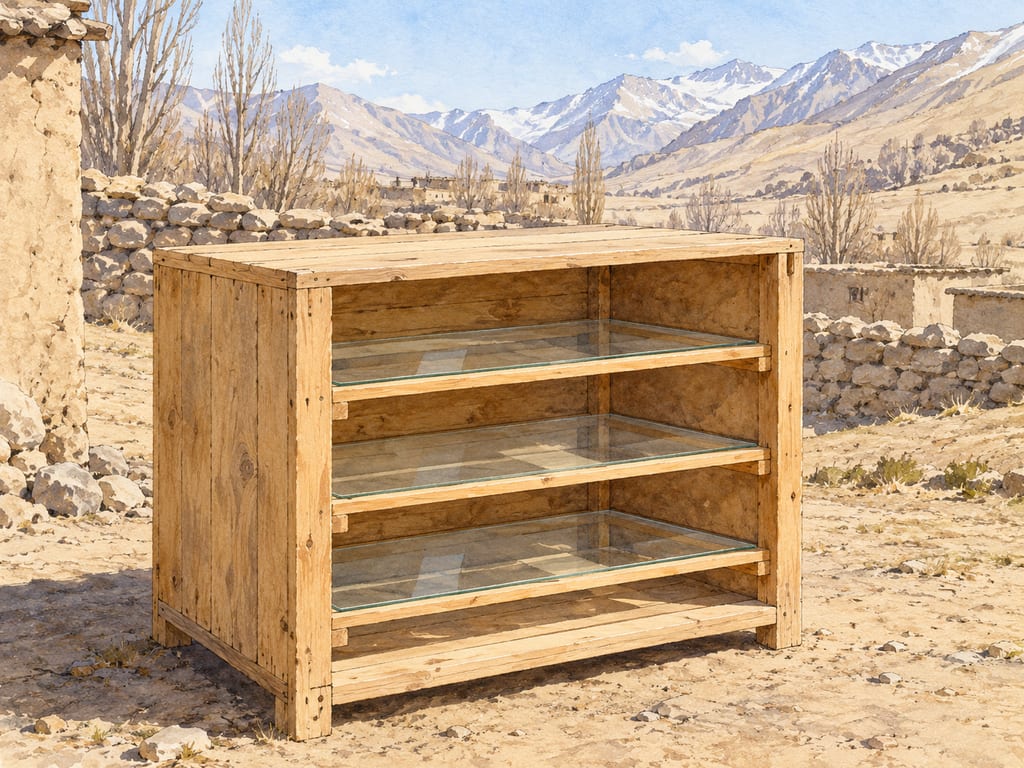
Protected apricot dryers
Tajik apricot growers use protected dryers to shield fruit from insects and weather. Documented equipment includes cabinet and portable tent designs; fixed greenhouse units are site installations.
 FermenteaWhere food goes to change
Equipment · Baskets, trays and beds
Traditional Tajik apricot drying used open ground, roofs and flexible surfaces such as reed mats and fabric. These distinct open-air surfaces leave fruit exposed to weather and surroundings.
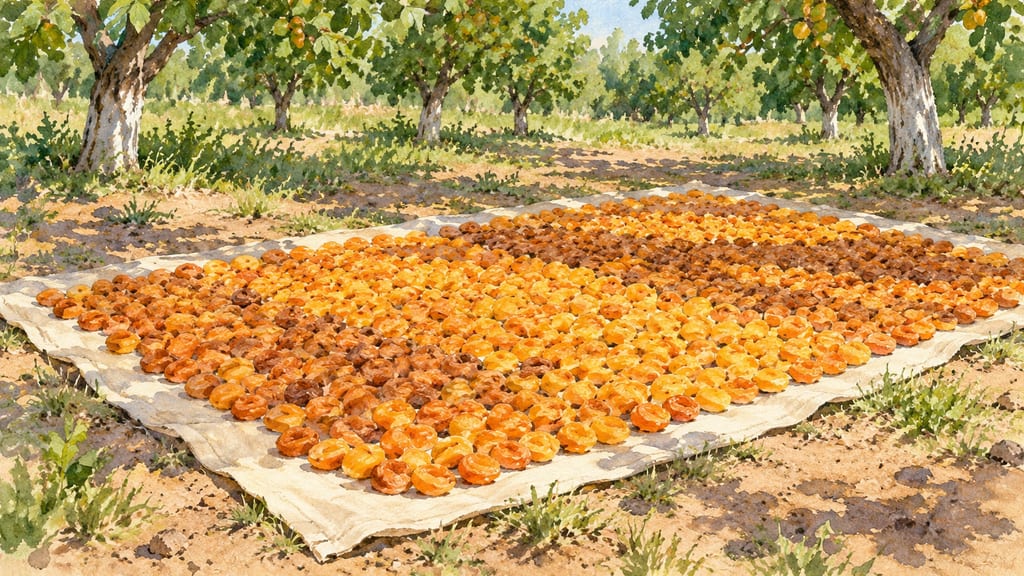
The name covers a family of places and coverings used to spread apricots in the open air: ground between orchard rows, household roofs, reed mats, cardboard and fabrics. A Tajik practitioner lists these as earlier drying arrangements when comparing them with a newer protected dryer. The list does not describe one standard tray, frame or construction plan. Ground and roofs are places already available to a household; mats and other flexible coverings can be moved and laid over a surface.
The differences matter. A patch of orchard ground, a roof and a portable mat have different supporting materials and exposures, even when each holds fruit under the sun. The source names the options but does not say that every orchard used all of them, or that they were always combined. This entry keeps them as reported alternatives rather than turning them into a single invented device.
A 2009 Radio Ozodi report follows a Sughd family gathering and drying apricots during the summer. A teenage grandson says that his grandfather taught him the work. For drying, he describes spreading the apricots on a farsh held on all four sides. Farsh means a floor covering; the report does not identify its exact fibre, weave or dimensions. The accompanying photograph shows fruit spread over pale, flexible-looking surfaces laid on the orchard ground, but the image alone cannot establish what those surfaces are made from.
The report then describes covering the fruit with plastic and fumigating it with sulphur. Those are separate steps in that family's account, not properties of the farsh itself and not a general operating or food-safety instruction. The report is one dated household example, not proof that every Sughd grower used the same covering or handling sequence.
A drying surface holds fruit where sun and ambient air can reach it while moisture leaves the fruit. These surfaces have no powered heat, controlled airflow or enclosure described in the cited accounts; the drying environment is the orchard or household setting around them. The practitioner interviewed in 2020 says the earlier open arrangements affected product quality and contrasts them with a protected dryer that shields fruit from contamination, insects, rain and wind.
That comparison explains what the newer equipment changes without making the older surfaces interchangeable with a dryer cabinet. Open ground and roofs can provide broad space, while mats and coverings can be moved or removed; none is documented here with a universal size, load, drying time or target temperature. Weather and exposure are part of the setting, and the sources do not offer a controlled specification for them.
Tajik apricots include named dried forms such as bargak, split and pitted fruit, and kaisa, fruit kept substantially whole with the stone removed; stone-in dried apricot is another form. These product distinctions describe how the fruit is prepared, not a special shape of mat or roof. The evidence does not assign a particular surface to each product form, so a surface should not be read as a recipe for one of them.
This equipment record is linked to the site's Tajik dried-apricot preparation. That connection makes the supporting surface discoverable alongside the product while leaving fruit preparation and product naming to their own page.
The clearest regional account is a 2009 report about one family in Sughd. The 2020 GEFF interview identifies a practitioner associated with Konibodom and recalls older surface-drying arrangements in Tajikistan while discussing newer protected equipment. Together these records support use in Tajikistan, with a specific family example in Sughd; they do not establish one national design or identify where the method began.
The earliest dated account used here is from 2009, but that is a date of documentation, not an invention date. The 2020 speaker's phrase about earlier practice supplies no starting year, and neither source says when ground, roofs or mats ceased to be used. The equipment's original date and present-day continuity therefore remain open.
A Radio Ozodi report dated 16 July 2009 describes one Sughd family drying apricots on a farsh and passing the work between generations. A 2020 GEFF Tajikistan interview recalls earlier ground, roof and mat surfaces alongside newer protected dryers. Neither source dates the beginning of the practice.
Open surfaces do not provide the rain, insect or contamination protection associated with the newer protected dryer discussed in the 2020 interview.
Source →The cited accounts give no standardized surface dimensions, drying temperature, capacity or duration for these surfaces.
Source →The interview names ground, roofs and several mat-like surfaces in Tajikistan; it does not establish one uniform method throughout the country.
The report follows one Sughd household; it does not claim that this farsh-based method was exclusive to the region.
Tajik apricot growers use protected dryers to shield fruit from insects and weather. Documented equipment includes cabinet and portable tent designs; fixed greenhouse units are site installations.

Soft, spreadable Calabrian pork sausage made with a great deal of red chilli and fatty pork, stuffed into natural casings, sometimes smoked and matured while staying soft.

A way to add independent temperature logging to an existing food dehydrator without changing its built-in controls or protections. It is a monitoring method, not a rewiring plan.

Pleurotus cystidiosus is the abalone mushroom, a cultivated oyster-type fungus with dark brown caps that grows more slowly and is more demanding than other Pleurotus species.

A dark, balanced vinegar from Emilia-Romagna made by combining cooked or concentrated grape must with wine vinegar, then acetifying and refining it in wood under a protected specification.

A living dairy inoculum that starts controlled cream fermentation, developing acidity and aroma before sour cream or cultured butter is finished.

A small electric incubator holds jars at a selected temperature for yogurt and other documented warm food preparations. Controls, capacity and vessel arrangement vary by model.

Adygean salt is a seasoned table salt associated with Adygea and the wider North Caucasian culinary tradition. Salt is blended with garlic and a variable selection of herbs and spices; the exact mix depends on the named style and maker.

The African Caesar-group mushroom, Amanita masasiensis, is a wild ectomycorrhizal species of central and southern African woodlands, eaten locally. The genus contains deadly poisonous species, so identification needs care.
No community contributions have been published for this entry yet.
Sign in to contribute. Published comments and photos are free to read.
European Bank for Reconstruction and Development (EBRD), GEFF TajikistanForm · Materials · Geography · Historical attestation · Comparison
GEFF Tajikistan Radio Interview #4: Innovative Apricot DryingA Tajik agricultural practitioner recalls earlier apricot drying on ground between garden rows, household roofs, reed mats, cardboard and fabrics.
The interview contrasts those open surfaces with a newer protected dryer and reports quality problems associated with the earlier arrangement.
The practitioner is identified with Konibodom; the interview discusses apricot production in Tajikistan.
Cited in: Several surfaces, not one standard dryer; Open-air drying and its trade-offs; Apricot forms belong to the fruit, not the surface; What the dates and geography establish
Radio Ozodi (Radio Free Europe/Radio Liberty)Form · Use · Regional attestation · Image reference
Дарёфти ризқу рӯзӣ аз дарахти зардолу (Earning a livelihood from the apricot tree)A report dated 16 July 2009 describes a Sughd family gathering and drying apricots, with a grandson learning the work from his grandfather.
The quoted method spreads apricots on a farsh held on all four sides; the source does not specify the covering's fibres or construction.
The article's photograph shows apricots spread on ground-laid pale flexible-looking surfaces in an orchard.
Cited in: The farsh in one Sughd household; What the dates and geography establish