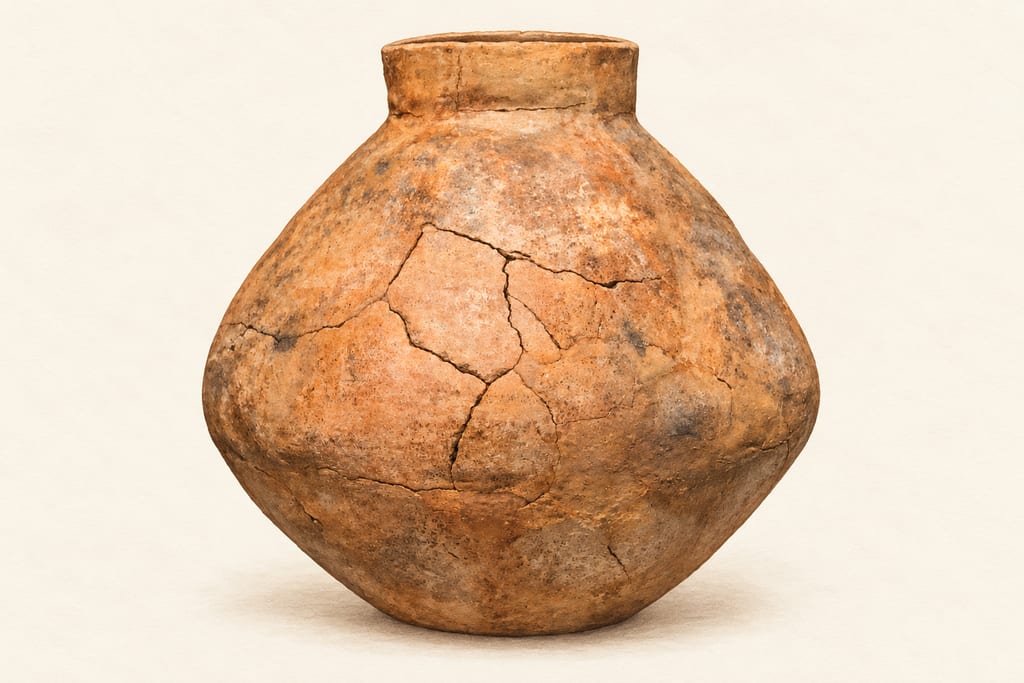
A household jar from Hajji Firuz
The Hajji Firuz jar is a reconstructed ceramic vessel catalogued by the Penn Museum as object 69-12-15. The museum dates it to 5400–5000 BCE and records it from Hajji Firuz Tepe in Iran. It was one of a group found set into the floor along an interior wall of a well-preserved Neolithic house described as a kitchen. This context places the jar among household storage equipment rather than in a separate, purpose-built winery. The group setting matters: this was one container within a domestic arrangement, not a single monumental vessel whose scale or function can stand for every early wine practice.
Sources for this section
Form, material and scale
The reconstructed jar is about 32 centimetres high and 33.4 centimetres across at its widest outside diameter. The collection record describes a restricted mouth and carinated profile: the shoulder turns distinctly into the body rather than forming a simple uninterrupted curve. It is ceramic, with fragments reconstructed into the vessel now seen in the museum. Its approximate capacity is 9 litres, a manageable household-scale quantity. These details distinguish this specimen from much larger later jars and from modern Georgian qvevri; resemblance among ceramic wine vessels does not establish that they shared the same construction, installation or use.
Sources for this section
What the residue can tell us
Reddish residue inside the jar tested positive for wine and terebinth tree resin. That finding connects the vessel to wine storage and to resin among the substances associated with its contents. It does not, by itself, show that resin was applied as a waterproof lining, how much wine the jar held at a particular moment, or how the jar was cleaned and sealed. The museum identifies it as a storage jar. The residue is not independent proof that primary fermentation took place inside this particular vessel, so its best-supported role here is containment of wine rather than an asserted fermentation method.
Sources for this section
Reading the vessel in context
The floor-set arrangement shows that these ceramic containers were integrated into the house, where their bodies could be supported by the surrounding floor. The sources do not give a measured temperature, sealing method, oxygen transfer rate, or evidence that the floor position was chosen for a specific fermentation effect. Those properties should not be supplied by analogy with later buried wine jars. The object is a useful early record of ceramic wine containment in Neolithic Iran, but it cannot establish a continuous line from this household jar to any present-day vessel tradition. It is a museum-held archaeological object, not a working design or a validated process guide.
Sources for this section
History
Penn Museum dates this reconstructed object to 5400–5000 BCE. It was one of a group of jars found sunken into the floor along the interior wall of a well-preserved Neolithic house described as a kitchen. The date belongs to this excavated vessel; it is not an endpoint for the broader practice of storing wine in ceramic jars.
Equipment details
CapacityThe Penn Museum gives an approximate capacity of 9 litres; it is not a measured range.
Size32 cm tall, 33.4 cm across Penn Museum measurements for the reconstructed vessel.
PowerNo power A storage jar does not require a power source.
How you get oneNot obtainable today This entry describes the archaeological specimen catalogued by Penn Museum as object 69-12-15. It is not an item available to obtain for use.
Made of
- Ceramic — Vessel body
The museum record specifies ceramic; the atlas describes reconstructed earthenware.
Limits
Wine-associated residue does not establish that this vessel was used for primary fermentation; the museum identifies it as a storage jar.
Source →Places
Hajji Firuz Tepe
Historical attestation · Locality evidenceFind provenance for object 69-12-15; this row does not assign the origin of all wine jars to Iran.