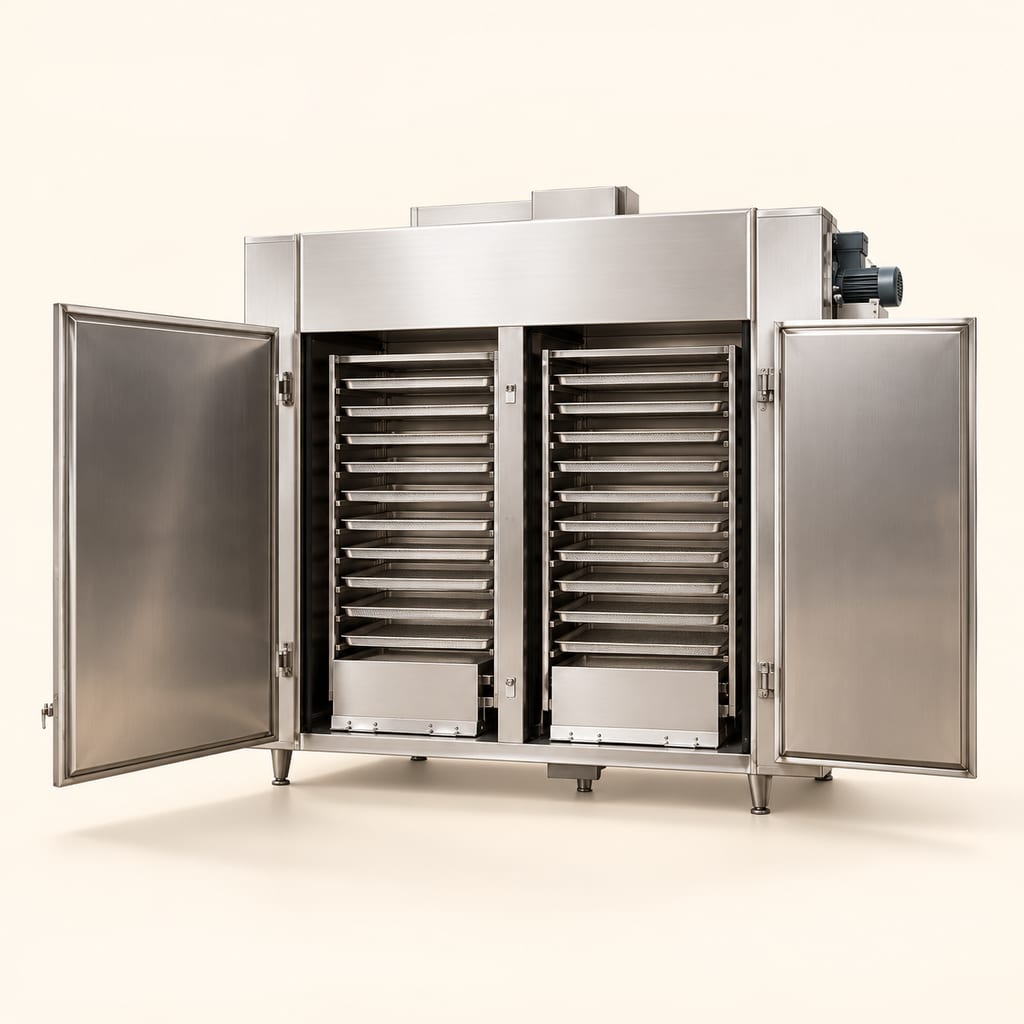
Cabinet and convection dryer
A heated-air cabinet with trays for drying fruit and other crops; PHilMech documents cabinet/convection dryers in Cebu's dried-mango trade and several Philippine equipment variants.
 FermenteaWhere food goes to change
Equipment · Drying kilns and dryers
Infrared-plus-convection dryer · FIRCH dryer · far-infrared and convection heating system
PHilMech's two-stage mango-drying system used intermittent far-infrared conveyor heating before a convection cabinet finish. Its pilot measurements describe one research setup, not a standard specification for every hybrid dryer.
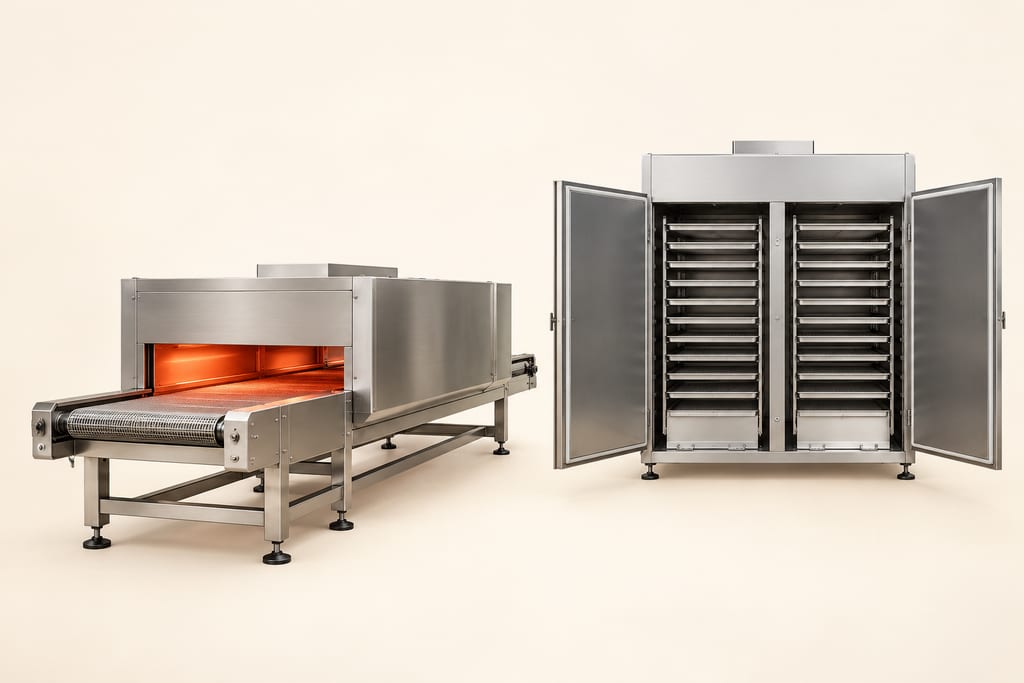
Far-infrared and convection heating (FIRCH) is a staged drying arrangement rather than one universal machine design. In the PHilMech process described in 2013, sliced mango passed first through intermittent infrared heating on a conveyor. The partially dried fruit then went to a cabinet convection dryer to finish. That split addressed a practical problem in Cebu, where cabinet dryers heated by LPG or steam boilers were common but processors had limited drying capacity during the mango harvest peak.
The stages do different work. Radiant infrared supplied a brief, direct heat exposure; circulating hot air in the cabinet continued moisture removal more gently. PHilMech emphasized that mango slices can develop case hardening if the outside dries while the inside remains soft, and that syrup added before drying makes the task more difficult. FIRCH therefore belongs to a specific process and product context, not a blanket replacement for every hot-air dryer.
PHilMech described its pilot-scale first-stage unit as a 9.6-metre-long tunnel, 0.38 metres wide and 0.38 metres high, made from food-grade stainless steel. Ceramic heaters produced infrared energy at a reported 250°C. Mango slices moved slowly on a conveyor, with each exposure lasting three minutes; the reported sequence used seven intermittent heating and cooling cycles. In that setup, 40 trays were partially dried in two hours, and moisture content fell from 60% to 40%.
These figures describe the tested pilot arrangement, not a required setting for other mangoes or a machine purchase specification. Intermittency mattered because longer or harsher exposure could burn the surface. A separate 2017 PHilMech annual report discusses later development toward a commercial-scale belt-type FIRCH dryer and records laboratory setups, including an LPG-fired infrared heater. Its development-stage apparatus should not be mistaken for proof of one standardized commercial design.
The partially dried slices still needed the second-stage cabinet dryer. PHilMech reported six hours in the cabinet to reach 14% moisture for its tested process. The article compared that eight-hour total with twelve hours for convection drying alone and reported energy savings for the combined arrangement. Those outcomes belong to the source's trials and assumptions; crop thickness, initial condition, loading, airflow and equipment capacity can change drying behavior.
The 2013 article also reports a technology demonstration among mango-industry participants in Cebu and says the infrared conveyor's capacity could be customized to suit processors' existing convection dryers. The report's commercialization expectation was stated at the time; the evidence reviewed here does not establish current supplier availability. For that reason this record describes the documented two-stage concept and research implementation, not a specific product model.
The infrared tunnel and cabinet are distinct stages. A source photograph of a modern cabinet dryer elsewhere on Fermentea illustrates the broad class of convection equipment, not the exact cabinet used in the PHilMech trial. Likewise, the linked infrared-conveyor photograph is a generic food-processing reference and is not presented as a photograph of the Philippine prototype. The generated hero pairs the two forms to explain the sequence while keeping them visually separate.
The documented figures are useful for understanding the research, but they should not be used to size or operate an unfamiliar production line. The system's complete installed dimensions, tray or mass capacity, current availability and universal power source are not established by the inspected sources. Operators need specifications and validated settings for their own equipment and product.
PHilMech published a report on the two-stage far-infrared and convection system in 2013 after laboratory and pilot-scale research. Its later annual report describes a commercial-scale belt-type development project and laboratory setups. These are dated Philippine engineering records, not a claim that the approach originated there.
The eight-hour combined cycle, moisture changes and reported energy savings are results for PHilMech's particular mango trials; they are not guaranteed for other crops, products or machines.
Source →High infrared exposure can scorch the mango surface; PHilMech used intermittent exposure in its pilot process.
Source →The 2017 annual report describes development toward a commercial-scale system and laboratory-stage setups; it does not by itself establish that a standardized commercial FIRCH model was completed or remains available.
Source →PHilMech reports demonstrating the FIRCH technology to mango-industry participants in Cebu and describes Cebu's established convection-dryer use. This is a documented demonstration/use association, not the equipment's place of invention or manufacture.
A heated-air cabinet with trays for drying fruit and other crops; PHilMech documents cabinet/convection dryers in Cebu's dried-mango trade and several Philippine equipment variants.

Soft, spreadable Calabrian pork sausage made with a great deal of red chilli and fatty pork, stuffed into natural casings, sometimes smoked and matured while staying soft.

A way to add independent temperature logging to an existing food dehydrator without changing its built-in controls or protections. It is a monitoring method, not a rewiring plan.

Pleurotus cystidiosus is the abalone mushroom, a cultivated oyster-type fungus with dark brown caps that grows more slowly and is more demanding than other Pleurotus species.

A dark, balanced vinegar from Emilia-Romagna made by combining cooked or concentrated grape must with wine vinegar, then acetifying and refining it in wood under a protected specification.

A living dairy inoculum that starts controlled cream fermentation, developing acidity and aroma before sour cream or cultured butter is finished.

A small electric incubator holds jars at a selected temperature for yogurt and other documented warm food preparations. Controls, capacity and vessel arrangement vary by model.

Adygean salt is a seasoned table salt associated with Adygea and the wider North Caucasian culinary tradition. Salt is blended with garlic and a variable selection of herbs and spices; the exact mix depends on the named style and maker.

The African Caesar-group mushroom, Amanita masasiensis, is a wild ectomycorrhizal species of central and southern African woodlands, eaten locally. The genus contains deadly poisonous species, so identification needs care.
No community contributions have been published for this entry yet.
Sign in to contribute. Published comments and photos are free to read.
Philippine Center for Postharvest Development and Mechanization (PHilMech)History · Form · Process · Geography
FIRCH: a Breakthrough in Mango DryingThe 2013 account describes a two-stage system: intermittent far-infrared conveyor heating followed by cabinet convection drying.
It describes the pilot tunnel as food-grade stainless steel, 9.6 m × 0.38 m × 0.38 m, with ceramic heaters producing infrared energy at 250°C.
In the reported pilot, slices received three-minute intermittent infrared exposures over seven drying/cooling cycles; 40 trays partially dried in two hours, with moisture reported from 60% to 40%.
The source reports six hours in a convection cabinet to reach 14% moisture and a total of eight hours compared with twelve hours for the conventional process in that study.
It says the technology was demonstrated to mango-industry players in Cebu and describes common cabinet-convection practice there.
Cited in: A two-stage dryer for mango slices; The pilot infrared tunnel; The convection finish and reported results; Reading the equipment record
Philippine Center for Postharvest Development and Mechanization (PHilMech)Development · Technical example
PhilMech Annual Report 2017The report describes a project to develop a commercial-scale belt-type dryer combining far-infrared and convection heating.
It describes separate laboratory far-infrared and convection dryers as initial setups and reports testing an LPG-fired infrared heater; these are development-stage details, not universal product specifications.
Cited in: The pilot infrared tunnel; Reading the equipment record
YFR / Huai'an Infrared HeatingImage reference
Infrared Heating and Drying for Food Processing: A Technical Deep Dive for Industrial ApplicationsThe page presents an image captioned as an infrared heating and drying evaluation for food processing; used solely as visual reference for an infrared conveyor tunnel, not as evidence about PHilMech's specific machine.