A basket built around leaves and air
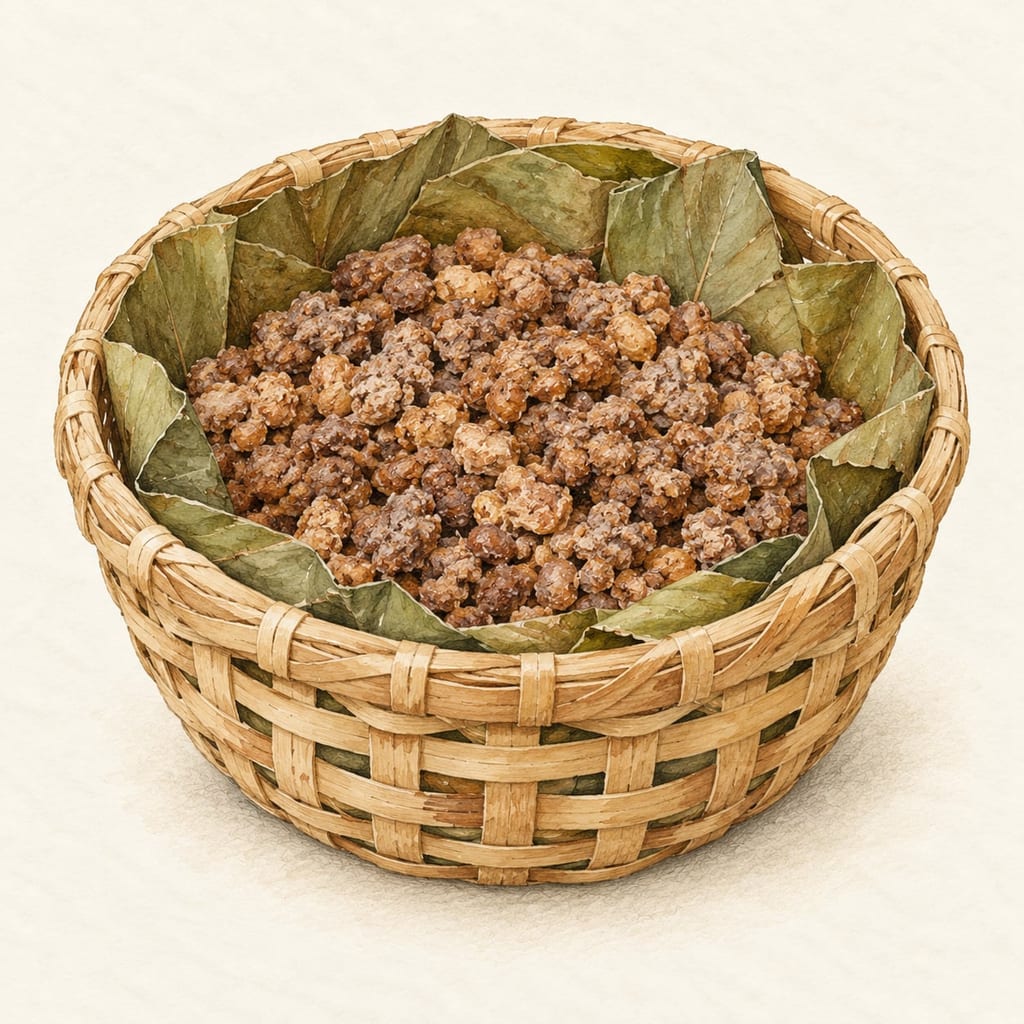
Kinema is a naturally fermented soybean food associated especially with Kirat communities, including Limbu and Rai households in eastern Nepal. The name and preparation vary across communities, and the food is also documented in Darjeeling Hills, Sikkim and southern Bhutan. For this preparation, an open woven bamboo basket is lined with broad leaves before it receives cooked, often split soybeans. The basket is the fermentation vessel; it is not a jar for keeping vegetables under liquid.
Fern fronds, fig leaves and banana leaves are all described as lining materials. Some accounts also describe leaves wrapped over the beans and an outer layer of jute or cloth. These are documented options, not one fixed design: local availability and household practice matter. The sources do not give a standard weave, size, capacity, or a single named maker, so none can be inferred from the basket's use.
Sources for this section
How the basket serves the fermentation
The beans are cooked before they enter the basket. In the reported household sequence, the cooked beans are drained, sometimes split or pounded, and placed against the leaf lining. Some producers add wood ash; others do not. The basket is then kept in a warm place, with accounts describing placement near or above an earthen kitchen oven or near a wood oven. It should not be pictured resting in direct flames.
This is a moist, solid soybean mass rather than a liquid ferment. The open woven form and leaf layers accommodate a warm, covered batch without turning it into a sealed, water-holding vessel. Kinema fermentation is alkaline and is driven chiefly by Bacillus species, alongside other organisms reported in studies. The research supports that microbiology for kinema; it does not show that bamboo alone starts or controls fermentation, or that every household uses the same leaves or temperature.
Sources for this section
Regional practice, not a standardized design
Khanal's account describes basket-lined kinema preparation among Kirat communities in eastern Nepal and names chembihik and hokuma in different communities. It records variation in how beans are pounded, whether ash is added and how the beans are kept warm. Tamang's review places leaf-lined bamboo-basket methods across the wider Eastern Himalayan kinema region. That geographical spread does not mean one basket design or one leaf choice is shared everywhere.
Stories about the age or original homeland of kinema appear in community writing, but the histories are presented as hypotheses and oral accounts rather than a dated record for this vessel. The sources used here document use in the present era; they do not establish when leaf-lined baskets first entered the method or whether an earlier form was materially identical.
Sources for this section
Use and limits
The basket's role ends with the fermentation stage. The resulting kinema may be eaten fresh, cooked into a curry or dried for later use; it is not the finished dish itself. The public Kinema preparation page gives the food method and its regional context, while this page describes the vessel that holds the beans.
The available accounts do not specify how to clean, repair or store a used basket, nor do they report standard dimensions or capacity. They also do not establish that every basket is lined, wrapped or covered in the same way. Those practical details should be left to a documented local method rather than filled in as universal instructions.
Sources for this section
History
The earliest dated account used here is Khanal's 2020 report, which describes Kirat household practice in eastern Nepal. Tamang's 2024 review summarizes kinema and leaf-lined bamboo baskets across the Eastern Himalayas. Neither source dates the beginning of the basket method.
Equipment details
CapacityNo standard or source-specific capacity is recorded in the sources used.
PowerNo power The basket is passive; warmth comes from its placement in a warm household location, not from a built-in heat source.
How you get oneNot established The sources describe bamboo baskets in use but do not identify makers, markets or a standard way to obtain one.
CareThe sources consulted do not give cleaning, repair or storage instructions for the basket.
Made of
- Woven bamboo — Open basket body
The sources identify a bamboo basket but do not specify a weave pattern, dimensions or maker. - Fern fronds, fig leaves or banana leaves — Lining
Documented alternatives vary by place and availability. - Jute or cloth — Cover or outer insulation
A jute or cloth layer is noted in some descriptions; practice varies.
Places
Eastern Himalayas
Traditional preparation · Region evidenceThe kinema process and basket use are reported across this broad region; this does not claim one uniform basket or leaf practice.