Two bronze forms, two excavated examples
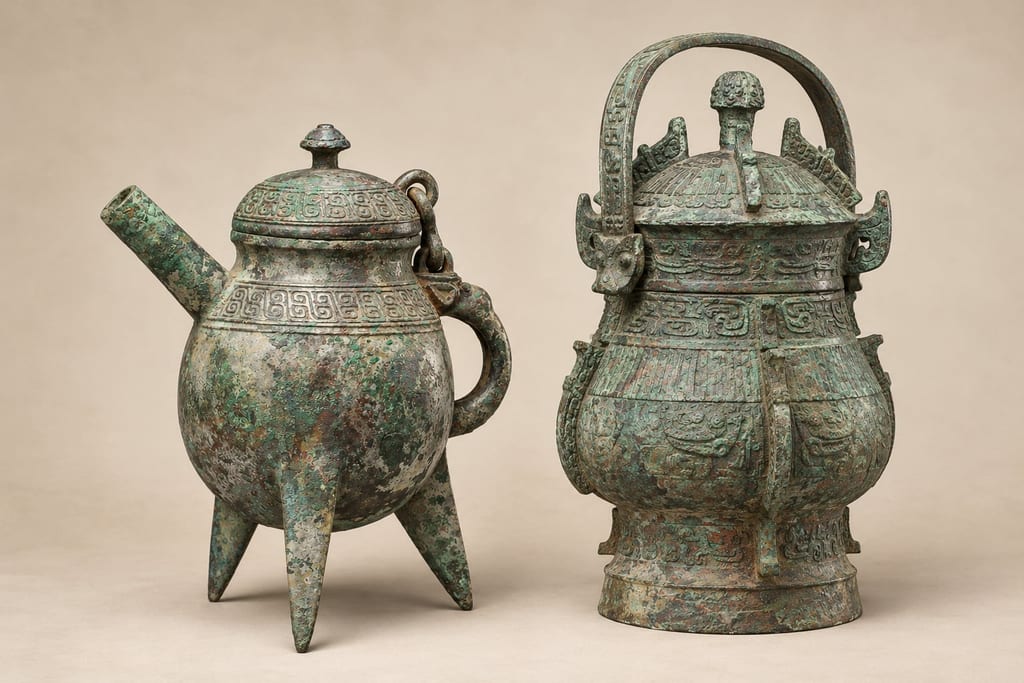
He (盉) and you (卣) name distinct vessel forms rather than interchangeable words for an ancient fermenter. A he is a lidded container with a pouring spout and handle; museum examples can stand on three legs. A you is a covered jar, often with a handle or carrying fitting. Their bodies, lids and ornaments vary between objects and periods, so no single museum piece should be treated as the pattern for every vessel.
The archaeological study examined liquids preserved in two tightly lidded bronze vessels from elite burials: a he from Liu Jiazhuang Tomb at Anyang and a you from Changzikou Tomb in Luyi County, both in Henan. The samples date to about 1250–1000 BCE, spanning late Shang and early Western Zhou contexts. These locations identify the finds analyzed in that study; they do not establish the birthplace of either vessel type.
Sources for this section
What the sealed liquids show
Chemical, botanical and archaeological evidence led the researchers to interpret the liquids as fermented and filtered rice or millet beverages, which they discussed as possible jiu or chang. Those names are alternatives, not a confident identification of the contents of each individual vessel. The Anyang and Changzikou samples show different carbon-isotope patterns: the first is consistent with a C4 cereal such as millet, and the second with a C3 source such as rice. The isotope signal does not by itself name a grain or reconstruct a recipe.
A preserved liquid residue is evidence about what a container held, not where fermentation took place. The authors distinguish these sealed bronze vessels from primary fermentation equipment: the material was bronze, but that does not make bronze the brewing substrate or prove a batch fermented inside the vessel. The safest description is beverage containment, storage and ritual handling, with the contents interpreted through multiple lines of evidence.
Sources for this section
Ritual use and the limits of reconstruction
Late Shang inscriptions and archaeological contexts place fermented drinks among offerings and elite ceremonial life. Bronze vessels could present, store, pour or serve beverages, and their deposition in burials connected them to funerary practice as well as to the lives of their owners. These broad roles make the he and you relevant to fermentation history without turning every decorated bronze wine vessel into a vat or a recipe-specific tool.
A separate Shang he in the Henan Museum collection, excavated at Huangdian in Zhongmu County, Zhengzhou, has a hemispherical cover, diagonal spout, three legs and a handle. That documented regional object demonstrates one possible arrangement, not the geometry of the Anyang he. Museum photographs also show how strongly surviving patina and ornament differ from one object to another. Excavated green or gray-green surfaces describe objects after burial and conservation; they should not be used to claim how a newly cast vessel looked.
Sources for this section
Reading a vessel as evidence
The distinction between vessel and process matters when interpreting ancient drink-making. A lidded container may preserve a sample and indicate careful storage, while a pour spout and handle make transfer plausible; neither feature alone identifies a fermentation stage. The study’s evidence concerns the sampled liquids and their archaeological context, not a complete brewing sequence. It cannot tell us the temperature, duration, starter, exact grain proportions or whether the beverage was filtered in that same vessel.
The Met’s he and you records offer accessible visual comparisons for the two forms, but each is a different collection object rather than one of the analyzed burial vessels. Their dates and documented public-domain imagery make them useful references for shape. A generated illustration should therefore show only a plausible paired he and you based on those examples, avoid copying unusual inscriptions or decorative motifs as universal features, and remain explicitly illustrative.
Sources for this section
History
Lidded bronze he and you vessels from late Shang and early Western Zhou contexts in Henan, dated about 1250–1000 BCE, preserved liquids studied as fermented cereal beverages; sampled vessels are containment and ritual-context evidence, not proof of primary fermentation.
Object details
PowerNo power These are unpowered containers; this description does not assign them a heating role.
How you get oneNot obtainable today The documented examples are archaeological objects. This is not a claim that functional reproductions cannot be made; no contemporary maker or acquisition route is established here.
CareFor museum objects, follow collection conservators’ instructions. The evidence does not support use of excavated bronzes as food-contact vessels or a cleaning method for replicas.
Made of
- Bronze — vessel body and lid
The archaeological paper and museum records identify the objects as bronze; no alloy percentages are supplied for the sampled vessels.
Limits
The sampled bronze he and you are not demonstrated to be primary fermenters, and bronze itself is not identified as the brewing material.
Source →Places
Liu Jiazhuang Tomb, Anyang
Historical attestation · Locality evidenceFindspot of the analyzed lidded he; not the origin of all he vessels.
Changzikou Tomb, Luyi County
Historical attestation · Locality evidenceFindspot of the analyzed covered you; not the origin of all you vessels.