A fermenting vessel above a collector
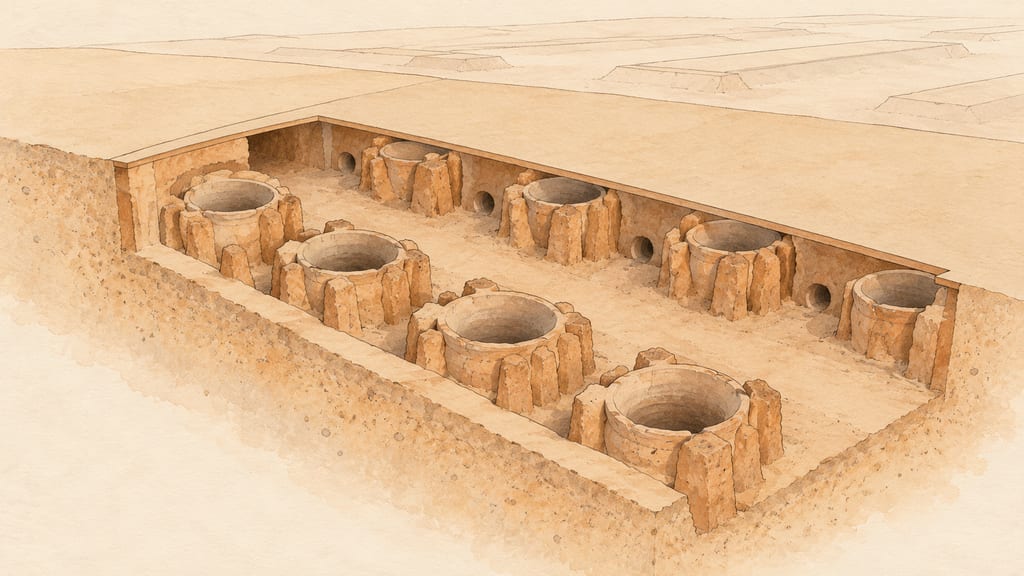
The Hymn to Ninkasi describes two vessels working together: a fermenting vat is positioned on top of a larger collector, and filtered beer is then poured from that collector. That is the clearest account of this equipment. The poem places the pair late in a sequence that includes malt preparation, soaking, cooling and brewing, but it is a poetic text, not a technical drawing. It gives no measured capacity, profile, clay recipe, support design or detailed join between the vessels.
The hymn is known from Old Babylonian copies dated to about 1800 BCE. Its technical terms have attracted competing interpretations, and scholars caution against treating a translated vessel name as a label that can be matched confidently to any one excavated pot. The upper vat and lower collector are therefore best understood as a described arrangement, not a standardized archaeological type.
Sources for this section
Later household vats at Tell Bazi
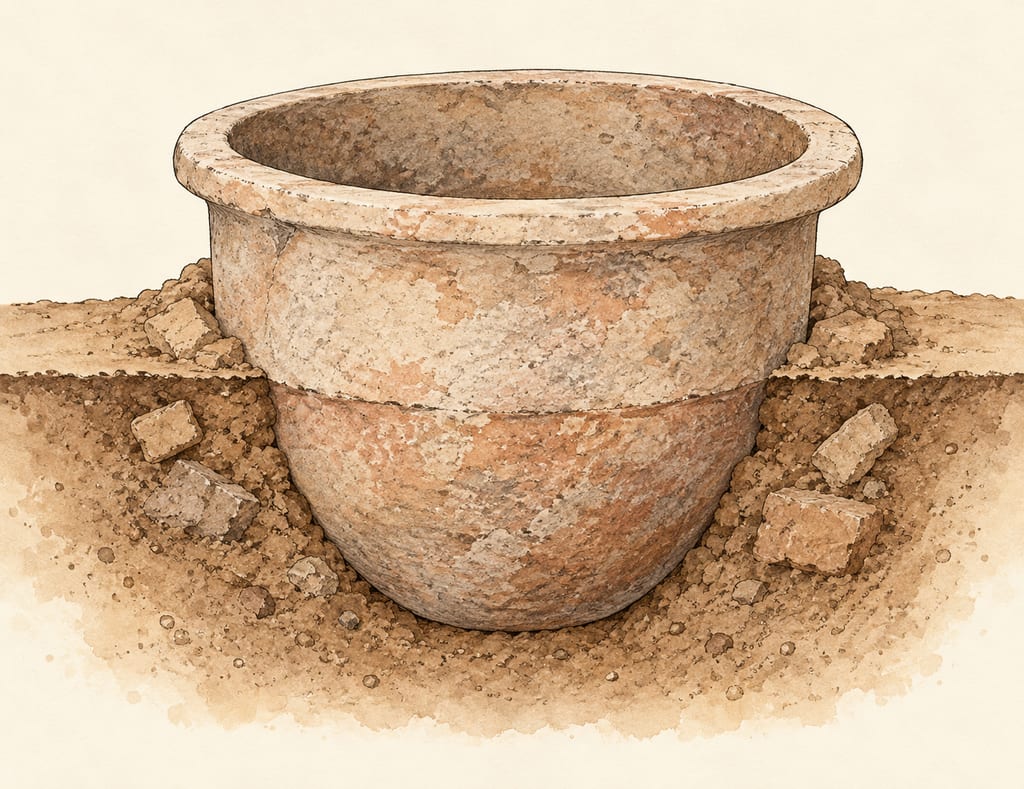
Archaeology provides a separate, later example of household beer equipment at Tell Bazi, on the Euphrates in northern Syria. In the Late Bronze Age settlement, a large ceramic Type 22 beer vat had a mostly cylindrical body, rounded lower part and exceptionally thick rim. Published examples are 70–78 cm high, with rim diameters of 68–80 cm, and capacities up to 200 litres. These are measurements for that Tell Bazi type, not for the vessels named in the Ninkasi hymn.
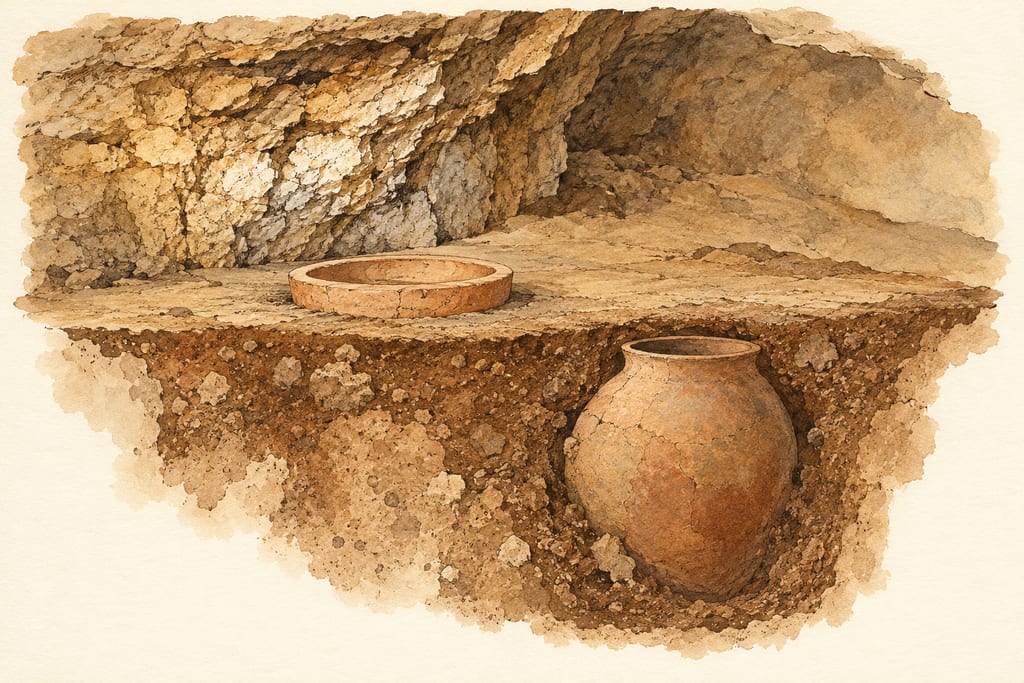
The heavy Type 22 vats were partly sunk into floors and braced with mud, mudbrick and stones. They were fixed in place, often in a ventilated part of the main room near an entrance or beneath a staircase; some houses had a second vat upstairs. Their position and the household assemblages help explain how brewing fitted into domestic work. Their size also had a cost: the excavator notes that they would have been difficult to clean thoroughly.
Tell Bazi's associated Type 20 vats had wide mouths and a perforation through the base. Reported examples are about 50–64 cm tall and 55–78 cm across the rim, with capacities around 80–115 litres. Their association with beer vats and storage jars, together with oxalate deposits identified as beerstone, places them within the brewing equipment at the site. This evidence shows that perforated ceramic vessels could play a role in a brewing set; it does not prove that one sat above the collector in the older hymn's arrangement.
Sources for this section
Ceramic systems, not one universal shape
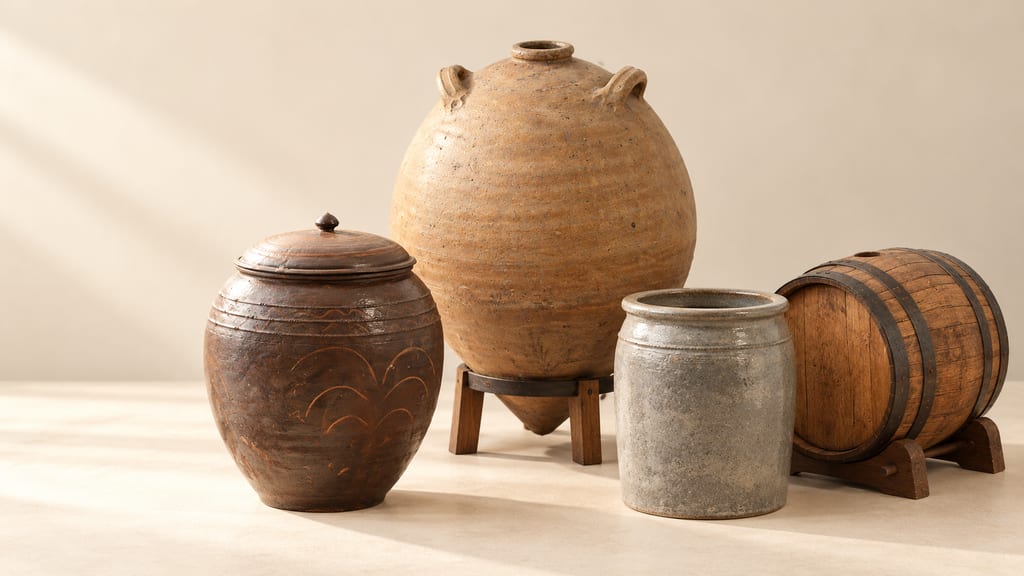
The later archaeological set and the hymn's two-vat description both make collection and transfer part of brewing, but their forms should not be collapsed into a single reconstruction. Central and southern Mesopotamian four-part ceramic sets include a large bowl or vat, a perforated stand, a strainer and a small beaker. They are generally discussed in connection with beverage preparation or service, and they are not the same as the Ninkasi pair. A separate photo of such a set is useful for the look of ancient ceramics; it is not documentary evidence for the hymn's exact equipment.
The physical arrangement suggests gravity helped move liquid from an upper vessel to a collector below. That is a straightforward reading of the described placement, but the text does not explain its plumbing or filtering surface. Modern experimental reconstructions can explore possibilities, yet they remain tests of a model rather than proof that every household used the same apparatus. The site record therefore keeps the two vessels and their relationship clear while leaving the unknown details open.
Sources for this section
History
The Old Babylonian copies of the Hymn to Ninkasi, dated by scholarship to about 1800 BCE, describe a fermenting vat above a large collector. Later Late Bronze Age household brewing equipment is archaeologically documented at Tell Bazi in northern Syria; it is a distinct comparison, not proof of the hymn's exact apparatus.
Equipment details
Capacityup to 200 L Up to 200 L is reported for the separate Type 22 beer vat at Late Bronze Age Tell Bazi. Its associated perforated Type 20 vat is reported at about 80–115 L. The Hymn to Ninkasi gives no capacity for its fermenting/collector pair.
SizeTell Bazi Type 22: height 70–78 cm and rim diameter 68–80 cm; associated Type 20 perforated vats: height 50–64 cm and rim diameter 55–78 cm. The hymn's two vessels are not measured, so these later dimensions are not a standard for them.
PowerNo power The vessel pair is not described as powered equipment. The poem names a brewing sequence but does not assign a heat source to these two vats.
How you get oneNot obtainable today The cited sources document ancient vessels and modern archaeological reconstructions, not a current maker or a present-day source for this specific ancient equipment.
CareNo contemporary cleaning or maintenance guidance is established. Tell Bazi's very large, partly buried Type 22 vats were difficult to clean thoroughly.
Made of
- Fired clay — Vessel body
Ceramic vats are documented at Tell Bazi. The Ninkasi hymn does not specify material; clay in an illustration of its pair is an editorial reconstruction, not a textual fact.
Limits
The Hymn to Ninkasi does not establish the vessels' material, profiles, capacity or the exact connection between them; matching its terms to excavated shapes remains uncertain.
Source →Tell Bazi Type 22 beer vats are later archaeological examples and should not be presented as the exact vessels named in the Old Babylonian hymn.
Source →The four-part ceramic sets from central and southern Mesopotamia are associated with beverage preparation or serving and are not the same system as the hymn's fermenting vat over a collector.
Source →Places
Central and southern Mesopotamia
Historical attestation · Region evidenceThe four-part beverage sets discussed in the archaeological literature occur in central and southern Mesopotamia; this location does not establish the origin or exact form of the Ninkasi vat pair.
Tell Bazi
Historical attestation · Locality evidenceTell Bazi provides separate archaeological examples of a large beer vat and associated perforated vats; it is not identified as the setting of the Hymn to Ninkasi.