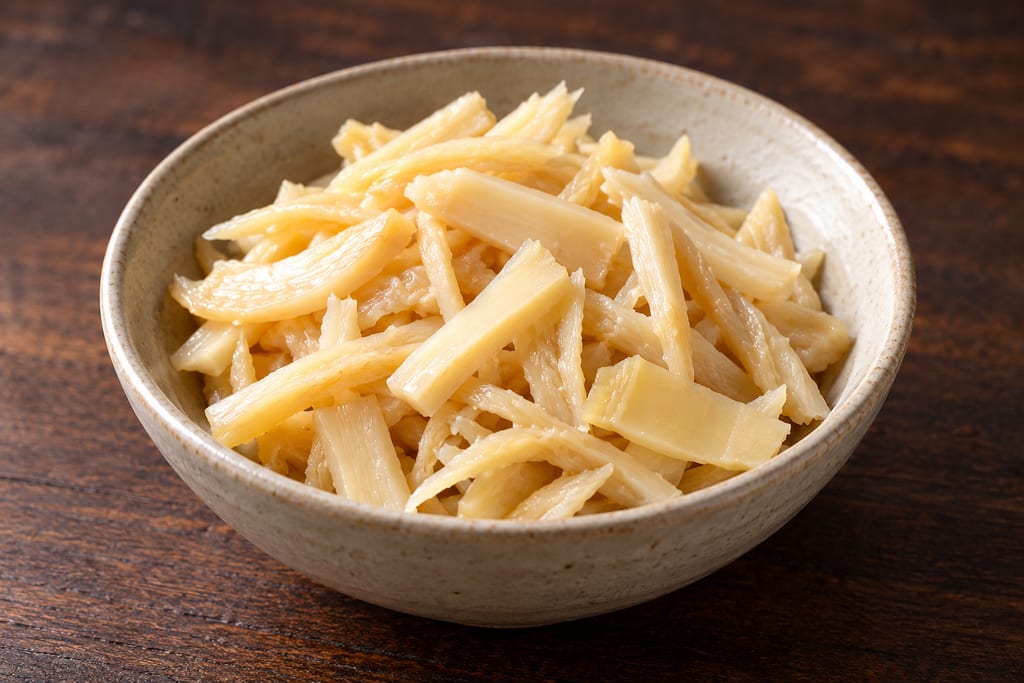
Mesu
Tender bamboo shoots fermented without salt in a hollow bamboo tube for about one to two weeks in Sikkim and Darjeeling, eaten as a sour pickle or in curry.
 FermenteaWhere food goes to change
Equipment · Bamboo, leaf and wraps
A green hollow bamboo stem holds tightly packed Mesu shoots, with leaves covering the open end during fermentation. The source documents the arrangement, but not a standard size or capacity.
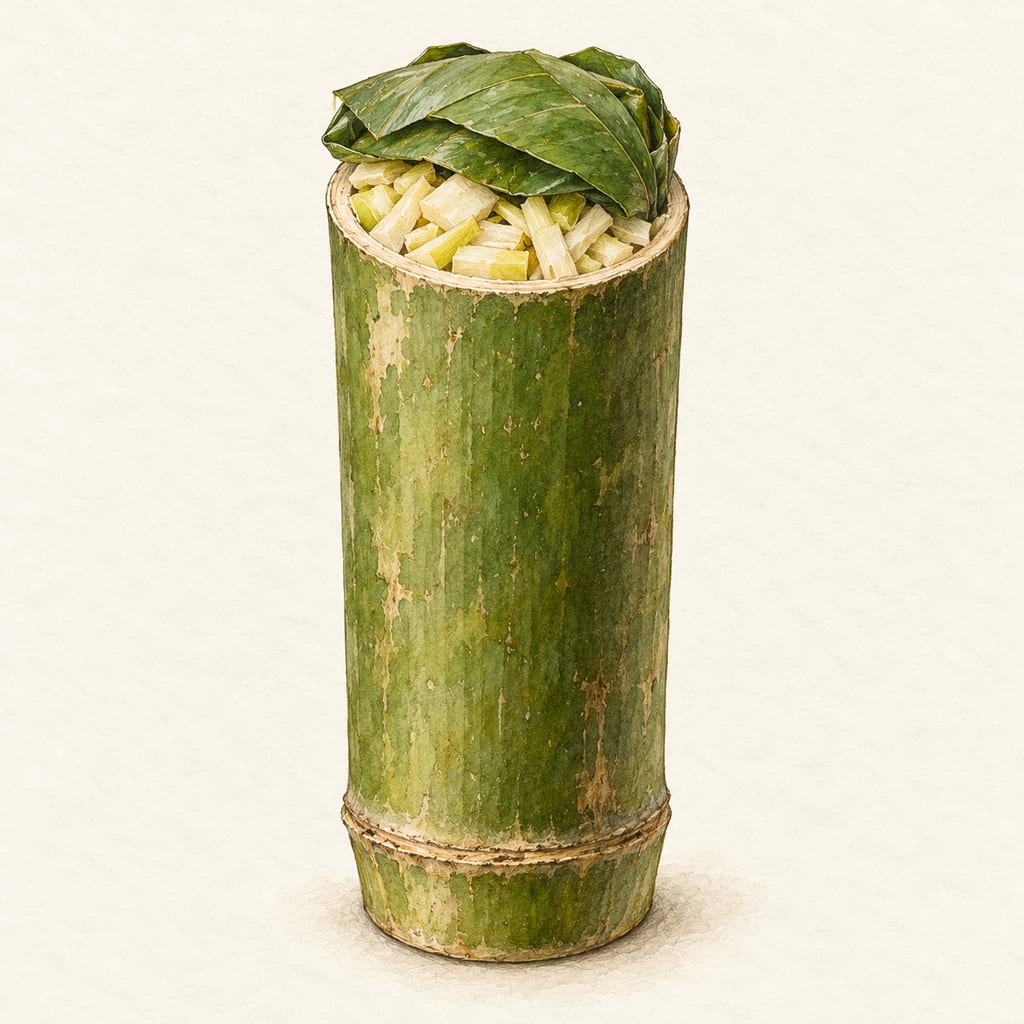
Mesu is a fermented bamboo-shoot food for which a hollow green bamboo stem serves as the fermentation vessel. In the reviewed preparation, edible shoots are trimmed, chopped and pressed tightly into the hollow stem. Leaves are packed over its open tip. The vessel is shown turned upside down before the fermentation stage, and the review describes the process as natural and anaerobic. This is a portable object made from bamboo, not a pit or other structure built in place.
The associated process figure is a schematic rather than a photograph of a particular historical vessel. It records the sequence and the broad arrangement—a bamboo tube, compacted shoots and a leafy closure—but does not document exact proportions or one standardized design.
The review associates Mesu with Sikkim and places its seasonal market presence in Sikkim and the Darjeeling hills. It describes green bamboo stems holding the packed shoots, while naming several bamboo species for the edible shoots; it does not establish that those shoot species are also the species used for the tube. The review's descriptions of the producing communities vary, so these regional records should not be turned into a single exclusive origin claim.
Mesu must also remain distinct from Soibum, Soidon and Soijim. A primary microbiology study treats them as separate fermented bamboo-shoot foods. Their shared plant material does not show that each one uses this Mesu tube. The tube is linked here to the Mesu preparation only.
The available descriptions give no length, diameter, capacity, tube species, cleaning routine, reuse practice or repair method. They also do not explain how a reader should select or prepare fresh bamboo. Those details remain unknown rather than being borrowed from another bamboo-shoot food or inferred from the schematic.
The review reports both seven to fifteen days and seven to twelve days in separate passages about Mesu fermentation. This equipment record does not collapse the two timings into one rule. It records the vessel arrangement and leaves recipe timing to the food-specific account.
The reviewed sources give no tube dimensions, capacity, cleaning or reuse instructions, and do not establish one universal construction.
Source →The source associates Mesu with Sikkim but does not locate a specific village for the bamboo tube.
Region-level association from a figure caption; not a claim that every local bamboo-shoot ferment uses this tube.
Tender bamboo shoots fermented without salt in a hollow bamboo tube for about one to two weeks in Sikkim and Darjeeling, eaten as a sour pickle or in curry.
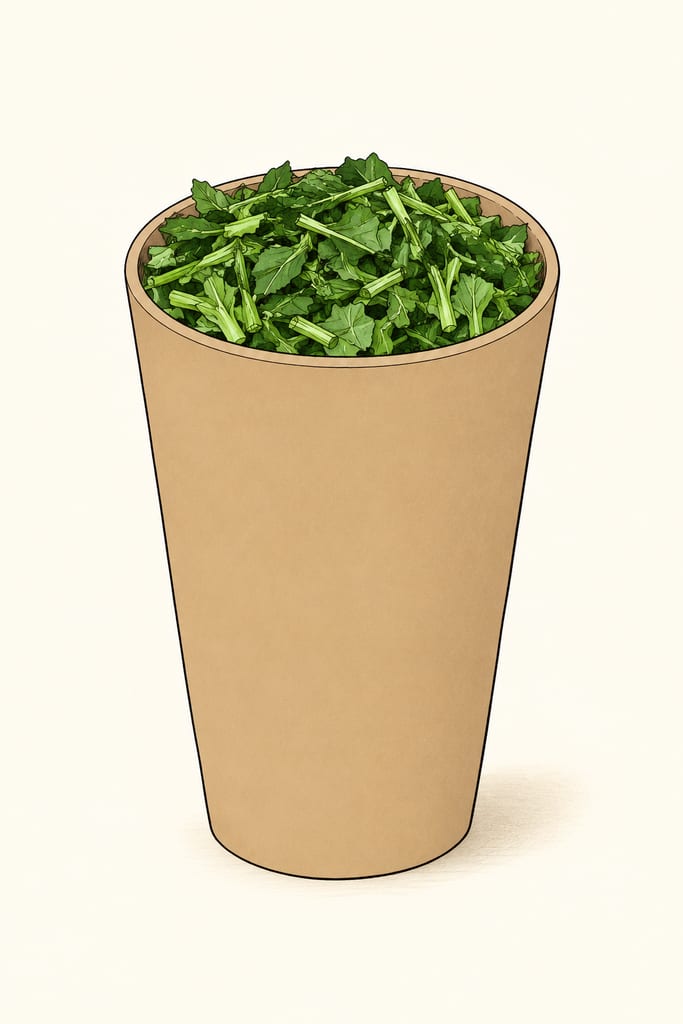
Gundruk pots and dhungro are fermentation containers documented in Nepal and one Darjeeling household. FAO describes earthenware; a 2024 figure identifies a bamboo-made airtight dhungro buried in a pit within a cow-dung heap.

Soft, spreadable Calabrian pork sausage made with a great deal of red chilli and fatty pork, stuffed into natural casings, sometimes smoked and matured while staying soft.

A way to add independent temperature logging to an existing food dehydrator without changing its built-in controls or protections. It is a monitoring method, not a rewiring plan.

Pleurotus cystidiosus is the abalone mushroom, a cultivated oyster-type fungus with dark brown caps that grows more slowly and is more demanding than other Pleurotus species.

A dark, balanced vinegar from Emilia-Romagna made by combining cooked or concentrated grape must with wine vinegar, then acetifying and refining it in wood under a protected specification.

A living dairy inoculum that starts controlled cream fermentation, developing acidity and aroma before sour cream or cultured butter is finished.

A small electric incubator holds jars at a selected temperature for yogurt and other documented warm food preparations. Controls, capacity and vessel arrangement vary by model.

Adygean salt is a seasoned table salt associated with Adygea and the wider North Caucasian culinary tradition. Salt is blended with garlic and a variable selection of herbs and spices; the exact mix depends on the named style and maker.

The African Caesar-group mushroom, Amanita masasiensis, is a wild ectomycorrhizal species of central and southern African woodlands, eaten locally. The genus contains deadly poisonous species, so identification needs care.
No community contributions have been published for this entry yet.
Sign in to contribute. Published comments and photos are free to read.
Applied Biochemistry and Biotechnology, Springer NatureMaterials · Use · Process · Geography · Visual reference
Health Benefits of Fermented Bamboo Shoots: The Twenty-First Century Green Gold of Northeast IndiaThe review describes Mesu shoots chopped and packed tightly into a hollow green bamboo stem, whose open tip is covered with leaves during natural fermentation.
It reports Mesu production and sale in Sikkim and the Darjeeling hills; its community attributions vary within the same section.
Figure 2 is a process schematic captioned as Mesu preparation in the Darjeeling hills, adapted from the article's cited source 11.
The review is CC BY 4.0; it gives no universal tube size, dimensions or capacity.
Cited in: The bamboo tube in Mesu fermentation; A vessel for Mesu, not every bamboo-shoot ferment; What the sources leave open
International Journal of Food Microbiology 121(1):35–40Fermentation · Scope
Phenotypic and genotypic identification of lactic acid bacteria isolated from ethnic fermented bamboo tender shoots of North East IndiaThe primary study concerns lactic acid bacteria isolated from multiple named fermented bamboo-shoot foods, including Mesu, Soibum, Soidon and Soijim; shared ingredient material does not establish interchangeable vessels.
Cited in: A vessel for Mesu, not every bamboo-shoot ferment