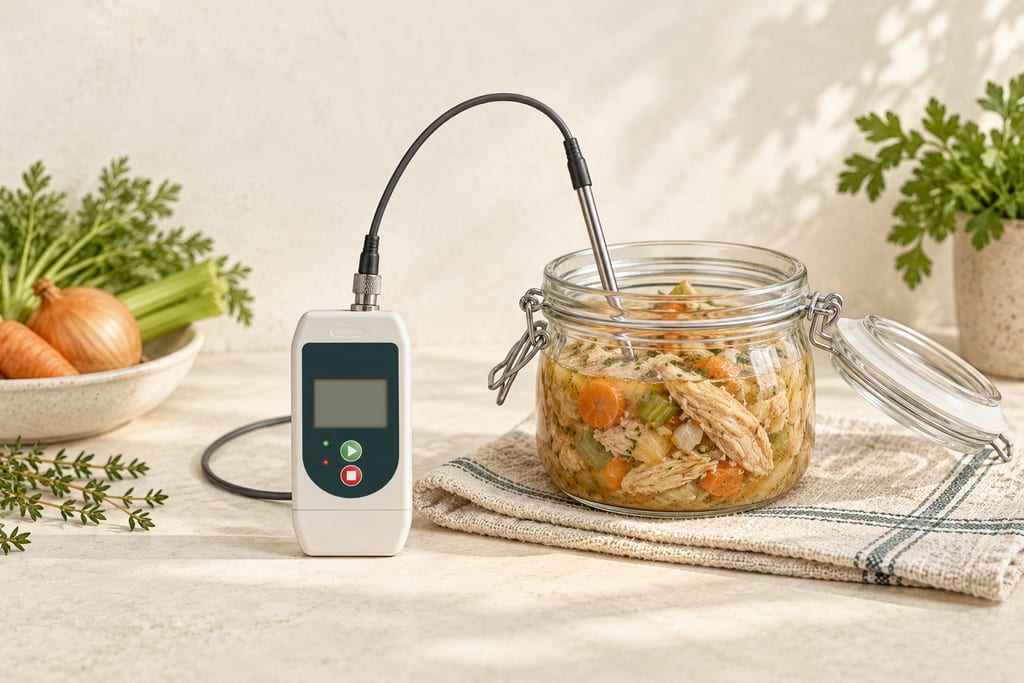
Food thermometer and temperature logger
A thermometer gives a reading at its sensor; a temperature logger records readings over time. Sensor placement and context determine what that record can tell you.
 FermenteaWhere food goes to change
Equipment · Instruments
A microcontroller is a programmable chip. A development board adds connections and supporting parts; with a suitable sensor and software, it can record readings without validating their meaning.
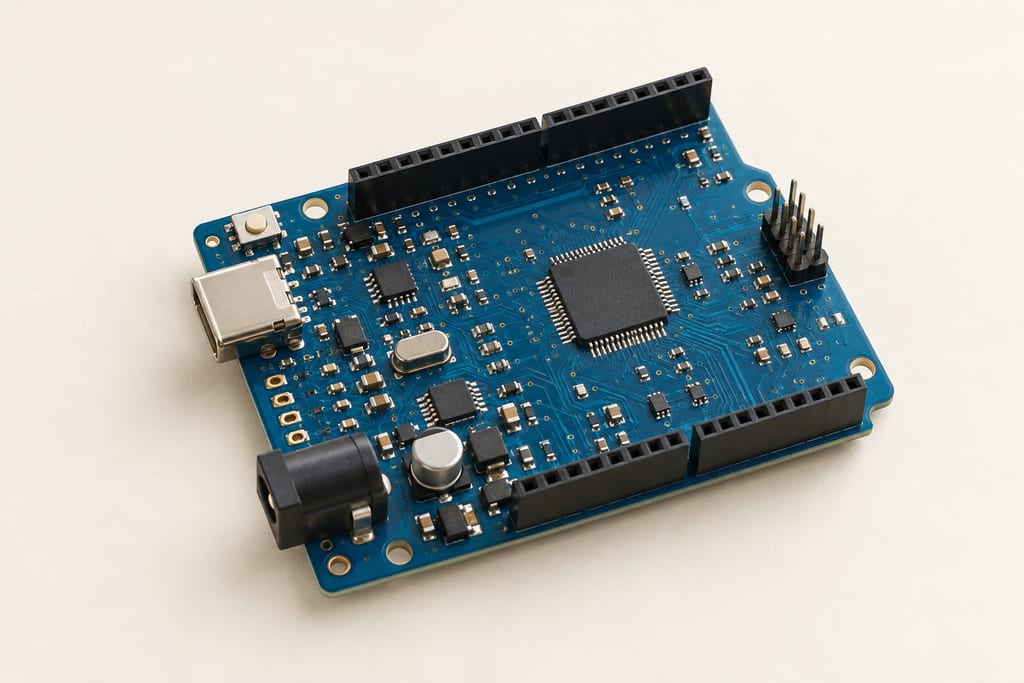
A microcontroller (MCU) is an integrated circuit that combines a processor with memory and peripheral functions for embedded tasks. A development board is a larger, model-specific assembly built around a microcontroller; it may add connectors, power regulation, status indicators and other components. The Arduino UNO R4 Minima is one documented example, with a Renesas RA4M1 device on a board whose analog inputs and other interfaces are described in its own specifications. Those details belong to that model, not to every MCU.
A microcontroller is programmable, but it is not a complete measuring instrument merely because it can run code. To collect a fermentation reading, a system needs a suitable sensor or instrument output, an electrically compatible interface, software that samples and records it, and a way to retain or retrieve the record. A logger is this assembled function; the chip alone does not sense temperature, acidity or sugar.
A board can be programmed to take a reading from a compatible input and save values for later inspection. Arduino documents a Nano RP2040 example that samples an analog input and writes values to a CSV file. This is a simple illustration of a data-logging pattern, not a ready-made fermentation instrument: the measured quantity, sensor, conversion, sampling behavior and storage all depend on the chosen hardware and software.
For fermentation monitoring, a microcontroller-based logger can be useful when the aim is to compare readings over time. The record is only as meaningful as the sensor, its placement, calibration and the relationship between its electrical signal and the quantity being discussed. Recording a number does not make it an alcohol, residual-sugar, pH or food-safety result. In particular, attaching a refractometer signal to a microcontroller does not turn the refractometer into an alcohol or sugar assay; claims about a beverage still require a method validated for that matrix.
A general-purpose MCU can be programmed to respond to inputs, but the equipment class does not promise a particular control function, safe switching hardware, alarm, enclosure or fail-safe behavior. A purpose-built temperature controller is a distinct device designed to use a temperature input to switch compatible equipment. A custom logger may record data alongside such a controller when their interfaces are compatible, but it should not be treated as the controller or as a safety interlock.
Choose a board only after identifying the sensor output, electrical interface, operating environment, power needs and required record format. The chip and board documentation describe that model’s limits. The software also needs to preserve units, timestamps and missing or invalid readings clearly. A trace can help someone review observed conditions; it cannot establish conditions at an unsensed point, validate a fermentation process, or prove a food safe.
The inspected sources document current microcontroller development boards and logging examples, but do not establish an invention date or one place of origin.
No source in this record establishes a place.
A thermometer gives a reading at its sensor; a temperature logger records readings over time. Sensor placement and context determine what that record can tell you.

Soft, spreadable Calabrian pork sausage made with a great deal of red chilli and fatty pork, stuffed into natural casings, sometimes smoked and matured while staying soft.

A way to add independent temperature logging to an existing food dehydrator without changing its built-in controls or protections. It is a monitoring method, not a rewiring plan.

Pleurotus cystidiosus is the abalone mushroom, a cultivated oyster-type fungus with dark brown caps that grows more slowly and is more demanding than other Pleurotus species.

A dark, balanced vinegar from Emilia-Romagna made by combining cooked or concentrated grape must with wine vinegar, then acetifying and refining it in wood under a protected specification.

A living dairy inoculum that starts controlled cream fermentation, developing acidity and aroma before sour cream or cultured butter is finished.

A small electric incubator holds jars at a selected temperature for yogurt and other documented warm food preparations. Controls, capacity and vessel arrangement vary by model.

Adygean salt is a seasoned table salt associated with Adygea and the wider North Caucasian culinary tradition. Salt is blended with garlic and a variable selection of herbs and spices; the exact mix depends on the named style and maker.

The African Caesar-group mushroom, Amanita masasiensis, is a wild ectomycorrhizal species of central and southern African woodlands, eaten locally. The genus contains deadly poisonous species, so identification needs care.
No community contributions have been published for this entry yet.
Sign in to contribute. Published comments and photos are free to read.
Microchip Developer HelpMicrocontroller components · Device distinctions
Differences Between MCU and MPU DevelopmentMicrocontroller and microprocessor development platforms differ in their integrated resources; memory and peripherals depend on the device and application.
Cited in: A chip and a board are not the same thing
Arduino DocumentationExample development board · Hardware components
UNO R4 MinimaThe UNO R4 Minima is one board featuring a Renesas RA4M1 microcontroller, with board-specific input/output, analog input, memory and timing features. Its specifications illustrate one model, not all microcontrollers.
Cited in: A chip and a board are not the same thing; Monitoring and control are different jobs
Arduino DocumentationExample data logging use
Nano RP2040 Datalogger with MicroPythonA documented example reads an analog input and writes values to a CSV file. This demonstrates a possible programmed use, not a universal capability or a validated measurement method.
Cited in: Logging is one possible application; Monitoring and control are different jobs