The open vessel belongs to the first fermentation
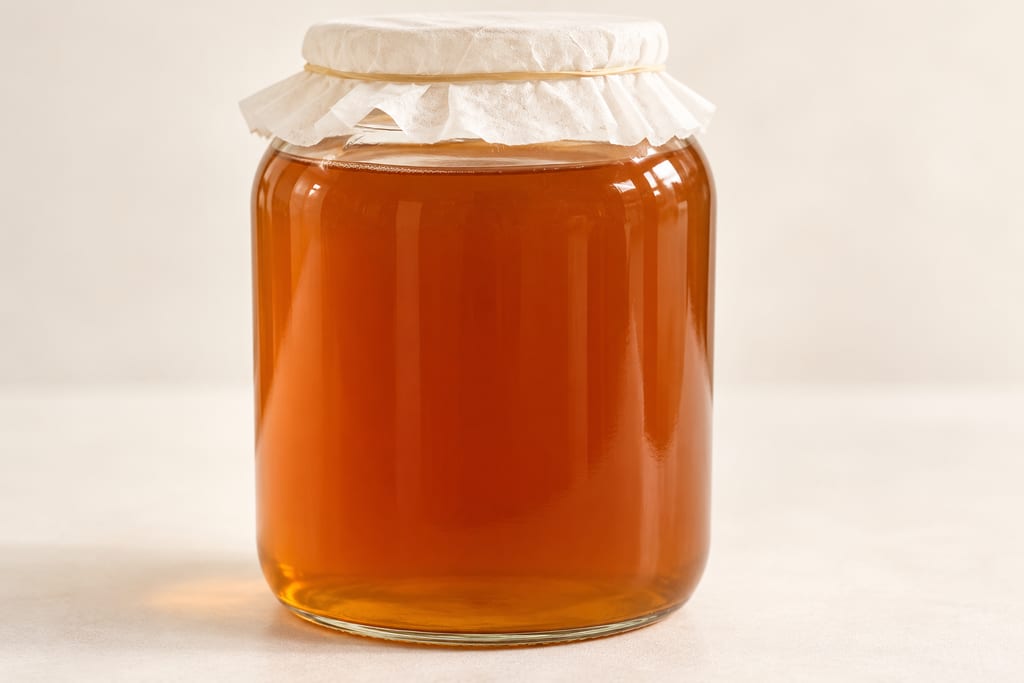
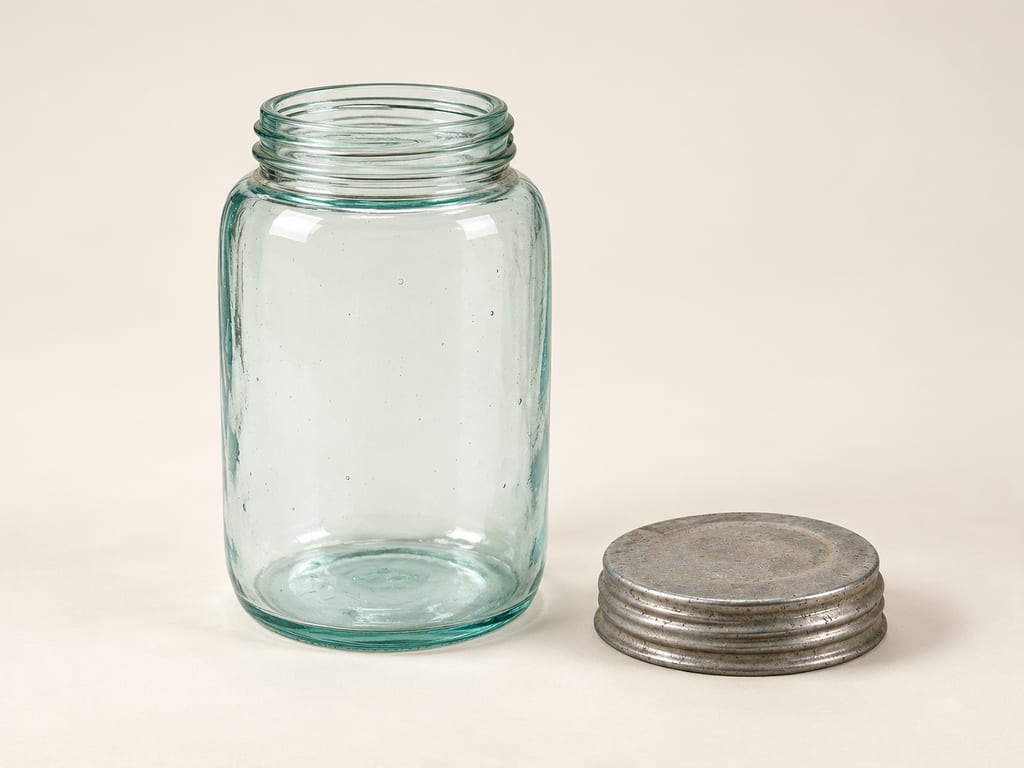
An open-surface kombucha fermenter is the vessel used while sweetened tea is fermenting in contact with air. The home-scale form is often a wide-mouth glass jar. The National Center for Home Food Preservation shows such a jar with a coffee filter over its mouth, secured by a band, and also allows clean paper towel or cheesecloth. Larger production may use broader tanks; this equipment family does not have one standard shape or material.
Keep this vessel distinct from the sealed bottles used later for carbonation. During the open-vessel phase, the cover keeps the opening shielded while allowing gas exchange. It is not an airtight lid, pressure closure, water seal, or airlock. The vessel’s purpose is to hold the liquid with a broad exposed surface, not to build pressure.
Sources for this section
Why the liquid surface matters
Kombucha is a mixed culture. Yeasts and bacteria share the tea, but their activities have different oxygen relationships. Acetic-acid bacteria use oxygen in oxidative metabolism that produces acids such as acetic acid. Oxygen therefore reaches the liquid through the exposed surface, making the area of that interface relevant to process design.
A 2022 oxygen-management experiment found that tea compounds consumed oxygen during the first day after inoculation. In its seven-day open-vessel stage, oxygen entered through the liquid surface, while its measurements found anaerobic conditions below that interface. These results describe the tested matrix and culture, not a promise that every household jar has the same oxygen profile.
Vessel geometry also affects the ratio between exposed surface area and liquid volume. Chaluvadi and colleagues compared specific interfacial areas from 0.09 to 0.16 in an experiment. Within those conditions, the larger ratio increased measured glucose, fructose, and gluconic acid, while acetic acid and ethanol did not differ significantly. The result illustrates why scaling by filling a narrow jar deeper can change the process; it does not identify a universal best ratio or a guaranteed final flavor.
Sources for this section
The pellicle is part of a changing culture
A pale cellulose pellicle may grow at the tea-air boundary. It is a biological film produced by part of the community, not a solid cover placed over the liquid and not the entire starter culture. Microscopy research describes layers and cellular structure within kombucha biofilm, while experimental cultures have formed a new pellicle from liquid inoculum. A thick film is therefore not required as proof that a batch is sound, and its appearance alone does not establish fermentation progress or safety.
The NCHFP image used in this page’s source gallery is captioned as day zero. Its jar and breathable cover are a useful reference for the equipment, but the photo does not show a mature pellicle. The generated hero follows the same vessel form and intentionally leaves the surface clear rather than implying that every fermentation stage looks the same.
Sources for this section
Scale, care and limits
At home, a broad-mouth jar gives access for adding tea and starter liquid and leaves a visible surface. A larger tank can support more liquid while preserving a useful surface-to-volume relationship, but changing the vessel also changes geometry and heat transfer. The cited studies do not tell every maker how wide or deep to build a container; they show that geometry is one of several conditions that need to be considered and recorded.
For the documented home method, NCHFP calls for washing and rinsing equipment, followed by submerging it in hot water at 171°F or above for at least 30 seconds. Its full current directions should be followed rather than treating this equipment account as a complete recipe or safety assessment. After primary fermentation, the liquid may be transferred to clean containers; any later carbonation stage uses a separate closed package and requires guidance appropriate to that process.
Sources for this section
History
Open-vessel kombucha production is described in contemporary scientific and home-preservation sources. The sources inspected here do not establish the invention date or a geographic origin for this vessel form.
Equipment details
CapacityThe vessel family ranges from home jars to broader tanks; no universal capacity applies.
SizeNo universal dimensions are specified. For static fermentation, the open liquid surface relative to liquid volume (specific interfacial area) is a process variable.
PowerNo power The described open-vessel fermentation is static and does not require powered mixing; its oxygen interface is exposed to surrounding air.
How you get oneNot established The sources document household jars and experimental vessels but do not establish how the full range is acquired.
CareThe National Center for Home Food Preservation instructs brewers to wash and rinse the equipment and submerge cleaned equipment in hot water of at least 171°F (77°C) for at least 30 seconds before use. Follow its full current procedure and do not treat this equipment description as a complete safety validation.
Made of
- glass — small-scale fermenting vessel
The National Center for Home Food Preservation illustrates a large glass jar and describes transferring the prepared tea to a fermentation container. The general design may also use broader tanks; the sources do not establish one required material for every scale. - closely woven cloth or paper filter — breathable cover
The National Center for Home Food Preservation specifies a paper towel, coffee filter, or clean cheesecloth secured over the jar opening during primary fermentation.
Limits
The oxygen and surface-area findings below are tied to specific experimental cultures, vessels, and conditions; they do not establish a universal vessel dimension or fermentation schedule.
Source →The photograph from the National Center for Home Food Preservation is explicitly labeled day zero. It shows vessel and cover, not a mature pellicle.
Source →Places
United States
Documented preparation · Country evidenceA U.S. public food-preservation source documents a wide-mouth covered jar in a home kombucha method. The location records documented use only.