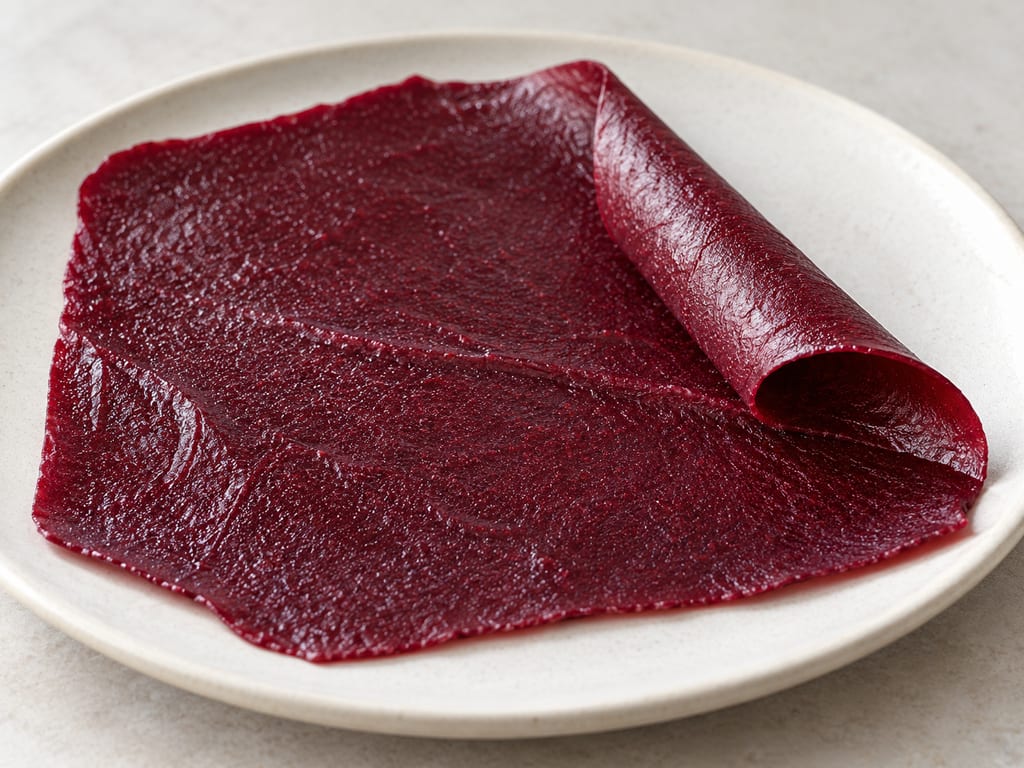
Fruit leather
Fruit pulp spread into thin sheets or shaped into cakes and dried, a compact, portable way of keeping fruit in western and central Asia and among Indigenous North Americans.
 FermenteaWhere food goes to change
Equipment · All-in-one appliances
dehydration-mode air fryer · dehydration-mode countertop oven
Some countertop ovens and air fryers combine cooking with a dedicated low-heat dehydration programme. The feature varies by model; an ordinary oven or air fryer without it is a different, less controlled adaptation.
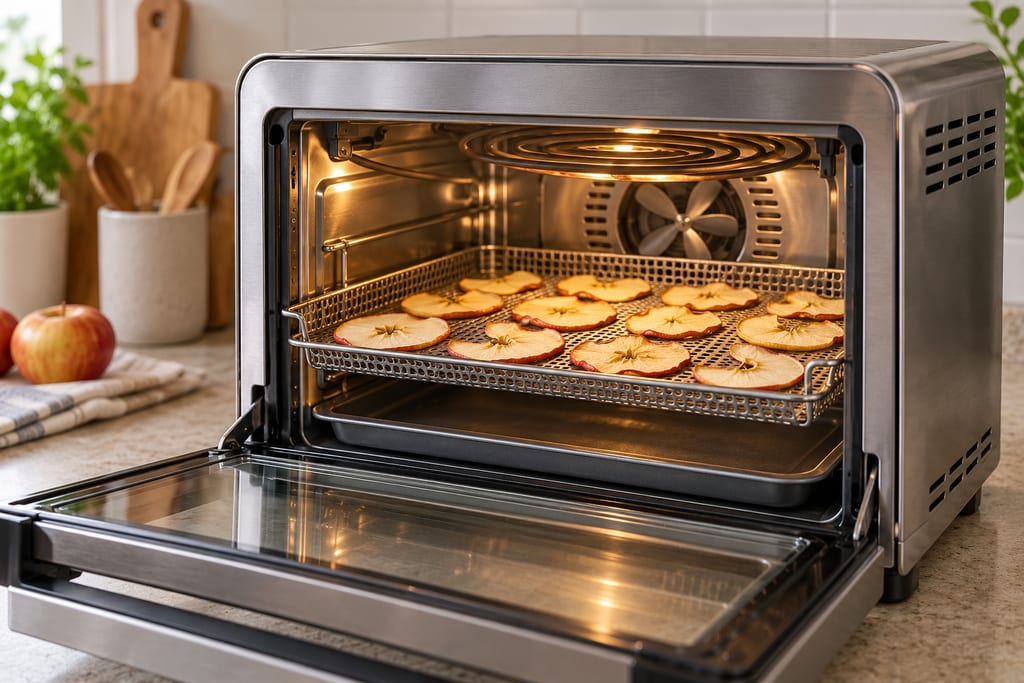
Some countertop ovens and air fryers combine high-heat cooking with a low-heat Dehydrate programme. The shared feature is the combination of a heated chamber, airflow and a timer; the machines that provide it are not otherwise identical. A toaster-oven-shaped air fryer holds racks or a basket behind a door. A basket fryer has a smaller drawer-like chamber. Neither should be described as a dedicated dehydrator unless the manufacturer does so.
This page covers portable household appliances whose own controls or manuals identify a dehydration function. It does not make every air fryer a dehydrator, nor treat a conventional wall oven as equivalent. The source dossier proposed these machines as tools for drying suitable foods, while the current manufacturer examples show why the exact model matters: controls, tray arrangement, temperature range and time limit differ. The appliance performs a physical drying operation; it does not ferment food.
The supplied equipment dossier also raises roasting nuts or cacao as possible heat-and-airflow uses. It records those as a research lead and says the appliance’s minimum setting, fan behavior and automatic shutoff need checking. The sources here document dehydration features and food-drying guidance, not a tested nut or cacao roast; a Dehydrate preset is not an approved roasting profile.
A food dehydrator is built around a simple set of parts: an electric heater, a fan and vents. Air movement renews the drier air at a food's surface as water evaporates. The National Center for Home Food Preservation contrasts the dedicated machine with the ordinary oven, which may not hold a low enough temperature and, in its improvised oven approach, needs a partly open door and a separate fan to move air. This is a useful distinction in practice: a model's Dehydrate mode brings a manufacturer-designed low-heat and airflow setting, while an oven without that setting needs its own carefully assessed arrangement.
Air-fryer cooking and dehydration share a fan-driven chamber but use it differently. Air-frying is presented as rapid high-heat cooking; dehydration uses a much lower setting over a longer period so that moisture can leave the exposed food. It is not a universal claim about what a fan does at every temperature. The dedicated dehydrator designs described by NCHFP also vary: horizontal airflow and vertical airflow distribute heat and drips differently. A countertop oven or basket fryer has its own geometry, which can produce different air paths and tray conditions.
Cuisinart's US-listed TOA-95NAS is a stainless-interior air-fryer toaster oven with a Dehydrate function, a high- and low-speed convection fan, and a 0.95-cubic-foot chamber. The product page lists 1800 watts and stainless-steel food-contact accessories. Its instruction booklet gives this particular model a 100–200°F dehydration range and a maximum cycle of 72 hours; its starting setting is 130°F for two hours. The manual also explains that drying time changes with slice thickness and relative humidity. These values describe a Cuisinart model, not a baseline for the whole appliance class.
A UK-published Instant Vortex Plus 5.7-litre basket-air-fryer manual uses Celsius and specifies a 54°C default, a 35–79°C adjustable range and one to 72 hours for Dehydrate. That smaller basket form is not a toaster oven, and its control range does not match the Cuisinart chart. The manufacturer’s UK product page lists a 220–240 V supply and 1450–1700 W for the listed basket model. These concrete examples make a useful buying rule: check that a model actually has the mode, then read its own range, duration, rack instructions, electrical rating and accessories. A temperature shown by one product is not a promise about another appliance.
For slices, the Cuisinart manual recommends its air-fry basket seated in the baking or drip pan and advises a single layer with little or no overlap. It warns that the time depends on cut thickness and relative humidity, and tells the user to check for dryness. That is a model's operating guidance, not a guarantee of uniform results. Pieces with different thicknesses can dry at different speeds; crowding reduces exposed surface and makes airflow less even. An open rack or basket is appropriate for slices when the manufacturer provides it, while liquids and purées need a supported, non-perforated surface.
Fruit leather illustrates the difference. NCHFP defines it as puréed fruit spread in a thin sheet; the surface must hold the purée instead of letting it drip through the rack. Its published guidance gives separate drying approaches for a dehydrator, an oven and the sun, and its oven method calls for 140°F. Cuisinart's manual also includes a fruit-leather recipe for its own tabletop oven. Those sources show that appliance accessories and method go together: a perforated tray serves slices, whereas a flat pan or compatible liner supports purée. Follow the chosen model's accessory instructions rather than improvising paper or plastic near heating elements.
Removing water slows or stops microbial growth only when a food has been dried sufficiently and stored appropriately; a display timer alone does not measure the finished food's water activity or establish shelf stability. This is especially important when the product is meat. The National Center for Home Food Preservation says jerky methods must bring meat to an internal 160°F and describes heating it in marinade before drying or heating the dried strips in an oven afterward. A low-temperature dehydration cycle is not, by itself, that safety treatment. Use a tested method for the specific food rather than extrapolating from a fruit or herb chart.
Drying also remains distinct from fermentation. It can prepare an ingredient for later cooking or use, but it does not cultivate a fermentation culture or prove that a fermented product is safe. The air fryer or oven offers controlled heat and moving air; the food's composition, preparation, thickness, humidity and validated process remain decisive. Do not infer readiness from color, touch or a machine's end-of-cycle signal where the chosen tested method requires another check.
The cited examples document the feature in two markets: Cuisinart lists a countertop air-fryer oven in the United States, and Instant's UK materials document both a basket-style fryer and an oven form with a Dehydrate programme. This evidence supports a modern appliance category rather than a single standardized machine. The user's actual unit may differ in supply voltage, wattage, minimum setting, timer limit, airflow, chamber volume and approved rack material. Follow the label and manual for that unit.
The record does not assign this appliance a traditional place of origin or imply a long-standing food-craft lineage. The historical contrast is functional: households have dried foods using sun, air and ordinary ovens, while modern countertop manufacturers now package heating and airflow under named presets. A built-in Dehydrate control can make the operation easier to set, but it does not make the appliance's temperature uniform or the outcome identical to a dedicated dehydrator. The generated hero is an illustration of that contemporary form, not a photograph of a tested run.
Current manufacturer pages and manuals document contemporary countertop air-fryer ovens and basket fryers with dedicated dehydration programmes in the United States and United Kingdom. The earliest cited model-specific manual has PDF creation metadata dated 13 November 2023; that file date does not establish the appliance category or function’s invention.
Manufacturer manuals warn that oven surfaces and removable racks or baskets become hot and require model-specific handling and cleaning instructions.
Hazard sourceDrying alone may not provide the validated pathogen-kill step for jerky; the National Center for Home Food Preservation specifies that the meat reach 160°F and gives defined pre- or post-drying heating options.
Hazard sourceUse the exact appliance manual, its intended accessories, a stable heat-resistant location and the stated clearances; unplug and let it cool before cleaning.
Control sourceFor jerky, follow a tested food-safety method that includes the specified internal-temperature step; do not assume an appliance's dehydration setting by itself makes meat safe.
Control sourceA preset temperature is a control setting, not proof that every piece of food reaches that temperature.
Drying is a moisture-removal operation, not fermentation or sterilization; time and results vary with the food, cut thickness, load and air conditions.
A conventional oven without a dedicated dehydration programme is not the same appliance scope. NCHFP's cited improvised oven method requires a low enough temperature, a propped-open door and a separate fan; ovens vary and the arrangement is energy-intensive.
Source →The word 'air fryer' does not imply a dehydration mode. Check the model's actual controls and manual. The cited Cuisinart oven and Instant basket model have different forms, accessories, capacity and temperature ranges.
Source →Drying duration and results depend on slice thickness and relative humidity; a timer or display does not confirm that food is dry or shelf-stable.
Source →Jerky needs the pathogen-control step in a tested method, including the cited 160°F internal-temperature treatment. Do not treat the machine's low-temperature Dehydrate programme as sufficient by itself.
Source →Documented for international use, with no single place of origin assigned.
Fruit pulp spread into thin sheets or shaped into cakes and dried, a compact, portable way of keeping fruit in western and central Asia and among Indigenous North Americans.

Soft, spreadable Calabrian pork sausage made with a great deal of red chilli and fatty pork, stuffed into natural casings, sometimes smoked and matured while staying soft.

A way to add independent temperature logging to an existing food dehydrator without changing its built-in controls or protections. It is a monitoring method, not a rewiring plan.

Pleurotus cystidiosus is the abalone mushroom, a cultivated oyster-type fungus with dark brown caps that grows more slowly and is more demanding than other Pleurotus species.

A dark, balanced vinegar from Emilia-Romagna made by combining cooked or concentrated grape must with wine vinegar, then acetifying and refining it in wood under a protected specification.

A living dairy inoculum that starts controlled cream fermentation, developing acidity and aroma before sour cream or cultured butter is finished.

A small electric incubator holds jars at a selected temperature for yogurt and other documented warm food preparations. Controls, capacity and vessel arrangement vary by model.

Adygean salt is a seasoned table salt associated with Adygea and the wider North Caucasian culinary tradition. Salt is blended with garlic and a variable selection of herbs and spices; the exact mix depends on the named style and maker.

The African Caesar-group mushroom, Amanita masasiensis, is a wild ectomycorrhizal species of central and southern African woodlands, eaten locally. The genus contains deadly poisonous species, so identification needs care.
No community contributions have been published for this entry yet.
Sign in to contribute. Published comments and photos are free to read.
National Center for Home Food Preservation, University of Georgia Cooperative ExtensionOrdinary oven contrast · Airflow context
Looking for a Gift that Keeps Giving? Try a Dehydrator!NCHFP says an ordinary oven may not maintain a low enough temperature for drying; its cited oven approach uses a propped-open door and a fan for circulation, with added energy and time.
NCHFP contrasts that improvised arrangement with a dehydrator designed with a heating element, fan and vents.
Cited in: Heat and moving air carry moisture away; A modern appliance class, not one worldwide design
National Center for Home Food Preservation, University of Georgia Cooperative ExtensionDrying principle · Dedicated dehydrator comparison
Food DehydratorsNCHFP describes a dehydrator as an electric heater with a fan and vents, and distinguishes horizontal from vertical airflow designs and their effects on tray heat distribution, flavor mixing and dripping.
The dedicated dehydrator's features and airflow layout are a comparison point; this page does not claim that a cooking appliance duplicates every dehydrator design.
Cited in: Heat and moving air carry moisture away; Drying is not preservation by assumption
CuisinartUS model example · Materials · Power · Functions
Large Air Fryer Toaster Oven (TOA-95NAS)Cuisinart lists the TOA-95NAS as a countertop air-fryer toaster oven with a Dehydrate function, high/low-speed convection, a 0.95-cubic-foot cavity and 1800-watt rating.
The product page specifies a stainless-steel interior and stainless-steel pan and air-fry basket; these are model-specific details.
Cited in: A cooking appliance with a separate drying programme; Two current models show why the manual matters; A modern appliance class, not one worldwide design
CuisinartDehydrate mode operation · Model specific schedule · Safety · Care
Large Digital AirFryer Toaster Oven TOA-95 Instruction & Recipe BookletThe manual says the Dehydrate function runs at 100–200°F for up to 72 hours, with a 130°F and two-hour default; its chart times vary with cut thickness and relative humidity.
It instructs the user to arrange food in one layer with little or no overlap, recommends an air-fryer basket fitted into the baking/drip pan, and provides its own produce and fruit-leather examples.
The manual specifies hot-surface handling, approved accessories and cleaning precautions; those directions apply to this named model.
The PDF metadata inspected locally records a creation date of 15 September 2025; this dates the current file and is not a first-use date.
Cited in: A cooking appliance with a separate drying programme; Two current models show why the manual matters; Arrange food for airflow, not browning
Instant BrandsUK model example · Dehydrate mode variation · Safety
Instant Vortex Plus 5.7 Litre Air Fryer User ManualThe UK-published manual lists Dehydrate with a default of 54°C, an adjustable range of 35–79°C and a duration range of one to 72 hours for this 5.7-litre basket-style model.
The manual warns that the appliance and accessories remain hot during and after operation, and gives model-specific electrical and cleaning instructions.
The PDF metadata inspected locally records a creation date of 13 November 2023; this dates the cited manual file and not the origin of the appliance class.
Cited in: Two current models show why the manual matters
Instant Pot UKUK market example · Capacity · Power
Instant Vortex Plus with ClearCook and OdourErase 5.7L Air FryerThe UK product listing identifies a 5.7-litre basket air fryer with a Dehydrate function, lists 1450–1700 W and a 220–240 V power supply, and names fruit slices and beef jerky among the maker's examples.
These specifications describe the listed UK model only and are not a universal range for all dehydration-capable appliances.
Cited in: A cooking appliance with a separate drying programme; Two current models show why the manual matters; A modern appliance class, not one worldwide design
National Center for Home Food Preservation, University of Georgia Cooperative ExtensionFood use · Fruit leather context
Fruit LeathersNCHFP describes fruit leather as puréed fruit spread on a flat drying surface; it gives a 140°F drying temperature and separate approximate times for dehydrator, oven and sun methods.
The page demonstrates why fruit leather requires a flat non-perforated surface while slices use an open mesh basket or rack.
Cited in: Arrange food for airflow, not browning
National Center for Home Food Preservation, University of Georgia Cooperative ExtensionMeat drying safety
JerkyNCHFP explains that home-dried jerky must include a process that brings the meat to 160°F internally; it describes heating the strips in marinade before drying or heating dried strips in an oven afterward.
A drying cycle or the appearance of a finished strip is not on its own the cited pathogen-kill step.
Cited in: Drying is not preservation by assumption