A drained box for wet cacao
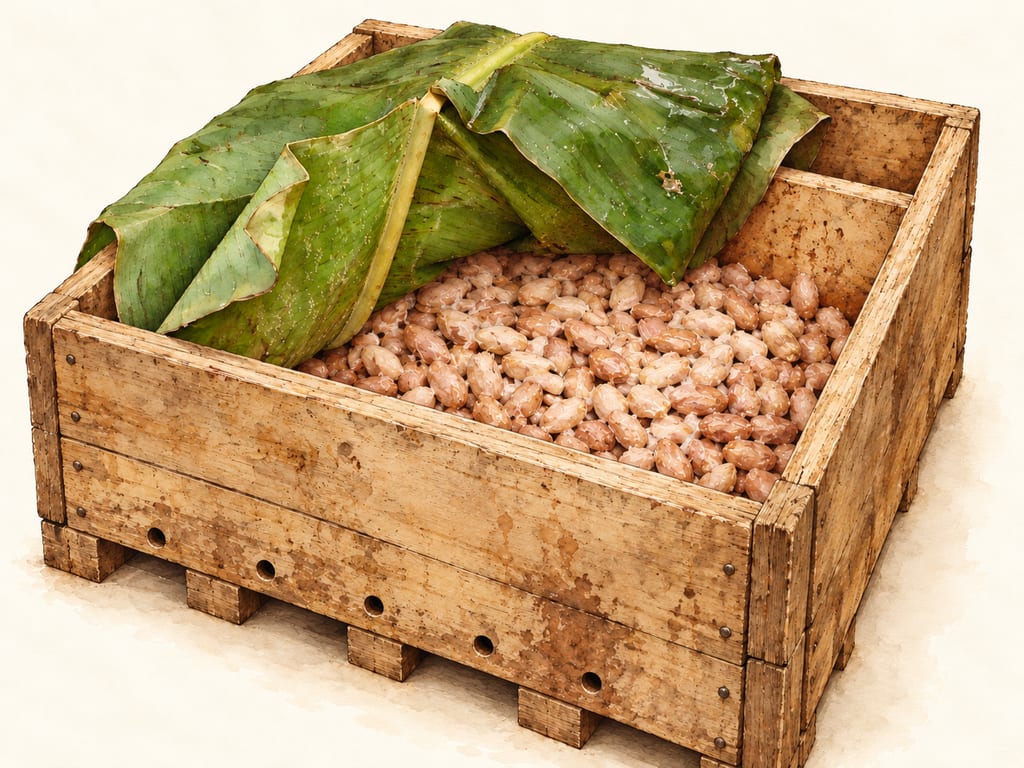
A cacao fermentation box holds fresh beans with their mucilage while the mass ferments. The documented vessels are assembled from wooden boards. Holes in the floor let liquid drain, and the box is raised above the ground or a drain. In the Côte d’Ivoire study, plantain leaves cover the beans. A box may be used alone or as one part of a stepped bank, where workers move the mass between levels; these are different arrangements rather than one fixed design.
A 2003 Cuyagua study describes two local saqui-saqui boxes: a square box 15 cm on each side and a rectangular one 10 × 15 × 20 cm. Each had five 0.8 cm openings in its floor and stood 2 cm above the floor on wooden strips. The trial vessels held 3 kg. These figures describe experimental equipment, not recommended production dimensions.
Sources for this section
Drainage, cover and handling
The beans enter with pulp. As the mucilage liquefies, juice drains through the floor. In the Côte d’Ivoire experiment, holes in the wooden and plastic box floors were described as allowing liquid to drain and air to reach the mass; those floors were raised over a drain and the beans were covered with plantain leaves. A separate Tamil Nadu Agricultural University guide describes a larger wooden box with openings in its bottom and sides. The designs vary, so the openings and lift need to be read from the actual vessel rather than assumed from a generic box shape.
The Cuyagua boxes were each filled with 3 kg and turned after 24 and 48 hours in a five-day trial. The Ivorian study reports 100 kg batches and compares four- and five-day treatments with or without turning. Those are study conditions, not a universal operating method or a litre capacity.
Sources for this section
Different boxes, different study conditions
In the Venezuelan comparison, box design affected measured fermentation characteristics: the square vessel reached higher temperatures and showed higher fermentation-index values than the rectangular vessel under those Cuyagua conditions. The authors considered the square design potentially more efficient in that experiment. The result does not establish a universal preference; the paper discusses the effects of mass volume and handling.
The Côte d’Ivoire paper compares wooden boxes, plastic boxes and heaps under another farm and batch setup. It describes raised floors with drainage holes and plantain-leaf covers, but gives no wood species or standard wooden-box dimensions. Results varied with method and turning. A university extension guide describes still another scale, with wooden boxes reported at 1.2 × 0.95 × 0.75 m and up to one tonne of wet beans. These records show why design, load, cover, drainage and handling must be considered together rather than attributing outcomes to wood alone.
Sources for this section
Places and evidence limits
The cited research contexts are Cuyagua in Venezuela and Kpada in the Soubré area of Côte d’Ivoire. They document particular cacao-growing settings, not a single origin for the wooden box. A Wikimedia Commons photograph shows beans in a wooden box under cut banana leaves, but does not establish the dimensions or exact design used in either experiment.
The sources do not give a common capacity in litres, a maintenance method or a procurement route. They do not show that every perforated box will produce the same result. Drainage openings and elevation matter within documented methods, while performance remains tied to how much cacao the box holds and how workers manage the batch.
Sources for this section
History
Published studies document wooden cacao boxes in Venezuela and Côte d’Ivoire. The 2003 Venezuelan paper records square and rectangular saqui-saqui boxes used in Cuyagua and compares their effects in small experimental batches; a 2010 Côte d’Ivoire study compares wooden boxes with plastic boxes and heaps. These are dated attestations, not invention dates.
Equipment details
CapacityThe sources report different experimental loads by mass, not a general working volume.
SizeNo single size is supported; the studies report designs made for specific tests.
PowerNo power The box is a passive, unpowered vessel.
How you get oneNot established The studies document locally used or experimental wooden boxes but do not identify a maker, seller or procurement route.
CareThe inspected sources do not give cleaning, repair or storage instructions for an empty box.
Made of
- Wood — box body
The 2003 Venezuelan study specifies saqui-saqui; the Côte d’Ivoire study names no species. - Plantain leaves — batch cover
Used to cover wet beans in the documented box method; this is a process cover, not the box body.
Limits
The sources do not establish standard dimensions, capacity or a universally superior box shape; their results apply to specific bean loads, handling and study conditions.
Source →Places
Cuyagua
Documented use · Locality evidenceThis source studies two local box designs; it does not establish that their measurements are standard outside the experiment.
Kpada
Documented use · Locality evidenceThe study names Kpada, a cacao-producing village in the Soubré area; this is one documented trial, not a claim about all Ivorian growers.