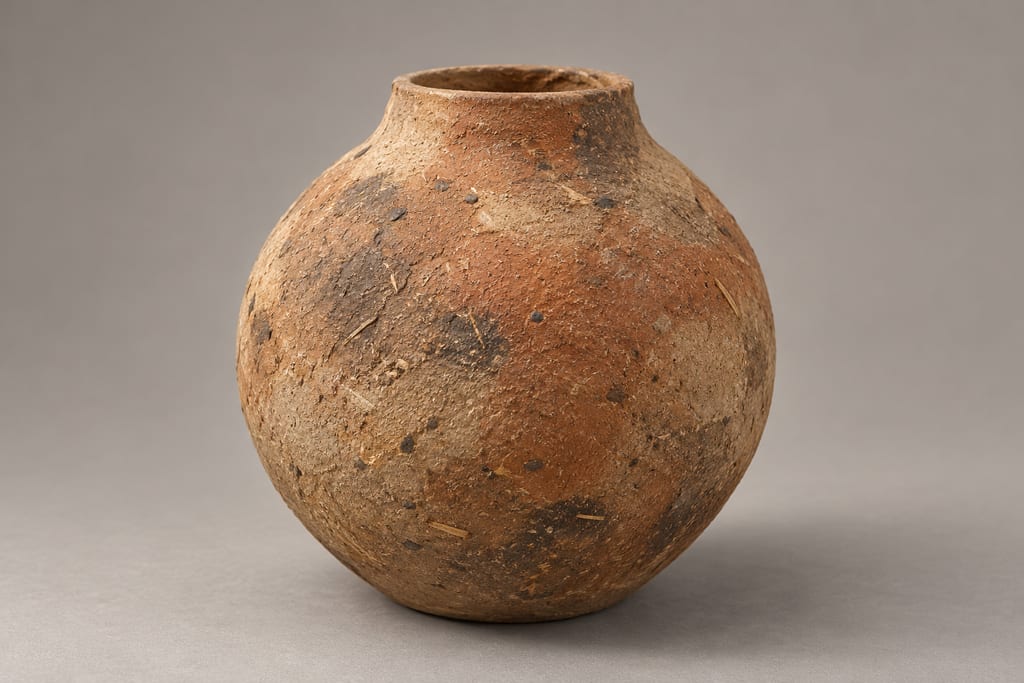
Shangshan globular rice-beverage jars
A small-mouth globular pottery jar from early Shangshan, ca. 10,000–9,000 cal BP. Residue study supports its possible use in rice-beverage fermentation, while leaving individual vessel functions uncertain.
 FermenteaWhere food goes to change
Equipment · Historical object · Jars, pots and crocks
桥头遗址 彩陶 壶
Painted long-necked hu vessels and bowls from Qiaotou, Zhejiang, associated with residues the researchers interpret as beer; the evidence concerns drinking and serving, not proof that these vessels were fermenters.
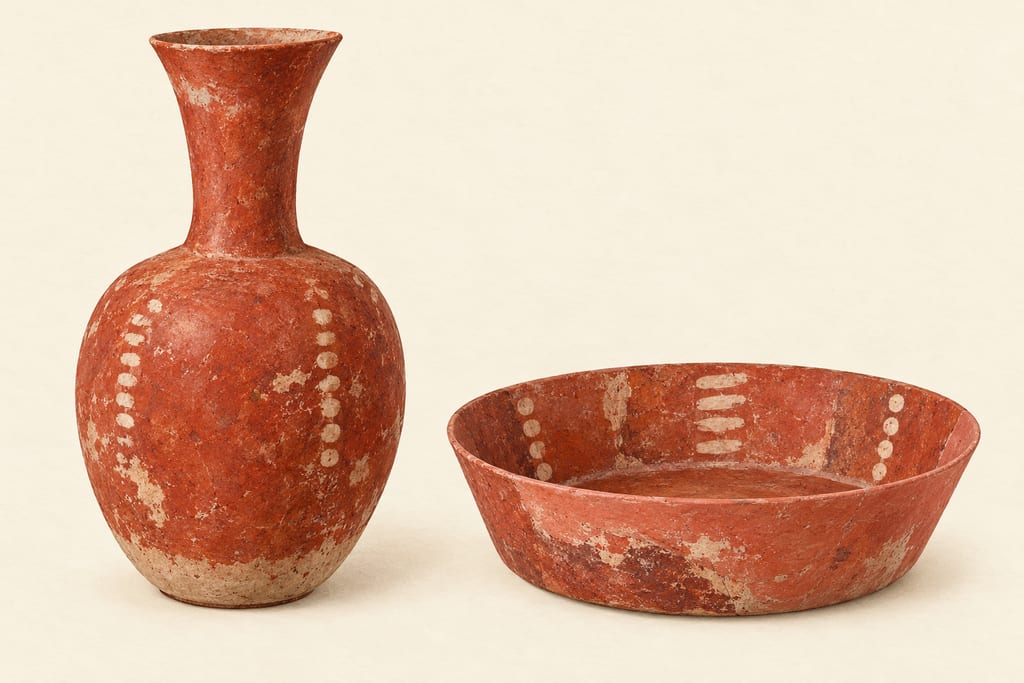
At Qiaotou, archaeologists recovered painted pottery in an unusual platform-mound context. A sample contains seven long-necked hu vessels, four bowls and nine jars. The hu have a narrow neck, globular body and slightly flaring, folded rim. The bowls are flat-bottomed with mostly vertical walls; some have horizontal lugs and impressed decoration. All the sampled vessels were slip-painted, and some carry white dots and lines on their exterior. The paper uses “hu” as a typological label and compares the silhouette with later Shang and Zhou bronze hu; it does not establish that Qiaotou's makers used that name.
These forms should be understood through the excavated examples, not treated as a single standardized design. The published figure identifies representative pieces but gives no scale bar, capacities or full manufacturing specification. The source does not establish the clay recipe, firing regime or composition of the slip.
Qiaotou lies in Zhejiang, in southern China, within the Lower Yangtze region. Wang, Jiang and Sun date the site to approximately 9,000–8,700 calibrated years before present and identify it as a non-habitation platform mound with human burials, architectural traces, a surrounding ditch and concentrations of pottery. The authors argue that the context was probably ritual rather than residential because elaborate pottery is abundant while ordinary activity tools are relatively scarce. That is an interpretation of the site evidence, not a certainty about every object or event there.
The pottery assemblage and this broad site date describe archaeological context. They do not provide a precise manufacture date for each vessel or show that all pottery at Qiaotou belonged to one ceremony.
The researchers analysed microfossil residues from the pottery, including starches, phytoliths and fungal remains, and compared them with control samples from the vessel exteriors. They report evidence interpreted as fermented beverage in six long-necked hu vessels and two bowls. The inferred ingredients include rice, Job’s tears and unidentified underground storage organs; the paper also reports acorn starch in the wider pottery sample. The analysis supports the authors’ interpretation of a beer-like drink but does not identify every ingredient or establish a complete recipe.
The authors suggest that the relatively small hu may have served individual drinkers and that larger bowls might have been shared. They link the discard of many vessels in pits associated with burials to funerary drinking. Both the drinking roles and the ritual explanation are archaeological interpretations. Residues show contact with contents interpreted as fermented drink; they do not prove fermentation happened in these vessels. The source distinguishes drinking vessels from the question of where a beverage was prepared.
The paper does not give a standard capacity, individual measurements, a local vessel name, or a full construction recipe for the painted pottery. Its small analysed sample cannot establish that all hu or bowls held beer, that each object had one fixed purpose, or that the vessels were fermenters. The safer description is therefore an assemblage of painted pottery with selected hu and bowls associated with beer residues in an excavated context. Figure 3 is a useful visual record of the reported forms; the accompanying generated illustration is an editorial rendering based on that figure, not an archaeological artifact or new evidence.
The published assemblage at Qiaotou includes seven long-necked hu vessels, four bowls and nine jars. Residue analysis identified evidence interpreted as fermented beverage in six hu and two bowls. These are specific archaeological vessels from a site dated approximately 9,000–8,700 calibrated years before present; the site date is not an individual manufacture date.
The authors report residue evidence interpreted as fermented beverage in six hu and two bowls; that finding applies to the sampled vessels, not every Qiaotou pot or all hu and bowls.
Source →The article suggests possible individual use of the hu and shared drinking from bowls. The typological name and later Shang/Zhou bronze comparison do not establish the makers' own name or a universal function.
Source →Residues interpreted as beer indicate vessel contact/use; they do not establish that fermentation took place inside these vessels.
Source →This places the Qiaotou site and assemblage in Zhejiang; it does not establish the origin of this vessel type across China.
A small-mouth globular pottery jar from early Shangshan, ca. 10,000–9,000 cal BP. Residue study supports its possible use in rice-beverage fermentation, while leaving individual vessel functions uncertain.

At North Abydos in Egypt, a fixed early Dynastic brewery comprised parallel semi-subterranean installations with rows of ceramic mash vats; excavation reports revise their number, scale and estimated batch capacity.

Ají amarillo is the orange-yellow Peruvian chilli cultivar group of Capsicum baccatum, used to colour and season huancaína sauce and ají de gallina. Published heat estimates do not establish one range for the named cultivar.

Toasted almonds are whole sweet almond kernels dry-roasted until golden to brown. Heat replaces their marzipan note with a roasted, nutty one; they thicken and flavour romesco.

Kodiak salmon, halibut and cod cut as seg'aq and hung on an initaq rack to become tamuuq, with kac'amaasaq and kupcuunaq named as different results.

Aniseed is the dried ripe fruit of Pimpinella anisum, an aromatic Apiaceae spice commonly called a seed. It adds a sweet, warm aroma to breads such as Moroccan krachel and South African mosbolletjies, and is distinct from star anise.

A fixed Late Chalcolithic installation in Areni-1 cave combined a shallow clay pressing basin with a large jar set into the cave floor and storage vessels nearby.

Ripe avocado flesh is the soft, buttery, fat-rich pulp of Persea americana, eaten raw. It is low in acid, so it is a fresh ingredient that needs care in chilled dishes.

A portable dome and pan used over a hearth, with embers on the lid and heat from below. Regional peka and saç forms share this principle while differing in materials, pan shape and how the food is cooked.
No community contributions have been published for this entry yet.
Sign in to contribute. Published comments and photos are free to read.
PLOS ONEArchaeology · Vessel form · Residue analysis · Historical context · Image
Early evidence for beer drinking in a 9000-year-old platform mound in southern ChinaQiaotou, a non-habitation platform mound in Zhejiang, is dated approximately 9,000–8,700 cal BP and contains burials and painted pottery.
The pottery assemblage sampled comprises seven long-necked hu vessels, four bowls and nine jars; the hu have narrow necks, globular bodies, and slightly flaring folded rims; bowls have flat bottoms and vertical walls, with some horizontal lugs and impressed decoration.
All vessels were slip-painted; some have white dots and lines on the exterior.
Residue evidence interpreted as beer was found in six hu vessels and two bowls; the paper suggests individual drinking from hu and shared drinking from bowls but presents this as a possible use.
The sampled vessels' residues were interpreted as beer involving rice, Job's tears and unidentified underground storage organs; this does not prove that the beverage fermented in these drinking vessels.
Figure 3 depicts representative Qiaotou hu, bowl, jar and painted motifs and is distributed under CC BY.
Cited in: Forms recorded at Qiaotou; Archaeological setting; What residue analysis suggests; Limits of the record