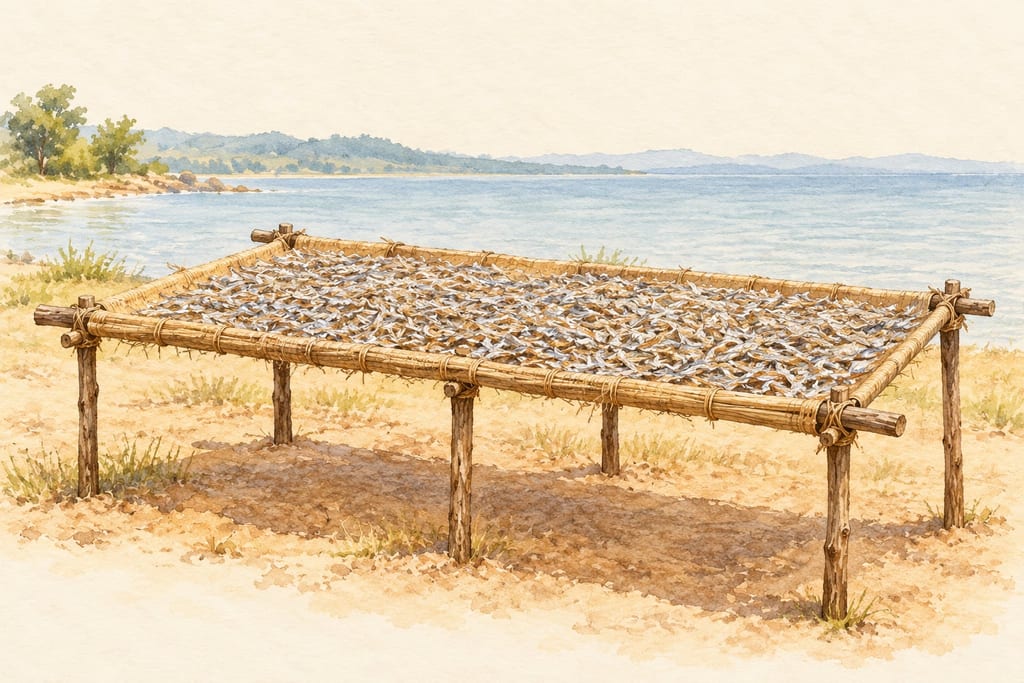
Raised fish-drying rack
A low-cost raised bed for sun-drying small fish, documented in Lake Victoria communities in Tanzania in wood-and-reed and improved mesh forms.
 FermenteaWhere food goes to change
Built structures · Baskets, trays and beds
Burundi fish drying rack · Raised drying rack for fish
A metal-frame rack set on concrete footings, with removable hardwood trays under mesh, raises fish above the ground for air-drying. The design was promoted in Burundi and documented by FAO in 2014.
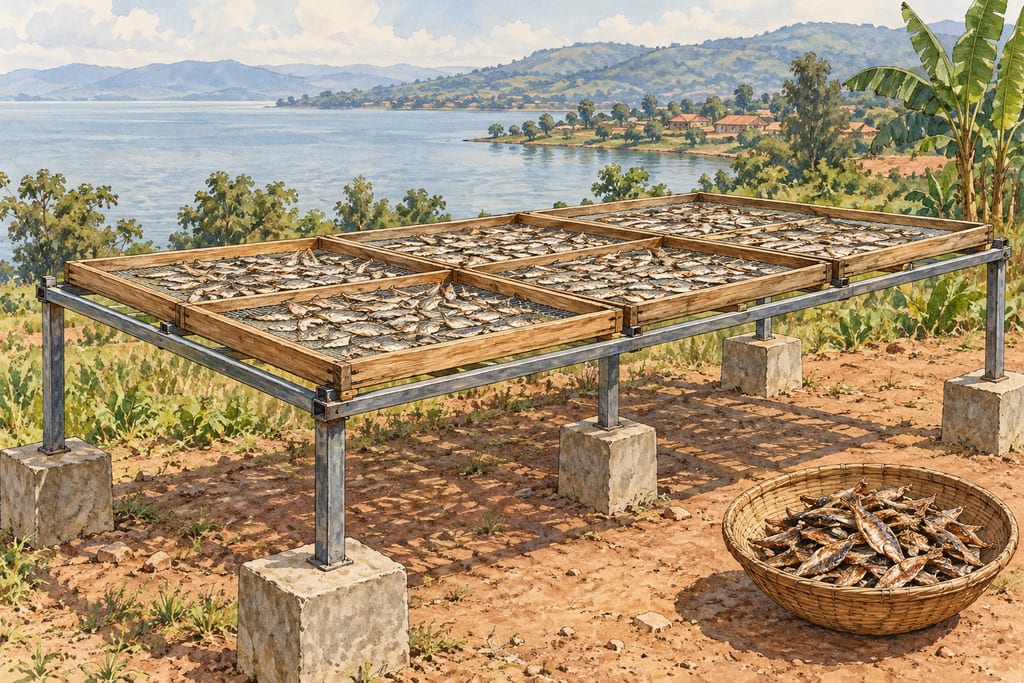
Fish laid on the ground dry slowly and pick up dust, ground water and animals. This Burundian design lifts the product on a metal frame, so air can reach the fish from above, below and the sides. The FAO account describes a rack 12 metres long, 2 metres wide and 1.10 metres high, which carries up to 22 removable trays. The manual gives an average of 12 kilograms of fish per tray.
The frame is metal, built from forty-by-forty tubes and set on concrete footings. The trays are separate hardwood frames with mesh underneath, so a tray can be lifted out to be loaded, emptied or cleaned without disturbing the rack.
Each tray is a hardwood frame, its boards about ten centimetres wide at the frame level. Mesh is laid across the underside and nailed in place with small nails. A batten of fifteen millimetres on the underside holds the mesh. The source does not give the tray's thickness, length, mesh gauge or nail size, so a builder would need to measure these from the original figures.
The metal frame is cut, ground and finished before assembly. The source describes welded metal construction in its photographs but gives no weld sizes, joint layout or footing drawing.
The rack documents an apparatus, not a drying process. The source does not give drying times, temperatures or humidity for fish on these racks, and it does not establish hygiene or fish safety. The 12 kilogram average describes the manual's loading, not a tested structural load.
Rain protection is mentioned, but its design is not dimensioned. A builder who adds a cover would need to test how it sheds water without blocking the airflow that the open frame relies on.
FAO TECA published the Burundi construction account in December 2014. It records the design as a promoted raised rack with a materials schedule and photographs. The account does not date the first use of this design.
A build is made where it stands: moving it means building it again.
Grinding and welding need task-specific eye, hand and respiratory protection. The source does not spell out PPE; this is a general workshop precaution.
The account describes a promoted design in Burundi. The source does not record a locality.
A low-cost raised bed for sun-drying small fish, documented in Lake Victoria communities in Tanzania in wood-and-reed and improved mesh forms.

Soft, spreadable Calabrian pork sausage made with a great deal of red chilli and fatty pork, stuffed into natural casings, sometimes smoked and matured while staying soft.

A way to add independent temperature logging to an existing food dehydrator without changing its built-in controls or protections. It is a monitoring method, not a rewiring plan.

Pleurotus cystidiosus is the abalone mushroom, a cultivated oyster-type fungus with dark brown caps that grows more slowly and is more demanding than other Pleurotus species.

A dark, balanced vinegar from Emilia-Romagna made by combining cooked or concentrated grape must with wine vinegar, then acetifying and refining it in wood under a protected specification.

A living dairy inoculum that starts controlled cream fermentation, developing acidity and aroma before sour cream or cultured butter is finished.

A small electric incubator holds jars at a selected temperature for yogurt and other documented warm food preparations. Controls, capacity and vessel arrangement vary by model.

Adygean salt is a seasoned table salt associated with Adygea and the wider North Caucasian culinary tradition. Salt is blended with garlic and a variable selection of herbs and spices; the exact mix depends on the named style and maker.

The African Caesar-group mushroom, Amanita masasiensis, is a wild ectomycorrhizal species of central and southern African woodlands, eaten locally. The genus contains deadly poisonous species, so identification needs care.
No community contributions have been published for this entry yet.
Sign in to contribute. Published comments and photos are free to read.
FAO, TECA (Technologies and Practices for Small Agricultural Producers)Equipment · Method · Geography
Construction of raised drying racks for fish: the experience from BurundiThe rack is 12 m long, 2 m wide and 1.10 m high, carries up to 22 removable trays, and averages 12 kg of fish per tray according to the source.
The raised open frame admits air around the fish and keeps the fish out of ground water, dust and ground-level animals.
The materials schedule lists ten 40 × 40 tubes, hardwood rods, cutting and grinding discs, paint, cement, sand and gravel.
Cited in: A rack above the ground; How the tray is built; What the rack does not settle
FAOHistory · Geography
Fisheries context report on BurundiGives the post-harvest context for fish processing in Burundi. It does not add a dimensioned drawing of the rack.