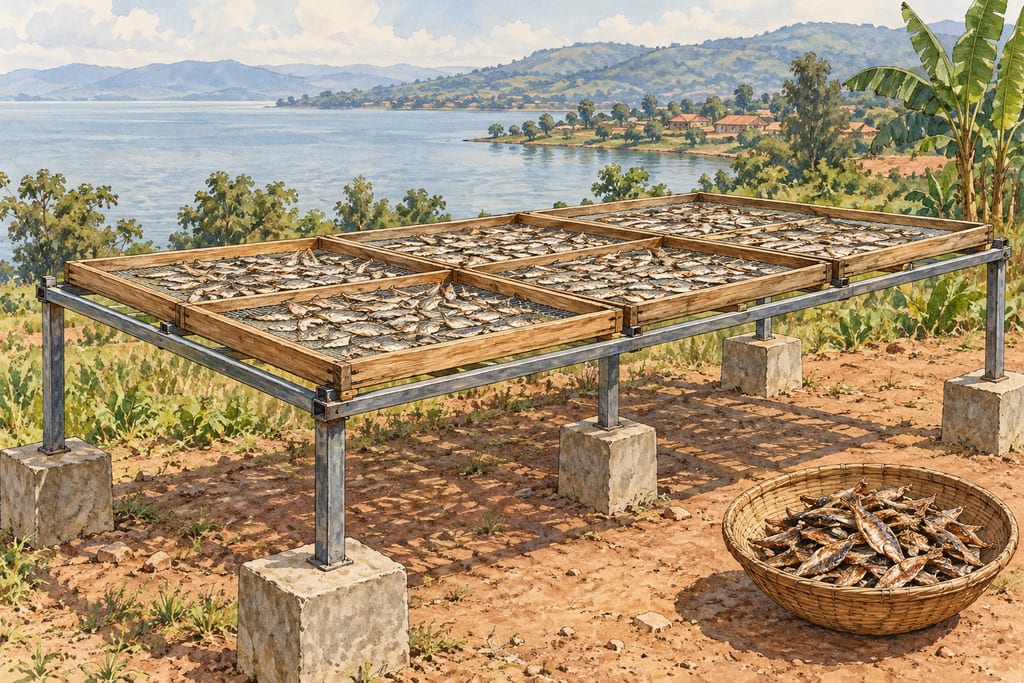
A Lake Victoria drying crib
A raised fish-drying rack holds the drying surface above the beach or ground. In 2019, Sokoine University of Agriculture described Lake Victoria processors in Mwanza being encouraged to use crib methods instead of spreading small fish on sand. The article reports contamination concerns around sand-dried fish and includes a photograph captioned “Sardines on the Cribs.” The photograph shows long raised beds loaded with small fish, but it does not identify their dimensions or the material of the pictured surface.
The rack supports sun drying; it is not the cooking vessel. The available accounts do not establish one universal shape, capacity, or drying schedule for the equipment.
Sources for this section
Traditional materials and later alternatives
A 2015 Tanzanian project assessment describes traditional local racks made from reeds and sticks. It says they wear quickly and need rebuilding. The same report discusses wire-mesh racks as a more durable proposed alternative. Those are distinct material choices: the wire-mesh project design should not be mistaken for the reed-and-stick form. The report does not provide a measured specification for the traditional racks, so this page gives no dimensions or construction plan.
A 2016 Lake Victoria Fisheries Organization survey spanning Uganda, Kenya, and Tanzania records raised racks among processors' methods, alongside nets and ground drying. It also identifies rain and poor drying conditions as regional challenges. Its results describe a sample across several countries, not every Tanzanian landing site.
Sources for this section
A varied current practice
A 2026 FAO/FISH4ACP account from Kigoma describes a Tanzanian processor working with fish racks alongside a solar tent and an oven. That is evidence that rack-based drying remains part of current fish processing, but it does not show that the Kigoma racks share the reeds-and-sticks materials described in 2015. The sources do not supply a capacity, exact height, surface construction, maintenance schedule, drying endpoint, or validated safety process. A raised bed may separate fish from sand; the equipment record alone cannot establish how dry or safe a batch becomes.
Sources for this section
History
A 2015 assessment names traditional reed-and-stick racks; a 2016 regional survey, a 2019 Mwanza account, and a 2026 Kigoma report document raised or rack-based fish drying in Tanzania. These sources establish varied present-day use, not a single design or an uninterrupted history.
Equipment details
PowerNo power The rack is an unpowered support; the documented Lake Victoria use is sun drying.
How you get oneNot established Local reed-and-stick construction is documented, but the sources do not establish a standard maker, purchase route, or build specification.
CareA 2015 Tanzanian project assessment reports that reed-and-stick racks do not last long and must be rebuilt; it gives no repair or service schedule.
Made of
- Reeds — frame
A 2015 Tanzanian project assessment describes traditional local racks made from reeds and sticks; it gives no reed species, dimensions, or treatment. - Sticks — supports and frame
The same assessment says traditional racks use sticks and need rebuilding, but does not specify their size or joinery. The 2019 Mwanza photograph does not identify its own rack materials.
Limits
The 2015 assessment says reed-and-stick racks wear quickly and require rebuilding; it supplies no service life or maintenance specification.
Source →Places
Mwanza Region
Documented use · Region evidenceSokoine University describes Lake Victoria fish processors in Mwanza using crib methods; this row does not claim every landing site uses the same rack.
Tanzania
Historical attestation · Country evidenceA 2015 Tanzania project assessment describes traditional reed-and-stick fish-drying racks; its country-level record is not narrowed to a specific community here.
Kigoma Region
Documented use · Region evidenceFAO/FISH4ACP describes a current fish processor working with racks alongside a solar tent and oven; the source does not identify those racks as reed-and-stick construction.