A closed vessel for processing sealed packages
A commercial retort is a closed thermal-processing vessel that heats hermetically sealed food packages. The packages may be cans, glass jars or flexible pouches; the retort surrounds a loaded group of them with a controlled heating environment. The word names a class of equipment, not one universal machine. A product can reach commercial sterility only through an established process appropriate to the food, container and equipment.
That distinction matters because the reader may encounter ‘retort’ used loosely for any hot pressure vessel. Retorting describes processing sealed packages in specialised equipment, with process conditions established for the product and package. A domestic pressure cooker or canner is not automatically equivalent to a commercial retort, and neither the vessel name nor a successful seal establishes a suitable process.
Sources for this section
Different machines move heat in different ways
Batch retorts load packages together for a cycle; continuous systems move packages through a thermal process. Within batch equipment, heating can use steam, water immersion, water spray or combinations of steam and water. Some vessels keep packages still; agitating designs rotate them during processing. These arrangements change how the heating medium circulates and how heat reaches packages, so their control systems and operating procedures are not interchangeable.
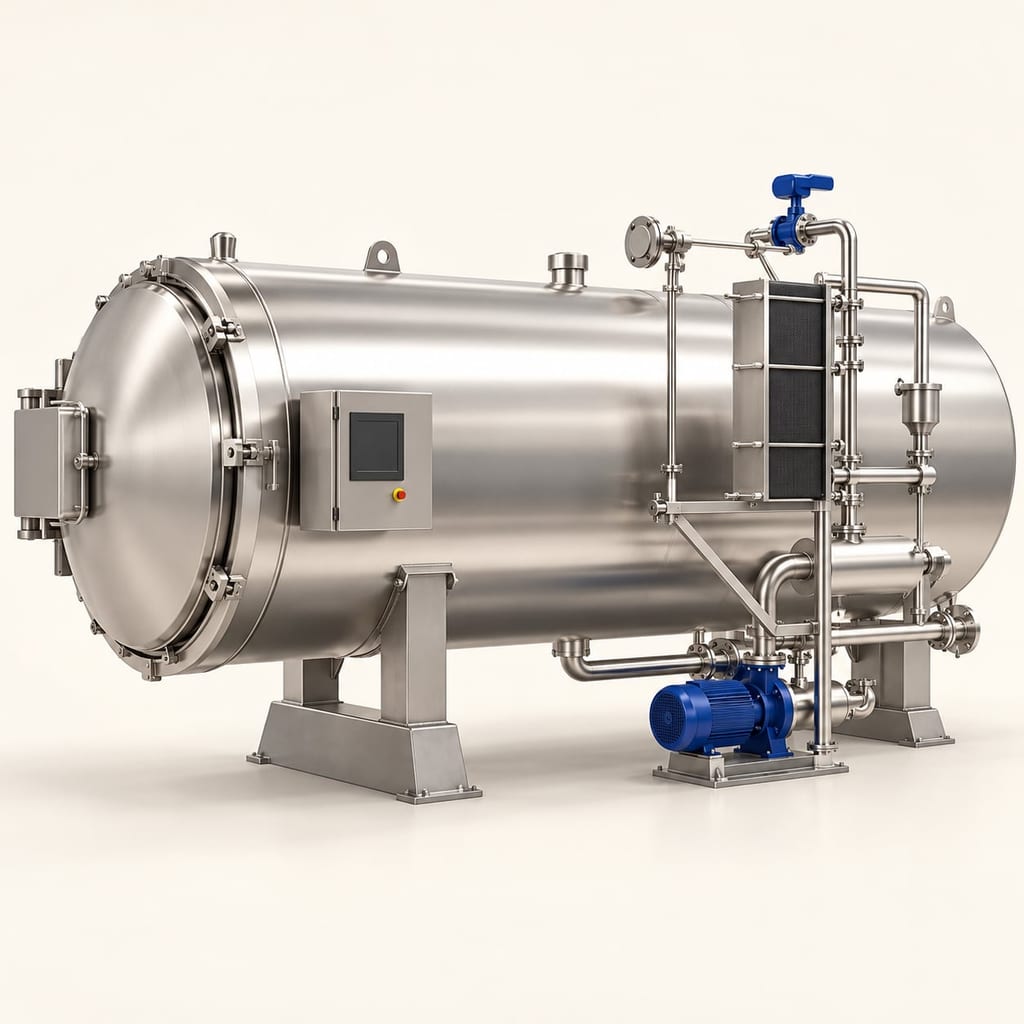
JBT Marel's current catalogue illustrates the range with static steam-water-spray, SuperCRss, SuperAgi and SuperStatic designs. The linked gallery image is one specific horizontal static steam-water-spray unit. Its long cylindrical shell, end door, support legs and attached pipework should be read as that photographed manufacturer's design, not as a template for every retort.
Sources for this section
The package and product define the process
Heat transfer continues through the package wall and into its contents. Container material, dimensions, product composition and packing arrangement affect how heat moves toward the coldest part of the food. Flexible retort pouches do not behave exactly like metal cans or glass jars; changing package type calls for reassessment rather than carrying over the old process unchanged. Even changing a formulation can change the conditions that were used to establish process adequacy.
For this reason, FDA process filings identify more than a target vessel temperature. They include the type of retort, minimum initial temperature, processing times and temperatures, sterilising value or equivalent scientific evidence, and critical factors that affect heat penetration. These details belong to the validated product-and-package process, not to a generic retort recipe.
Sources for this section
Agitation, circulation and controls
An agitating water-immersion batch retort moves containers so the headspace bubble shifts during heating. The FDA describes end-over-end rotation in one discontinuous design and notes that positions within a basket can receive different agitation. This is a useful example of why a machine's model, basket arrangement and motion matter. It does not describe every agitating retort, and the schedule must account for the particular equipment and process.
Retort operation also depends on process-specific procedures such as steam venting or the come-up sequence, temperature distribution, timing, pressure control and cooling. Instrument calibration and equipment maintenance are part of maintaining process delivery. Automated valves and controllers can carry out parts of a cycle, but automation does not make process establishment or monitoring unnecessary.
Sources for this section
Industrial role, geography and limits
Retort systems support shelf-stable packaged foods distributed through commercial supply chains, including meals and products packed in cans, jars or pouches. Their presence in a plant does not by itself identify which foods the site can process: that depends on the installed machine, qualified process, package, operator procedures and applicable regulation. JBT Marel documents several present batch designs, while FDA materials describe the process-control framework within United States low-acid canned-food oversight.
The sources establish current commercial equipment but do not establish one origin or a universal worldwide sales footprint for the retort as a category. Dimensions, working capacity, materials, power arrangement and purchase route therefore vary by model and are not stated here as class-wide specifications. A particular supplier's retort page is the right source for a specific machine; a qualified process authority is required to establish a food's scheduled process.
Sources for this section
History
The word retort covers several closed thermal-processing systems rather than one standard machine. FDA inspection guidance treats the type of retort or other thermal-processing equipment as part of the process filing, while a current JBT Marel catalogue illustrates several batch designs. The exact development history of the broader equipment class is not established by these sources.
Equipment details
CapacityNo common capacity can be assigned across batch, continuous, static, agitating and package-specific retort designs.
SizeNo general dimensions apply across different retort designs; the linked JBT photograph shows one manufacturer's horizontal static unit.
PowerNot established Retort designs use different heating, circulation, agitation and control arrangements; the sources do not establish one power source for the equipment class.
How you get oneBought, manufactured Commercial retorts are factory-made process equipment; the JBT product page documents current manufactured batch systems.
Made of
- Stainless steel — Pressure-vessel shell on the pictured JBT static retort
This is the specific manufacturer's product shown in the gallery, not a claim that all retorts use the same material.
Limits
A retort or its process cannot be treated as interchangeable across food formulations, package materials or container sizes; each scheduled process is specific to stated critical factors.
Source →Places
Unknown
Relationship not established · Place not establishedThe cited material documents current commercial designs and U.S. process oversight, but it does not establish a unique geographic origin or the equipment class's global reach.