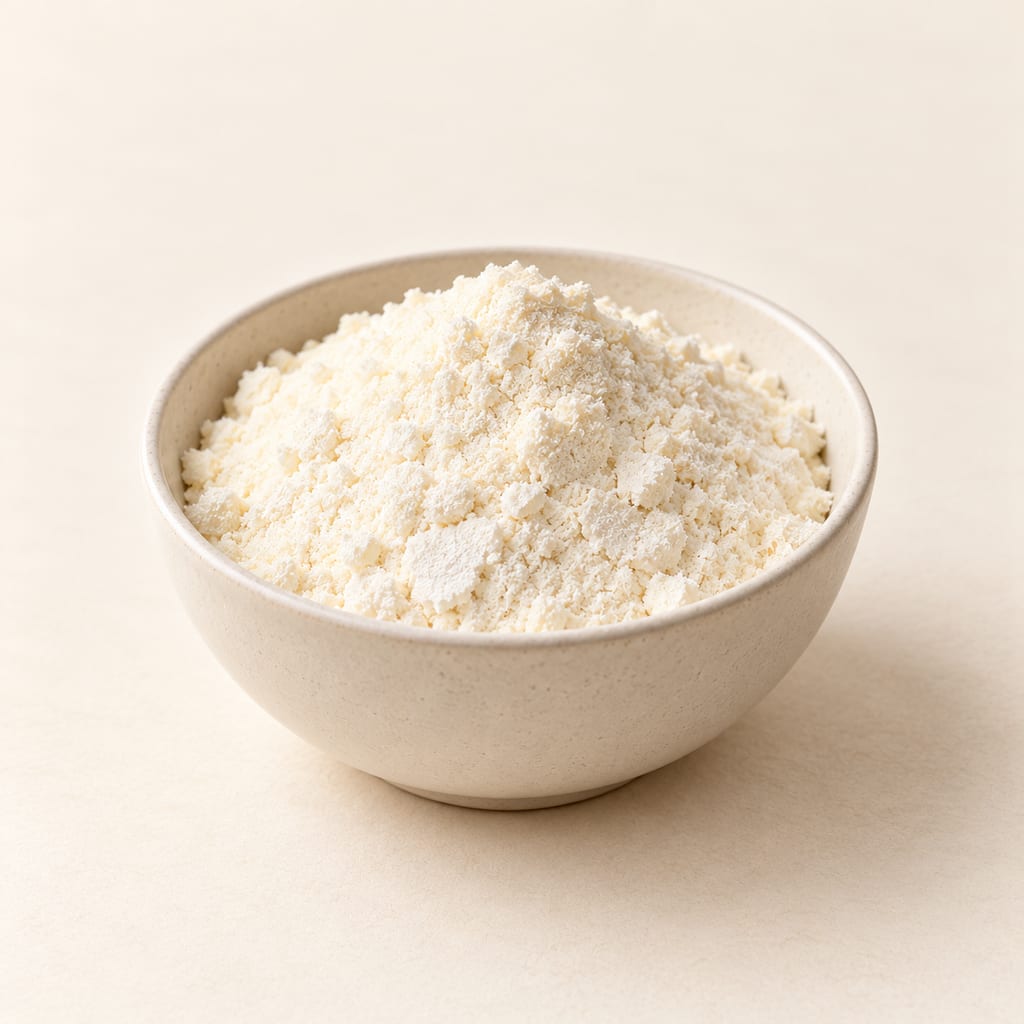
Dry milk
Dry milk is a family of dairy ingredients made by removing most water from milk or cream. The name includes distinct whole, partly skimmed and nonfat powders; fat level, heat treatment and particle form determine handling and use.
 FermenteaWhere food goes to change
Equipment · Industrial and laboratory plant
Spray-drying machine · Spray-drying plant
A spray dryer turns a pumpable liquid concentrate into powder by atomizing it into droplets that meet heated air in a drying chamber; the particles are then separated from the exhaust air.
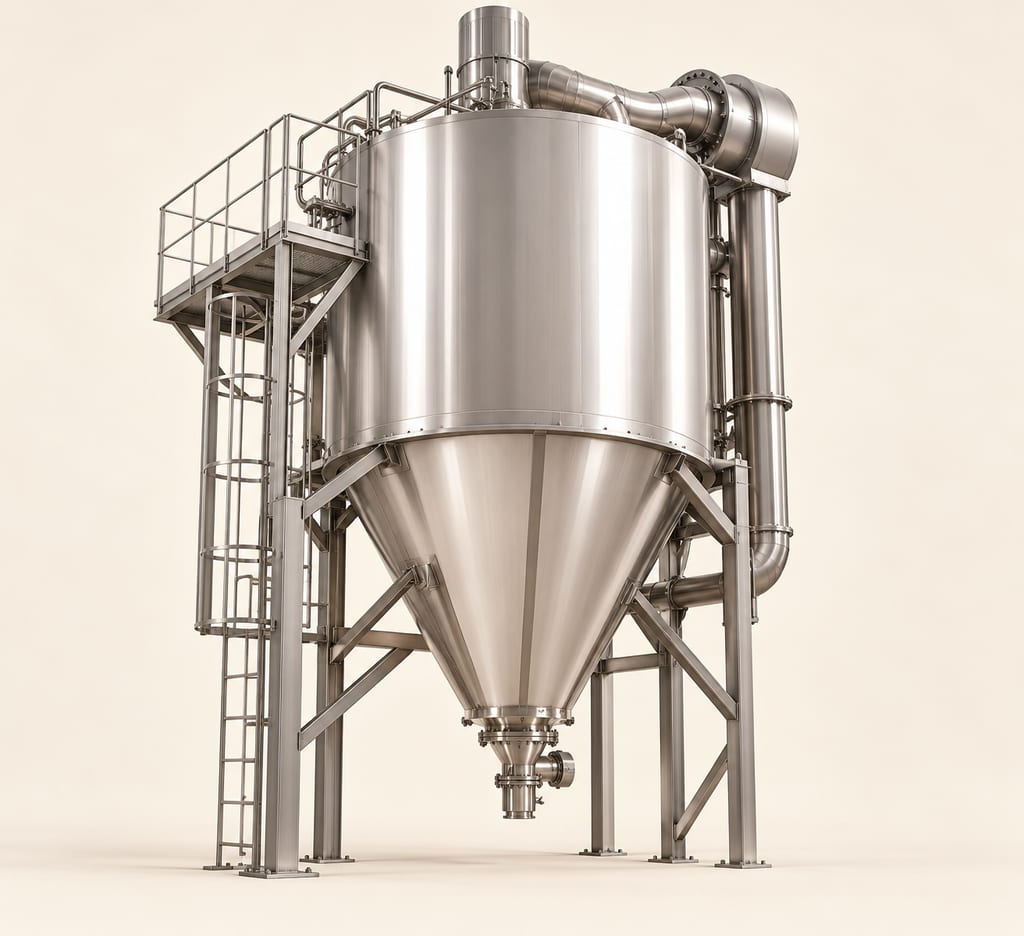
A spray dryer is a manufactured process machine that turns a pumpable liquid or slurry into dry particles. Instead of spreading the feed across a heated surface, it first breaks the liquid into many small droplets. Those droplets meet a stream of heated air inside a drying chamber. Their large exposed surface lets water evaporate during flight, leaving solid particles that can be collected as powder.
The machine is usually part of a larger processing line. A liquid may be concentrated before it reaches the dryer, while powder cooling, screening, blending or packaging can follow it. The dryer itself is not a fermenter or a complete food plant; its feed preparation and downstream equipment depend on the product.
Atomization can use a rotary wheel or disc, or a pressure nozzle. These are alternative ways to disperse the feed, not interchangeable parts of one fixed design. The atomizer and air distributor are selected to produce a droplet pattern that works with the liquid and the chamber. The GEA conventional dryer example documents both rotary-atomizer and nozzle arrangements.
Inside the chamber, droplets travel in heated air as moisture leaves them. The resulting powder is discharged from the chamber and separated from the moist exhaust stream. Cyclones and bag filters are common collection devices in manufacturer descriptions; some installations combine them or add further stages. A fluid bed may finish drying, cool the powder or support agglomeration, but not every spray dryer includes one. Fines return and air-flow layouts are also configuration-specific.
Milk and whey are prominent applications. Spray drying is widely used to make powdered dairy ingredients, and industrial systems also serve other liquid food materials and ingredients. The powder's particle form and reconstitution behavior depend on the feed and plant configuration, so the equipment name alone does not promise a particular solubility, texture or shelf life.
Dry milk is a useful related ingredient page for readers encountering the product made by this equipment. The connection is an equipment-to-product use, not a claim that every dry-milk ingredient was made on one machine or by one recipe. Spray dryers also appear in the broader manufacture of food powders, but the cited examples do not define one universal feed or powder specification.
Spray and drum dryers are distinct equipment classes. A spray dryer atomizes liquid and dries suspended droplets in hot air; a drum dryer lays a thin wet film directly on a heated rotating cylinder and scrapes the dried layer away. The first is organized around atomization, a drying chamber and air-powder separation. The second is organized around a heated contact surface and scraper.
Both routes can make milk or whey powders, but the resulting products need not have the same functional behavior. Tetra Pak describes spray drying as the most widely used milk-and-whey route in its discussion and records that drum drying can reduce some milk powder functional and instant properties. The drum-dryer page describes that alternative in more detail. These are processing choices, not household directions; exact machine design and product outcomes are manufacturer- and feed-specific.
The GEA reference photograph shows a contemporary stainless industrial drying chamber and its surrounding installation. It is a documented manufacturer example, not a drawing of every tower or evidence for hidden internal details. Current spray dryers differ in atomization, air handling, collection, cleaning and safety arrangements, and plants are specified for the material and production line.
Spray drying is a modern industrial equipment class, but its earliest invention and one geographic birthplace are not established here. Industrial layouts and maker sites vary, so no standard capacity, dimensions or power source apply across the category.
Contemporary industrial spray dryers apply atomized-droplet drying to food and ingredient powders; the class's earliest maker and geographic origin are not established here.
The cited handbook and manufacturer page document current spray-drying applications and machine designs, but do not establish a unique origin, traditional region or the manufacturing site of the general equipment class.
Dry milk is a family of dairy ingredients made by removing most water from milk or cream. The name includes distinct whole, partly skimmed and nonfat powders; fat level, heat treatment and particle form determine handling and use.

Soft, spreadable Calabrian pork sausage made with a great deal of red chilli and fatty pork, stuffed into natural casings, sometimes smoked and matured while staying soft.

A way to add independent temperature logging to an existing food dehydrator without changing its built-in controls or protections. It is a monitoring method, not a rewiring plan.

Pleurotus cystidiosus is the abalone mushroom, a cultivated oyster-type fungus with dark brown caps that grows more slowly and is more demanding than other Pleurotus species.

A dark, balanced vinegar from Emilia-Romagna made by combining cooked or concentrated grape must with wine vinegar, then acetifying and refining it in wood under a protected specification.

A living dairy inoculum that starts controlled cream fermentation, developing acidity and aroma before sour cream or cultured butter is finished.

A small electric incubator holds jars at a selected temperature for yogurt and other documented warm food preparations. Controls, capacity and vessel arrangement vary by model.

Adygean salt is a seasoned table salt associated with Adygea and the wider North Caucasian culinary tradition. Salt is blended with garlic and a variable selection of herbs and spices; the exact mix depends on the named style and maker.

The African Caesar-group mushroom, Amanita masasiensis, is a wild ectomycorrhizal species of central and southern African woodlands, eaten locally. The genus contains deadly poisonous species, so identification needs care.
No community contributions have been published for this entry yet.
Sign in to contribute. Published comments and photos are free to read.
Tetra Pak Dairy Processing HandbookMechanism · Dairy applications · Powder recovery · Comparison
Milk and Whey Powdered IngredientsSpray drying atomizes liquid concentrate into droplets that dry in hot air.
Drying air and particles are separated using equipment such as cyclones and filters; designs and stages vary.
Spray drying is a widely used route for milk and whey powders, with product properties shaped by the drying system.
Cited in: From liquid concentrate to airborne droplets; Atomizers, chamber and powder collection; Dairy powders and other food ingredients; How it differs from a drum dryer; Industrial plant, with no single origin claimed
GEACurrent equipment · Design variation · Atomization · Powder recovery
Conventional spray dryerGEA describes rotary atomizer and nozzle choices, hot-air distribution, a drying chamber, powder discharge, and cyclone or bag-filter separation of exhaust powder.
Some plant configurations add a fluid bed for further drying and cooling and may return fines for agglomeration; these are design options, not universal features.
Cited in: From liquid concentrate to airborne droplets; Atomizers, chamber and powder collection; Industrial plant, with no single origin claimed
Tetra Pak Dairy Processing HandbookDairy applications · Comparison
Milk and Whey FractionationThe handbook identifies spray and drum drying as routes for milk and whey.
It describes spray drying as the most widely used method for milk and whey in its discussion and notes functional and instant-property trade-offs for drum-dried milk powder.
Cited in: Dairy powders and other food ingredients; How it differs from a drum dryer