History and scope
Stainless wine fermenters belong to modern commercial winemaking. The consulted manufacturer catalogue describes a current product family; it does not establish when the general tank form first appeared or identify a single place of origin. This page focuses on a particular design feature: low access intended to make the removal of red-wine pomace practical. It is a manufactured tank that can be installed in a winery, not a tank built into the site.
Sources for this section
The pomace opening
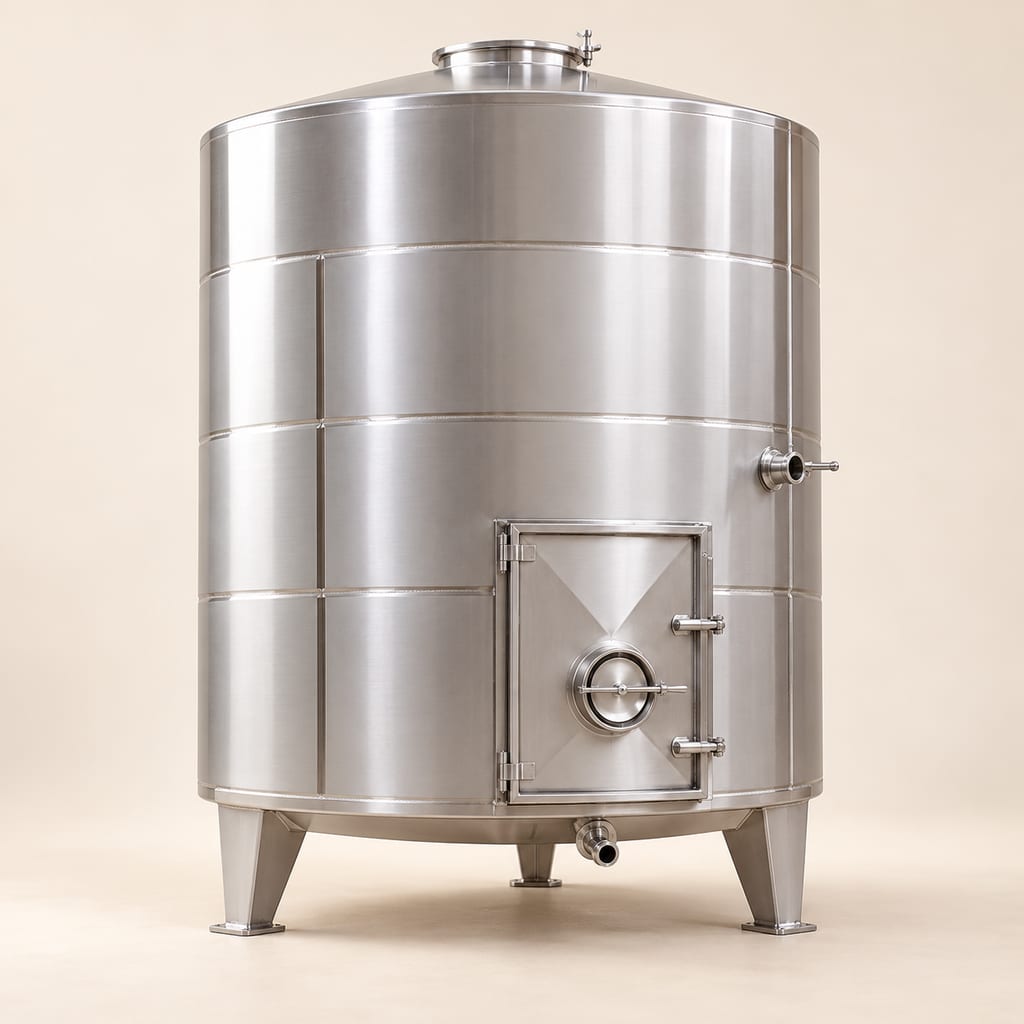
In red-wine fermentation, grape skins and seeds remain with fermenting juice. The top of this mass forms a cap that winemakers manage during fermentation; after processing, solids must be removed from the vessel. The Paul Mueller red-wine configuration places an outside-opening access manway flush with the tank bottom, with an outlet connection. That low opening is the defining feature for this entry: it allows access near the solids rather than requiring every red-wine tank to use the same top or side opening. The tank is not itself a pomace press, and the opening does not specify a single method for managing the cap.
Sources for this section
A tank configured for red or white wine
The product family makes clear that “wine fermenter” does not describe one universal door. The manufacturer's red-wine model has an 18-inch outside-opening manway at the tank bottom. Its white-wine tank instead has a side-entering, inswing manway listed at 16 by 20 inches. The brochure gives corresponding outlet sizes for those configurations. These dimensions belong to the manufacturer's specified models; they are not standards for every wine fermenter. A mixed-use or custom tank should be understood from its own drawings and fittings.
Sources for this section
Cooling and other fittings
The listed tanks use a heat-transfer surface to support cooling, and the manufacturer describes operation with glycol or ammonia refrigeration systems. Thermowells provide locations for temperature monitoring. Racking connections, a top vent, side drain and optional sample valves serve different functions: transferring clearer wine, draining the vessel, venting and sampling. Some tanks can be insulated or fitted with an outer jacket. Those additions are options, not defining features of every stainless wine tank; cooling equipment and instrumentation also vary by installation.
Sources for this section
Material, capacity and limits
The manufacturer describes Type 304 stainless as a standard construction material and lists Type 316 or 316L options. Its product page gives capacities for individual models spanning 500 to 12,000 US gallons, with dimensions that change by size. Those figures help readers understand the scale of one commercial product range, not a type-wide capacity rule. Stainless avoids the oak contribution of a new wooden vessel, but it does not make every wine made in steel taste alike: grape variety, fermentation management, temperature and other cellar choices remain consequential. The consulted source does not assign one pressure rating to the whole product family, so pressure use must be checked against the exact vessel's documentation.
Sources for this section
History
The consulted manufacturer catalogue documents current commercial wine tanks but does not date the origin of the general form.
Equipment details
CapacityThe manufacturer lists individual designs from 500 to 12,000 US gallons (about 1,893 to 45,425 litres); these are its product examples, not a universal range for all wine fermenters.
SizeDimensions are model-specific. Manufacturer dimensions should be checked against the selected capacity and configuration.
PowerNo power The tank itself is passive; heat transfer requires a separate glycol or ammonia cooling system when fitted.
How you get oneBought, manufactured Manufactured as commercial winemaking equipment; the cited example is made by Paul Mueller Company. Custom designs and options vary.
CareFollow the maker's cleaning and access instructions for the exact tank, door seal, outlet fittings and cooling system. The cited materials describe sanitary construction and smooth-radius manway assemblies; they do not provide a single care procedure for every model.
Made of
- Stainless steel — Tank body
The cited manufacturer describes corrosion-resistant Type 304 as standard, with Type 316 or 316L options on its equipment brochure; exact alloy is model-specific.
Limits
The bottom-level outside-opening manway and its outlet are described for red-wine models; white-wine tanks use a different side-entry, inside-closing access configuration.
Source →Pressure capability depends on the exact model; no general pressure rating is assigned here.
Source →Places
Unknown
Relationship not established · Place not establishedSources identify a current commercial wine-tank product but do not establish the design's geographic origin or all manufacturing locations.