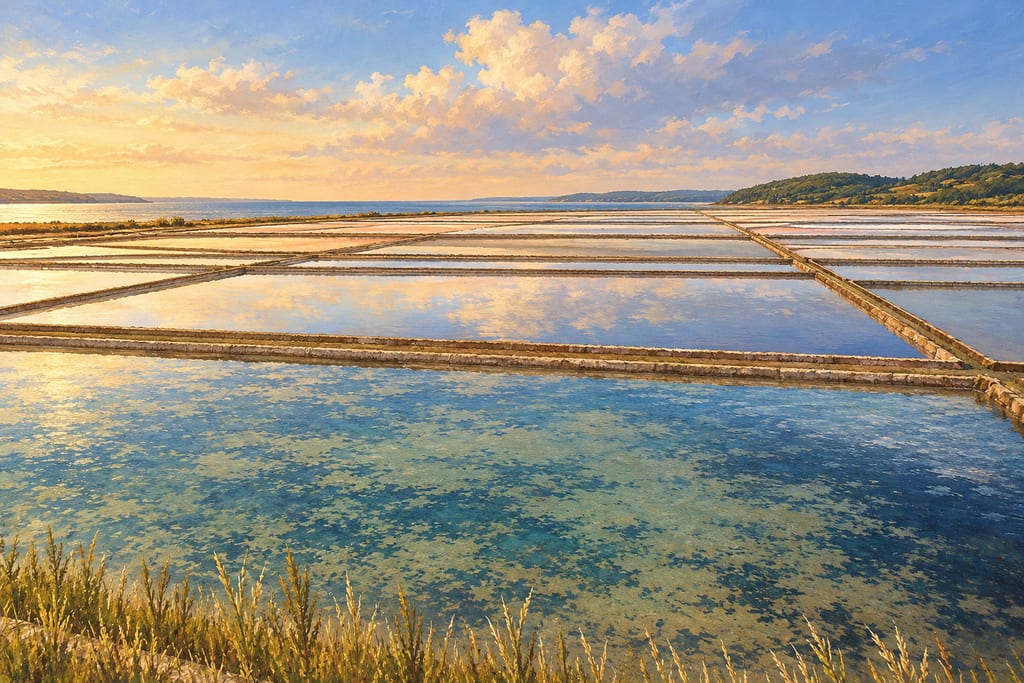
Sečovlje Salt Pans
A northern Adriatic saltworks in Slovenia where seawater passes through evaporation ponds into crystallisation beds, with the traditional petola layer and daily hand harvesting preserved.
 FermenteaWhere food goes to change
Place · salt-evaporation-pans-and-salina
Solana Ston · Ston saltworks · Solana u Stonu
The Ston Salt Pans are a working Adriatic saltworks on Croatia’s Pelješac peninsula, where seawater moves through evaporation and crystallisation ponds before seasonal harvest.
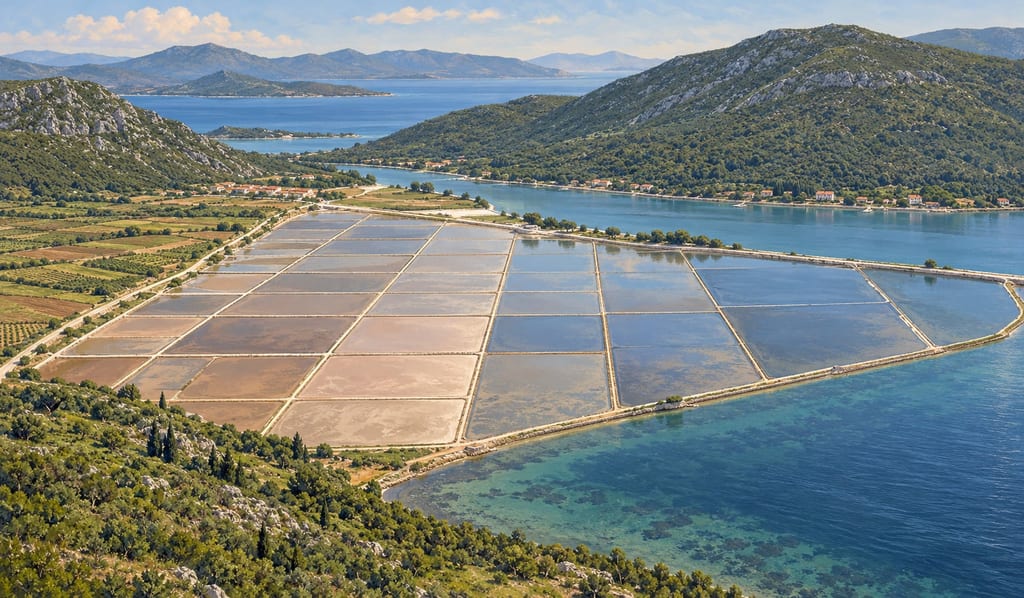
A UNESCO heritage paper describes Ston as founded in the early fourteenth century as an important place for salt production and the fortifications as protection for the salt fields. UNESCO's Tentative List includes the salt pans in the Ston–Mali Ston cultural landscape. These sources do not date today's pond layout.
Use official visitor routes and operator guidance; do not enter or alter working ponds or channels without permission.
UNESCO identifies the pans within the Ston–Mali Ston cultural landscape; these sources do not provide coordinates for the individual working ponds.
A northern Adriatic saltworks in Slovenia where seawater passes through evaporation ponds into crystallisation beds, with the traditional petola layer and daily hand harvesting preserved.

Protected Italian vinegar made only from cooked grape must, fermented and aged in a battery of wooden barrels for at least 12 years: sweet, sharp and syrupy.

Airag is Mongolia’s fermented mare’s-milk drink, traditionally churned with saved starter in a reusable cowhide khokhuur.

Appam, or hoppers, are South Indian and Sri Lankan rice pancakes made from a fermented coconut-and-rice batter and cooked in a curved pan to a crisp lacy rim and a soft, spongy centre.

Auricularia tremellosa is a wood ear fungus of the genus that supplies most dried wood ear sold in China; its own food record is thin, and the culinary practice described here comes from the closely related wood ear species.

Ayran is Turkey’s cold, savoury yogurt drink: plain yogurt is loosened with water and lightly salted, then whisked smooth or aerated into a soft cap of foam.
A thin stone griddle used over an open hearth. Norwegian archaeology documents the established tradition from the early Middle Ages; a Viking-period origin is only a cautious suggestion linked to Shetland.

Crushed or milled barley cooked in water until the starch softens and the mixture thickens, the plainest way a northern household turned stored grain into a meal, here with apple and hazelnut.

Black carrot is the anthocyanin-pigmented Eastern carrot (Daucus carota var. atrorubens), the purple root that preceded orange types and still colours kanji and şalgam.
No community contributions have been published for this entry yet.
Sign in to contribute. Published comments and photos are free to read.
UNESCO World Heritage CentreLocation · Heritage landscape
Historical-town planning ensemble of Ston with Mali Ston, connecting walls, the Mali Ston Bay nature reserve, Stonsko Polje and the salt pansCroatia submitted this cultural ensemble to the Tentative List in 2005; it includes Ston, Mali Ston, connecting walls, Mali Ston Bay reserve, Stonsko Polje and the salt pans.
The submission describes successive historical stages and the strategic and economic role of the area.
UNESCO World Heritage Centre; Matko VetmaHistory · Fortifications
City walls of Ston – fortress Veliki KaštioThe paper describes Ston as founded in the early 14th century as an important place for salt production.
It states that the walls and fortress protected the town and sea-salt fields.
Croatian Island Product Programme, Ministry of Regional Development and EU FundsMethod · Seasonality · Historical trade · Product context
Sea Salt Product Line (Linija proizvoda od morske soli)The listing identifies Solana Ston as the holder of a sea-salt product line on Pelješac.
It describes seawater evaporation in large shallow basins using sea, sun and wind and gives April–October as the harvest and production season.
It states that during the Dubrovnik Republic the purest salt was sent to the Vienna court.
Solana Ston d.o.o.Current site · Process layout
About usThe operator describes its business as sea-salt extraction and a flow-based organization of evaporation and crystallisation ponds. No pond counts are used because the operator's pages differ in their totals.
Solana Ston d.o.o.Historical context
The HistoryThe operator says Ston joined the Dubrovnik Republic in 1333 and that salt production was economically significant; these claims are used only for the 1333 civic context, not broader unsupported claims of prehistoric saltworks or exact continuity of present pond fabric.