← Equipment

Equipment · Churns, agitators and drums

Suspended goatskin churn

sqa · qirbah · Dhofar goatskin churn

Loading ratings…

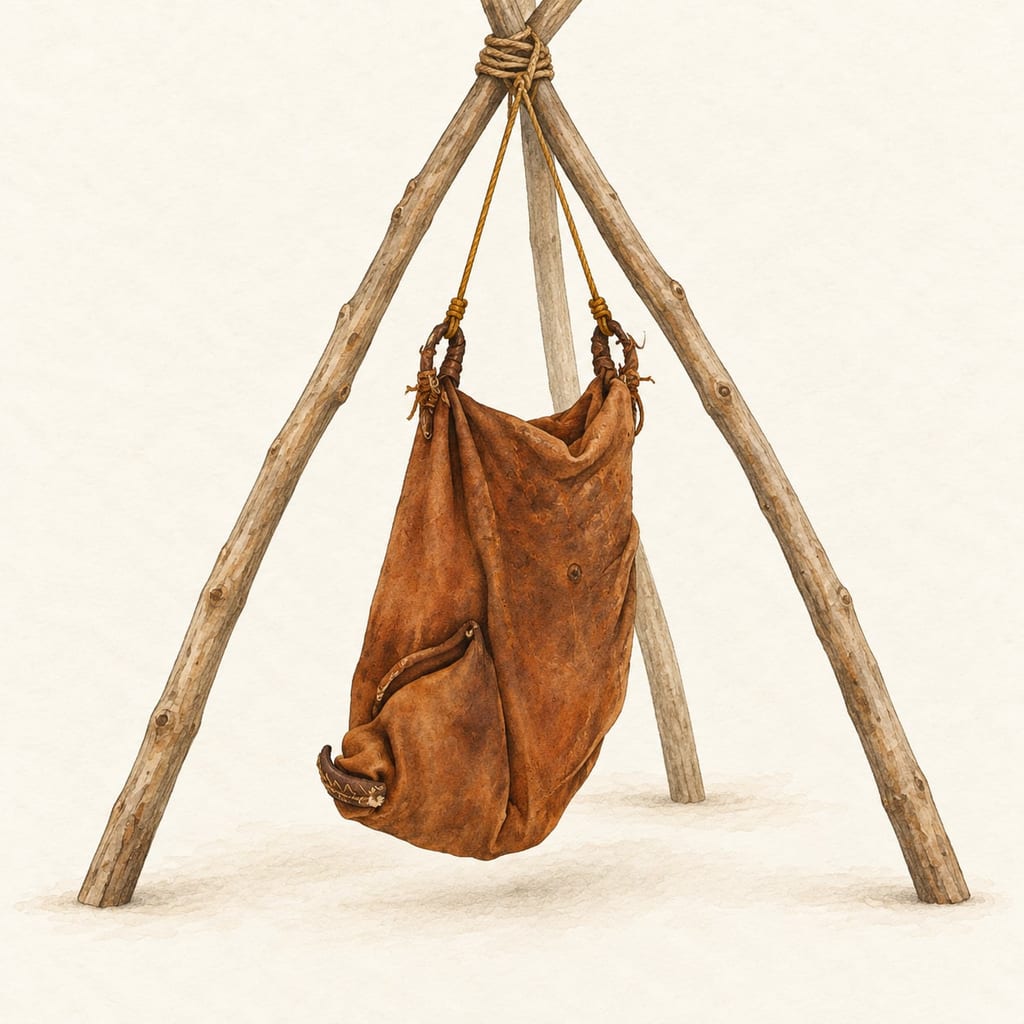
A flexible goat-skin bag from Dhofar hangs by a long cord and is rocked to churn milk or buttermilk. The British Museum records one 1970s specimen; churning is mechanical separation, not proof that the milk fermented.

An irregular goat-skin churn hangs by its cord from a plain tripod, illustrated on warm ivory paper.

A bag designed to swing

The British Museum’s As1985,18.4 is a brown goat-skin bag made in Dhofar in the 1970s. The bottom is closed with a thick stitched and embroidered leather strip. At the open top, a plaited leather handle and long waxed cord provide the points for suspending the flexible body. The museum says it could hang from a tripod or tree branch, with enough room to rock back and forth. This is a particular collected object, not a standard pattern for every skin churn.

Its measured bag body is 58 cm long and 20.5 cm wide; the full length with cord is 87 cm. The museum gives a weight of 240 g. It records no capacity, and these measurements do not establish how much milk a reader could safely load into another bag.

Sources for this section

Churning is a separate operation

The museum identifies the bag as a churn for milk or buttermilk, used to make laban, and also records storage or transport of water and camel or goat milk. In its churn use, the suspended skin bag is rocked repeatedly. That movement agitates the contents and separates milk solids; it is a mechanical operation. The record does not show that fermentation occurred in every use, so the churn should not be described as a fermenter merely because some of its contents may be fermented milk.

A qirbah is also named as a water or milk bag in the museum record, while sqa is used for the churning bag. The object's role depends on how it is used, not on the outline of the soft skin body alone.

Sources for this section

One recorded Dhofar specimen

The British Museum attributes the bag to Bedouin makers and records it as made at Tawi Ateer, Jabal Qara, in Dhofar, Oman. Its production date is given as the 1970s, and the donor’s tag records collection in 1978. These details locate and date this specimen; they do not establish where the broader churn tradition began or how far it extended.

The museum lists goat leather, goat skin and wool among its materials. Its object description identifies the stitched closure, plaited handle and waxed cord, but does not say which part contains wool or what fibre makes the cord. The page likewise gives no cleaning, drying or storage procedure and no present-day route for obtaining a comparable churn.

Sources for this section

Equipment details

CapacityThe British Museum record gives no capacity.
SizeThe bag body is 58 cm long and 20.5 cm wide; overall length including the suspension cord is 87 cm. The source does not describe these as height or diameter.
PowerNot established The museum describes the suspended bag being rocked back and forth but does not identify the operator or energy source.
How you get oneNot established The museum records a specific Bedouin-made specimen collected in 1978; it does not establish current makers or an acquisition route for a reader.
CareThe British Museum record does not describe cleaning, preparation, drying or storage care for the skin bag.

Made of

  • Goat skin — Flexible bag body
    The British Museum identifies the bag as goat-skin.
  • Leather — Closure and handle
    A thick stitched and embroidered leather strip closes the bottom; a plaited leather handle is attached at the open top.
  • Waxed cord — Suspension
    A long waxed cord suspends the bag; the museum record does not specify its fibre.
  • Wool — Material recorded for the specimen
    The British Museum lists wool among the materials but does not specify its exact component.

Limits

The source documents a churn as well as water and milk storage or transport, but a bag's shape alone does not identify which use it had.

Source →

Churning is mechanical agitation and separation; this museum record does not establish that every milk use included fermentation.

Source →

Places

Tawi Ateer, Jabal Qara

Manufacture · Locality evidence

The British Museum records this specimen as made and collected here; this does not establish a single origin or the full distribution of qirbah or sqa churns.

Related

Community

No community contributions have been published for this entry yet.

Share what you made

Sign in to contribute. Published comments and photos are free to read.

Sources