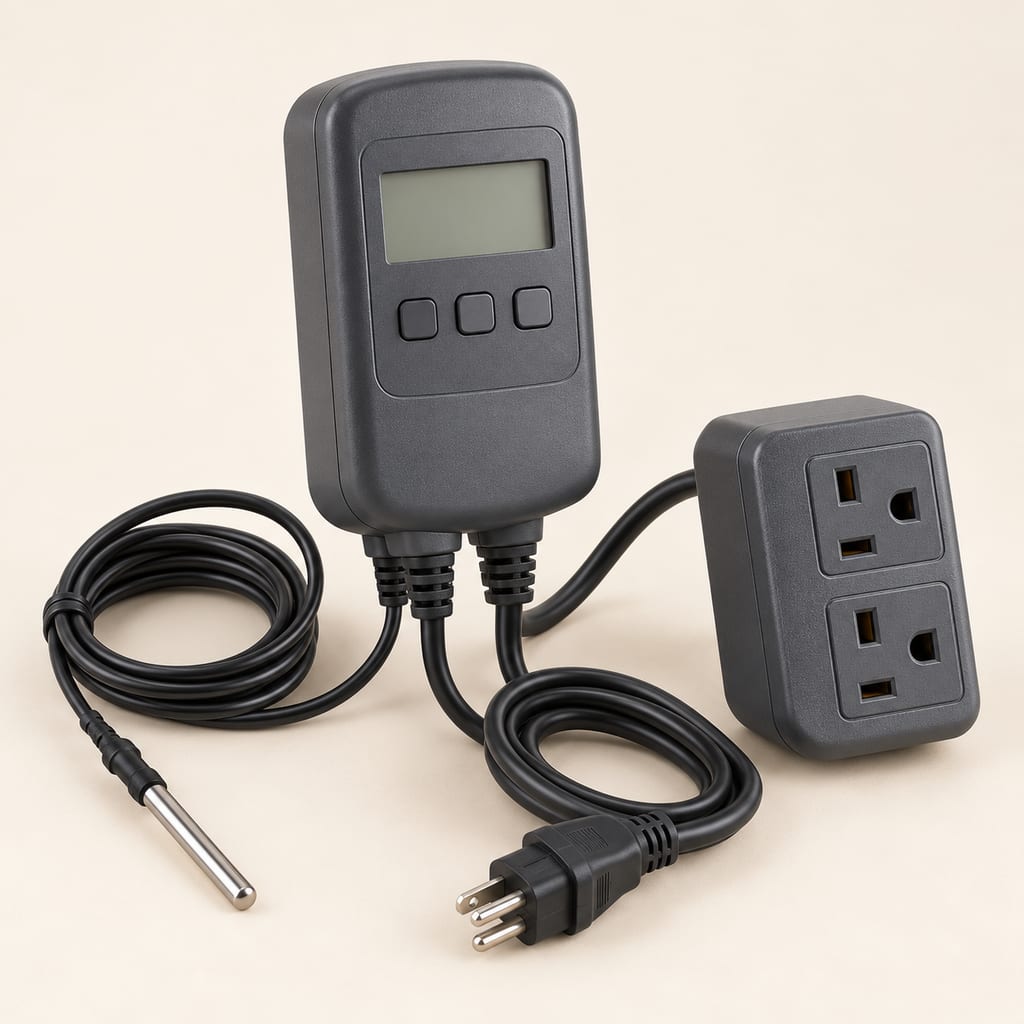
Plug-in temperature controller
A plug-in controller reads a wired probe and switches compatible heating or cooling appliances around a setpoint. It adds feedback; it is not itself a heater, cooler or validated food process.
 FermenteaWhere food goes to change
Equipment · Instruments
A thermowell is a passive protective sleeve that holds a separate removable temperature sensor in a tank or pipe. It neither senses temperature nor controls a heater.
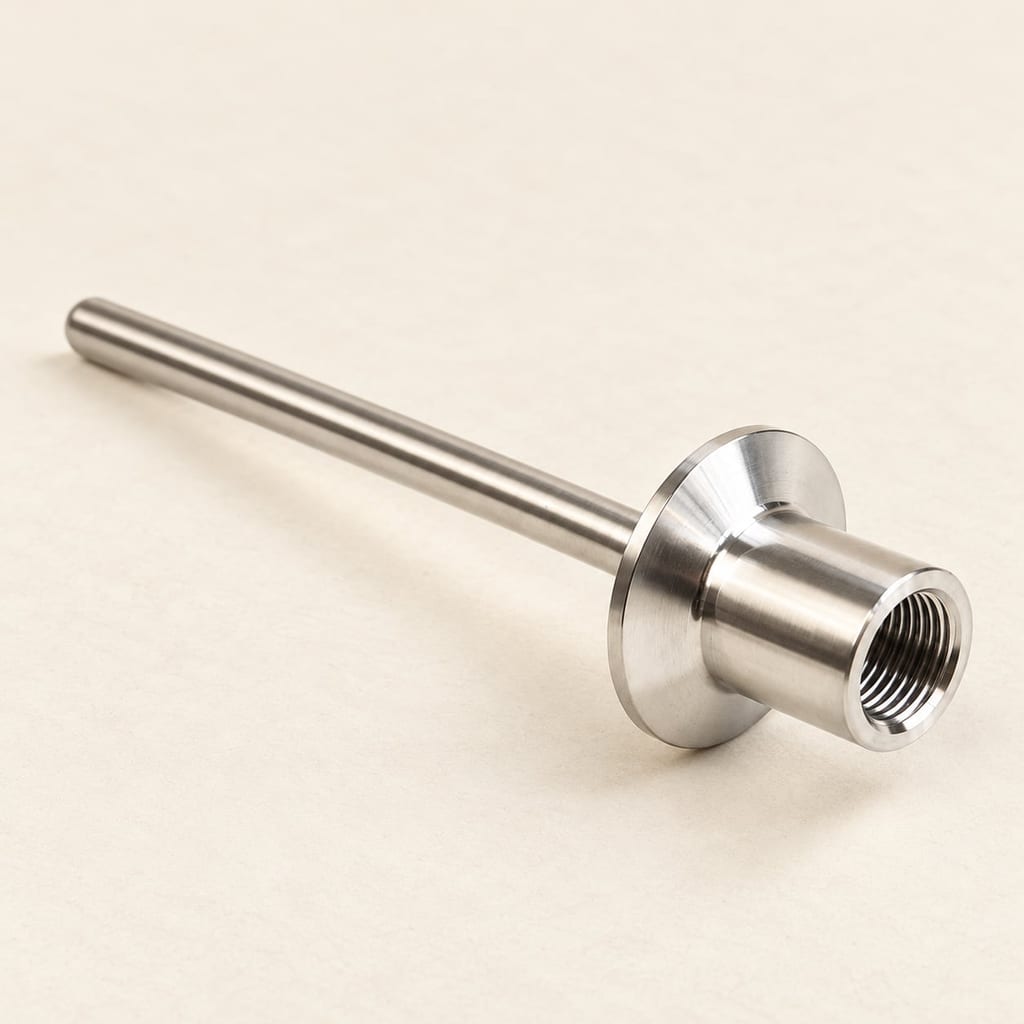
A thermowell is a closed-ended sleeve fitted through a tank or pipe so that a separate temperature-sensing insert can be placed in the process. The outer surface is exposed to the contents; the sensor sits inside the well and can often be removed without opening the vessel or stopping the process. In Endress+Hauser’s instrumentation terminology, the well is the process-wetted protection component, while the insert carries the sensor. Some fermentation suppliers use the same arrangement for a temperature probe in a tank.
That distinction matters in a homebrew setup. A thermowell does not sense temperature, display a value or switch a heater. A probe or thermometer does the sensing; a controller, when present, reads the probe and switches compatible heating or cooling equipment. Calling the sleeve a probe or controller would collapse three different parts into one. The Fermentea kombucha equipment notes similarly treat a food-compatible probe or thermowell as alternatives for putting a measurement point in the liquid, and distinguish both from a temperature controller.
The practical aim is to position the sensor where its reading represents the liquid rather than only the room, vessel wall or nearby heater. A thermowell provides a sealed barrier between a compatible sensor and the fermenting contents. It can make a probe removable for service while the well remains installed. Whether that arrangement gives a useful process reading depends on the well's immersion length, where it sits, the sensor's fit and the vessel's temperature gradients. A single sensing point does not establish that every part of a large or uneven batch is at the same temperature.
A well is a passive fitting, not a guarantee of a particular response time, accuracy or fermentation result. It may be used in a system with a wired temperature controller, but that does not make every well compatible with every probe: check the internal bore, probe diameter, process connection and intended installation. A wall-mounted external probe is a different arrangement and should be compared against a suitable liquid measurement before it is treated as representative. A controller can regulate only from the signal it receives; it cannot infer the core temperature from an unrelated point.
Thermowells are manufactured in several forms. Endress+Hauser lists welded, barstock and forged industrial examples, while brewing suppliers offer narrow stainless sleeves with threaded or sanitary clamp fittings. Some are welded or threaded into a port; others attach through a tri-clamp. A closed tip protects the probe from direct contact, and the open connection at the other end admits a removable sensor. This page describes the function and a few documented modern examples, not one standardized design.
The fitting and sensor must match. Pureweld lists one brewery example with 1-inch or 1.5-inch tri-clamp connections, a 7 mm bore, 10 mm outside diameter and 150 mm submerged length. Ss Brewtech lists 6.5 mm internal diameter and multiple length options for its own weldless product. LiquoSystems lists a separate 316L model at 8 mm internal diameter, 10 mm outside diameter and 237 mm overall length. These are not interchangeable universal specifications. Confirm the well's depth reaches the intended measurement point and that the probe, process port and seal are compatible.
Examples in the current brewing catalogues use 304 stainless steel; a LiquoSystems product uses 1.4404/AISI 316L. Those grades belong to the cited products, not to every thermowell. Industrial designs also vary in wall construction, connection, insertion length and materials. A food or beverage installation needs a product appropriate to its actual contact, cleaning and process conditions; a catalogue description of one hygienic fitting does not certify a different model.
Pressure, temperature and flow affect mechanical suitability. Endress+Hauser says its selection process includes sizing calculations for structural integrity under the intended conditions. Its product portfolio spans different applications and ratings, so a pressure or temperature figure from one model must not be transferred to another. Do not improvise a vessel opening or assume a sensor sleeve is pressure-rated because it is stainless steel. Follow the maker's installation and cleaning instructions for the exact body, connection, seals and sensor; no single cleaning or service procedure applies to the whole class.
The sources establish contemporary manufactured thermowells used in industrial measurement and fermentation equipment, but they do not establish when the general device was first invented or a traditional geographic origin. The reviewed product examples are marketed by suppliers in the United Kingdom, Germany and the United States, showing current international availability. Supplier addresses and catalogue markets do not prove where every well is made or used. The history and origin of the class therefore remain unspecified.
Current product listings from instrumentation and fermentation suppliers document modern thermowells with different materials, connections and dimensions. Those examples do not establish a first inventor, date or traditional region.
A thermowell is passive and does not measure, display or regulate temperature. A separate compatible sensor and, if needed, controller are required.
Source →Pressure, temperature, flow, immersion length, material and process connection affect structural suitability; use the rating and sizing guidance for the exact model rather than transferring another product's rating.
Source →Bore and sensor dimensions are model-specific; listed 6.5 mm, 7 mm and 8 mm bores are examples, not class-wide compatibility.
Source →The consulted pages establish current industrial and fermentation products and markets, but not a historical origin, traditional region, or class-wide manufacturing location.
A plug-in controller reads a wired probe and switches compatible heating or cooling appliances around a setpoint. It adds feedback; it is not itself a heater, cooler or validated food process.

Soft, spreadable Calabrian pork sausage made with a great deal of red chilli and fatty pork, stuffed into natural casings, sometimes smoked and matured while staying soft.

A way to add independent temperature logging to an existing food dehydrator without changing its built-in controls or protections. It is a monitoring method, not a rewiring plan.

Pleurotus cystidiosus is the abalone mushroom, a cultivated oyster-type fungus with dark brown caps that grows more slowly and is more demanding than other Pleurotus species.

A dark, balanced vinegar from Emilia-Romagna made by combining cooked or concentrated grape must with wine vinegar, then acetifying and refining it in wood under a protected specification.

A living dairy inoculum that starts controlled cream fermentation, developing acidity and aroma before sour cream or cultured butter is finished.

A small electric incubator holds jars at a selected temperature for yogurt and other documented warm food preparations. Controls, capacity and vessel arrangement vary by model.

Adygean salt is a seasoned table salt associated with Adygea and the wider North Caucasian culinary tradition. Salt is blended with garlic and a variable selection of herbs and spices; the exact mix depends on the named style and maker.

The African Caesar-group mushroom, Amanita masasiensis, is a wild ectomycorrhizal species of central and southern African woodlands, eaten locally. The genus contains deadly poisonous species, so identification needs care.
No community contributions have been published for this entry yet.
Sign in to contribute. Published comments and photos are free to read.
Endress+HauserDefinition · Function · Design selection · Industrial context
Thermowells for Temperature SensorsEndress+Hauser defines the thermowell as the process-wetted component that protects a temperature-sensor insert from corrosive media, pressure and flow, and permits insert replacement without stopping the process.
The company lists welded, barstock and forged constructions and several process connections; selection depends on application, standards, dimensions and process conditions.
The manufacturer describes sizing calculations for structural integrity and suitability under intended conditions.
Cited in: A protective sleeve, not a thermometer; Temperature measurement in a fermenter; Forms, connections and dimensions vary; Materials and process limits; History and geographic scope
Pureweld Stainless LtdFermentation use · Model example · Materials · Dimensions
ThermowellPureweld lists a hygienic thermowell for temperature probes in tanks and process pipework, with 1-inch or 1.5-inch tri-clamp options and a 1/2-inch BSP outer connection.
Its listed example is 304 stainless steel; the page gives 150 mm submerged length, 10 mm outside diameter and 7 mm inside diameter.
The maker markets this particular product for brewing, dairy, distilling and food and beverage uses; these are product-specific claims.
Cited in: A protective sleeve, not a thermometer; Temperature measurement in a fermenter; Forms, connections and dimensions vary; Materials and process limits; History and geographic scope
Ss BrewtechModel variants · Materials · Fit
Thermowell | Weldless (Threaded)Ss Brewtech lists 304 stainless steel thermowells with a 6.5 mm internal diameter, designed for installation into 17 mm holes.
Its product page offers length variants of 55, 100, 200 and 300 mm plus an angled form, and notes compatibility with its LCD thermometers.
These specifications describe Ss Brewtech's product family and are not universal thermowell dimensions or sensor compatibility.
Cited in: Forms, connections and dimensions vary; History and geographic scope
LiquoSystems GmbHFermentation use · Model example · Materials · Dimensions
Thermowell: For installation in the tankLiquoSystems lists a tank thermowell for temperature sensors and fermentation control, supplied with a stainless mounting kit and sensor clamp fitting.
That product example uses 1.4404/AISI 316L stainless steel and lists an 8 mm inside diameter, 10 mm outside diameter and 237 mm overall length for tanks with a 21 mm bore / 1/2-inch connection.
These figures are for the named product and do not establish class-wide dimensions.
Cited in: Temperature measurement in a fermenter; Forms, connections and dimensions vary; Materials and process limits; History and geographic scope