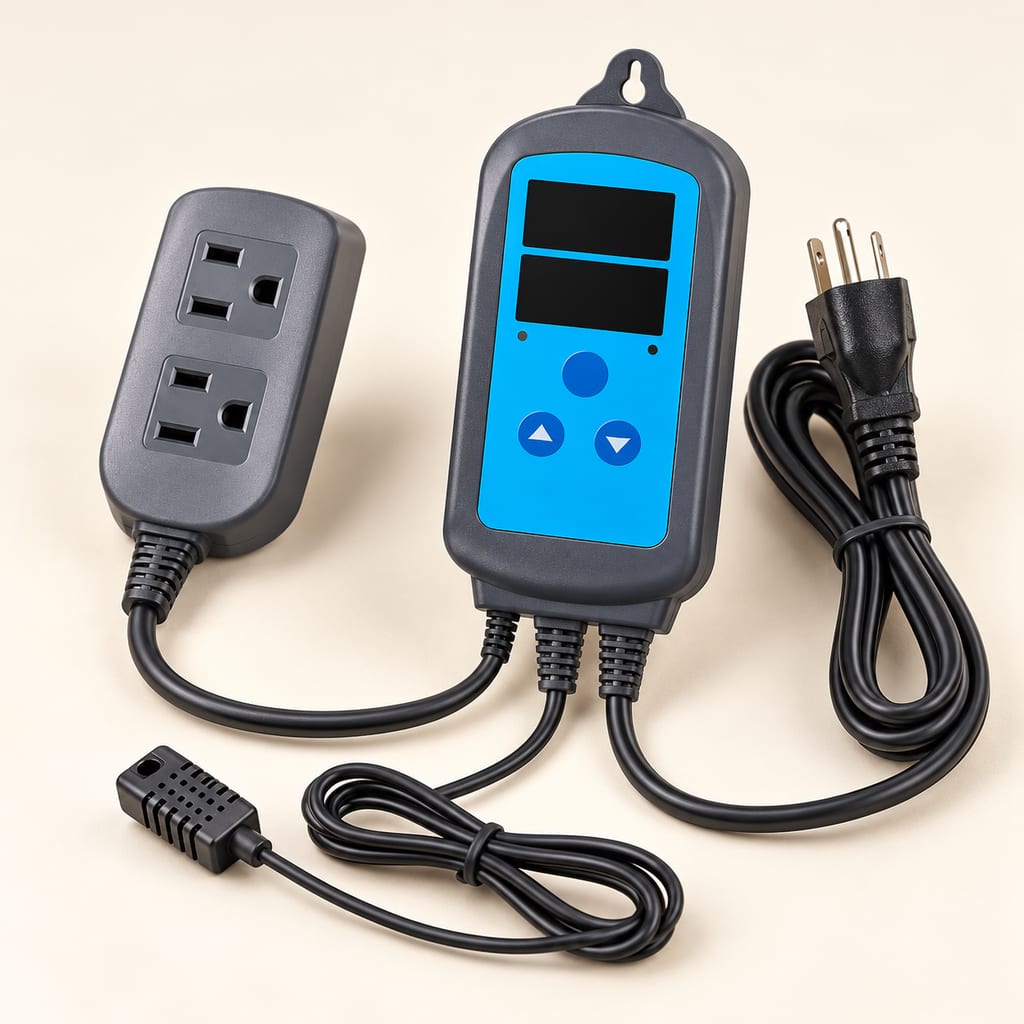
INKBIRD IHC-200
A plug-in humidity controller that reads a cabled sensor and switches separate humidifying and dehumidifying loads. It controls relative humidity, not temperature, and is distinct from the ITC-308 temperature controller.
 FermenteaWhere food goes to change
Equipment · Instruments
A thermo-hygrometer measures air temperature and relative humidity. It observes local conditions but does not control humidity or directly measure a food’s water activity.
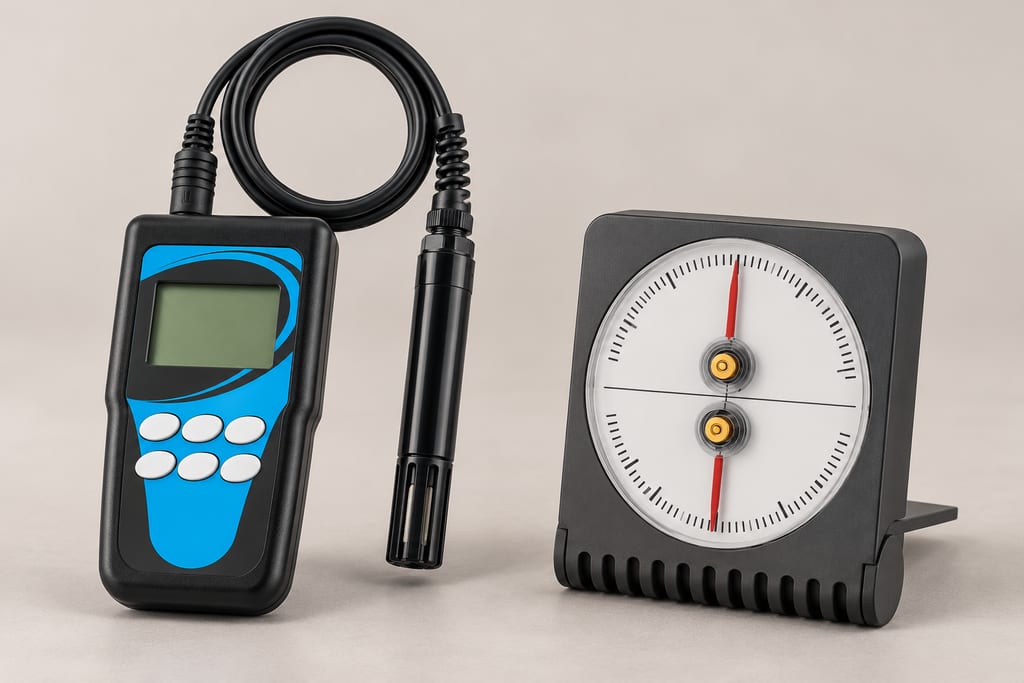
A thermo-hygrometer combines measurement of air temperature with relative humidity (RH). Some related hygrometers measure humidity alone, while chilled-mirror instruments infer moisture from dew or frost point. The instrument reports conditions at its sensing element, not a room-wide average. A display may show current readings, retain minimum and maximum values, log a time series, or send a signal elsewhere; those features depend on the model.
This is measurement equipment, not a humidity controller. A meter observes conditions but does not switch a humidifier or dehumidifier. A controller can use a humidity sensor to switch equipment. A separate meter can monitor conditions alongside a controller, but the devices are not interchangeable and their sensors need not agree exactly.
The class includes compact mechanical dial instruments, handheld electronic meters, wired probes, fixed wall or duct transmitters, and recorders that store readings. A TFA analogue model has a circular dual-scale face and folding cover stand and needs no battery. COMET's D3121 is a different example: a powered digital data logger with an LCD, memory and an external temperature-and-humidity probe. Its one-metre lead, recording functions, accuracy, range and protection ratings describe that model only.
Sensor principles and readouts vary. A capacitive RH sensor is common in electronic instruments; chilled-mirror hygrometers determine dew or frost point and include temperature measurement. NIST's calibration service treats relative-humidity sensors and chilled-mirror instruments as distinct types. For that reason there is no single housing, sensor placement, power source, accuracy or calibration interval that describes all thermo-hygrometers.
A sensor measures its local air. A warm wall, nearby heater, direct sunlight, humidifier outlet or stagnant pocket can make that local condition unrepresentative of the space a user wants to understand. Rotronic's HC1 instructions give one model-specific example: its sensing end faces downward for wall mounting, while duct mounting places the filter perpendicular to airflow. The maker also calls for an access opening for checking and calibration. These details are not universal instructions for other probes.
Calibration compares an instrument with known humidity conditions. NIST's humidity generator supplies air of accurately known moisture content to a controlled test chamber and supports several instrument classes and humidity definitions. A calibration statement belongs to the particular instrument and service, with its own range and uncertainty. A generic consumer display or a button labelled calibration does not by itself establish traceability or prove that readings remain accurate after handling, contamination or aging.
In fermentation, drying and storage, air temperature and humidity can help describe the environment around a batch. A meter placed in a cabinet or room can reveal trends and short-term excursions; a logger can show when they happened. It does not control the room, measure the temperature inside a food, or show how much water remains in a product. Conditions can differ between the sensor, a wall, the product surface and the batch centre.
Water activity (aw) is a property of food related to the vapour pressure of its water. The FDA describes measuring it through a sealed sample headspace allowed to reach equilibrium at controlled temperature; in that specific equilibrium, aw equals the headspace equilibrium RH divided by 100. Ordinary room RH is not a substitute for that sample test. Use a method appropriate to the food and process whenever a water-activity result matters.
Choose by the quantity to be measured, required range and accuracy, whether the sensor must sit outside the display, whether readings need to be recorded, and the environment in which the sensor will operate. A simple mechanical dial needs no battery but offers no electronic record. A logger can retain readings but brings model-specific limits for battery life, probe exposure, alarms, memory and data export. Fixed transmitters may suit ducts or cabinets, but their installation rules belong to the selected model.
Keep the sensor clear of condensation, direct water or steam unless the manufacturer specifies that exposure is suitable. Avoid positioning it where the device's own heat or a nearby surface changes the measurement. Follow the particular manual for cleaning, protection, recalibration and storage. The cited sources and product examples do not establish a universal cleaning method, accuracy guarantee or maintenance schedule for every humidity instrument.
NIST currently calibrates multiple humidity-measuring instrument types, and current manufacturers offer digital, analogue and fixed-probe models. The sources inspected do not establish one invention date or origin for this broad class.
Relative humidity in room air is not by itself a measurement of a food's water activity; the FDA describes an equilibrium sample/headspace method under controlled temperature.
Hazard sourceFor a food water-activity result, use a suitable instrument and sample method with equilibrium and temperature controlled; do not substitute a room hygrometer reading.
Control sourceThis instrument class measures conditions; it does not humidify, dehumidify or validate a fermentation or drying process.
An ambient RH reading is not a direct measurement of water activity. The FDA's relationship applies to equilibrium relative humidity of a food sample's headspace under controlled temperature, not to any room reading.
Source →Accuracy, range, response time, logging and environmental protection are model-specific; the COMET D3121 data must not be generalized to other instruments.
Source →Probe orientation and placement depend on the model and installation. Rotronic's HC1 instructions should not be applied to every handheld or fixed hygrometer.
Source →Calibration is a comparison against known humidity conditions; a display reading alone does not demonstrate calibration or traceability.
Source →Documented for international use, with no single place of origin assigned.
A plug-in humidity controller that reads a cabled sensor and switches separate humidifying and dehumidifying loads. It controls relative humidity, not temperature, and is distinct from the ITC-308 temperature controller.

Soft, spreadable Calabrian pork sausage made with a great deal of red chilli and fatty pork, stuffed into natural casings, sometimes smoked and matured while staying soft.

A way to add independent temperature logging to an existing food dehydrator without changing its built-in controls or protections. It is a monitoring method, not a rewiring plan.

Pleurotus cystidiosus is the abalone mushroom, a cultivated oyster-type fungus with dark brown caps that grows more slowly and is more demanding than other Pleurotus species.

A dark, balanced vinegar from Emilia-Romagna made by combining cooked or concentrated grape must with wine vinegar, then acetifying and refining it in wood under a protected specification.

A living dairy inoculum that starts controlled cream fermentation, developing acidity and aroma before sour cream or cultured butter is finished.

A small electric incubator holds jars at a selected temperature for yogurt and other documented warm food preparations. Controls, capacity and vessel arrangement vary by model.

Adygean salt is a seasoned table salt associated with Adygea and the wider North Caucasian culinary tradition. Salt is blended with garlic and a variable selection of herbs and spices; the exact mix depends on the named style and maker.

The African Caesar-group mushroom, Amanita masasiensis, is a wild ectomycorrhizal species of central and southern African woodlands, eaten locally. The genus contains deadly poisonous species, so identification needs care.
No community contributions have been published for this entry yet.
Sign in to contribute. Published comments and photos are free to read.
National Institute of Standards and TechnologyMeasurement · Calibration
HygrometersNIST calibrates relative-humidity sensors and chilled-mirror hygrometers by exposing instruments to air with accurately known moisture content in a controlled chamber.
The page recognizes relative-humidity sensors, thermohygrometers, chilled-mirror and cavity ring-down hygrometers as distinct instrument types.
Calibration ranges and uncertainties belong to the NIST service, not to consumer instrument specifications.
Cited in: What a thermo-hygrometer measures; One name, several instrument forms; Placement and calibration shape the reading; Humidity monitoring around food
RotronicPlacement · Installation · Limits
HC1 Mechanical InstallationRotronic's HC1 instructions show wall and duct mounting for that specific sensor.
For wall mounting, the maker says to face the sensing element downward to reduce heat propagation from the transmitter.
For a duct installation, the filter end meets the measured airflow perpendicularly; the instructions recommend a nearby opening for checking and calibration.
The instructions are model-specific and warn about condensation and local heat effects; they are not universal installation directions for all hygrometers.
Cited in: Placement and calibration shape the reading; Choosing and caring for an instrument
U.S. Food and Drug AdministrationFood measurement · Limits · Interpretation
Water Activity (aw) in FoodsThe FDA defines water activity from the food's vapour pressure relative to pure water at the same temperature.
Under the described equilibrium method, water activity equals equilibrium relative humidity divided by 100; the sample is held in a tight enclosure and temperature must be controlled.
The FDA lists several humidity measurement instrument types and distinguishes an ambient reading from a sample-based water-activity determination.
Cited in: Humidity monitoring around food
COMET SYSTEM, s.r.o.Model example · Measurement · Logging · Specifications
Thermo-hygrometer with external probe (D3121)COMET describes the D3121 as a temperature and relative-humidity data logger with an external combined probe, LCD, alarms, minimum/maximum memory and optional dew-point display.
The manufacturer lists a one-metre probe cable, 9 V battery power, internal memory and model-specific measurement ranges, accuracy and IP ratings.
The page represents one digital logging model, not specifications common to every thermohygrometer.
Cited in: What a thermo-hygrometer measures; One name, several instrument forms; Choosing and caring for an instrument
TFA DostmannModel example · Analogue form · Power
Analogue thermo-hygrometer 45.2018TFA documents a compact mechanical analogue thermo-hygrometer with a foldaway cover/stand and no battery requirement.
This is one maker's model and does not establish that all analog hygrometers share its dimensions, calibration or construction.
Cited in: One name, several instrument forms; Choosing and caring for an instrument