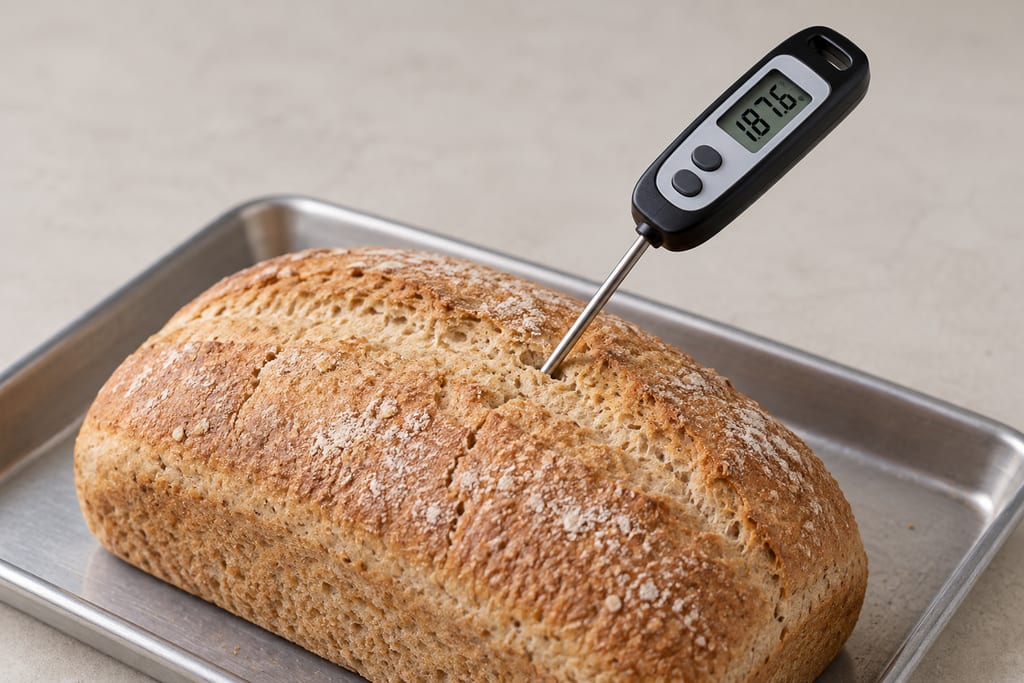
Food probe thermometer
A probe thermometer measures the temperature of food at its sensing tip. It answers a different question from a kettle, oven or water-bath display, and from a pH meter.
 FermenteaWhere food goes to change
Equipment · Instruments
A water-bath thermometer reports the temperature of the surrounding bath, so an operator can monitor the heating medium. It does not by itself show the temperature at the centre of a thick food or paste.
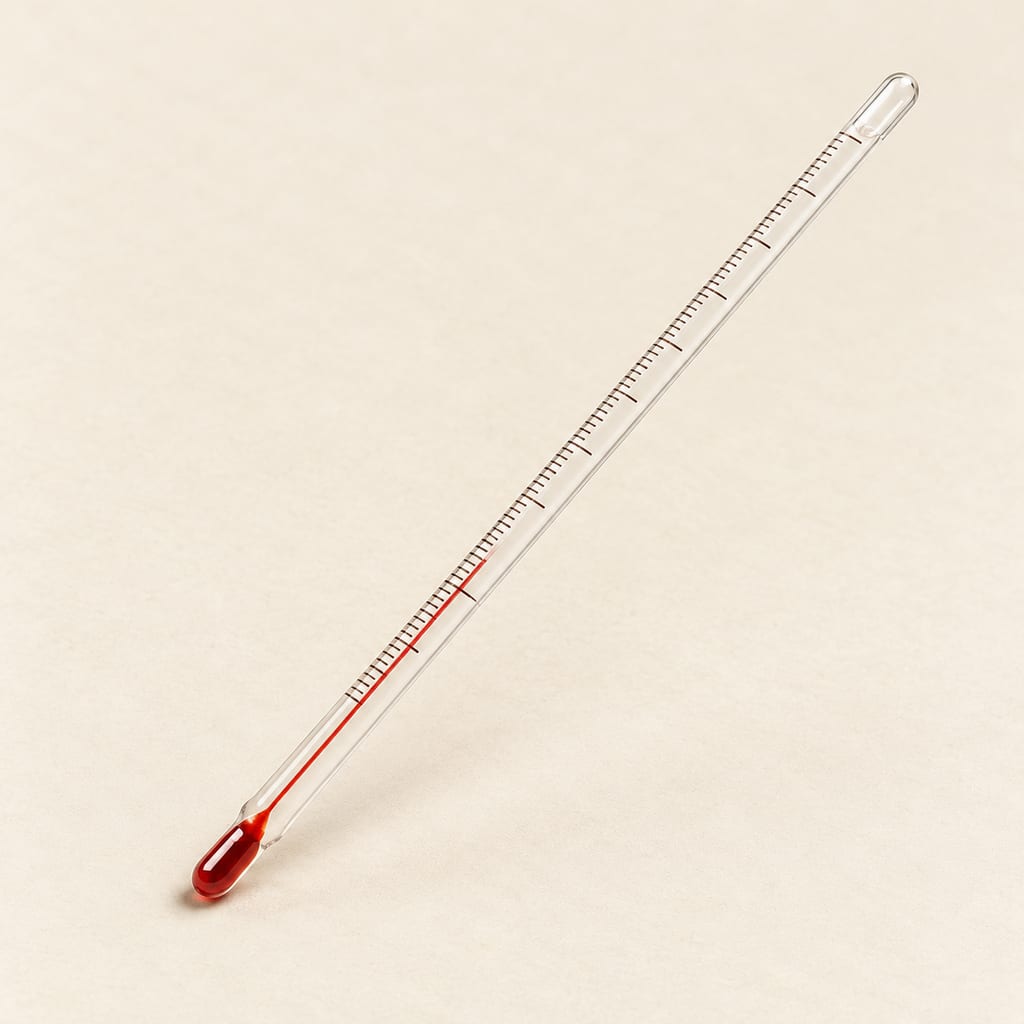
A water-bath thermometer reports the bath, not the food inside it. A bath reading does not reveal the centre temperature of a thick paste, and a momentary surface reading does not show that the whole heat process is complete.
This is why a bath thermometer and a food probe are different instruments. Food Standards Australia New Zealand notes that thermometers fitted to food-service equipment such as bain-marie units show the unit's operating temperature; a separate probe is needed to measure the actual food. USDA guidance likewise directs the reader to place a food thermometer at the location that matters, generally the thickest part. Those principles describe different measurement targets, not interchangeable ways of saying that the same temperature was reached.
One common form is a separate liquid-in-glass thermometer: a narrow sealed tube with a bulb, a visible liquid column and a graduated scale. Current Thermo Scientific listings sell glass accessories for named Precision water baths. One example is 165 mm long for particular models; another is 305 mm for other baths. The listing specifies spirit fill, 1°C increments and monitoring use. These details describe those accessories, not every water-bath thermometer.
A different supplier example is a six-inch red-liquid total-immersion thermometer. Its listing gives a -20°C to 110°C range and explains that the intended temperature mark must be immersed to the liquid-column meniscus. The same catalogue also distinguishes total-immersion thermometers from partial-immersion designs, whose reference line sets a different immersion depth. A glass instrument therefore needs to be read and positioned according to its own instructions rather than by copying another thermometer's setup.
Some bath systems include a fixed display or an integral sensor instead of a separate glass accessory. In either arrangement, the reader should identify what is being measured: bath temperature, a vessel's heating surface, or the food itself. The device label and display alone do not make those values equivalent.
Immersion is part of the measurement. The thermometer must be used at the depth for which its scale is intended; on the cited total-immersion example, the relevant scale mark is placed below the bath surface until the meniscus aligns with the target. A partial-immersion thermometer instead uses its own depth marker. The manufacturers' examples span different lengths, scales and immersion modes, so a stated range or 1°C division is not a guarantee of the same accuracy for every instrument.
A bath can be monitored while a separate probe checks food or paste. For a thick mixture, the bath and the centre can warm at different rates; reading one does not certify the other. If a method specifies an internal measurement, use a clean, suitable probe at the location the method names. Follow the method's time and temperature requirements for the food as a whole. A thermometer cannot convert a bath reading, an appliance setting or a brief surface check into a validated pasteurisation process.
For food-business probes, FSANZ gives Australian requirements and practical guidance for accuracy, cleaning, sanitising and regular calibration. Those rules apply to its stated food-business context and food-contact probes; they should not be copied as a universal specification for every glass bath thermometer. For any instrument, follow its maker's instructions for immersion, reading, calibration, cleaning and safe storage.
The reviewed material documents contemporary manufactured glass thermometers marketed for laboratory water baths and general immersion instruments that can measure hot water. It does not establish when the first water-bath thermometer was made, where the form originated, or whether there was one standard design. Current supplier catalogues in Germany and the United States show present-day examples in more than one market; those listings are not evidence of a manufacturing origin or of universal use.
Current supplier catalogues describe separate glass thermometers made for named water-bath models and general immersion thermometers suitable for measuring a hot-water bath. They do not identify an inventor or earliest use.
A bath thermometer reports the bath at its measuring point; it does not establish the temperature at the centre of a thick paste. A momentary surface reading also does not establish the whole heat history.
Source →Food-service equipment thermometers, including those in bain-marie units, measure the unit's operating temperature. FSANZ says food businesses still need a separate probe thermometer to measure the actual food.
Source →Immersion depth matters for a liquid-in-glass instrument. The cited full-immersion product instructions say to immerse deeply enough for the target reading to align with the meniscus; do not assume one depth rule applies to every design.
Source →Current supplier locations and product markets do not establish the water-bath thermometer's historical origin or manufacturing location.
A probe thermometer measures the temperature of food at its sensing tip. It answers a different question from a kettle, oven or water-bath display, and from a pH meter.

Soft, spreadable Calabrian pork sausage made with a great deal of red chilli and fatty pork, stuffed into natural casings, sometimes smoked and matured while staying soft.

A way to add independent temperature logging to an existing food dehydrator without changing its built-in controls or protections. It is a monitoring method, not a rewiring plan.

Pleurotus cystidiosus is the abalone mushroom, a cultivated oyster-type fungus with dark brown caps that grows more slowly and is more demanding than other Pleurotus species.

A dark, balanced vinegar from Emilia-Romagna made by combining cooked or concentrated grape must with wine vinegar, then acetifying and refining it in wood under a protected specification.

A living dairy inoculum that starts controlled cream fermentation, developing acidity and aroma before sour cream or cultured butter is finished.

A small electric incubator holds jars at a selected temperature for yogurt and other documented warm food preparations. Controls, capacity and vessel arrangement vary by model.

Adygean salt is a seasoned table salt associated with Adygea and the wider North Caucasian culinary tradition. Salt is blended with garlic and a variable selection of herbs and spices; the exact mix depends on the named style and maker.

The African Caesar-group mushroom, Amanita masasiensis, is a wild ectomycorrhizal species of central and southern African woodlands, eaten locally. The genus contains deadly poisonous species, so identification needs care.
No community contributions have been published for this entry yet.
Sign in to contribute. Published comments and photos are free to read.
Thermo Scientific / Thermo Fisher ScientificWater bath specific example · Materials · Dimensions · Monitoring
Glass Thermometers for Precision™ Water BathsThermo Scientific specifies 165 mm and 305 mm glass thermometer options for different Precision water-bath models.
The product page describes a non-hazardous spirit fill and 1.0°C scale increments, and labels the thermometer for monitoring only.
These dimensions and specifications apply to the listed Thermo Scientific accessories, not the whole class.
Cited in: Glass instruments and other arrangements; History and geographic scope
Nova-Tech International, Inc. (United Scientific Supplies product listing)Immersion principle · Model example · Image reference
THPC06 Red-Liquid Total-Immersion ThermometerThe listing describes a United Scientific 6-inch total-immersion red-liquid thermometer with a -20°C to 110°C range.
Its instructions say a full-immersion thermometer must be submerged deeply enough for the target temperature to align with the meniscus; a hot-water bath example is given.
The listing explicitly says its pictures are representative and may differ from the product supplied, so its photo is a broad form reference rather than proof of exact model appearance.
Cited in: Glass instruments and other arrangements; Reading and using the instrument; History and geographic scope
United Scientific Supplies / Fisher ScientificInstrument variants · Materials · Immersion
United Scientific Education Products Catalog, 2023The catalogue lists red spirit-filled glass thermometers in total- and partial-immersion forms and describes the red liquid column as safer than mercury.
It explains that partial-immersion instruments use a reference line, while a full-immersion thermometer's target mark must be submerged.
The listed forms show why immersion instructions depend on the particular thermometer.
Cited in: Glass instruments and other arrangements
Food Standards Australia New ZealandBath versus food measurement · Food probe distinction · Calibration · Care
Thermometers and using them with potentially hazardous foodFSANZ says built-in thermometers on bain-marie and other food-service equipment measure the unit's operating temperature, not the actual temperature of the food; a separate probe thermometer is needed for food measurement.
For the Australian food-business context described on this page, the required probe is accurate to ±1°C and should be calibrated regularly according to maker instructions.
The page gives cleaning and sanitising guidance for food-contact probes; that does not apply to every bath-only instrument.
Cited in: The water around the food; Glass instruments and other arrangements; Reading and using the instrument
USDA Food Safety and Inspection ServiceFood core measurement
How to use a food thermometer?USDA advises placing a food thermometer in the proper location, generally the thickest part, to determine whether food has reached its target temperature throughout.
This food-measurement guidance helps distinguish a bath reading from an internal food reading; it does not itself validate a koji heat-treatment process.
Cited in: The water around the food; Reading and using the instrument