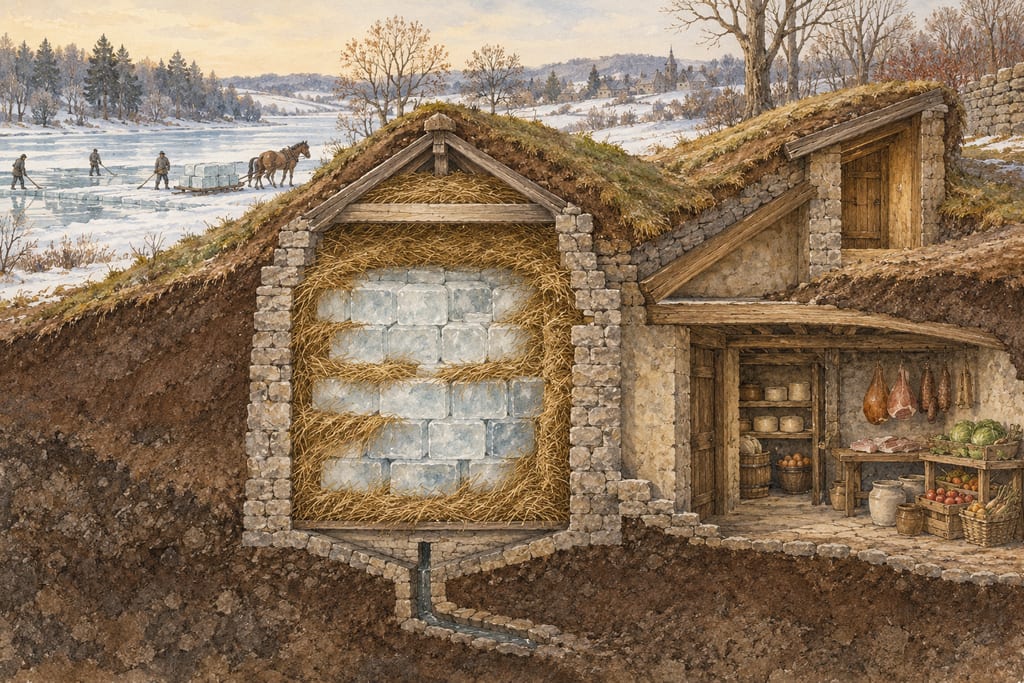
Icehouse
A structure in which winter ice or compacted snow is stored in insulation and drained, then drawn on later to cool food, separating the season of collecting cold from the season of using it.
 FermenteaWhere food goes to change
Built structures · Cold stores and coolers
A yakhchāl is an Iranian building or covered pit for storing ice harvested in winter for summer distribution. Its forms vary, and the sources do not show that it was a food cellar.
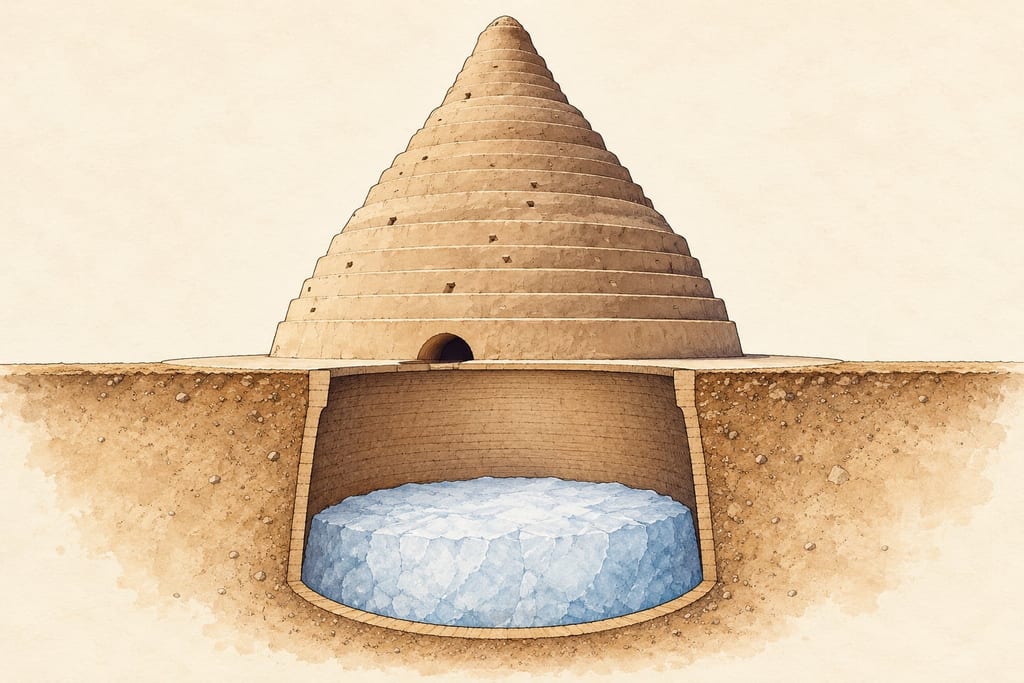
Yakhchāl (“ice pit”) and yakhdān (“ice container”) refer to Iranian facilities for holding solid ice, and sometimes compressed snow, collected in winter for local summer distribution. Encyclopaedia Iranica emphasizes that this was ice storage, not a room for keeping food cool. It was part of a vernacular response to hot, dry conditions on the Iranian plateau, with water supply and seasonal labor supporting the system.
The name should not be treated as evidence of one age or one architectural plan. Iranica discusses simple pits that may date back to the first millennium BCE, but says the record does not securely connect those pits to later domed icehouses. The separate eighteenth-century BCE icehouses mentioned at Mari were probably palace cellars and are not evidence that the Iranian yakhchāl existed in that form then.
One simple form has a pit was dug into the ground and covered with straw, rush and earth to protect the ice from sun and heat. Some pits acquired their own domes; other pits were located in cellars within larger buildings. Iranica also describes walled icehouses with open pits shielded on the south by tall walls, sometimes extending east and west. These are alternatives across sites, not parts that should automatically be combined into one reconstruction.
Many systems used shallow open-air basins to make ice during frosty winter weather. Iranica reports thin layers of water freezing overnight and says the buildings and operation relied on local raw materials, water and manual labor. This describes a broad practice, not instructions for building or operating an icehouse.
An ICOMOS evaluation for the Bam Citadel describes a large icehouse outside the fortified enclosure. A mud-brick dome covered a large tank. During winter, water froze in a broad shallow pool shaded by a long, high wall; workers moved the ice into the tank at dawn so it could be used in summer. This is a specific Bam account and should not be generalized to every yakhchāl.
The report places Bam in Kerman Province, on the southern edge of Iran’s high plateau. Its setting links the icehouse to the wider local system of water supply, including qanāts, but the report does not provide a measured yakhchāl plan or evidence that all sites depended on the same water source.
A 2017 photograph by Bockomet identifies the Aghazadeh icehouse in Yazd. It records a stepped mud-brick dome, small exterior openings and a low arched entrance. Those visible features support the above-ground form shown in the gallery; the photograph does not reveal the buried chamber or prove the structure’s original dimensions and operation.
The page’s cutaway illustration shows a dome above a below-ground ice pit because Iranica documents that relationship for some yakhchāl forms. It is explanatory rather than a reconstruction of the photographed Yazd interior. The sources consulted here do not establish a food-storage role, one universal design, exact capacity or an invention date.
Iranica reports simple pits possibly in use since the first millennium BCE, while warning that a secure archaeological or textual chain to domed forms is absent. Its separate account of eighteenth-century BCE Mari palace cellars is an earlier icehouse reference in Mesopotamia, not proof of a yakhchāl in Iran at that date. The cited Bam icehouse is a specific historical example; the Yazd photograph is a modern photograph of a surviving building.
Iranian vernacular ice storage; no single design is implied.
The source photograph identifies the photographed Aghazadeh icehouse in Yazd.
ICOMOS describes this one icehouse and its adjacent shaded freezing pool.
A structure in which winter ice or compacted snow is stored in insulation and drained, then drawn on later to cool food, separating the season of collecting cold from the season of using it.
George Washington’s Mount Vernon ice house stored winter-cut Potomac ice in a hillside dry well for use in warmer months. The official description and 1798 estate inventory give distinct details of its form.
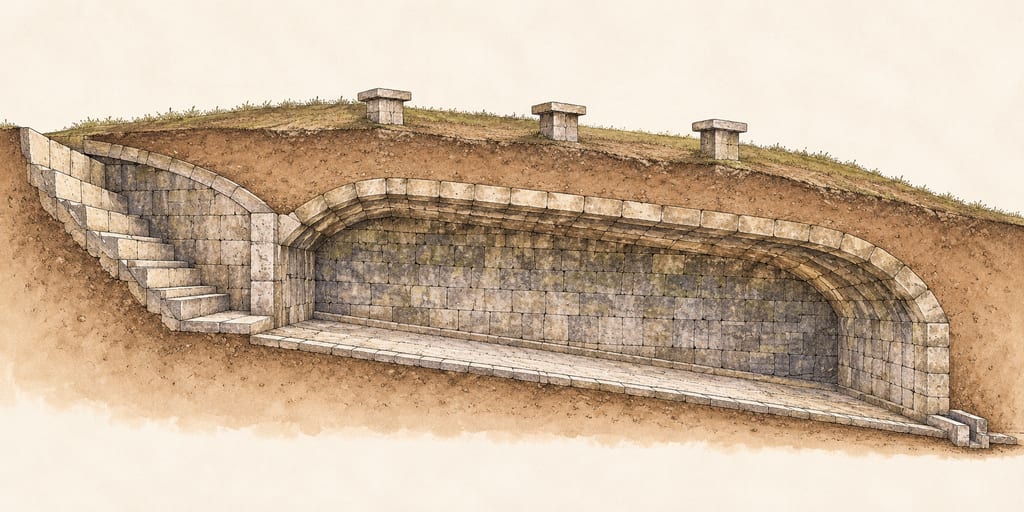
Gyeongju Seokbinggo is a Joseon-era semi-subterranean stone ice store at Wolseong in Gyeongju, Korea. The surviving stone structure dates to 1738 and was moved to its present site four years later.
Bojkhāne names a rice-smoking room in some Gilan accounts. It was part of a flexible household room tradition, not a single standardized plan.
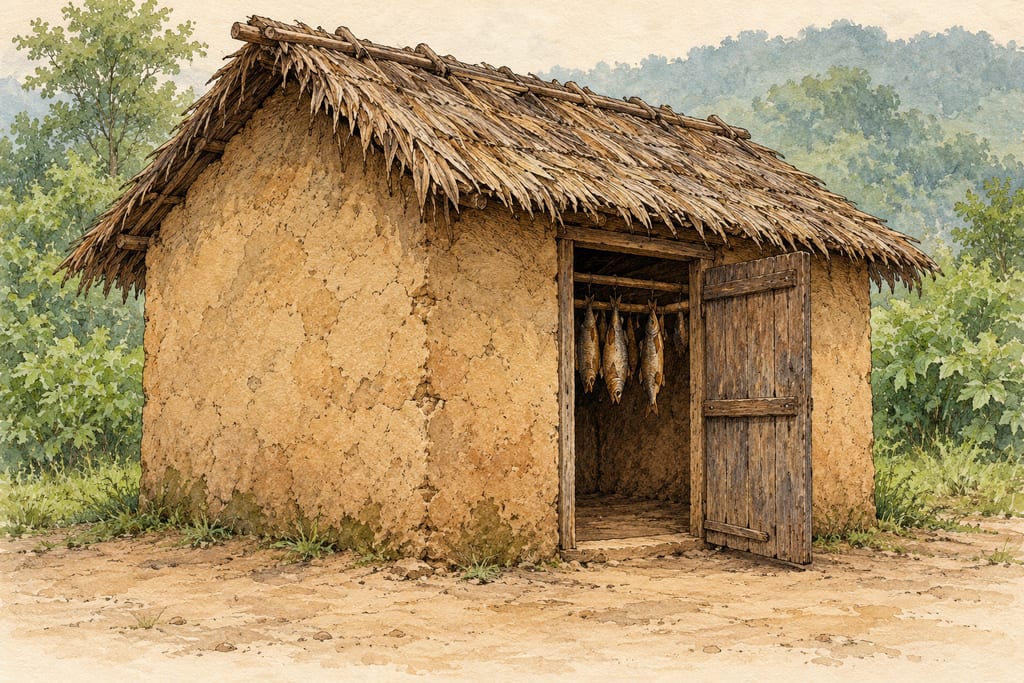
Dudkhāneh is a smokehouse term used in Gilan. A field report documents one fish-smoking workshop at Mobandan; its mud-plastered room and thatched roof are one local example, not a universal plan.
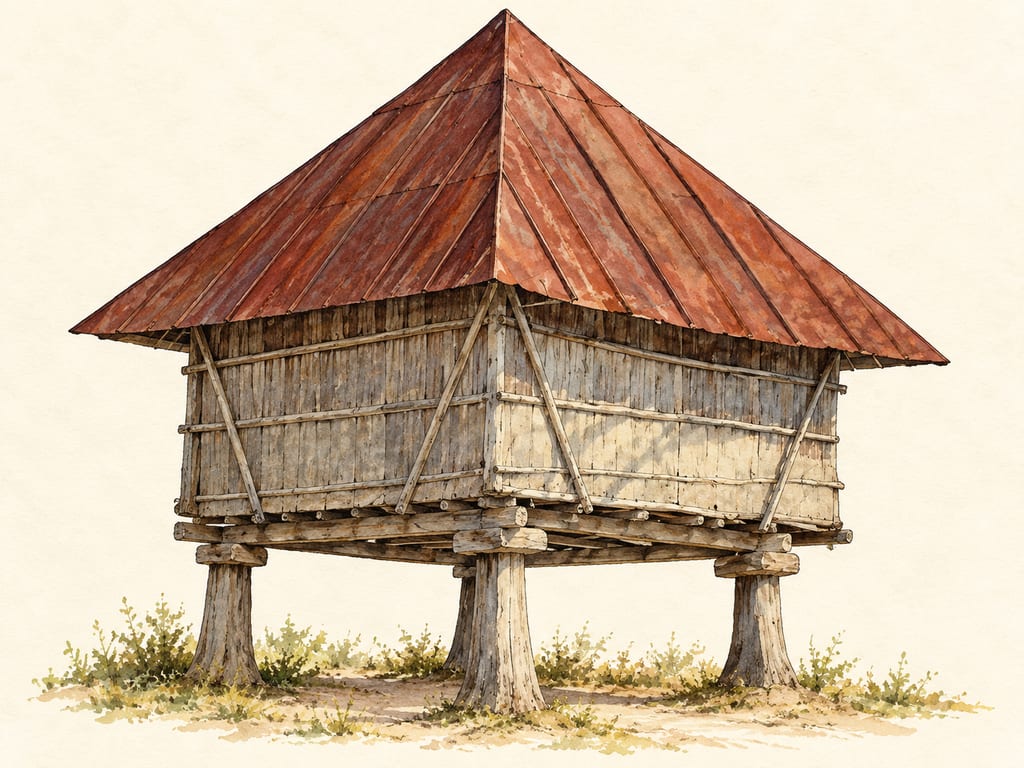
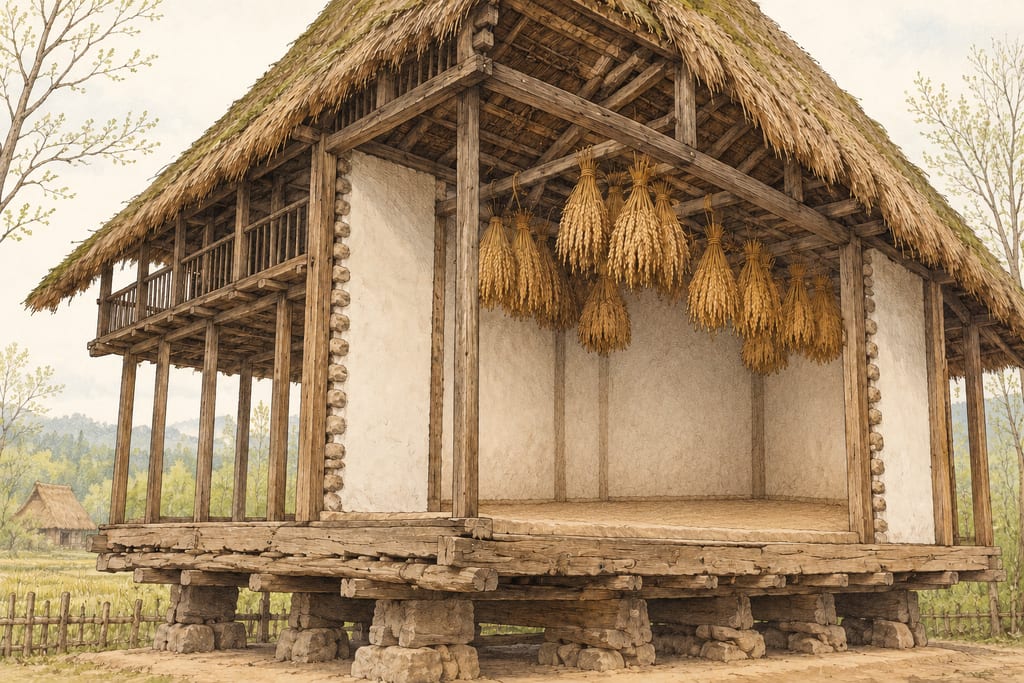
A kundej is a raised rice barn documented in central and eastern Gilan, Iran. Its regional forms store harvested sheaves above damp ground while ventilation helps dry them.
A sardāb is a deep cellar in Iranian vernacular houses, used in summer to keep perishable food cool. Sources describe varied depths and ventilation, so this is not one fixed design.
No community contributions have been published for this entry yet.
Sign in to contribute. Published comments and photos are free to read.
Encyclopaedia IranicaHistory · Form · Use · Geography
YAḴČĀLYakhchāl and yakhdān store winter ice for summer distribution, not food refrigeration.
Iranian forms include covered pits, domed pits and open pits shaded by walls; no secure evolution from early pits to domed buildings is established.
Many systems froze water in shallow open-air basins in winter.
Cited in: What a yakhchāl stored; Several forms, not one standard building; What the Yazd photograph shows
UNESCO World Heritage CentreSpecific example · Geography · Ice making
Bam Citadel (Iran), ICOMOS EvaluationICOMOS describes a Bam mud-brick dome over a large ice tank; ice was made in a shallow pool shaded by a long wall and moved to the tank for summer.
This is one documented Bam installation, not a universal design.
Cited in: A documented installation at Bam
Wikimedia CommonsImage reference · Visual form · Geography
File:Ice House Iran.jpgPhotograph caption identifies a yakhchāl in Yazd; the image shows the stepped mud-brick dome and low opening, not the underground ice chamber.
Commons identifies the image as Bockomet’s own work under CC BY-SA 4.0.
Cited in: What the Yazd photograph shows