What it is
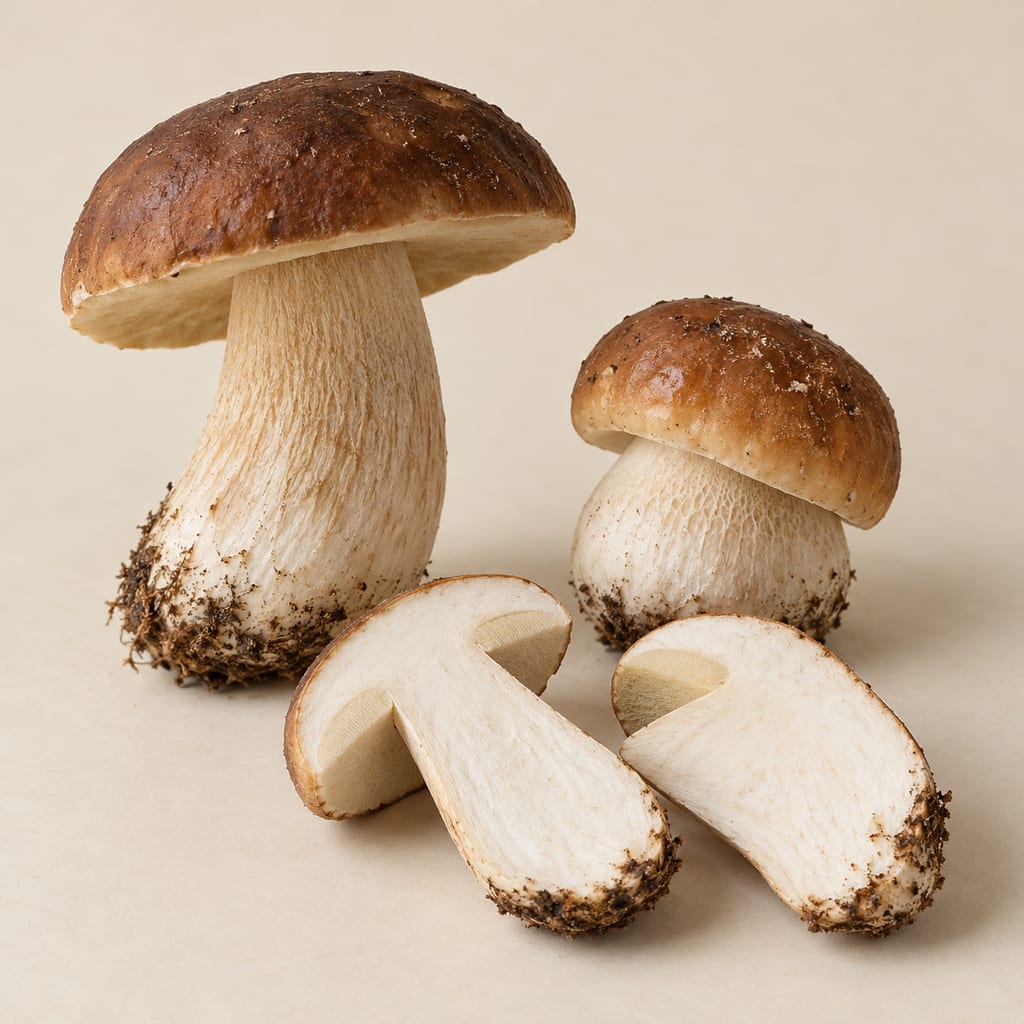
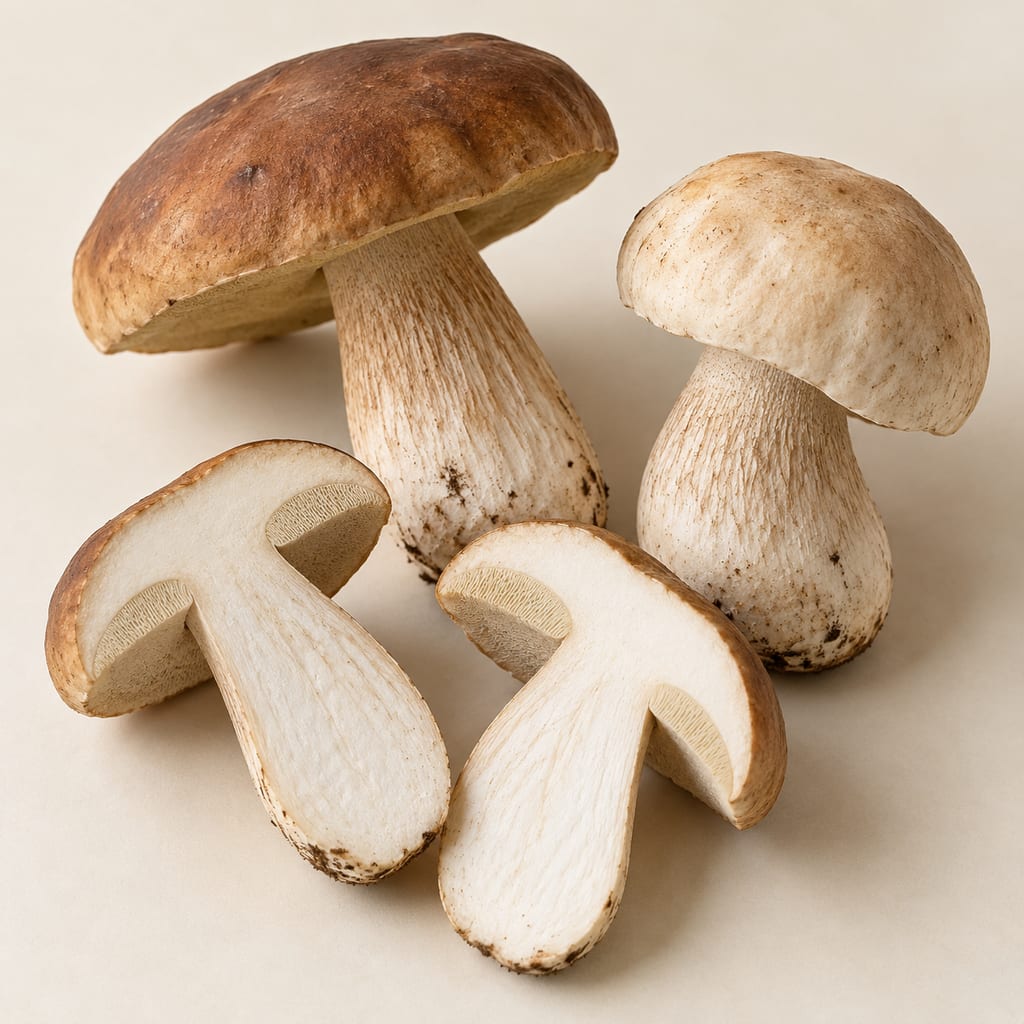
Boletus pinetorum is a large bolete of the penny bun group. In its description the cap is 15 to 25 cm across, occasionally 30 cm, greyish brown and sometimes yellowish or dark brown. The surface is smooth to almost smooth, matt when dry and slightly viscid when wet, and the edge is wrinkled. The tubes are 2 to 4 cm long, yellow at first, then greenish yellow and finally greyish yellow-green, with small pores of the same colour.
The stem is 13 to 17 cm long, cylindrical or swollen below, whitish with a brownish tint, and carries a distinct white net. The meshes of the net are about 3 mm long and 0.5 to 1 mm wide at the top of the stem and up to 10 by 2 mm at the base. The flesh is white, with a yellowish brown zone under the cap skin, firm when young and soft later. The taste is pleasant and the smell pleasant and strong.
Under the microscope its spores are 16.5 to 19 by 5.5 to 6.5 micrometres, somewhat broader than those of the penny bun, and its sterile hair cells on the stem net are unusually large and bottle-shaped, 70 to 160 micrometres long. The authors name the greyish-brown cap with a wrinkled edge, the habitat with pine and these large cells as the points that set it apart.
Sources for this section
Where it was found and when it was named
Korhonen suggested in 2000 that a distinct species of the penny bun group lived in Fennoscandian pine heaths, different in appearance, ecology and microscopic features. The 2009 paper gave it a name. The type collection was made on 24 September 1994 in a dry Scots pine forest on sand about a kilometre north of Tvärminne, at Hanko in southern Finland. The other collections examined came from southern Finland and from Skibotn in Troms, northern Norway, between 1983 and 2003. The description gives its range as Scandinavia, Finland and Estonia.
The authors compared it with its neighbours. It resembles the penny bun, B. edulis, which in Finland grows with spruce, but has a greyish-brown cap with a wrinkled edge and grows with pine. It shares pine heaths with B. pinophilus, which has a reddish-brown cap and cap-skin cells that are inflated and encrusted.
Sources for this section
Habitat and season
The fungus is associated with Scots pine, Pinus sylvestris. It is common in dry sandy pine heaths and in dryish to somewhat moist coniferous forests. It fruits in habitats like those of B. pinophilus and comparatively late in summer, later than the penny bun. The collections in the study were made between 20 August and 30 September.
Sources for this section
A species that DNA does not separate
The authors sequenced the ITS region of B. pinetorum and its relatives. B. pinophilus, B. reticulatus and the penny bun group each formed a supported lineage, but B. pinetorum did not separate from B. edulis, B. betulicola and a second oak-associated form inside that group. A further region, IGS1, gave the same result. The authors still treat the four as separate species on the strength of their different shapes and ecology.
Earlier European work had concluded that the penny bun is one very variable species living with several trees, and Wikipedia treats several of the look-alikes as part of a species complex with little genetic variation. Whether B. pinetorum is a species or the pine form of the penny bun is therefore open.
Sources for this section
Eating it
The Finnish description gives the taste as pleasant and the smell as pleasant and strong. The sources read for this page contain no record of the species being sold, no preparation method and no safety assessment, so nothing is claimed here about cooking it or about whether it is traded apart from the other porcini.
Sources for this section
The European porcini compared
Boletus pinetorum sits at the contested edge of the group. European DNA work separates B. aereus, B. reticulatus and B. pinophilus from a broad B. edulis lineage but not the forms inside it, the pine form included. The Finnish authors keep it apart on microscopic and ecological grounds. Fechtner's bolete, once listed with the porcini, was moved to Butyriboletus after molecular data placed it far from the penny bun.
In short, from the sources: B. pinetorum has a greyish-brown cap with a wrinkled edge, a distinct white net on a whitish stem, and grows with Scots pine in late summer. B. pinophilus has a reddish-brown cap with a thicker, gelatinous skin and a coarse reddish net, also under pine. B. edulis has a pale to dark brown cap, viscid when wet, and a fine white net clearest at the top of the stem; it grows with spruce in the Finnish study. B. betulicola is slender and grows with birch. B. aereus has a dark bronze-brown, slightly velvety cap and grows under oak, beech and chestnut. B. reticulatus has a velvety cap that cracks in dry weather to show white flesh, and grows under oak and other broadleaf trees.
The bitter bolete, Tylopilus felleus, is the classic confusion. Its pores are white when young and turn pink with age, and its stem carries a coarse dark brown net on a lighter ground, the reverse of a penny bun. Its flesh is intensely bitter, cooking makes this worse, and sensitivity to the bitterness varies between people, so tasting is not a safe test. Red- and orange-pored boletes are a different hazard. Satan's bolete, Rubroboletus satanas, has yellow to orange pores that turn red and blue at a touch and is described as moderately poisonous, especially raw. The bitter beech bolete, Caloboletus calopus, has a pink-red lower stem, pores that bruise blue and flesh that stays bitter after cooking.
This record is not a field guide. Identification has to be certain, from the whole mushroom and several features together, and checked by an experienced local identifier before anything is eaten. Smell, taste or colour change alone never establish safety.
Sources for this section
Places
Finland
Relationship not established · Region evidenceThe type collection is from a dry pine forest on sand near Tvärminne, Hanko, 24 September 1994; occurrence records only, no food practice is claimed.
Troms
Relationship not established · Region evidenceTwo specimens from pine woodland at Furumoen; occurrence only.
Estonia
Relationship not established · Country evidenceThe description lists Estonia in the known range without naming a locality; occurrence only.