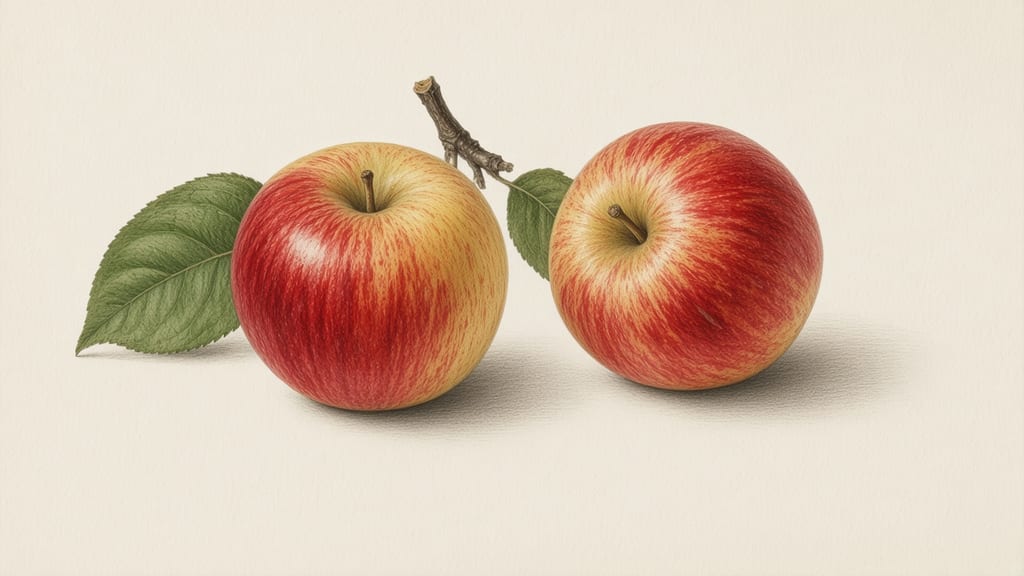
Redstreak apple
The Redstreak was the famous seventeenth-century cider apple of Herefordshire, linked with Lord Scudamore. A yellow apple streaked with red, it was lost as a distinct variety by the 1880s.
 FermenteaWhere food goes to change
Preservatives
Campden tablets portion a metabisulfite salt for particular wine, cider or other fermentation uses. Tablet strength and the resulting free sulfur dioxide depend on the product and liquid.
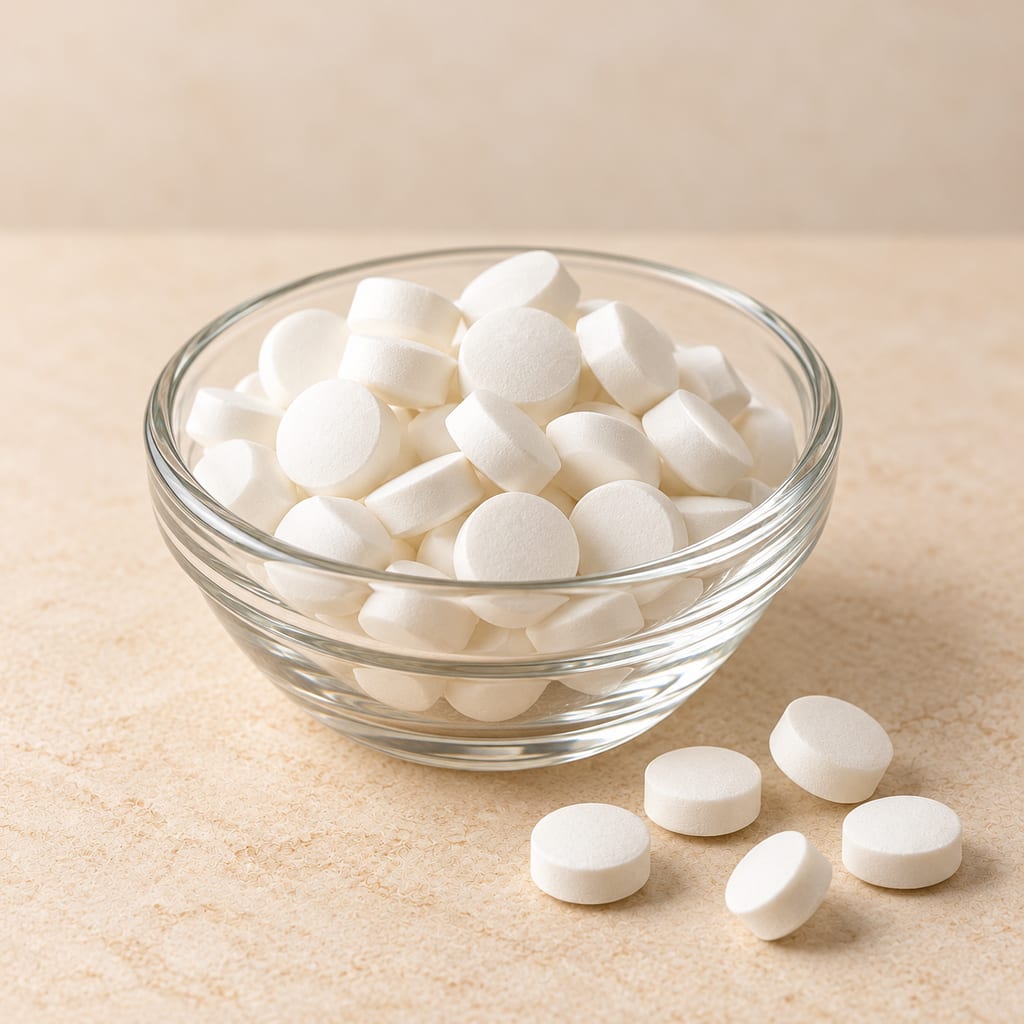
Campden tablets are compact, premeasured forms of a sulfite additive used in home winemaking and other fermentations. Their name is familiar, but it does not identify one universal formula or dose. Products sold under the name may contain potassium metabisulfite or sodium metabisulfite, together with a tablet binder or carrier. A tablet is therefore a particular manufacturer’s portion of an active chemical, not a standard unit that can be assumed to equal every other tablet.
The useful identity is the active ingredient printed on the packet. Potassium metabisulfite is also called potassium disulfite or potassium pyrosulfite. Sodium metabisulfite is also called sodium disulfite or sodium pyrosulfite. In current UK additive nomenclature, potassium metabisulfite is E224 and sodium metabisulfite is E223. Both can release sulfur dioxide species when dissolved. That common wine action does not make their tablet weights interchangeable. A tablet may include carrier material, and manufacturers specify different active amounts and sulfur-dioxide yields.
The name points to Chipping Campden in Gloucestershire, where the Long Ashton Fruit and Cider Research Station had established an outstation in 1919. Andrew Lea traces the tablet to a fruit-preservation problem rather than a wine recipe. The stations had explored sulfur-dioxide solution as an alternative to heating fruit in bottles; a prepared Campden Fruit Preserving Solution was offered during the 1920s and 1930s. A fruit glut in summer 1940 met wartime sugar rationing, and demand outgrew the prepared solution. Under the Ministry of Food, a tablet formula was circulated to chemists and pharmacists so households could prepare measured preserving liquid. Lea says a tablet dissolved in half a pint of water produced a 900–950 ppm sulphite solution for one pound of fruit. The historical specification aimed to deliver four grains, about 260 mg, of SO2 per tablet. This was a fruit-preserving technology with a much larger treatment concentration than a general instruction for finished wine.
After wartime fruit preservation declined, home winemakers adopted the convenient measured portion for must and wine. The transition explains why an ingredient named for a fruit-preserving station appears beside grapes in the later Concord and Muscadine recipes. The tablet has no single named inventor, and no first winemaking use is established. The old four-grain specification is also a historical formulation, not a promise about the contents of a modern packet. Even the traditional shorthand “one tablet per gallon” changes its arithmetic between an imperial and a smaller U.S. gallon.
The tablet is a delivery form. In water, the metabisulfite salt forms dissolved bisulfite and related sulfur dioxide species. In a must or wine, their proportions shift with pH and temperature. Winemaking describes three relevant forms: molecular sulfur dioxide (SO₂), bisulfite (HSO₃⁻) and sulfite (SO₃²⁻). At the pH common to wine, bisulfite predominates; a smaller fraction is molecular SO₂ and very little is sulfite. “Free SO₂” is the sum of the unbound forms available for protective action. “Bound SO₂” is sulfur dioxide that has attached to wine compounds and is no longer counted as immediately available protection. Total SO₂ combines free and bound forms.
This equilibrium makes sulfite addition more complicated than counting pills. As pH falls, a greater share of free sulfur dioxide is molecular; as pH rises, a smaller share is. The molecular fraction is especially effective against microorganisms. A wine at one pH therefore does not receive the same protective effect from the same free-SO₂ concentration as a wine at another pH. Existing sulfur dioxide, the wine’s binding compounds, oxygen exposure and losses also change what remains available. A tablet count alone cannot tell the reader the finished wine’s free concentration, molecular concentration or total residue.
Sulfur dioxide has two central enological roles. Its antioxidant action helps limit oxidation reactions that can brown must and dull or alter aromas. Its antimicrobial action inhibits susceptible yeasts and bacteria. These are forms of protection and control, not a promise of sterility. The term “sterilizing” in some homebrew instructions overstates what a Campden addition establishes: sulfite does not certify that a juice, wine, vessel or process is sterile, and it does not replace sound sanitation. Nor does it prove that fermentation is complete or a bottled wine is stable. Professional winemaking guidance treats sulfur dioxide as something measured and managed over time because free SO₂ can bind or be lost.
The tablet’s cation matters to the mixture: a potassium metabisulfite product adds potassium, while a sodium metabisulfite product adds sodium. Neither name alone gives the mass of active salt in a particular tablet. Loose powder is another dosing form, and winery effervescent tablets can be different products altogether. Erbslöh’s Oenodose 5, for example, combines potassium metabisulfite with potassium bicarbonate so it effervesces in wine; its maker states that one tablet in a 225 L barrel releases about 22 mg SO2 per litre. That industrial barrel product is not a household Campden tablet or a substitute at equal tablet count. Its distinct composition and stated yield make the product label, vessel volume and intended use central to any addition.
Two related grape-wine recipes show how one broad ingredient name can conceal different schedules. The Concord recipe from Adventures in Homebrewing lists ten Campden tablets for its five-gallon batch. It directs five crushed tablets into the must before a 24-hour wait and lists the remaining five at bottling after clearing. Its directions call the first treatment “sterilizing,” but this is the supplier’s wording, not evidence that the must becomes sterile or that the complete recipe has been validated. The recipe gives no active salt or strength for the tablets. Its ten-tablet count belongs to that recipe and its unspecified product, rather than a universal Concord-wine ratio.
The University of Georgia Cooperative Extension’s dry Muscadine recipe lists six tablets. It directs four crushed tablets into the juice before a four-hour stand; after fermentation slows and the wine is racked, it directs one tablet before clearing, and another if the wine remains cloudy after a month. The sixth tablet is thus a conditional second clearing-stage addition in the recipe, rather than an entirely unallocated ingredient. The recipe gives no metabisulfite salt, brand, active mass per tablet or measured free-SO₂ result. The dose cannot safely be restated as a standard for other Muscadine wines or for a different packet.
Both grape-wine procedures place an initial sulfite treatment before cultured yeast, but the waits differ: the Concord supplier says 24 hours and the Georgia extension guide says four. Neither recipe gives the tablets’ exact formulation, so the interval cannot be traced to grape type alone. The later Muscadine additions follow racking and a conditional clearing check; the Concord recipe places its remaining tablets at bottling. Those stages matter because a must and a nearly finished wine present different questions about oxygen, microbes and binding of sulfur dioxide. Their schedules illustrate decisions within two complete recipes, while the resulting free and total SO2 remain unmeasured in the instructions.
Commercial listings show why the packet has to be read before its tablets are counted. RahrBSG calls its product sodium-metabisulfite tablets of about 0.5 g each and claims one per gallon gives 30 ppm free SO2. The same listing spells the ingredient “sodium metabisulfate” in its >90% line, so that line does not independently establish a >90% metabisulfite formulation. MoreWine titles its product potassium metabisulfite and claims one tablet per gallon gives 75 ppm free SO2; its description also uses a “metabisulphate” spelling. These are supplier-stated product yields, not measurements of the two grape-wine recipes or a basis for treating unlike packets as equivalent. A strength printed for one brand cannot be transferred to another whose active mass and binding ingredients differ.
Keep tablets dry and tightly closed, away from acids and strong oxidizers. Chemical-safety cards identify dust, eye and respiratory exposure as handling concerns for the concentrated salts and note sulfur dioxide release when acid is involved. Follow the actual packet when storing and crushing a tablet; minimizing dust also keeps more of a measured dose in the vessel. The package’s date and storage directions belong to the product bought. If a recipe counts tablets without identifying their strength, the chemical amount in a replacement brand remains uncertain even when the tablets look alike.
Sulfites are not a major food allergen under U.S. labeling, but the Food and Drug Administration treats sulfites as a separately monitored food ingredient because sensitive people may react to them. U.S. food labeling has a distinction that a short threshold slogan can obscure: a sulfiting agent that still has a technical or functional effect in the finished food must be declared by its common or usual name regardless of level; if it has no such effect, the incidental-additive exemption applies only below 10 parts per million. Sulfites do not belong in the major-allergen “Contains” statement. Wine follows its own Alcohol and Tobacco Tax and Trade Bureau rule: a label must carry a sulfite statement when sulfur dioxide or a sulfiting agent is detected at 10 ppm or more, measured as total SO₂. That threshold applies to the finished wine, not the tablet count. A recipe’s addition does not by itself determine whether the wine reaches that analytical threshold.
The Food Standards Agency guidance for England, Wales and Northern Ireland and separate Food Standards Scotland guidance both address sulfur dioxide and sulfites above 10 mg/kg or 10 mg/L, calculated as total SO2 in finished food or drink. The Scottish document expressly applies to Scotland. The declaration question concerns the product as consumed, including sulfite carried through another ingredient, rather than the original tablet count. Food-additive labelling can also require an additive’s function and name where it continues to act in the finished food. These rules are jurisdiction-specific; the U.S. food and wine thresholds discussed above use their own legal categories. Someone sensitive to sulfites needs information about the actual finished product, not an assurance inferred from a recipe.
Sulfite tablets also appear in cider, mead and fruit-must directions. The target liquid changes the job. Before yeast is pitched into fruit must, the purpose may be to suppress some unwanted microbes and limit oxidation; in wine after racking, oxygen exposure and the free-SO2 balance become more prominent. A supplier’s word “sanitizer” does not convert any of these additions into proof that a must, barrel or finished drink is sterile.
The distinction between tablet mass and sulfur dioxide in the wine is especially useful at bottling. The compact tablet is easy to portion, but its metabisulfite salt is the chemical input; the wine’s free, bound and total SO2 are properties of the mixture after that input meets fruit compounds and oxygen. A bound fraction does not supply the same immediate antimicrobial protection as free SO2. A quiet ferment or clear appearance likewise does not reveal the wine’s measured SO2 or its stability. The two grape recipes specify when their authors add tablets, while a winemaker assessing a real batch must read its particular product and process information.
The old fruit-preserving name and the two grape methods together explain the ingredient’s place: a convenient tablet form of a metabisulfite salt. Because neither grape recipe identifies the brand, active salt or mass of its tablets, their tablet counts cannot be converted into one chemical dose or borrowed as a general rule for grape must. The useful information is the tablet form, its possible metabisulfite salts, and the need for an identified packet to interpret a particular recipe.
sulphites
Andrew Lea attributes the tablet’s origin to the Long Ashton outstation at Chipping Campden.
The Redstreak was the famous seventeenth-century cider apple of Herefordshire, linked with Lord Scudamore. A yellow apple streaked with red, it was lost as a distinct variety by the 1880s.

Soft, spreadable Calabrian pork sausage made with a great deal of red chilli and fatty pork, stuffed into natural casings, sometimes smoked and matured while staying soft.

A way to add independent temperature logging to an existing food dehydrator without changing its built-in controls or protections. It is a monitoring method, not a rewiring plan.

Pleurotus cystidiosus is the abalone mushroom, a cultivated oyster-type fungus with dark brown caps that grows more slowly and is more demanding than other Pleurotus species.

A dark, balanced vinegar from Emilia-Romagna made by combining cooked or concentrated grape must with wine vinegar, then acetifying and refining it in wood under a protected specification.

A living dairy inoculum that starts controlled cream fermentation, developing acidity and aroma before sour cream or cultured butter is finished.

A small electric incubator holds jars at a selected temperature for yogurt and other documented warm food preparations. Controls, capacity and vessel arrangement vary by model.

Adygean salt is a seasoned table salt associated with Adygea and the wider North Caucasian culinary tradition. Salt is blended with garlic and a variable selection of herbs and spices; the exact mix depends on the named style and maker.

The African Caesar-group mushroom, Amanita masasiensis, is a wild ectomycorrhizal species of central and southern African woodlands, eaten locally. The genus contains deadly poisonous species, so identification needs care.
No community contributions have been published for this entry yet.
Sign in to contribute. Published comments and photos are free to read.
Andrew Lea / The Cider WorkshopHistory
The Origin of the Campden TabletSecondary account by Andrew Lea of the Campden tablet: Long Ashton's outstation at Chipping Campden set up in 1919; Campden Fruit Preserving Solution marketed in the 1920s and 1930s; the 1940 fruit glut and sugar rationing; a tablet formula circulated through the Ministry of Food; one tablet in half a pint of water gave a 900-950 ppm sulphite solution for one pound of fruit; specification of 4 grains (260 mg) of sulphur dioxide per tablet. Cites A. Crang's 1941 Long Ashton Annual Report and Barker and Grove 1924.
Cited in: From fruit preservation to a household wine ingredient; Uses, distinctions and what remains unknown
Oklahoma State University ExtensionScience
Understanding Free Sulfur Dioxide in WineFree, bound and total sulfur dioxide; molecular fraction depends on pH.
Cited in: What happens when a tablet dissolves; Two grape-wine recipes; Uses, distinctions and what remains unknown
Iowa State University ExtensionScience
Sulfur Dioxide Measurement and Overestimation in Red WineBinding and measurement qualifications in red wine.
Cited in: What happens when a tablet dissolves; Uses, distinctions and what remains unknown
RahrBSGIdentity · Product
Campden Tablets 46 gCurrent product page describes its roughly 0.5 g tablet as sodium metabisulfite and claims 30 ppm free SO2 per tablet per gallon, while its ingredient line spells the salt metabisulfate.
Cited in: A small tablet with a much larger chemical job; Reading the label before counting tablets; Uses, distinctions and what remains unknown
MoreWineIdentity · Product
Campden Tablets (Potassium Metabisulfite)Potassium metabisulfite is named in the product title; the product page claims 75 ppm free SO2 per tablet per gallon, while its description spells the salt metabisulphate.
Cited in: A small tablet with a much larger chemical job; Reading the label before counting tablets; Uses, distinctions and what remains unknown
ILO/WHOSafety
Potassium Metabisulfite ICSC 1175Potassium salt identity, dust, eye, acid-contact and storage precautions.
Cited in: A small tablet with a much larger chemical job; What happens when a tablet dissolves; Reading the label before counting tablets
ILO/WHOSafety
Sodium Metabisulfite ICSC 1461Sodium salt identity, dust, eye, acid-contact and storage precautions.
Cited in: A small tablet with a much larger chemical job; What happens when a tablet dissolves; Reading the label before counting tablets
US Code of Federal Regulations via Cornell LIILabel
27 CFR §4.32(e): Declaration of sulfitesWine labeling at 10 ppm or more total SO2.
Cited in: Sulfites, sensitivity and the limits of a label threshold
US Food and Drug AdministrationLabel
Import Alert 99-21: Undeclared Added Sulfiting AgentsFunctional and incidental sulfite food-label distinctions; not a major allergen.
Cited in: Sulfites, sensitivity and the limits of a label threshold
UK GovernmentLabel
Food allergen labelling and information requirements technical guidanceGuidance applies to England, Wales and Northern Ireland; sulphite declaration threshold is above 10 mg/kg or mg/L total SO2 in finished food.
Cited in: Sulfites, sensitivity and the limits of a label threshold
UK GovernmentIdentity
Approved additives and E numbersE223 sodium and E224 potassium metabisulphite.
Cited in: A small tablet with a much larger chemical job
University of Georgia Cooperative ExtensionRecipe
Winemaking at Home, Circular 717Dry Muscadine source: six listed, four before yeast, one after racking, sixth conditional on clarity.
Cited in: Two grape-wine recipes; Uses, distinctions and what remains unknown
Adventures in HomebrewingRecipe
Concord Grape Medium Bodied Wine RecipeFive crushed tablets before 24-hour wait and five at bottling in supplier recipe.
Cited in: Two grape-wine recipes; Uses, distinctions and what remains unknown
Erbslöh Geisenheim GmbHProduct · Form
Oenodose 5Producer identifies potassium metabisulfite and potassium bicarbonate effervescent wine tablet; one tablet in 225 L claims about 22 mg/L SO2.
Cited in: What happens when a tablet dissolves; Reading the label before counting tablets
Food Standards ScotlandLabel
Food Allergen Labelling and Information Requirements: Technical GuidanceScottish guidance applies in Scotland and requires sulphite declaration above 10 mg/kg or mg/L total SO2 in finished food.
Cited in: Sulfites, sensitivity and the limits of a label threshold