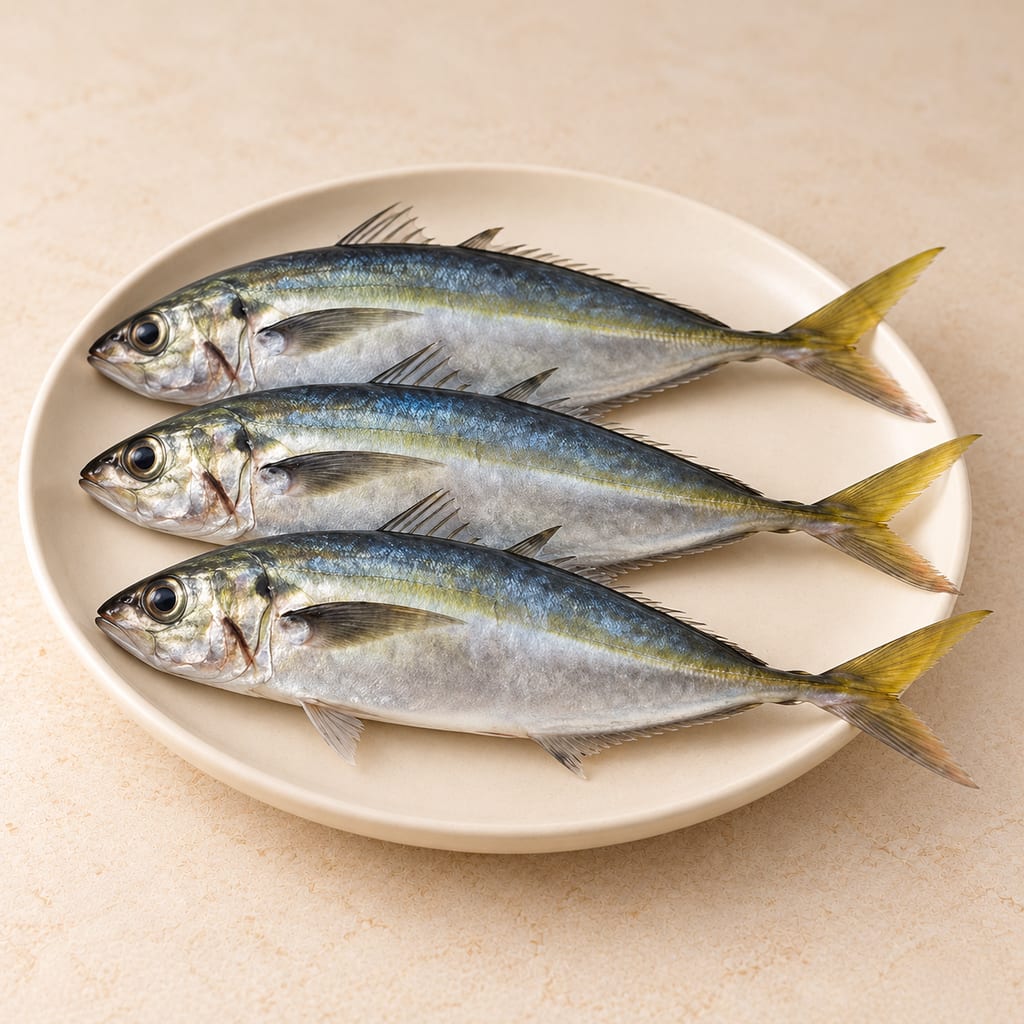
Amberstripe scad
A marine scad named in a Vietnamese fish-sauce account as a whole-fish substrate; the account gives a 4:1 fish-to-salt example but no species-level voucher.
 FermenteaWhere food goes to change
Substrates
Freshwater fish substrate in a Vietnamese fish-sauce account, which particularly names Mekong cá dánh (*Puntioplites falcifer*) as a prized household sauce fish.
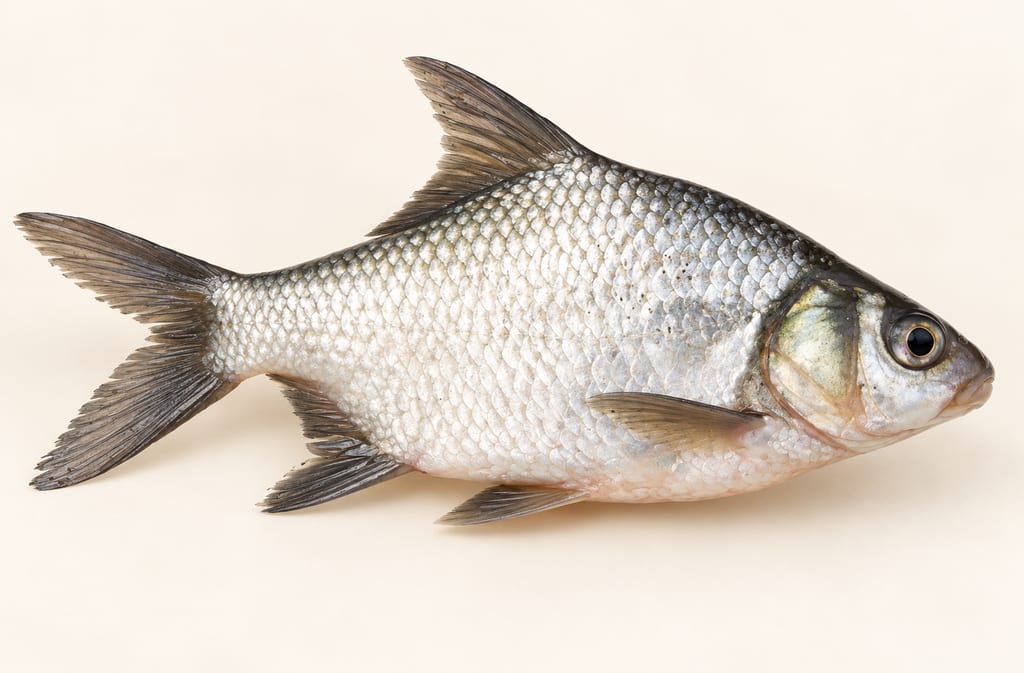
Cyprinid is a family name, not one fish species. Carp, barbs and many other freshwater fish belong to Cyprinidae. The Vietnamese fish-sauce account linked to this ingredient is more exact: Le Hai Dang names *cá dánh*, identifies it as *Puntioplites falcifer*, and places it in the Mekong Basin. Eschmeyer's Catalog of Fishes currently treats that Latin name as valid. A page titled “cyprinid fish” should therefore not pretend that any random carp is the fish praised in the account. The broad name is a doorway into a specific freshwater tradition, and the species name marks what the cited passage actually says.
The account makes a striking contrast with better known marine fish sauces. It lists amberstripe scad, anchovy and other sea fish, then singles out *cá dánh* sauce as traditionally prized, mostly served at fishermen's home meals and hard to find in markets. That observation places value in a household setting rather than on a factory label. A sauce can be culturally important without being widely bottled for sale. The fish is a whole-fish substrate for a long salted transformation; the sauce is the condiment that eventually comes to the table. Keeping those two stages apart prevents a recipe reader from substituting a bottle of fish sauce for the fresh fish specified at the start.
The Nagao Natural Environment Foundation's Mekong fish guide lists *P. falcifer* under a Vietnamese *cá dánh* name and records several food uses, including roasting, steaming, drying, soup, chili paste and fish sauce. These are different ways of valuing the same freshwater catch. Fish chosen for sauce becomes a concentrated liquid seasoning after prolonged handling, while a roasted or steamed fish remains a meal of flesh and bones. The guide's photographs and local names help recognize the species in a regional market, but a market name alone is less secure than a correctly identified specimen. Other *Puntioplites* can look similar.
The Mekong River Commission describes *P. falcifer* as common in the river's mainstream from northern Thailand toward southern Vietnam in its surveyed data. Its long dorsal fin makes it recognizable, although the commission cautions that it can be confused with another member of the genus. The fish's home is freshwater river and floodplain country, not the coastal water of scad or anchovy. That difference changes the human story too: the catch may come from river fisheries connected to villages and seasonal water movement, then enter a local sauce-making practice. The heritage account's fishermen's-home association is particularly understandable in that setting, though it does not name a single landing site for the sauce it describes.
Fish used for sauce is often discussed as anonymous bulk. Here the name carries ecological specificity. The MRC notes deep-pool preferences reported by fishermen and seasonal movements; the Nagao guide gives distinct local names across Laos, Cambodia, Thailand and Vietnam. Those details remind us that fresh fish availability depends on a river system, not just a shop shelf. They are not a recommendation to capture fish from a particular pool or to infer one harvest season for every household. The useful culinary point is that a locally available whole fish can become an ingredient for a strongly flavored preserve rather than requiring transport to a coastal factory.
Le Hai Dang's wider account describes *nước mắm* as both a dipping condiment and a seasoning in cooked dishes. It also describes a shared bowl of sauce at Vietnamese meals. The *cá dánh* version is said to remain close to fishermen's homes, which gives that shared bowl a particular intimacy: the fish caught and salted by a community may return to the table as a few savory drops. Nothing in the account provides a dated origin for this exact freshwater sauce. Its value is recorded as a living preference and pattern of use, not as a fixed ancient recipe that can be reconstructed from a single paragraph.
The cited fish-sauce method layers fish and salt inside a barrel. For “Cyprinidae and many other species” the author gives a fish-to-salt example of 6:1, compared with 4:1 for amberstripe scad. The source does not explicitly say every *P. falcifer* household sauce is made at precisely 6:1. The ratio belongs to the method's family-level example, while the prized *cá dánh* identity belongs to the preceding comparison of sauces. Linking them is useful for understanding the ingredient's likely culinary setting, but keeping the wording exact avoids inventing a proprietary formula for the fishermen's household version.
The barrel method does more than season the surface of fish. Layers are weighted and covered so the fish stay submerged. Liquid comes out through a lower spigot after several days, and the maker later manages, mixes and returns it before final draining. The heritage account gives roughly six months to one year from salting to sauce in the traditional process. A handful of fish and salt left overnight will taste salty; it will not have undergone this long transition into a liquid rich in protein breakdown products. The duration is not a timer to be copied without the rest of the container, salt and handling conditions.
Salt both supports preservation and affects the pace of protein breakdown. A controlled study on sardine and anchovy showed that increasing salt reduced proteolysis in those test systems, and the fish species differed in how quickly they liquefied. These are marine species, not *P. falcifer*. The comparison helps explain why one should not read 6:1 as “less salt therefore faster finished sauce” without any other conditions. The fish's own enzymes, the material's size and condition, the surrounding microorganisms, time and management all contribute. The named ratio is an observation of practice, not a complete kinetic model.
Fresh fish muscle is a close-packed structure of water and protein. In the salted barrel, some liquid is drawn out, while enzymes break long proteins into smaller soluble fragments. When the maker drains the barrel, those fragments travel with the brine. The sauce's savory effect is therefore tied to a real change in the fish, not merely to salt water that has touched a fish. The whole fish disappears as an easily recognized shape, but the resulting liquid retains parts of its chemical substance. That is why the raw fish is properly an ingredient, and why its species and handling matter.
One Vietnamese laboratory experiment tracked this transformation in an anchovy-based fish sauce with a selected salt-tolerant bacterium. Total and amino nitrogen rose over six months, and the study measured changes in savory amino acids and aroma. Its organism and anchovy substrate are specific to that experiment; they cannot be assigned to a traditional *cá dánh* barrel. They do provide a measured example of the process behind the sensory description. A sauce can acquire body, scent and depth as fish protein is cleaved and other compounds form under high salt, even though the exact final profile will vary by species and method.
The heritage author separates freshwater *cá dánh* from marine scad and anchovy sauces in value and availability. He does not give a chemical analysis or color for the prized household sauce. It would be tempting to borrow the scad sauce's dark brown or the anchovy sauce's light yellow and attach one to *cá dánh*; neither transfer is supported. The taste and appearance must be learned from an actual preparation. The family-level 6:1 example tells us how a fish may enter the barrel, while the home-meal account tells us why the sauce matters after it leaves.
The Nagao guide describes *P. falcifer* as a deep-bodied, laterally compressed fish with pale orange fins and a notably long dorsal fin ray. The MRC also points to that dorsal feature while warning that field identifications can be confused with other *Puntioplites*. The scientific name is therefore helpful but not a shortcut past careful recognition. A broad request for “cyprinid fish” at a shop may bring an entirely different freshwater species. For this linked heritage account, *cá dánh* is the relevant local name, with the valid *P. falcifer* identification attached to the passage.
The same fish may be roasted, steamed or dried, according to the Mekong guide. Those alternatives underline what sauce-making asks of the raw material. Roasting seeks a cooked whole fish; drying removes moisture for keeping; fermenting with salt aims to draw out and transform fish substance into a liquid condiment. Starting from a dried fish would alter the water available to the barrel and cannot be treated as a silent substitution for the whole fresh catch. Conversely, a jar of finished sauce has already passed through the transformation; it is ready for seasoning, not for standing in as the fish in another batch.
If comparing market fish for a sauce project, separate identification from quality and process. A correctly named species does not make a poor-condition fish suitable, and a fresh fish does not make a loosely managed ferment equivalent to the long barrel method. The sources here describe a cultural practice and a family-level ratio, not a complete measured home-production specification. The cooking value of this ingredient page is to show which kind of animal the name points to, why its freshwater origin matters and what role the fish plays before it becomes sauce. That clarity is useful even for a reader who will only encounter the finished condiment at another household's table.
There is a productive tension between the database label “cyprinid fish” and the heritage account's specific *cá dánh*. Cyprinidae tells the reader this fish belongs to a large freshwater family. *Puntioplites falcifer* tells the reader which species the author associates with a prized, mostly household *nước mắm*. Keeping both levels visible avoids two mistakes: treating a whole family as one ingredient, and pretending the account offers a full species-specific production manual. The MRC's note about lookalike fishes also reminds us why naming is a careful task in a diverse river system.
The species description was published scientifically in 1929, according to Eschmeyer's catalog. That is a botanical-style naming milestone for zoology, not an attestation that fishermen began salting *cá dánh* in that year. The 2022 cultural essay is a dated modern account of a living preference. Neither establishes the first culinary use of this fish in sauce, so the earliest historical period remains unknown. The page can still make a precise claim: in this documented account, a Mekong freshwater fish becomes a scarce, valued household seasoning through a long salt process.
At the end of that process, the distinction between family and species is felt in the bowl. A small shared portion of sauce has passed through catch, salting, pressing, time and careful draining. The fish's original shape has gone, but its substance remains in a concentrated condiment. The family name says where to place the animal; the local name and exact cited species say whose food story is being told. Both belong beside the recipe, while the old barrel does its slow work.
fish
Cultural account documents Vietnamese cá dánh sauce; this country-level culinary association does not localize the catch or all Cyprinidae.
A marine scad named in a Vietnamese fish-sauce account as a whole-fish substrate; the account gives a 4:1 fish-to-salt example but no species-level voucher.
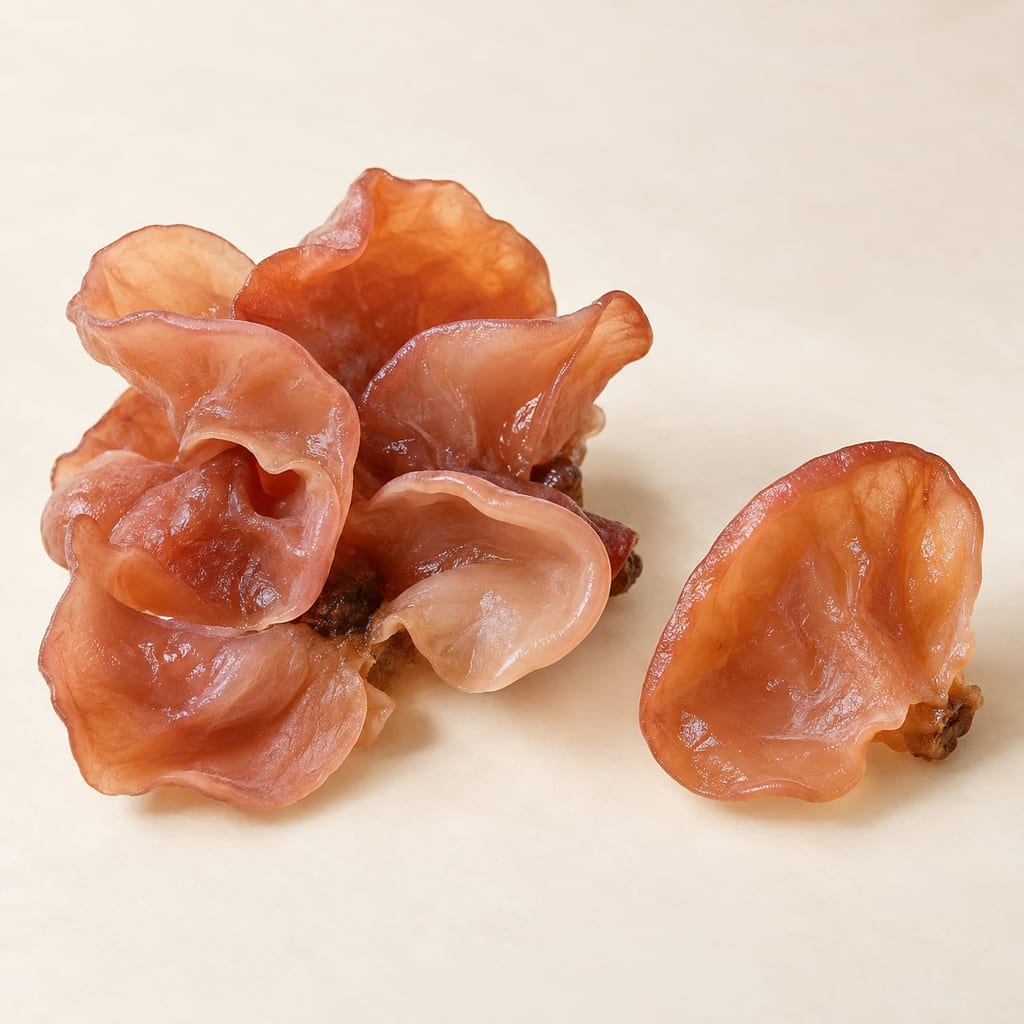
Auricularia thailandica is a thin, gelatinous wood ear described from Southeast Asian collections. Research reports it edible and experimentally cultivable, but species-specific recipes and everyday handling guidance are scarce.
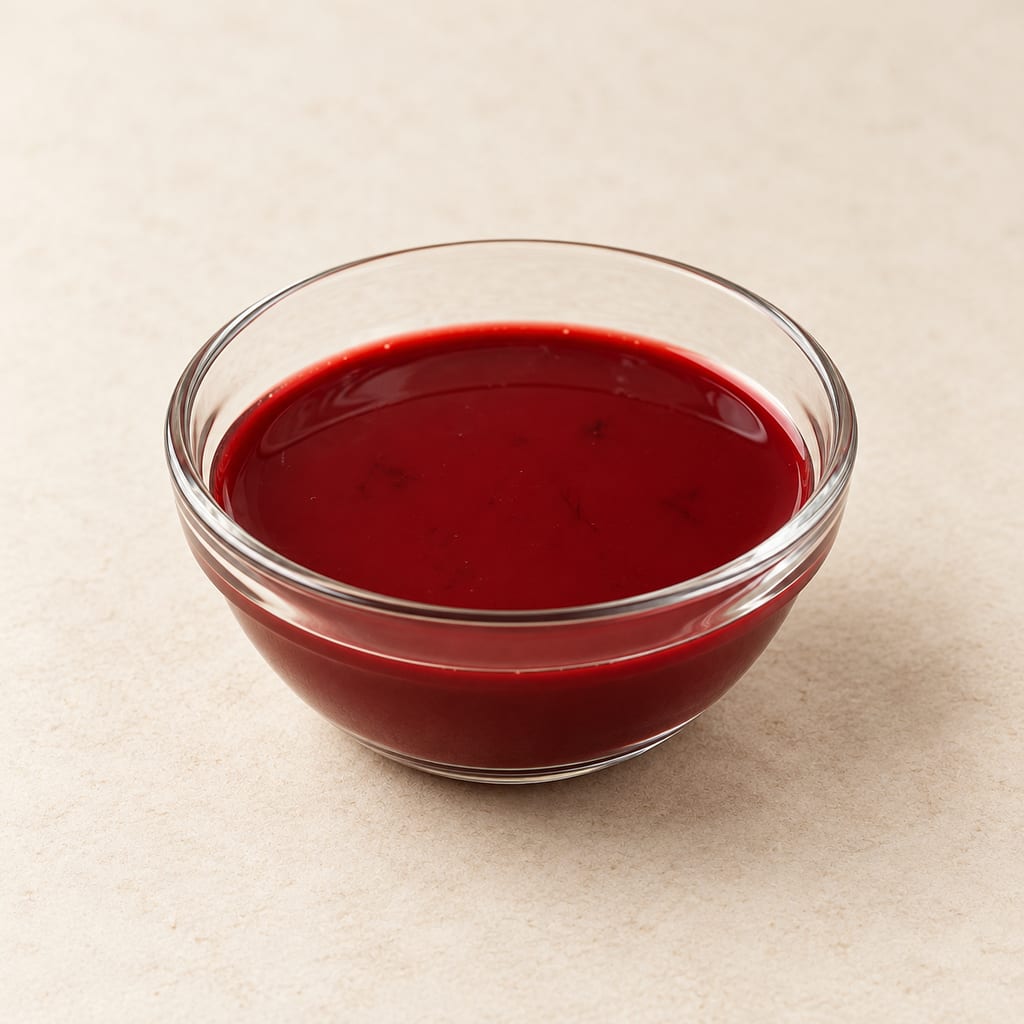
Animal blood is a perishable food material used fresh, coagulated, cooked, dried or processed into ingredients. Its uses range from grain-filled puddings to functional protein ingredients, each with distinct history and handling needs.
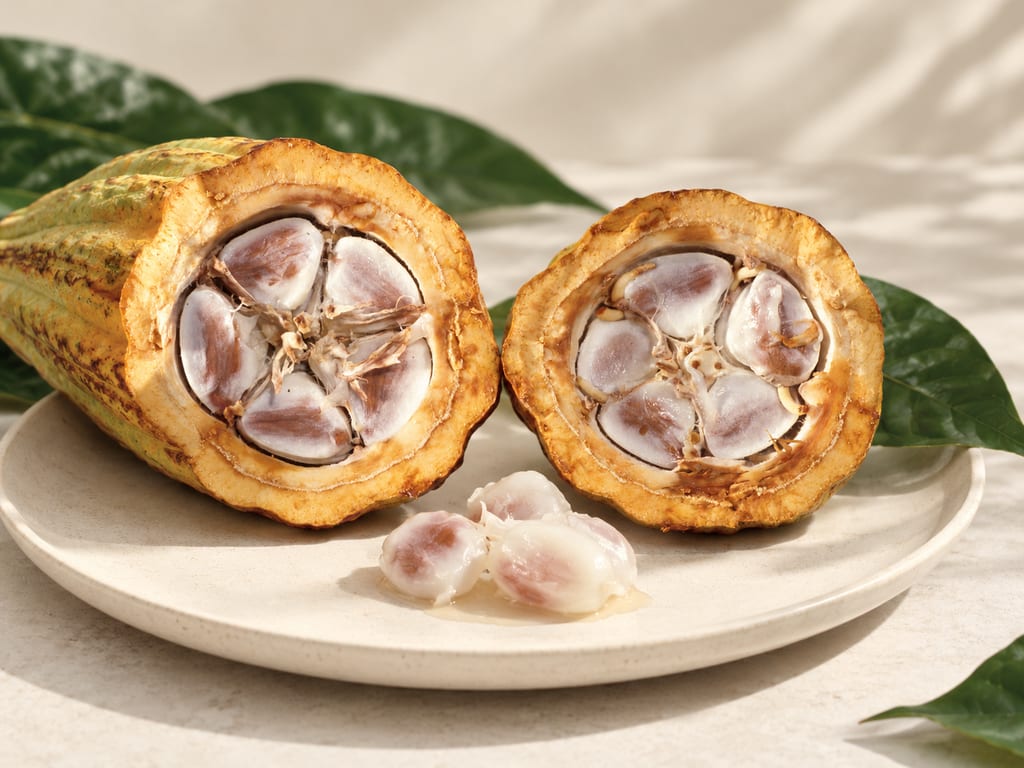
Cacao pulp is the moist, sweet-acid mucilage around cacao seeds. It fuels bean fermentation and can be extracted for fruit drinks, wine and vinegar.
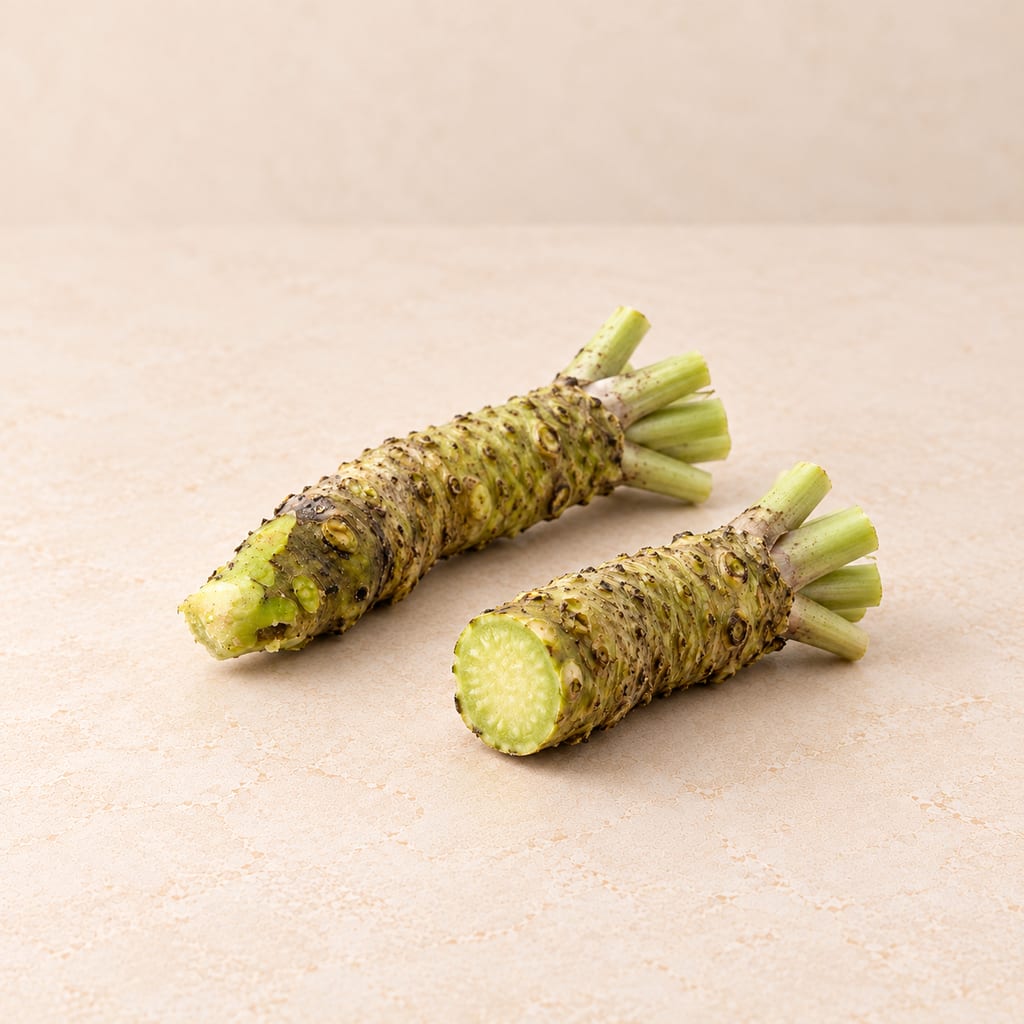
Wasabi is the enlarged stem of Eutrema japonicum, a pungent perennial in the mustard family. Fresh rhizome is grated as a Japanese condiment; powder and prepared paste are separate products.
Men or bánh men is a mixed Vietnamese starch-based rice fermentation starter. Published samples vary; their isolates and performance do not define a standard culture or household formula.
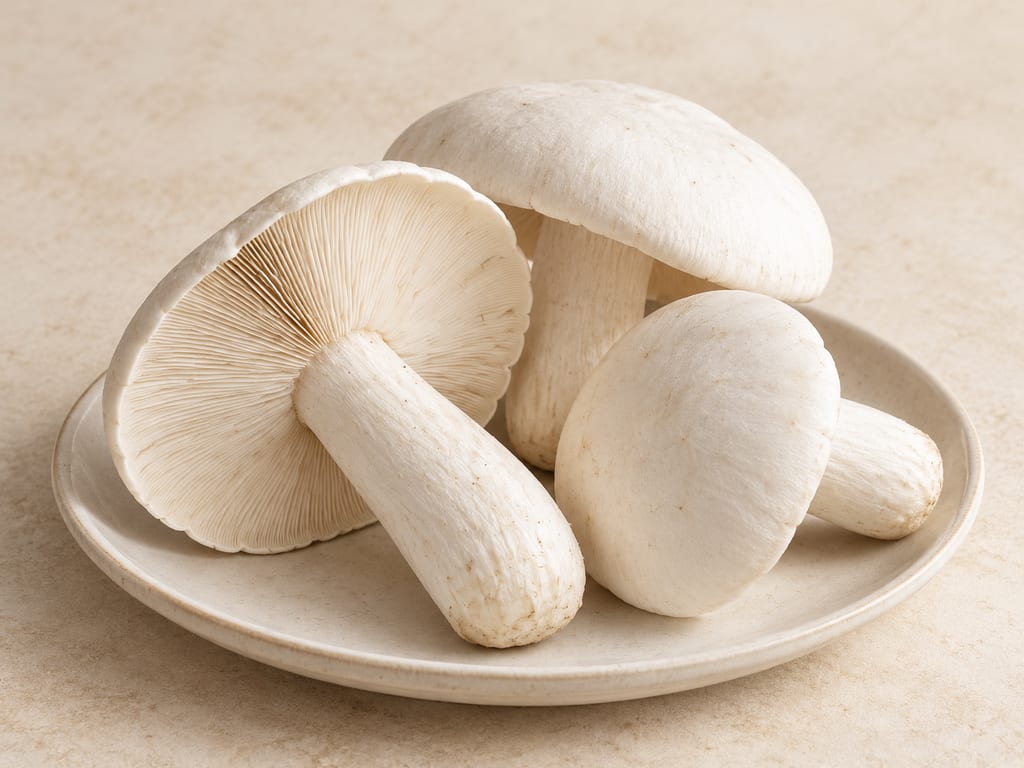
The milky mushroom is a warm-climate cultivated edible, historically named Calocybe indica and now listed by Species Fungorum as Macrocybe indica. Indian cultivation research centres on straw substrates and a separate casing layer.
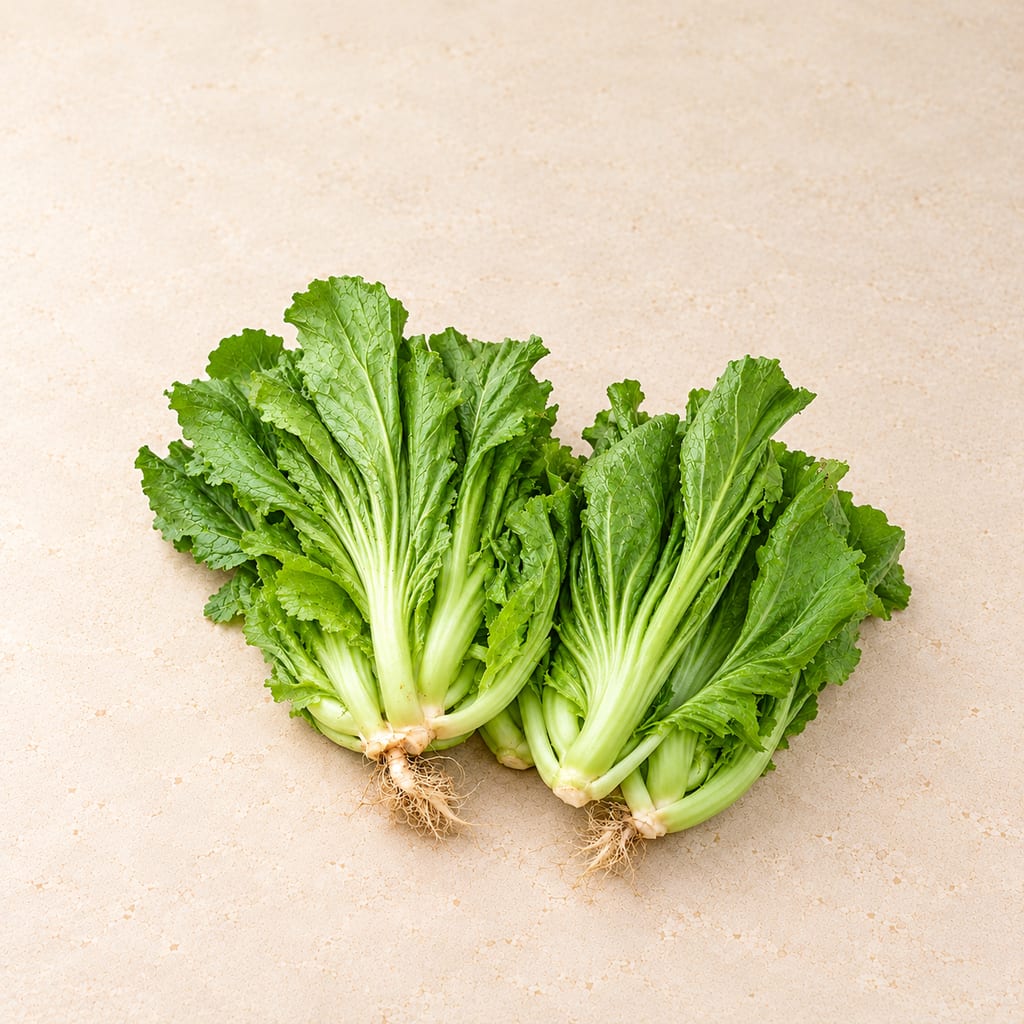
The leaves of Brassica juncea, a hardy cool-season crop with a sharp, sulfurous bite, eaten fresh and cooked and fermented across Asia as pickled greens, kimchi and gundruk.
No community contributions have been published for this entry yet.
Sign in to contribute. Published comments and photos are free to read.
ICH Courier, volume 53 (December 2022), UNESCO ICHCAPNamed Vietnamese culinary practice · Fish sauce process · Geography
Nước Mắm (Nuoc Mam): A Savory Depth of Flavor in Vietnamese Culinary LifeDecember 2022 account names prized household ca danh as Puntioplites falcifer; family-level Cyprinidae fish:salt example 6:1, not expressly a fixed ca danh ratio; long barrel method
Cited in: The freshwater fish behind cá dánh sauce; From the Mekong to the meal; Salt and fish in the barrel; Why fish becomes liquid flavor; A precise name within a broad family
California Academy of SciencesAccepted species and publication
Eschmeyer's Catalog of Fishes: Puntioplites falcifervalid species Puntioplites falcifer Smith 1929; Mekong freshwater distribution; 1929 is zoological publication, not food attestation
Cited in: The freshwater fish behind cá dánh sauce; Recognizing the fish, choosing the form; A precise name within a broad family
Nagao Natural Environment FoundationFish identification · Documented food forms
Fishes of the Mekong: Puntioplites falciferregional vernacular names; compressed body/orange fins; uses include roasting, steaming, drying, chili paste and fish sauce
Cited in: The freshwater fish behind cá dánh sauce; From the Mekong to the meal; Recognizing the fish, choosing the form
Mekong River CommissionPrimary river survey and identification
Key Mekong Fish Species: Puntioplites falcifersurvey reports species in Mekong mainstream from northern Thailand toward southern Vietnam; long dorsal fin but possible confusion with congeners; fishermen report deep-pool preference
Cited in: From the Mekong to the meal; Recognizing the fish, choosing the form; A precise name within a broad family
Food Technology and Biotechnology 53(1):87–90 (2015); DOI 10.17113/ftb.53.01.15.3893Comparative mechanism
Proteolysis of Sardine and Anchovy by Commercial Enzymes in Saline Solutionsdifferent marine fishes liquefied differently and greater salt slowed proteolysis; not direct Puntioplites result
Cited in: Salt and fish in the barrel; Why fish becomes liquid flavor
Food Science & Nutrition 9(2):651–661 (2021); DOI 10.1002/fsn3.2024Comparative fish sauce chemistry
Fish sauce fermentation using Marinococcus halotolerans SPQ isolate as a starter culturesix-month anchovy starter experiment tracked soluble nitrogen, amino acids and aroma; not a claim of this organism in ca danh sauce
Cited in: Why fish becomes liquid flavor