
Spices and aromatics
Fresh ginger
Fresh ginger is the aromatic underground stem of Zingiber officinale, used as a pungent ingredient in sauces, preserves, fermented foods and drinks.
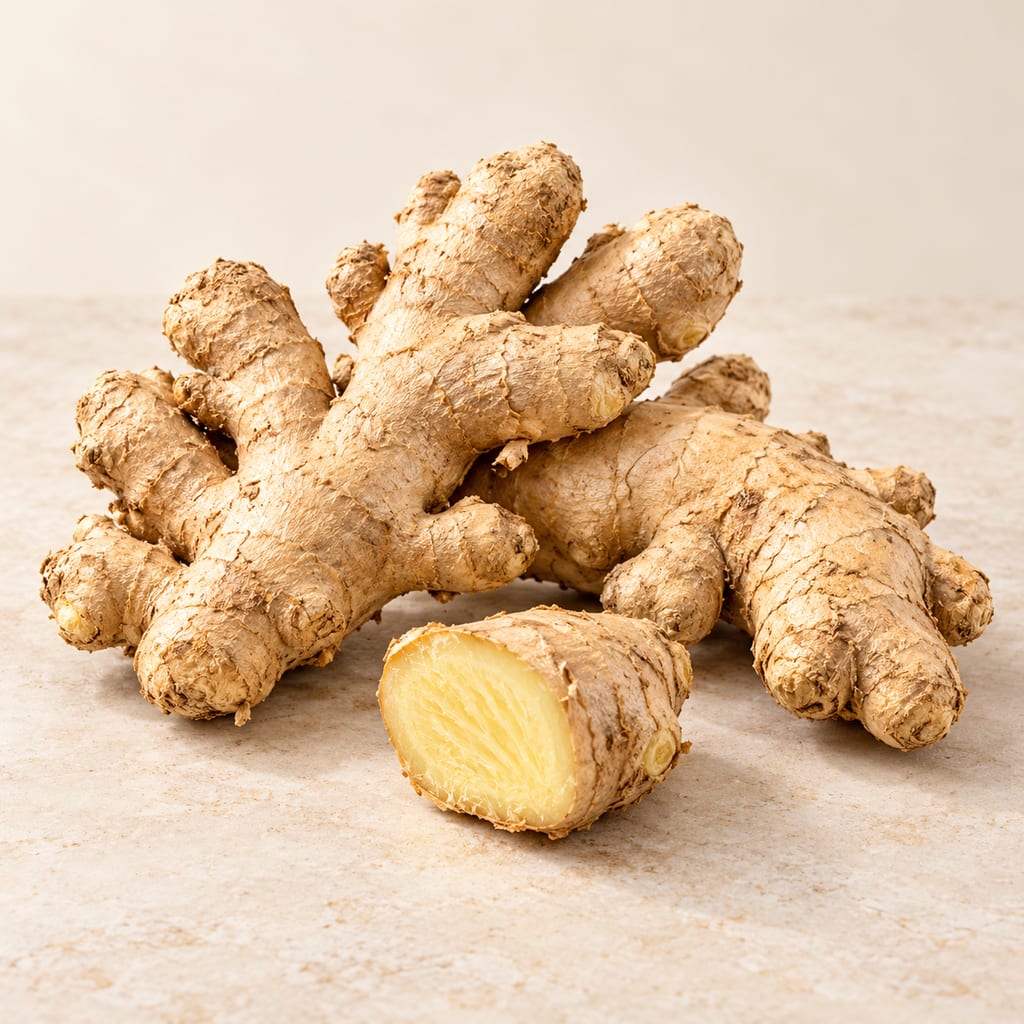
A stem that grows underground
Fresh ginger is the harvested rhizome of Zingiber officinale, a member of the ginger family. A rhizome is a stem that grows below the soil, not a true root. It branches into short, knobbly fingers, with buds from which new shoots can grow. The familiar whole piece may be called a hand because of those branches. Its thin buff skin surrounds firm, pale flesh with a sharp, warm flavour and a fresh, almost lemon-like aroma.
Age at harvest changes how ginger behaves in the kitchen. Young ginger is tender, juicy and thin-skinned; mature rhizomes develop tougher skin and more fibre, and taste hotter. Both are fresh ginger, but a tender young piece needs different preparation from an older fibrous hand. The flavour comes from volatile aromatic compounds as well as pungent compounds such as gingerols, so its fragrance and its heat are related but distinct qualities.
Sources for this section
A cultivated crop with a long route
Ginger has been cultivated widely across tropical Asia and moved through trading networks long before modern refrigerated transport. Kew places the accepted native range from the eastern Himalaya to south-central China; the exact history of domestication and its early movement should not be reduced to a single birthplace. Its rhizomes travel well in forms that can be dried or preserved, which made the spice useful far from the fields where it grew.
Greek and Roman buyers obtained ginger through Arab traders, and it became an important spice in medieval northern Europe. Those records describe a traded spice rather than a continuous account of every local method of growing it. Today ginger is a crop across South and Southeast Asia, tropical Africa, the Caribbean, parts of the Americas and Australia. Local harvest age, cultivar and handling determine what reaches a particular market.
The plant’s early cultivation is difficult to locate precisely. It has been propagated from rhizome pieces for a long time, and people’s movement of planting material obscures where domestication first took place. India has been discussed as a possibility, but the evidence does not establish a precise birthplace. Accounts of ginger in Greek and Roman settings and its later importance in Europe describe trade and particular written evidence, not an unbroken record of every culinary practice.
Sources for this section
How a hand becomes a crop
Culinary ginger is normally propagated from pieces of rhizome rather than seed. A viable piece carries buds: planted in warm soil, it can produce both the next shoot and new underground growth. Growers choose healthy planting material and work with loose, well-drained soil. Moisture supports the plant, but standing water and injury can encourage decay. The leafy above-ground stems arise from overlapping leaf sheaths; the harvested swollen part remains underground.
Young ginger can be harvested before the crop reaches full maturity. Fully developed rhizomes take a much longer growing season, commonly around eight to ten months in the extension accounts. The difference is visible at the counter: baby ginger has a delicate skin, while the mature rhizome is better developed and more fibrous. Both need careful digging and handling, because scraped skin exposes tissue to drying and spoilage.
Sources for this section
Aroma, heat and the cut surface
A cut, grated or crushed piece releases aroma into food much faster than an intact rhizome. Cutting increases the surface exposed to the rest of a dish, while grating distributes fine particles throughout it. A large slice can be removed later and gives a different eating experience from ginger grated into a sauce. The choice is not merely visual: it changes how much of the fibrous material remains in each mouthful.
Gingerols contribute to the pungency of fresh ginger; related compounds including shogaols are important to the broader flavour of processed ginger. Volatile oils provide much of the scent. Drying, heating and other processing change the proportions and perception of these compounds, so dried powder should not be described as an identical flavour simply because it comes from the same plant.
Sources for this section
In fermented drinks
Fresh ginger can flavour a fermented ginger beer, but the rhizome and the culture do different jobs. Ginger brings its own pungent and aromatic materials; microorganisms in a starter or fermentation turn available substrates into a changing mixture of acids, alcohols and volatile compounds. Sugar, water, culture, vessels and handling all matter to the result. Ginger alone is not a complete recipe or a reliable description of the organisms in a particular batch.
In one experimental back-slopped ginger beer, researchers measured the community and chemical changes in the ginger-based starter and the subsequent beverage. Longer starter activation and fermentation in that study were associated with changes in organic acids, alcohols, volatile compounds and microbial diversity. Those observations describe the studied preparations; they do not establish the composition, safety or completion of an arbitrary homemade drink.
Sources for this section
Ginger itself can be fermented
Ginger may also be the principal vegetable being fermented rather than only a flavour added to a liquid. A study of naturally fermented Xiaohuang ginger followed a specific Chinese cultivar over a 42-day preparation. Its measured acidity rose as pH fell, texture firmness declined, and lactic acid bacteria increased. The researchers also observed yeasts alongside bacteria and reported changes in the flavour-related compounds they measured.
The study identified Lactiplantibacillus plantarum among the dominant bacteria, with Pichia fermentans and Kluyveromyces hubeiensis among prevalent yeasts in its samples. These are observations of that named preparation, not a guaranteed starter composition for every ginger ferment. The measured laboratory timeline is not a household safety endpoint; the species names help explain one documented fermentation without turning the ingredient page into a recipe.
Fresh, dried and preserved forms
Fresh ginger is sold whole, sliced or prepared for cooking. It appears in sauces, chutneys, curries, sweet preserves, drinks and baked foods. Its sharp aroma can sit beside acid, sweetness, salt or other aromatics, but the form of the ginger changes the result: the texture of fresh grated rhizome is not the texture of a dry spice, and a preserved piece brings the character of its preserving medium.
Dried ginger and ginger powder are made from the same botanical ingredient but are distinct pantry forms. Oil and oleoresin concentrate different parts of the aroma and flavour and are used in food processing. A jar of ginger in brine, vinegar or syrup is a prepared product: the added liquid and treatment should remain part of its identity rather than being silently treated as raw fresh rhizome.
Sources for this section
Choosing and keeping fresh ginger
Choose firm pieces with intact skin and avoid visibly damaged or decayed tissue. Fresh mature ginger may have fine surface wrinkles and irregular knobs; those are features of its normal form, not a reason to choose a different species. Young pieces are especially easy to bruise. The pale interior is revealed only when cut, and colour and fibre can vary with maturity and variety.
For food, clean the rhizome before cutting and keep cut surfaces and utensils clean. Florida extension describes refrigerating dried, harvested rhizomes or freezing them for later use. Handling for replanting is a different task from storage for food: healthy buds and preservation of planting material matter there. Freshness, storage and intended use therefore belong to the specific piece in hand, rather than to an invented universal shelf life.
Sources for this section
Reading the ingredient in a preparation
Ginger can be a main subject, a seasoning or one component of a starter mixture. In a pickle, its own tissue may soften and acidify with the ferment; in a beverage, it may mainly contribute flavour while sugars in the liquid feed the community. A recipe should say which form is used and how it is cut, because “ginger” alone does not distinguish fresh slices from powder or a finished preserve.
Its intense smell is useful to a cook but does not measure a fermentation. Bubbles, a sour aroma or the presence of ginger cannot establish that a process is safe or that a particular organism is present. Follow the handling and storage conditions of the actual preparation, and keep observations from a controlled study separate from claims about an unmeasured home batch.
Cleaning before preparation
Before cutting or peeling fresh ginger, rinse it under running water and use clean hands, a clean board and clean utensils. Remove visibly damaged areas, and keep it apart from raw meat, poultry and seafood. Do not use soap or detergent on produce. Washing reduces surface contamination but does not sterilize the rhizome. This research did not establish a ginger-specific validated storage or preservation limit. Oil-packed or fermented ginger needs controls supported for that specific preparation; the ingredient’s aroma or traditional use does not establish safety.
Sources for this section
Places
No source in this record establishes a place.
Community
No community contributions have been published for this entry yet.
Share what you made
Sign in to contribute. Published comments and photos are free to read.
Sources
Royal Botanic Gardens, KewContext
Zingiber officinale Roscoetaxonomy
botany
distribution
trade
Cited in: A stem that grows underground; A cultivated crop with a long route; Reading the ingredient in a preparation
University of Wisconsin–Madison Division of ExtensionContext
Ginger, Zingiber officinalecultivation
appearance
culinary use
Cited in: A stem that grows underground; A cultivated crop with a long route; How a hand becomes a crop; Aroma, heat and the cut surface; In fermented drinks; Fresh, dried and preserved forms; Choosing and keeping fresh ginger; Reading the ingredient in a preparation
University of Florida IFAS ExtensionContext
Gingerpropagation
harvest
handling
Cited in: How a hand becomes a crop; Choosing and keeping fresh ginger
ICAR–Indian Institute of Spices ResearchContext
Ginger – Zingiber officinale Roscoeculinary forms
pungency
cultivation
Cited in: How a hand becomes a crop; Aroma, heat and the cut surface; Fresh, dried and preserved forms
Food Chemistry: XContext
Quality attributes, metabolomics and microbial community dynamics of naturally fermented Xiaohuang gingerobserved microbes and changes in a named fermented ginger
Cited in: Ginger itself can be fermented; Reading the ingredient in a preparation
Food ChemistryContext
Ginger beer derived from back-sloppingmicrobial and chemical changes in an experimental ginger beer
Cited in: In fermented drinks; Reading the ingredient in a preparation
Oxford University Plants 400History · Context
Zingiber officinalevegetative propagation
historical movement and cultivation
limits on identifying original domestication site
Cited in: A cultivated crop with a long route
U.S. Food and Drug AdministrationHandling
Selecting and Serving Produce Safelywashing produce under running water
clean hands and utensils
removing damaged areas
separating produce from raw animal foods
washing does not sterilize produce
Cited in: Cleaning before preparation