What it is
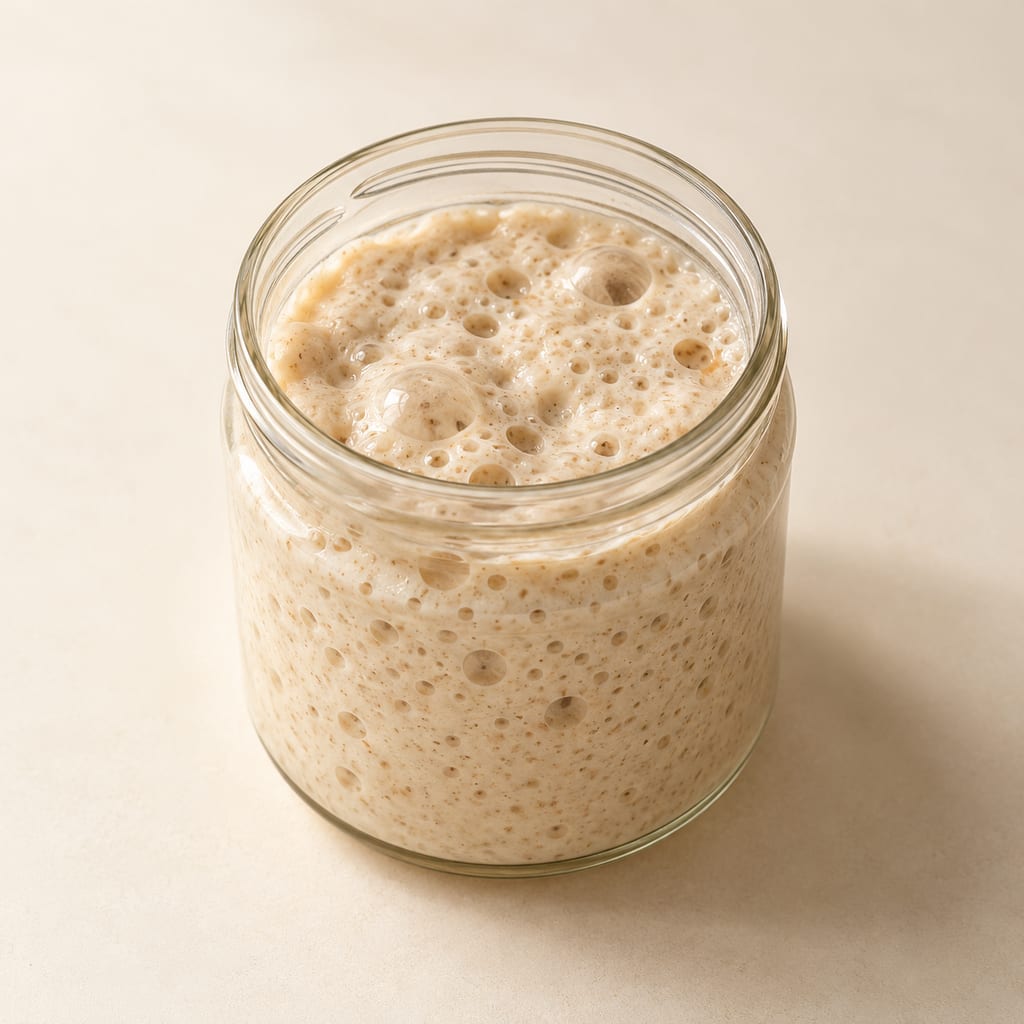
Lievito madre and pasta madre are Italian names for a sourdough culture that a baker keeps alive by repeated refreshment and uses to leaven dough. It is a mixed community of lactic acid bacteria and yeasts living in flour and water, and it is the leaven behind panettone, colomba and related enriched Italian baking. The two names are used for the culture itself, not for a single strain, a fixed hydration or a fixed lineage.
The sweet dough is not the culture. A baker refreshes the mother on its own schedule so that acidity and leavening power are in the right place before it is built into a rich dough, and the enriched dough that follows is a separate preparation. Practitioner descriptions treat a firm wheat dough as the usual form, with the baker's own hydration, wrapping, holding temperature and timetable held steady from one refreshment to the next.
Sources for this section
The microbes in two studied mother sponges
A three-year Food Microbiology study by Venturi, Guerrini and Vincenzini followed the mother sponges used by two Italian manufacturers, one making panettone and one making the Genoese dry biscuit Lagaccio, through every stage of production. The same three species dominated both: the bacterium Lactobacillus sanfranciscensis, the yeast Candida milleri, now placed in Kazachstania humilis, and the baker's yeast Saccharomyces cerevisiae. Each manufacturer's mother held its own strains of those species, which molecular methods could tell apart.
The three species grew at nearly the same rates and did not run out of maltose, glucose or fructose, so a maltose-using species and a maltose-negative one could live side by side without crowding each other out. The balance between bacteria and yeast was not the same in the two products: the ratio of lactic acid bacteria to yeasts was higher in the panettone sponge. The authors linked the difference mainly to the temperature of the regeneration stage, which for panettone took place under moderate refrigeration. These results describe those two processes. They do not describe every Italian mother.
Sources for this section
Refreshment routines
Professional routines differ. The panettone booklet from the pastry house Loison shows repeated refreshments before the staged panettone process, and its Italian and English versions disagree about whether the mother dough is made with wheat or rye flour, so that detail cannot be read as settled. A published recipe by the pastry chef Iginio Massari and a method by the chef Stefano Barbato each give their own way of refreshing the mother before a rich dough. Their timings, ratios and quality cues belong to those methods, and they do not combine into one universal care schedule.
Sources for this section
Place and the limits of a regional claim
In the study, panettone is a soft, stuffed cake of northern Italy and Lagaccio is a dry biscuit from Genoa. Those are product associations in a single paper. They do not show where lievito madre began, that a culture belongs to one place, or that every panettone uses the same microbial community.
Sources for this section
Judging a culture
The Massari recipe describes sensory and acidity readings as ways to judge the quality of the mother for pastry. Those are the cook's quality cues and not validated food-safety limits, and taste or acidity alone cannot show that a culture is safe to keep or use. The sources reviewed give no general rule for storage, for responding to contamination or for reviving a neglected mother.
Sources for this section
Places
Italy
Documented use · Country evidenceThe sources document the culture in Italian panettone and Lagaccio production. They do not establish an origin or exclusive geography.