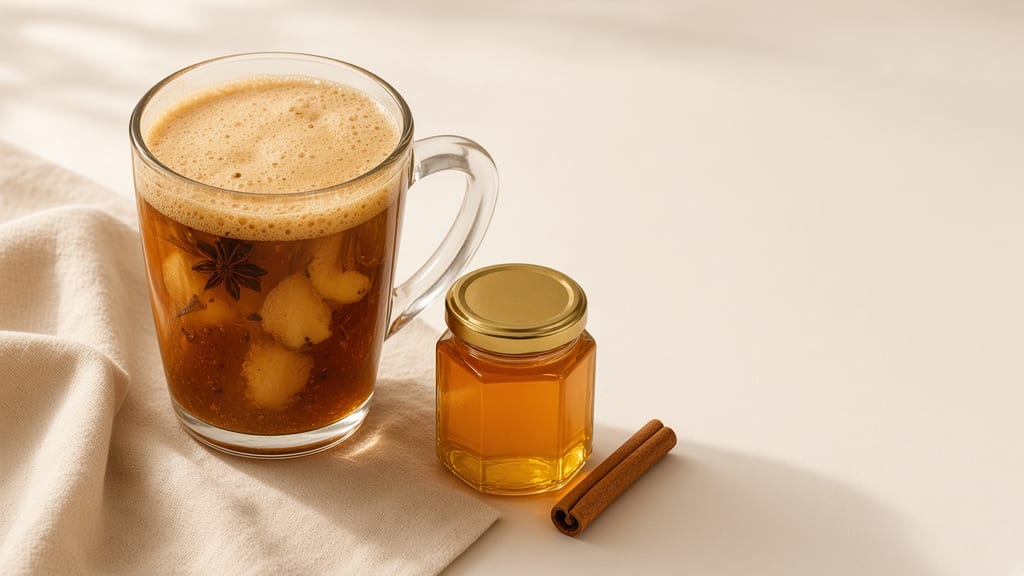
Sbiten
Hot Russian street drink of honey boiled with spices: a plain cup, the 1799 milk finish and a dark honey concentrate kept in a jar for a spoonful per glass.
 FermenteaWhere food goes to change
Spices and aromatics
Mace is the dried red aril that wraps the nutmeg seed, Myristica fragrans. It is sold as flat orange blades or ground, and tastes like nutmeg but lighter.
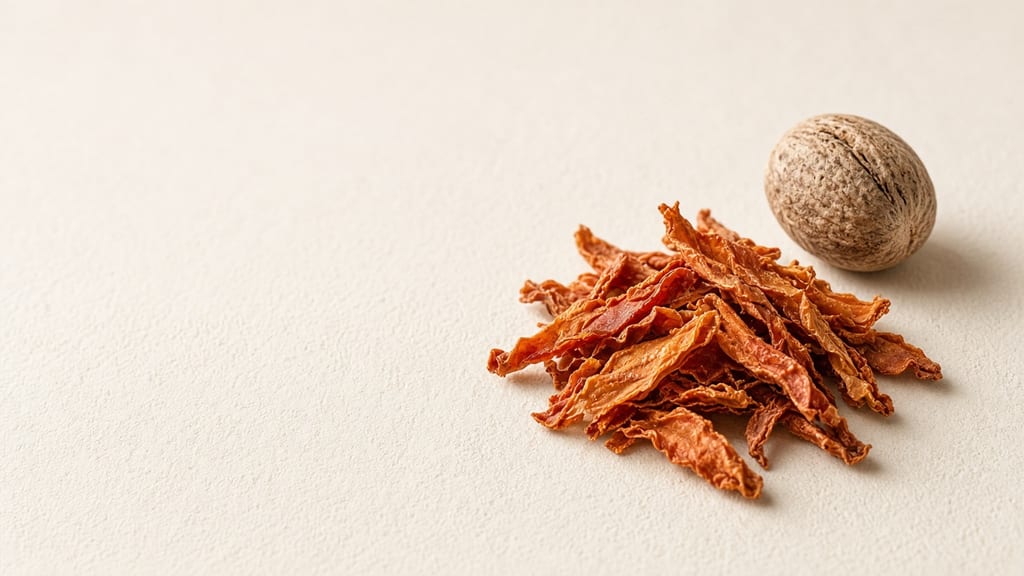
The nutmeg tree, Myristica fragrans, gives two spices. Nutmeg is the dried kernel of the seed. Mace is the dried aril, the covering that wraps the seed inside the fruit. Serious Eats describes the fruit as having a hard stone at its centre, like a peach. The seed is that stone. The aril around it is a bright red webbing, and when it is dried each piece is called a blade.
The tree is native to Maluku, the Moluccas in eastern Indonesia. ICAR's review names Indonesia, Grenada, Sri Lanka, China and India as the main producers, and says the tree is now grown across Asia and the Caribbean, especially Grenada.
The Russian name, мускатный цвет, means nutmeg flower. It is a misnomer. The Russian magazine Khimiya i Zhizn says the spice has nothing to do with flowers. It is the aril, also called мацис.
Growers harvest the fruit when it splits open on ripening. The review from ICAR says mace must be detached from the nut carefully and soon after harvest. It is washed, flattened by hand or between boards, and dried until it is brittle. Processing has to finish on the day of harvest, or the dried mace is of poor quality. The target moisture is about 10 per cent.
Colour sets the price. Fresh mace is red because of lycopene, the pigment that also colours tomatoes. Khimiya i Zhizn says the aril goes limp and orange when it is first dried in the sun, then it is shaped and dried further. The finished mace is thin, brittle and pale orange or dark yellow. ICAR says the pigment is sensitive to heat and light. Traditional drying over a fire is hard to control and chars 2–3 per cent of the mace. Hot-air drying keeps the colour better than sun drying.
The Khimiya i Zhizn account adds that the aril is pressed off the seed whole, so a damaged blade is worth less.
Both spices have a similar flavour. The sources disagree on which is sweeter. ICAR reports that nutmeg is slightly sweeter and is preferred in food. Serious Eats says that mace is lighter, subtler and sweeter than nutmeg, and likens it to nutmeg mixed with coriander, with a note of citrus and cinnamon.
ICAR says mace is popular in light-coloured foods because of its light orange colour. Serious Eats suggests it where nutmeg would be too heavy, for example in fruit dishes, white fish, chicken, lighter dairy dishes, pork, cookies, cream soups and root vegetables.
Mace is sold as whole blades and as a ground spice.
Kommersant quotes O. N. Shamanskaya's recipe for condensed sbiten. It takes molasses or honey, ginger, cardamom, "мускатного цвету", which is mace, and bay leaf, and boils them in a clean enamel pan until the mixture is dark and thick. The cook cools it, puts it in a glass jar and keeps it in a cool place. One tablespoon is stirred into a glass of boiling water. The recipe calls the result a very warming drink for colds.
The sbiten recipe on this site lists a pinch of mace in its concentrate.
No cited source dates the first use of mace in Russia, and none gives the amount of mace in Shamanskaya's recipe. The sources do not agree on whether mace or nutmeg is the sweeter spice.
Native range of the nutmeg tree according to ICAR-IISR; not a statement about where any one batch of mace was grown.
A condensed sbiten recipe quoted by Kommersant lists mace, under the Russian name for it.
Hot Russian street drink of honey boiled with spices: a plain cup, the 1799 milk finish and a dark honey concentrate kept in a jar for a spoonful per glass.
Boerewors, biltong and droëwors share a table but follow different paths from meat to meal. Their histories lead from the braai and butcher's counter to drying lines, household pots and the science of keeping food.
No community contributions have been published for this entry yet.
Sign in to contribute. Published comments and photos are free to read.
Indian Horticulture, ICAR, July–August 2025Agricultural institute review
Post-harvest processing, value-addition and by-product utilisation of nutmeg (Myristica fragrans)nutmeg tree is native to Maluku and gives two spices
mace is the dried aril around the seed
harvest when fruit splits
mace processing on the day of harvest, drying to about 10% moisture
scarlet colour sensitive to heat and light
traditional fire drying chars 2–3% of mace
nutmeg slightly sweeter than mace
mace preferred in light-coloured foods for its colour
Cited in: The red net around the nutmeg; From fruit to blade; Mace beside nutmeg; What the sources do not establish
Serious Eats, updated 26 February 2020Culinary article
How to Use the Spice Macenutmeg is a fruit with a stone at its centre
red webbing dries into mace, sold in blades
mace described as lighter, subtler and sweeter than nutmeg
suggested uses where nutmeg would be heavy
Cited in: The red net around the nutmeg; Mace beside nutmeg; What the sources do not establish
Химия и жизнь, no. 11, 2016Russian popular science article
Душистый мускатникмускатный цвет is also called мацис and is the aril, not a flower
fresh aril is red from lycopene, dries to a pale orange or dark yellow
the aril is pressed off the seed whole, sun-dried and flattened
Cited in: The red net around the nutmeg; From fruit to blade; Mace in sbiten
Kommersant, 13 July 2015Secondary article quoting Russian sources
«Стали важничать да барничать»: почему исчез самый любимый русский горячий напиток1852 recruit-party recipe names bay leaf as one option
Shamanskaya's condensed sbiten recipe names honey or molasses, ginger, cardamom, mace and bay leaf
Cited in: Mace in sbiten; What the sources do not establish