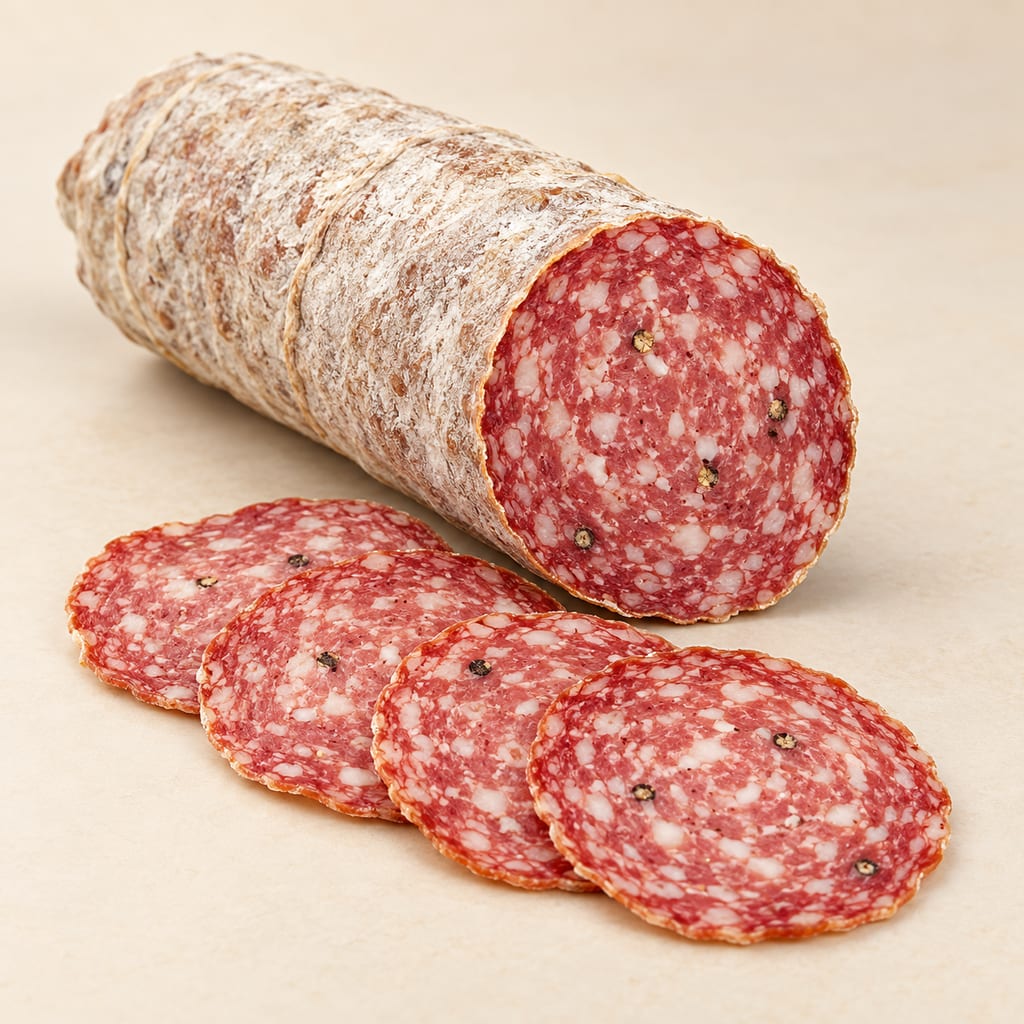
Genoa-style salami, red-wine method
Pork, beef and back fat ferment with a named starter, cure and red wine before the sausages dry in casings. This contemporary formula uses no wood-smoke stage.
 FermenteaWhere food goes to change
Cultures
MOLD-800 is a freeze-dried blend of two Penicillium species applied to the outside of dry sausage to establish a pale surface bloom.
Bactoferm® MOLD-800 is a freeze-dried surface culture for molded dried sausages. Its purpose is to establish a pale bloom on the casing as the sausage matures. The culture is supplied as a ground powder, described by its manufacturer as off-white to brownish, and is mixed with water before it is applied to the sausage. Once it grows, the cover is white to light gray and may be dense, medium in height or very fluffy. The manufacturer associates it with a fresh Camembert aroma; its broader surface-culture manual also describes mushroom flavor and a scent of moss.
The name refers to a particular commercial blend, not a color or a general household category. The producer lists two species in MOLD-800: *Penicillium candidum* and *Penicillium nalgiovense*. It publishes no strain identifiers or proportions in the product information consulted here. That distinction matters when comparing starter cultures: Bactoferm MOLD-600, for example, is listed separately and contains *P. nalgiovense*. The manufacturer describes MOLD-600 as producing a traditional white, uniform cover with a pronounced mushroom flavor. MOLD-800 is the mixed culture, with the more fluffy surface and Camembert-like aroma described above. A white sausage casing alone cannot tell a reader which culture was used.
Mold on cured sausage is older than the packet culture. Chr. Hansen’s account of fermented-sausage production describes historical sausage surfaces acquiring mold from the local production environment. This “in-house” flora could contribute aroma and texture, but it was not consistent from batch to batch. Directly applying a selected food culture gave manufacturers a way to make the surface cover more uniform and reduce failures caused by unwanted mold growth. The goal was a more controlled bloom, not the invention of mold-aged sausage.
The manual describes different appearances in different traditions: Hungarian smoked salami may develop a weak cover after smoking, while air-dried Milano-type sausages can have a whitish and sometimes marbled surface. These are examples of broader sausage-making practice, not evidence that MOLD-800 created those traditions or is used in each one. Smoke generally suppresses mold growth, and the manual connects the weak cover in the Hungarian example to the interaction of smoking with a long maturation and the meat batter’s pH. Regional appearance is therefore a result of the whole process and its local conditions, not simply a choice of culture.
The specific history of MOLD-800 remains undocumented in the material consulted: its launch date, selection history and original strain sources are not given. The manufacturer identifies it by product name and species, not by an archival story. It is more accurate to place the culture within the modern practice of selected surface inoculation than to assign it an invented origin or date.
MOLD-800 grows on the outside of a sausage. It is not the bacterial starter mixed through the meat to acidify it. In the Genoa salami recipe discussed below, SM-194 is added to the mince, while the mold culture is brushed or dipped onto the casing after stuffing. That physical separation is a useful way to understand the two jobs: the meat starter works throughout the mixture; MOLD-800 is intended to establish a surface cover.
As the cover develops, it forms a layer between the sausage and the surrounding air. Chr. Hansen’s meat manual explains that mold cover can reduce the direct effect of ventilation, diminish a hard, dry outer rim, and support more even drying. A dry rim forms when the outside loses moisture faster than the interior can equalize; the resulting contrast can leave the casing edge firmer than the center. A surface culture is one part of the maturation environment, not a substitute for controlling the process around the sausage.
The manual also describes proteolysis and lipolysis: enzymes break down proteins and fats during maturation. These changes contribute to aroma and texture, and the manual associates mold activity with a softer, less chewy result. MOLD-800’s combination of appearance and aroma is its own product profile, not a universal effect of every mold on every sausage. The manufacturer says its culture can help suppress indigenous molds, yeasts and bacteria, and can help prevent a dry rim. Its product sheet adds that during maturation the mold promotes a rise in pH and a less sour flavor. These are bounded product claims; they do not establish what will happen under every drying condition.
The manufacturer describes MOLD-800 as fast-growing under high humidity and suitable temperature, while retaining growth potential in dry or unstable conditions. “Potential” does not mean that the culture will produce identical coverage in any room. Chr. Hansen’s manual stresses that air speed, relative humidity and temperature strongly affect growth. In its general guidance for surface molds, it gives an ideal relative humidity above 90 percent, moderate air movement and a temperature range of 24–30°C; its product information gives technical growth data at 20–24°C for approximately 72 hours, with relative humidity higher than 93 percent at the beginning. These are related but distinct conditions for different contexts. These ranges should remain attached to their source and purpose rather than combined into a new universal schedule.
The casing and sausage shape also matter. The manual says natural casings are generally favorable for mold growth, whereas cellulose casings may be drier and can take longer to cover; collagen casings have different evaporation behavior. Fat-to-lean ratio and particle size affect moisture transfer to the casing, while smearing from filling can lead to uneven evaporation and uneven growth. The manual warns that too much air movement or too little humidity can slow coverage; a poorly growing inoculated culture may leave space for wild flora to appear. These observations explain why a named culture is not a visual guarantee: the resulting surface reflects the organism, casing and drying conditions together.
The manual’s troubleshooting notes offer a way to interpret uneven growth without treating it as proof of what organism is present. In its general observations, early growth may appear as small white dots; cold, dry or strongly ventilated conditions can slow coverage and leave larger uncovered areas. If the inoculated culture grows poorly, wild yeasts may take over. Green patches can indicate wild molds growing over the culture or later sporulation, while a weak cover can also reflect low humidity, high air speed or low temperature. The manual associates an overly strong ammonia aroma with excessive *P. candidum*, yeast growth or a process that kills the initial mold layer. These are producer troubleshooting possibilities across sausage-mold applications, not a diagnostic test for MOLD-800 or a reason to judge safety by sight or smell.
The pale coat is also a record of the conditions around the sausage. Growth may differ where air movement or contact differs, even on links treated from the same suspension. The manufacturer’s manual treats uneven coverage as a reason to examine humidity, ventilation, casing and application together. It is a visible process clue, not a measurement of acidity or moisture inside the meat.
Chr. Hansen’s product information describes a product-specific suspension method: mix a pouch into 1–2 litres of tap water at about 20°C, let it equilibrate for two hours at room temperature, then dilute it to the required suspension volume. The listed dosage is 50 g per 50 litres. The producer says to inoculate after stuffing and any acclimatization, by dipping, spraying or showering. It instructs the user to stir the suspension continuously so spores do not settle, and to use it on the day it is prepared; chlorinated water may reduce activity. The manufacturer’s meat manual likewise says dry spores are soaked for two hours before the suspension is made. These directions describe the manufacturer’s product and scale. They do not supply a validated conversion from a household teaspoon to grams or a dose per kilogram of meat.
In the Genoa salami recipe by Eric at 2 Guys & A Cooler, MOLD-800 is applied to the stuffed sausage by brushing or dipping. The recipe’s ingredient list calls for half a teaspoon in half a cup of non-chlorinated water, said to cover five to ten pounds of salami, and says to let it stand at room temperature for at least five hours. The method section instead says to prepare the culture two to three hours before it is needed. Those directions disagree. The linked instructional video could not be retrieved during this research, so it has not resolved the difference. A reader-facing recipe should retain the discrepancy or seek clarification from the author; it should not quietly choose one interval and present it as confirmed.
That recipe also names MOLD-600 as an alternative, and the author confirms a reader’s use of MOLD-600 in a comment. This is a practical recipe-level substitution note, not evidence that the two products are compositionally identical. The manufacturer’s product descriptions show that they differ in species composition and reported flavor/coverage characteristics. Any adaptation should continue to distinguish the culture named on the package from the starter used in the meat and from the full fermentation and drying controls of the recipe.
The manufacturer expresses its amount as a volume of suspension rather than as a dose by meat weight. Its production manual explains that how many sausages a suspension treats depends on their diameter: a larger sausage presents less surface area per unit of meat than a narrow one. That industrial observation is another reason not to read a retailer’s “pounds treated” claim as a universal conversion from the producer’s litres of suspension. For a reader following the Genoa recipe, the spoon measure and stated 5–10 lb coverage remain the recipe author’s own directions, separate from the pack-level manufacturer rate.
The 2020 product sheet says the dry culture should be stored below −17°C. It gives a minimum shelf life of 18 months when stored as recommended and a maximum of six weeks at +5°C. These are manufacturer label statements for that product sheet, not a guarantee for an opened packet or any specific lot. The sheet lists sucrose and culture as ingredients and marks the common allergens in its US/EU table as absent. It reports Kosher Pareve status excluding Passover and Halal certification. Those declarations belong to the named formulation and document; they do not certify a finished salami.
The product information is explicit that the manufacturer of the final food remains responsible for its food safety and should maintain continuous controls and conduct application-specific food-safety studies. A white bloom, a familiar aroma or a named culture cannot by itself establish that a sausage is safe. MOLD-800’s role is a selected surface culture within a controlled curing process; it does not replace the recipe’s separate meat fermentation, drying and handling requirements.
The sources establish the product name, its two listed species, powder form, intended surface application and broad characteristics. They do not identify the strains or their proportions, document a product launch date, or verify the culture on a pictured Genoa salami. The product’s supported application here is surface treatment of molded dried sausages; the consulted sources do not support extending MOLD-800 to unrelated foods or uses.
Producer documents do not establish the culture blend’s production origin or the source of its undisclosed strains.
Pork, beef and back fat ferment with a named starter, cure and red wine before the sausages dry in casings. This contemporary formula uses no wood-smoke stage.

Soft, spreadable Calabrian pork sausage made with a great deal of red chilli and fatty pork, stuffed into natural casings, sometimes smoked and matured while staying soft.

A way to add independent temperature logging to an existing food dehydrator without changing its built-in controls or protections. It is a monitoring method, not a rewiring plan.

Pleurotus cystidiosus is the abalone mushroom, a cultivated oyster-type fungus with dark brown caps that grows more slowly and is more demanding than other Pleurotus species.

A dark, balanced vinegar from Emilia-Romagna made by combining cooked or concentrated grape must with wine vinegar, then acetifying and refining it in wood under a protected specification.

A living dairy inoculum that starts controlled cream fermentation, developing acidity and aroma before sour cream or cultured butter is finished.

A small electric incubator holds jars at a selected temperature for yogurt and other documented warm food preparations. Controls, capacity and vessel arrangement vary by model.

Adygean salt is a seasoned table salt associated with Adygea and the wider North Caucasian culinary tradition. Salt is blended with garlic and a variable selection of herbs and spices; the exact mix depends on the named style and maker.

The African Caesar-group mushroom, Amanita masasiensis, is a wild ectomycorrhizal species of central and southern African woodlands, eaten locally. The genus contains deadly poisonous species, so identification needs care.
No community contributions have been published for this entry yet.
Sign in to contribute. Published comments and photos are free to read.
Chr. Hansen A/S (transcription hosted by Manuals+)Ingredient context · Process
Bactoferm MOLD-800 Product Information, version 6Two listed species; product form and claims; producer preparation, storage and final-food responsibility.
Cited in: A culture for the outside; What a surface culture changes; Conditions shape the bloom; Applying the named culture; What is established—and what is not
Chr. Hansen A/S (PDF hosted by CFU Bio)Ingredient context · Process
Bactoferm Meat Manual vol. 2: Fermented sausages with Chr. Hansen surface culturesGeneral mold-cover history, growth influences, casing interactions and distinct MOLD-800 profile.
Cited in: A culture for the outside; From spontaneous growth to selected surface flora; What a surface culture changes; Conditions shape the bloom; Applying the named culture; What is established—and what is not
2 Guys & A CoolerIngredient context · Process
Genoa SalamiRecipe-specific MOLD-800 quantity, 5–10 lb coverage, inconsistent soak intervals and brushing/dipping stage.
Cited in: What a surface culture changes; Applying the named culture