
Aniseed
Aniseed is the dried ripe fruit of Pimpinella anisum, an aromatic Apiaceae spice commonly called a seed. It adds a sweet, warm aroma to breads such as Moroccan krachel and South African mosbolletjies, and is distinct from star anise.
 FermenteaWhere food goes to change
Mushrooms
Cantharellus pallens is a pale, fleshy European chanterelle with orange-yellow folded ridges. It is gathered and sold as food in documented regional traditions, but its variable appearance makes photographs unreliable for identification.
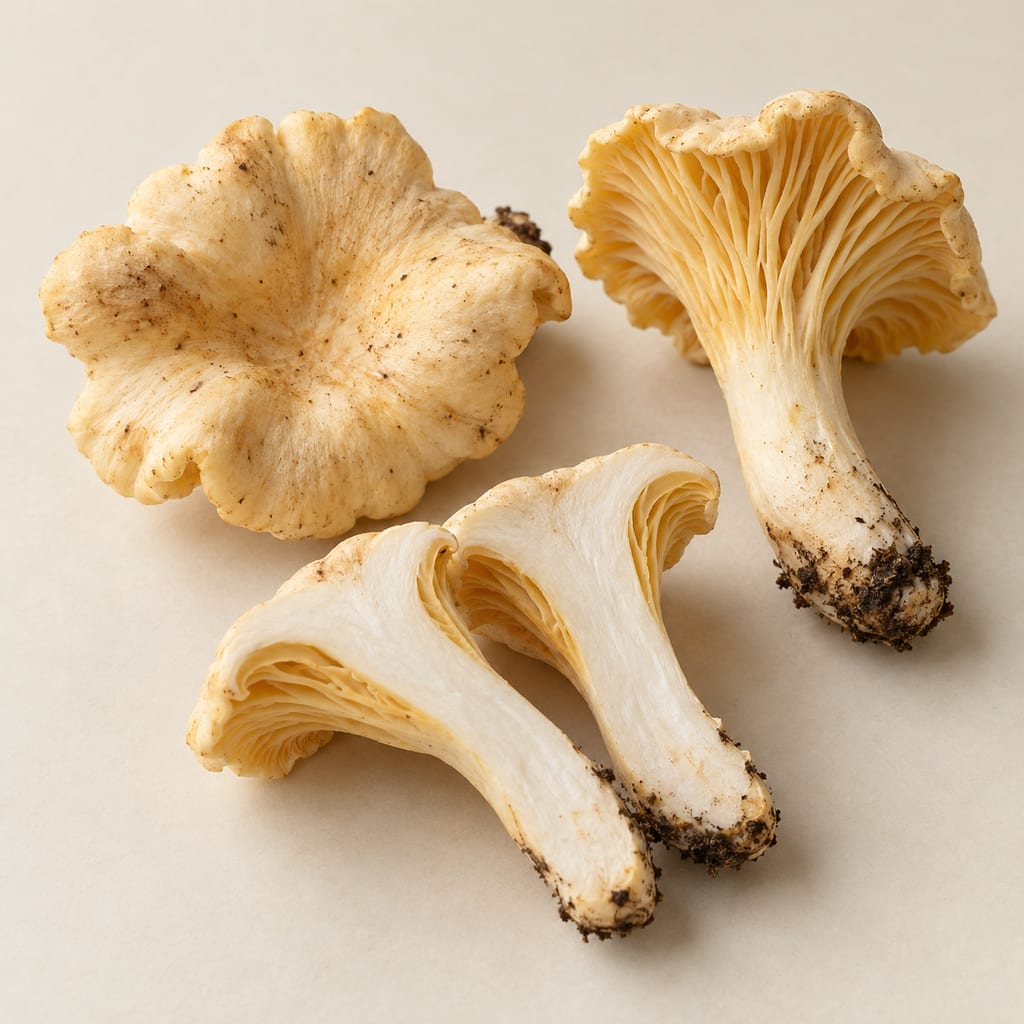
Cantharellus pallens Pilát is a wild, tree-associated chanterelle known in English as the pale chanterelle. The current European taxonomic treatment does not describe it as simply a colour form of the familiar golden chanterelle. Olariaga and colleagues re-examined European type specimens and compared four DNA regions, recognizing eight species in Cantharellus sensu stricto. Their 2017 treatment placed Cantharellus cibarius var. albidus, C. cibarius var. bicolor and C. subpruinosus within C. pallens. The Red List account now follows that revised, broader concept.
This history matters when reading older field guides, market records and local names. In northern Europe, authors often used C. pallens; in southern Europe, C. subpruinosus was commonly used for the same taxon. An older record under one of these names may refer to the same species, but it still needs to be checked against the concepts used by its author. In particular, historical records that call every golden chanterelle C. cibarius can conceal several species and should not be reassigned automatically.
Pilát described C. pallens in 1959 from a collection made on 10 September 1957 at Přeštice in Bohemia, now part of Czechia. The 2017 revision sequenced the type and found its ITS2 sequence identical to the other material that the authors assigned to C. pallens. This links the name to a specimen-based taxonomic concept, rather than to the pale appearance alone.
The fruitbody is fleshy and substantial. In the European revision the cap is 25–95 millimetres across. Young caps are often pale orange-white, sometimes with a slight pinkish cast; as they expand and age, they may become entirely orange-yellow or keep paler patches where they were sheltered. A dry young specimen may stain strongly when touched, while a mature or water-soaked one may show little staining. These variable responses are part of the species description, not a simple test that can confirm it.
The underside carries thick, blunt ridges rather than the thin, separate gills of many familiar mushrooms. The ridges run down the stem, fork and join again, and are usually ochre to orange-yellow, often brighter near the cap margin. The solid stem is often pale when young and becomes more yellow with age. Local Spanish guides describe a white or pale surface bloom on young caps and stems; the molecular revision notes that this coating is absent in its formal description, so it should not be treated as a universal feature. Colour shifts with age, exposure, moisture and the taxonomic concept used.
These features explain why a photograph may be attractive but inconclusive. Older, washed or waterlogged fruitbodies can lose the pale contrast and look much like C. cibarius. Other European chanterelles overlap in cap colour, staining and habitat. The revision distinguishes species through combinations of characters and specimen comparisons, not a single visual hallmark.
Cantharellus pallens is ectomycorrhizal: it fruits from a fungal network associated with tree roots rather than from a rotting log. The trees and soils reported with it vary geographically. European vouchers include collections under oak, beech, hazel, spruce, pine, aspen and mixed woodland. The Red List summary describes predominantly deciduous hosts but also records associations with Pinus, Picea, Arctostaphylos and Cistus. The Ultzama Mycological Park guide in Navarre emphasizes beech and oak.
The 2017 study notes an ecological difference across the range. In Fennoscandia, the species is reported mainly in forests with richer ground; Mediterranean collections are more strongly associated with acidic soils. This is a pattern, not a rule that lets a reader identify a mushroom from its soil. Chanterelles occur in complex forest communities, and a host tree or soil type is supporting context rather than proof of species.
Humidity influences fruiting. The Navarre park says that high ambient moisture is important and that moist, relatively cool summers are favorable in its beech woods. A forest can support the fungus without producing fruitbodies every year, and the above-ground season should not be mistaken for the life of the underground mycelium.
The IUCN Red List assessment describes a broad range from the Mediterranean, including Morocco, north to Fennoscandia, and says the species is more frequent in southern Europe. It is assessed as Least Concern, while its population trend remains unknown. The mapped range reflects the current taxonomic concept and available records; it is not a complete survey of every forest or a guarantee of local abundance.
The European revision gives specimen-level localities that can be traced: the type locality at Přeštice in Bohemia; a French type of the synonym C. subpruinosus in Haute-Savoie; several collections in Italy's Belluno and Siena provinces; records in Catalonia, the Basque Country, Madrid and Navarre in Spain; a collection from Chefchaouen Province in Morocco; and an Uppland specimen in Sweden. These are evidence of collections, not all evidence of culinary use.
A 2019 report added a voucher-backed collection in Burabay National Park, Akmola Region, Kazakhstan: it was found under aspen in a mixed conifer-deciduous forest on 15 August 2016. That record extends the documented geography eastward beyond the range usually summarized in European field guides. The publication provides a voucher, collector and date, which makes it stronger than a map pin without specimen evidence, while still representing one identified collection.
There is no single fruiting calendar that fits the whole range. Vouchers in the European revision were gathered from June to November: examples include a June record in Madrid, July collections in Italy and France, an August collection in Navarre and Sweden, and October or November records in Catalonia, Italy and Morocco. The type itself dates to September. The Kazakhstan voucher was collected in August.
The Ultzama park describes fruiting in beechwoods from late May to early November, with beech woods tending to fruit earlier than oak woods in its local conditions. It attributes good fruiting to moist, relatively cool summers. The Moroccan interviews add a very different local picture: respondents said the mushroom could appear in autumn, winter, spring or across more than one season. Those answers reflect local observation and the questions used in the survey, not a controlled phenology study.
Together, the records show that fruiting can span spring through autumn in some European sites and include winter reports in the Moroccan study area. Month-by-month changes in rainfall, elevation, forest host and temperature can shift the season. A fruiting report from one site should not be used to predict the harvest window somewhere else.
A particularly detailed food-use account comes from the Moroccan sector of the Intercontinental Biosphere Reserve of the Mediterranean. Rosas, Daniëls and Infante interviewed 129 people in 2011 and 2012 in Chefchaouen town, Bab Taza and nearby rural settlements. They found that C. pallens was nearly the only wild mushroom gathered for consumption and sale in the study area, even though the parks contain many other fungi. Knowledge and use were greater in rural communities; many urban residents were unfamiliar with wild mushrooms unless their families came from rural areas.
The interview study gives a glimpse of knowledge moving through households. More than half of the respondents who described who taught them to pick mushrooms named family, usually grandparents. People who picked C. pallens often did so frequently in season. Among those who gathered it, 40 percent reported collecting only for sale and 60 percent for both sale and household consumption. These percentages describe the survey's interviewees, not the Moroccan population as a whole.
The researchers describe purchases in Chefchaouen markets and at street stalls around Chefchaouen, Dardara and Bab Taza. This is a documented wild-food economy tied to rural gathering and short-distance sale. It should not be turned into a timeless claim about present-day supply: the evidence is a specific field study from 2011–2012, and the authors' use of the species name follows the taxonomic concept available then.
The Moroccan survey found that rural respondents described preparing mushrooms in a tajine, while town respondents more often reported cooking them with eggs or using them on pizza and pasta. The survey grouped cooking responses for wild and cultivated mushrooms and did not supply a C. pallens recipe with quantities or timings. Its value is evidence that the chanterelle entered distinct home and market settings, not a universal method.
Spanish specialist sources call it a good or excellent edible mushroom and describe it as versatile in cooking. The Ultzama guide says it dries readily, while a Nordic food-trade assessment reports occasional sales fresh, dried or canned. These sources reflect different regional practices; they do not prove that each method is equally common or that dried, canned and fresh forms behave identically. The Spanish national commercial list includes C. pallens among species that may be marketed fresh under that country's rules.
The Moroccan interviewees reported that wild mushrooms were not preserved, even though urban households bought canned cultivated button mushrooms. Since C. pallens was the only wild mushroom they commonly ate, the finding is relevant to its local use, but it remains a survey result rather than a universal cultural practice. I found no species-specific fermentation method. Fermentation should not be inferred from sale, cooking, drying or canning.
The edible designation is supported by several kinds of evidence: the IUCN Red List calls C. pallens edible; Spanish specialists describe it as a food mushroom; Morocco's field interviews document its collection, sale and consumption; and Spanish regulations list it for fresh marketing. Together these sources support a page about a named food ingredient and its documented uses.
Those reports do not certify an unknown specimen. A species-level statement of edibility is different from an identification, a toxicological assessment of every population, or a safe-use instruction. The Nordic assessment is an older food-market source and records past taxonomic uncertainty around the name. Modern phylogenetic work clarifies the name but also shows why visual rules can fail: chanterelle characters overlap and change with age and moisture.
A related orange mushroom, Omphalotus illudens, is mentioned in regional guides as a possible confusion; it grows on wood and has true gills. That comparison is a warning about the limits of casual visual matching, not a complete diagnostic checklist. Readers should rely on qualified local expertise and applicable food regulations rather than this page or a photo to decide whether to eat a wild specimen.
The evidence supports C. pallens as a gathered food mushroom used cooked in several documented European and Moroccan settings. Sources describe fresh sale, drying and canning, but I found no traditional or modern fermentation process specific to this species. A Fermentea ingredient record can explain its identity and food context without inventing a fermented preparation or implying that preservation methods are interchangeable.
The research candidate already exists as “Pale chanterelle,” with C. pallens and C. subpruinosus among its names. It is being reused rather than duplicated. The current version is a draft for review and will remain unpublished until its source coverage, narrative depth, places and imagery are checked.
The market context also sets a boundary around what this record can say. A mushroom sold under a vernacular market name may not be traceable to an individual voucher, and a sales statistic for a regional chanterelle trade cannot by itself show the proportion made up by this species. The stronger evidence combines specimen-based taxonomy with field or regulatory records that explicitly use C. pallens. Where a source uses an older name, this account keeps the synonym relationship visible and avoids silently reassigning records that have not been examined. These distinctions matter to readers because taxonomic revisions change which observations belong to a species, even when the mushroom and local name appear unchanged.
Interview study documents collection, sale and consumption of C. pallens; does not imply all Morocco follows the practice.
Regional mycological park describes the species as a good edible and gives local habitat and season information.
IUCN assessment describes a broad distribution and edible status; this region-level row is not a record of continuous occurrence or uniform culinary practice.
Voucher occurrence record, not a food-use location.
Type locality in the European revision; a taxonomic record, not a food-use location.
Aniseed is the dried ripe fruit of Pimpinella anisum, an aromatic Apiaceae spice commonly called a seed. It adds a sweet, warm aroma to breads such as Moroccan krachel and South African mosbolletjies, and is distinct from star anise.

Ripe avocado flesh is the soft, buttery, fat-rich pulp of Persea americana, eaten raw. It is low in acid, so it is a fresh ingredient that needs care in chilled dishes.
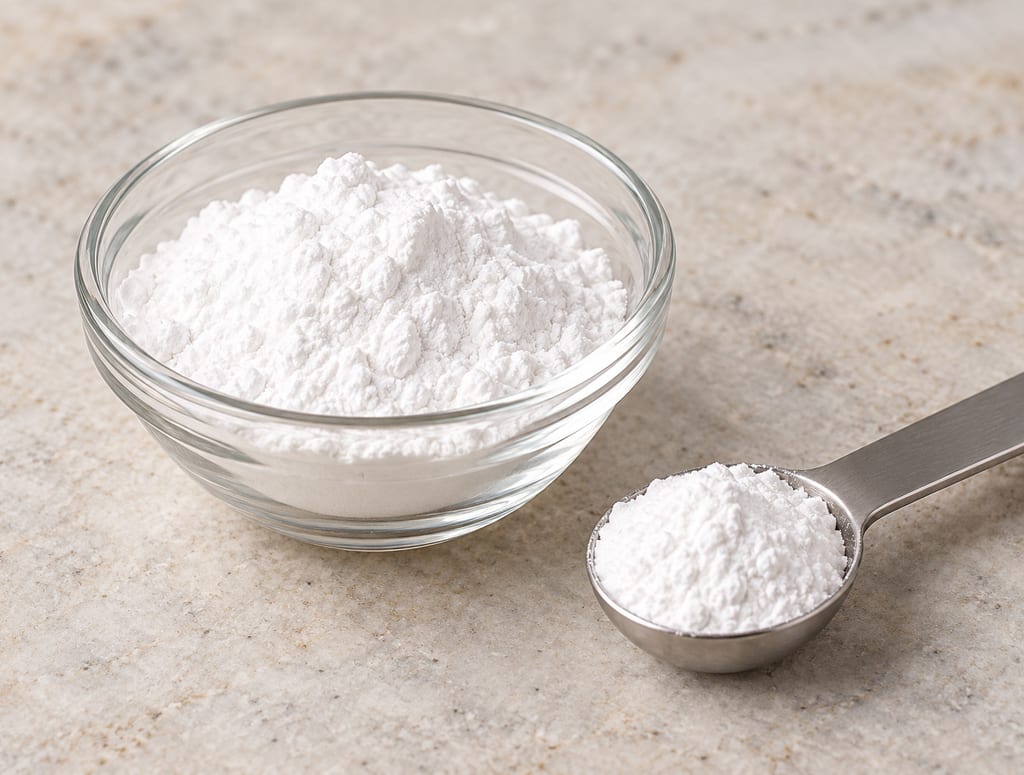
Baking powder is a dry chemical leavener that combines bicarbonate with acid-reacting ingredients and a carrier. Moisture and heat release carbon dioxide for quick breads, batters and griddle cakes.
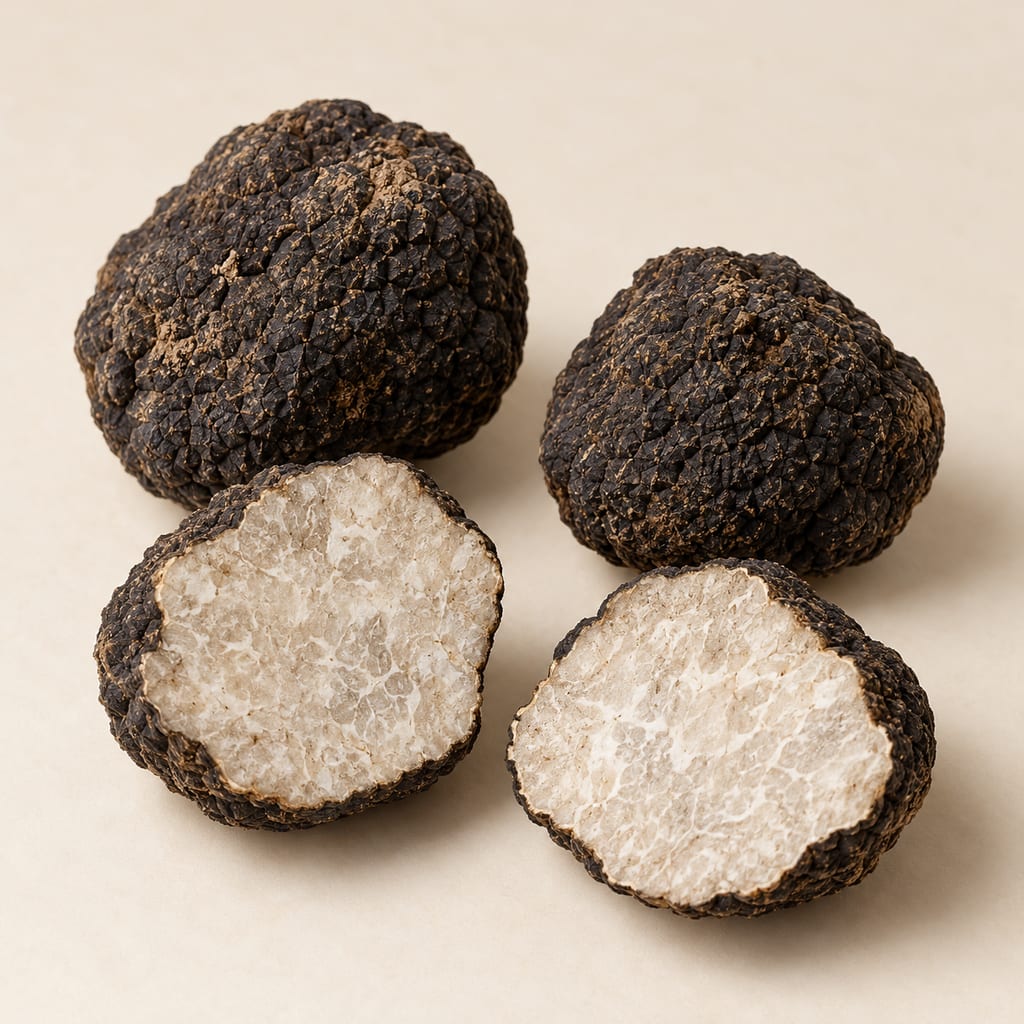
The black desert truffle, catalogued as Picoa juniperi, is a subterranean fungus gathered wild in arid and semi-arid lands. Eastern Anatolian households eat it, usually fried with eggs.

Chicken eggs supply proteins and yolk fats that set and emulsify. Atlas breads use them in enriched doughs, surface washes and a sourdough pancake batter mixed after fermentation.
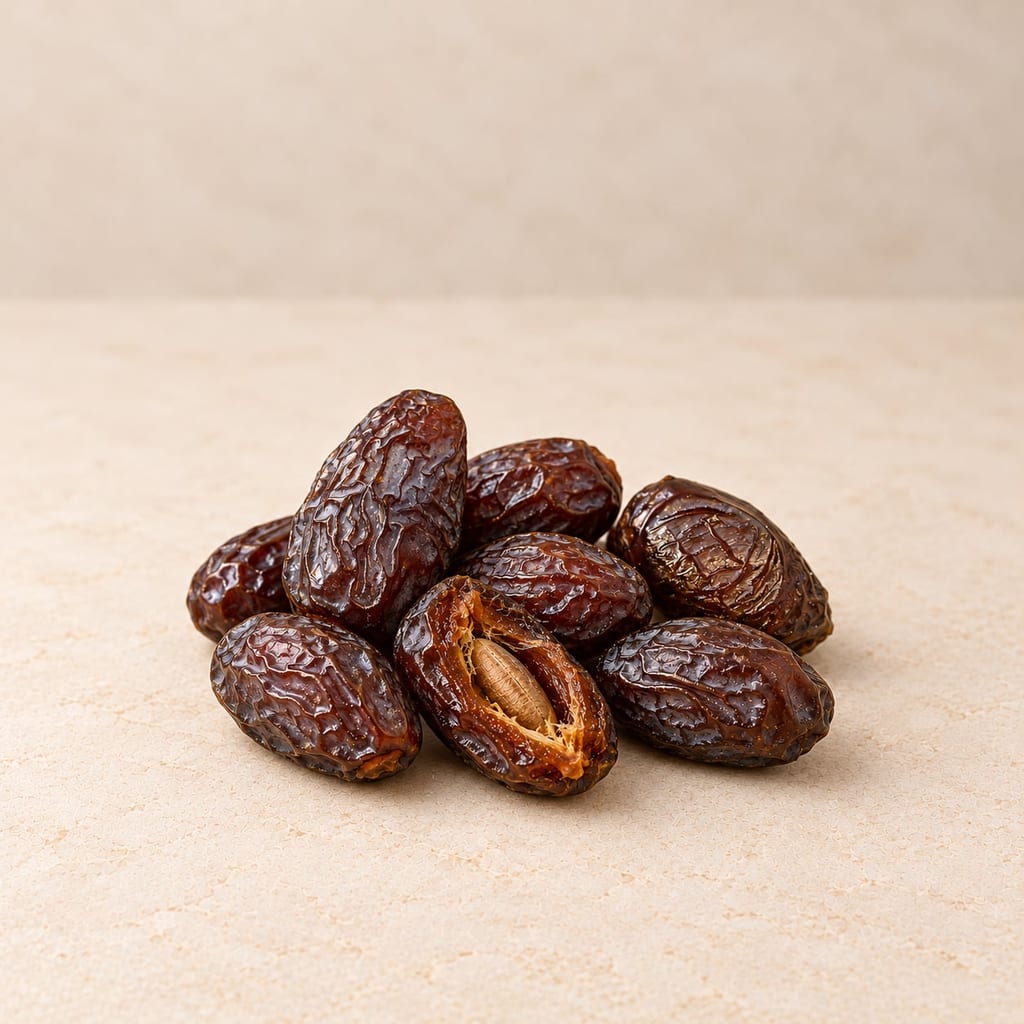
Dates are the sugar-rich fruit of the date palm, eaten soft or dried and used whole, pitted, as syrup or as paste. In sauces and chutneys they add sweetness and body.
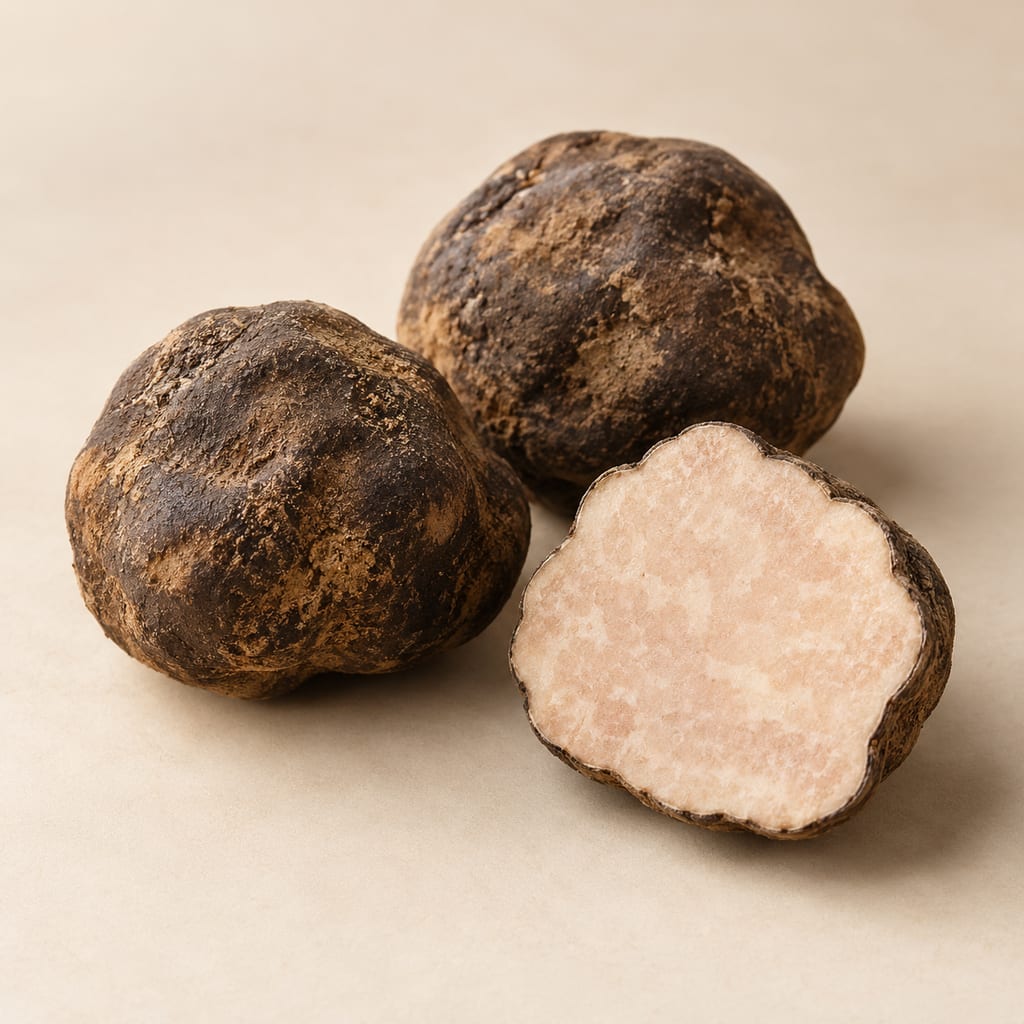
Desert truffle, Terfezia claveryi, is an underground fungus of dry Spanish and Moroccan ground that is gathered and sold seasonally, under names such as terfass, in local markets.
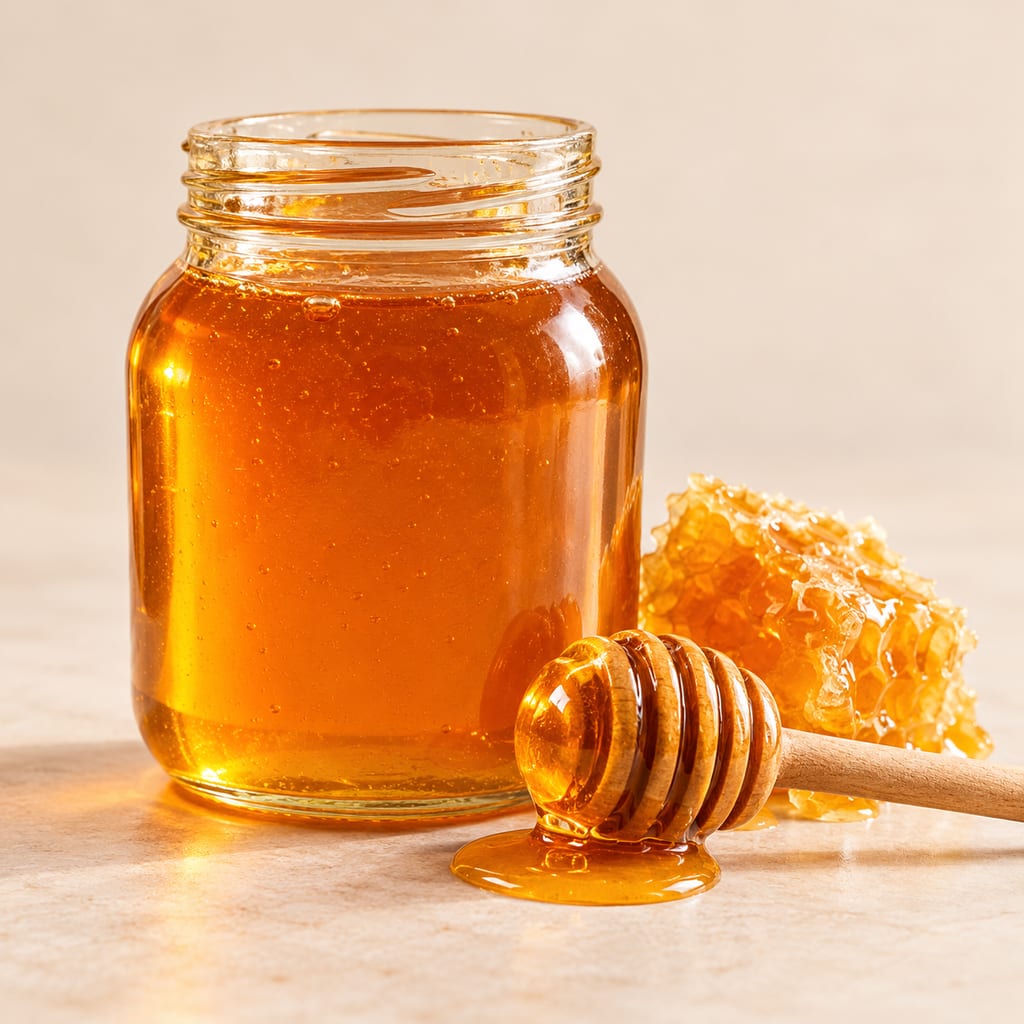
Honey is a bee-made food from floral nectar or honeydew; breads use it in dough or as a syrup served with cooked griddle breads.
No community contributions have been published for this entry yet.
Sign in to contribute. Published comments and photos are free to read.
Fungal DiversityTaxonomy · Identity · Ecology · Geography · Season
Cantharellus (Cantharellales, Basidiomycota) revisited in Europe through a multigene phylogenyFour-locus revision of European Cantharellus names and species limits.
Synonymy of C. subpruinosus and historical C. cibarius varieties under C. pallens.
Holotype and dated voucher localities, morphology, soils, host records and range.
Cited in: A pale chanterelle with a revised name; Appearance changes with age and weather; A forest partner across different soils; A range documented by specimens and food records; Fruiting time follows place and weather; What the food reports do and do not establish
The IUCN Red List of Threatened SpeciesTaxonomy · Geography · Ecology · Food use
Cantharellus pallensMediterranean/North African to Fennoscandian range; more frequent in southern Europe.
Forest habitat and host range; edible use; Least Concern assessment with unknown population trend.
Cited in: A pale chanterelle with a revised name; A forest partner across different soils; A range documented by specimens and food records; Gathering and food trade in the Rif; What the food reports do and do not establish
Boletín de la Sociedad Micológica de Madrid 41Food history · Traditional use · Geography · Season
Ethnomycological study of the Moroccan sector of the Intercontinental Biosphere Reserve of the Mediterranean129 interviews in 2011–2012 document C. pallens gathering, sale and consumption in Chefchaouen province.
Respondents reported rural/urban differences, market/street-stall purchasing, tajine and other cooking contexts, and multiple fruiting seasons.
The study does not provide a full C. pallens recipe or species-specific fermentation method.
Cited in: Fruiting time follows place and weather; Gathering and food trade in the Rif; Cooking and preservation are regional choices; What the food reports do and do not establish; A wild ingredient with no established fermentation role
Parque Micológico UltzamaEcology · Season · Food use · Safety
Cantharellus pallens – RebozueloLocal Navarre association with beech and oak, humidity and late-May-to-early-November fruiting.
Regional food-value description and named lookalike warning.
Cited in: A forest partner across different soils; Fruiting time follows place and weather; Cooking and preservation are regional choices; A wild ingredient with no established fermentation role
Comunidad de MadridFood use · Regulation
Comercialización de setasSpanish official list includes C. pallens among mushrooms permitted for fresh marketing under Spanish rules.
Cited in: Cooking and preservation are regional choices; What the food reports do and do not establish
Current Research in Environmental & Applied Mycology 9(1)Geography · Ecology · Season
New macrofungal records for KazakhstanVoucher-backed Cantharellus pallens record from Burabay National Park, Akmola Region, under Populus in mixed forest, collected 15 August 2016.
Cited in: A range documented by specimens and food records; Fruiting time follows place and weather
Nordic Council of MinistersFood use · Safety · Market
Mushrooms Traded as Food, Volume II, Section 2Older Nordic food-trade assessment says C. pallens was appreciated and occasionally sold fresh, dried or canned.
The report records historical disagreement about whether C. pallens should be treated as a separate species from C. cibarius.
Cited in: Cooking and preservation are regional choices; What the food reports do and do not establish; A wild ingredient with no established fermentation role
Sociedad Micológica BarakaldoIdentity · Food use · Ecology
Cantharellus pallens PilátSpanish regional description and seasonal/ecological notes; specialist account describes it as an excellent edible species.
Cited in: Appearance changes with age and weather
Xunta de GaliciaIdentity · Food use · Ecology · Safety
Guía de cogomelos de GaliciaRegional description of pale bloom, folded hymenophore, apricot aroma, host woods and late-spring-to-autumn fruiting.
Warns that washed or mature specimens can resemble C. cibarius; the regional guide lists it as edible.
Cited in: Appearance changes with age and weather