What baking powder is
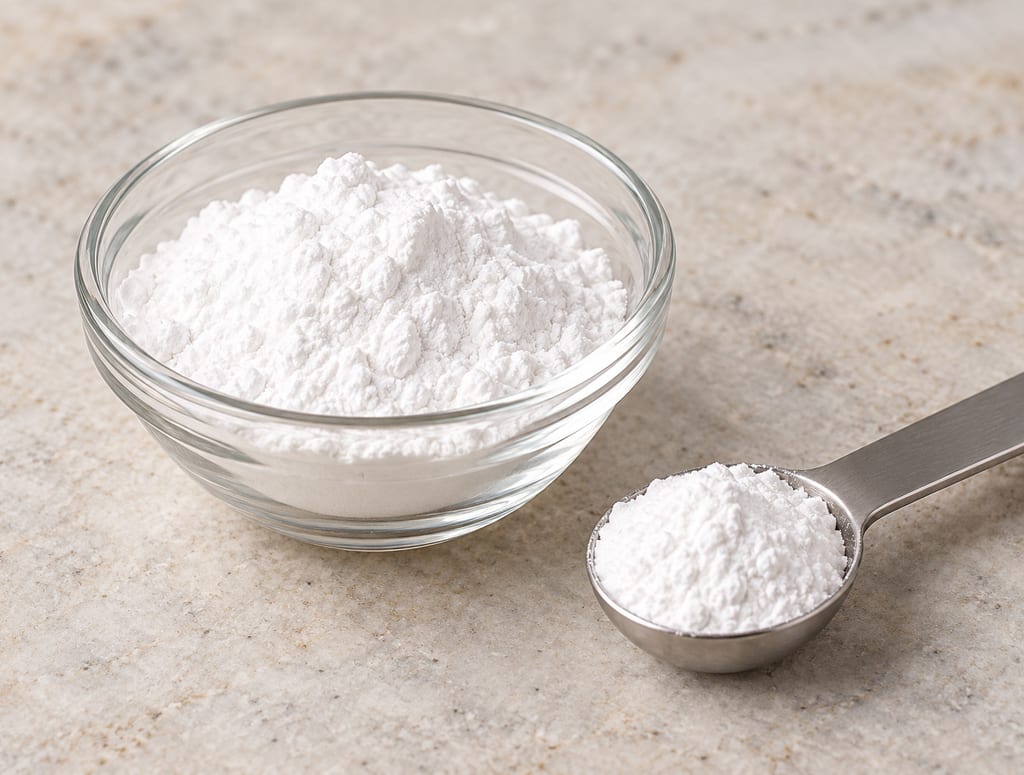
Baking powder is a dry chemical leavener: a prepared blend rather than a single compound. Its central pair is an alkaline bicarbonate and one or more dry acid-reacting materials. A carrier, often starch or another neutral substance, helps keep the components dispersed and limits premature contact with moisture. When the mixture reaches water in a batter, the base and acid can react and release carbon dioxide.
Baking soda is different. It is sodium bicarbonate alone, so a formula using it must supply a suitable acid elsewhere or use its heat-driven decomposition. Baking powder packages both sides of an acid–base system, which is why many recipes can use it without separately listing vinegar, cultured milk, citrus or another acid. This does not mean every powder uses the same acid or that every batter has identical acidity.
The Canadian Food Compositional Standards define the mixture as sodium or potassium bicarbonate combined with acid-reacting material and starch or another neutral material. The standard recognizes more than one possible acid family, including lactic, tartaric, phosphate and aluminum compounds. The commercial name therefore refers to a functional class of leavening mixtures, not one fixed chemical recipe. A product label is the source for what a particular packet contains.
Sources for this section
How the dry mixture became familiar
The American Chemical Society describes bakers using sodium bicarbonate with sour milk in the 1830s. The milk supplied acid, but its strength varied, so the rise was less predictable from batch to batch. Cream of tartar, a dry acid available to bakers by the 1840s, made the pairing more regular. At first, those ingredients were sold or stored separately because dampness could start the reaction before the cook wanted it.
Eben Horsford, a Harvard chemist working with George Wilson, developed calcium acid phosphate as another acid component and patented its manufacture in 1856. Their business, Rumford Chemical Works, made the phosphate and marketed a baking preparation with bicarbonate. Adding corn starch helped keep the ingredients dry and separate in storage. It made the premixed product more convenient: a baker did not have to measure the alkaline and acidic powders separately.
The ACS account places this product history around Rumford's works in Rhode Island, with later commemorations in East Providence and at Clabber Girl in Indiana. It also notes that commercial product names and formulations changed over time. This chronology is useful for understanding the modern packaged leavener; it should not be read as an origin date for all chemically leavened foods or as a claim that earlier cooks lacked other ways to raise dough.
Sources for this section
What happens after mixing
When water dissolves the dry components, hydrogen ions from an acid react with bicarbonate. In simplified terms, the reaction produces carbon dioxide and water. The gas forms bubbles in the batter. Air already incorporated during mixing can give those bubbles places to start, and the expanding gas enlarges the cells as the food heats. The leavener produces gas; the dough's structure must hold it long enough for starch and proteins to set.
Baking powder is not yeast and does not ferment the dough. It does not need a living culture, a long proof or microbial growth to create its leavening gas. A cook can nevertheless find it in a recipe that also uses yeast or a fermented starter. In that case the two methods are distinct: yeast or bacteria contribute biological changes over time, while the powder supplies a chemical reaction after wetting and heating.
The timing depends on the blend and the recipe. A single-action powder releases its gas primarily when moistened. A double-acting powder combines acids that react at different stages, with some gas released after mixing and another portion during heating. The term describes the leavener's reaction pattern, not a promise that the batter can wait for any length of time. Follow the recipe's mixing and cooking sequence.
Sources for this section
Different blends and the recipes they support
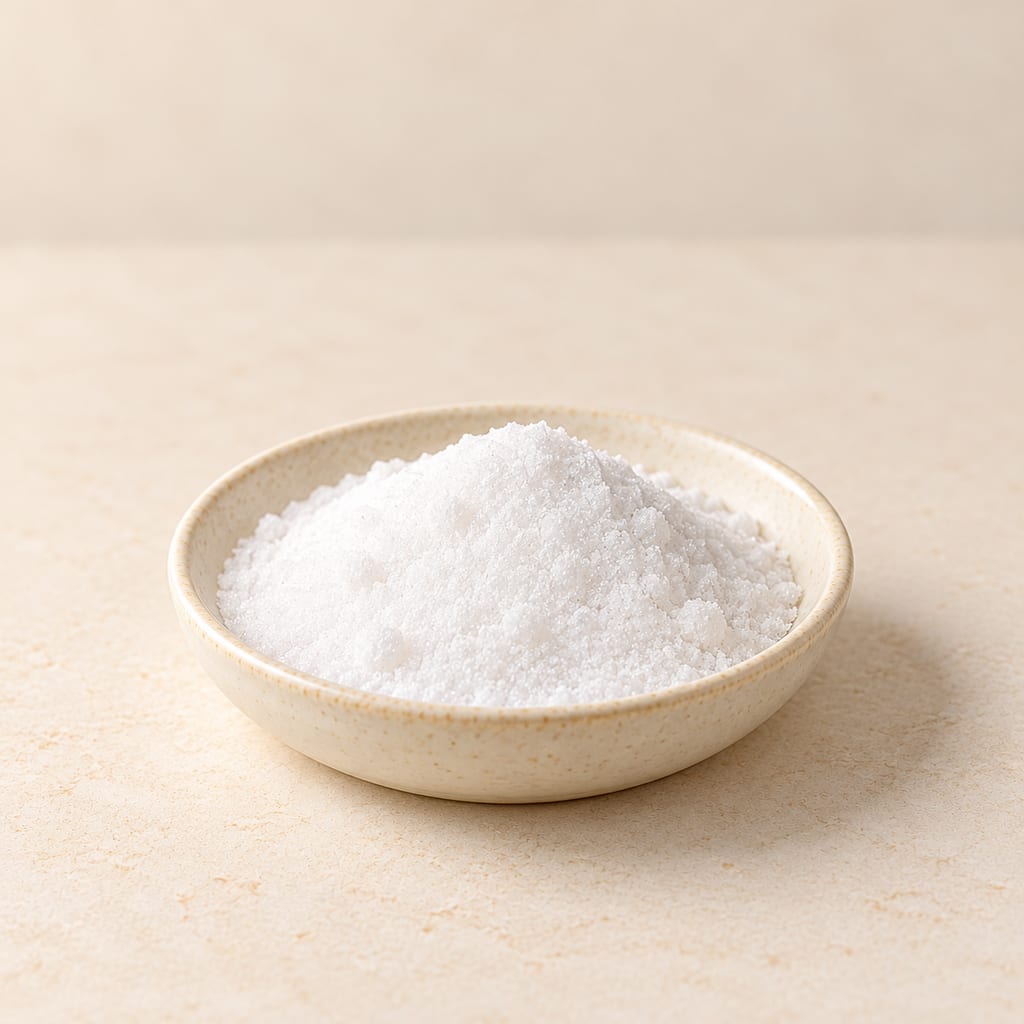
Baking powder formulations can vary in their acid salts and carriers. The chosen acid affects how readily the mixture reacts when it is wet and how much reaction continues as it heats. Starch or another neutral material dilutes and separates the active ingredients in a dry blend. The precise combination belongs to the manufacturer and any food standard that governs the product. A cook cannot identify the blend just by seeing a white powder.
This variation is one reason recipe writers specify baking powder separately from baking soda and give a formula's own amount. A recipe can also use both. One reason is that the food includes acid but needs more lift than that acid and soda pairing alone would supply; another is that the cook wants to retain a particular acidity while adding more gas. Those decisions depend on the whole recipe. A casual swap can change height, taste, browning and crumb.
The product is often chosen for preparations whose mixing and cooking happen within one session: biscuits, muffins, cakes, scones, pancakes and some griddle breads. In these foods, bubbles expand while the flour-and-liquid structure sets. Bread made with powder is often called quick bread because it can rise without a lengthy yeast proof. The label describes the leavening route; it does not establish a single global bread tradition.
Sources for this section
Documented breads in several places
In the United States, King Arthur Baking's contemporary light biscuit recipe lists baking powder among its ingredients. It is one recipe for tender, raised biscuits, not a universal formula for biscuits everywhere. The ACS account also associates baking powder's nineteenth-century commercialization with American quick baking such as biscuits and cookies.
A Moroccan food writer describes harcha as a pan-fried semolina cake and records baking powder in both plain and seasoned versions. In that specific formula, the powder is mixed into semolina and the shaped rounds cook on a pan. Milk quantity is adjusted to the semolina's absorption, and a rest gives the grain time to take up liquid. This is practical recipe evidence, not proof that all harcha use the same leavener.
The Migrating Kitchen Trust's Somalia recipe page gives a muufo formula with coarse cornmeal, plain flour and baking powder. It combines the dry ingredients with onion and other additions, then cooks the flat dough on a heated pan under a grill. The page is a record of one version, not an exhaustive account of Somali bread. These examples show that modern home recipes use baking powder in different grain bases and cooking settings, while each remains tied to its own sourced version.
The regional examples also show why a leavener article should not turn a shared ingredient into a shared food identity. The Moroccan writer describes harcha as a Moroccan breakfast staple and the cited formula is a pan-cooked semolina cake; the Somali food project presents muufo as cornmeal cornbread and serves it with meat dishes. Baking powder has the same broad chemical role in each, but the grain base, mixing, shaping and cooking remain different. An ingredient link can help readers follow that role across the catalogue while each preparation page keeps its own name and context.
Sources for this section
Using it at home
Measure the product named by the recipe and distribute it through the dry ingredients. BCcampus's baking text advises combining baking powder with flour or other dry ingredients so the leavener spreads through the batter. This matters because a pocket that receives much more powder than the rest of the mixture will not raise the same way as an even dose. Follow the recipe's specified amount and order rather than adding powder by eye.
Once the dry leavener meets liquid, a reaction may begin before the pan or oven is ready. Have the vessel and heat prepared according to the recipe, and avoid adding extra wait time without evidence for that particular formula. Double-acting powder provides a later gas release, but it does not make every batter tolerant of indefinite resting. Recipe differences in flour, water, acid, sugar, fat and mixing all affect how the gas is held.
Do not replace powder and soda in equal spoon measures. Baking soda is a concentrated alkaline ingredient without the dry acid blend, while baking powder includes both. King Arthur Baking explains that substitutions change the amount of base and the acidity balance, and may affect taste and texture. Use a tested recipe's stated leavener; if changing it, use a reliable formulation for the specific bake rather than assuming the two white powders behave alike.
Some cooks mix a leavener from separate ingredients, but the proportions must suit the chosen acids, bicarbonate and carrier. The cited food standards show that several components are possible, so an improvised blend cannot be assumed equivalent to a commercial packet. This page does not provide a universal homemade formula or a replacement ratio.
The amount of powder is part of a recipe's structure, not just a flavour adjustment. BCcampus notes that excessive baking powder can make a baked item collapse, and that accurate scaling matters. A spoonful added because a batter looks flat can overleaven the mixture instead of fixing its balance. When a bake does not rise, check the ingredient label, storage conditions, measuring, distribution and the recipe's sequence before changing quantities. This is a troubleshooting path, not a test for food safety.
For home cooks, the simplest useful distinction is practical: baking powder is often the complete dry system named in a formula, while baking soda depends on the formula to provide acid. The powder's own acids mean a recipe can use milk, water or other ingredients without requiring one particular sour ingredient, but that does not make it neutral in flavour or interchangeable in every bake. The recipe still controls the amount, mixing order and heat source.
Sources for this section
Storage, labels and dietary questions
Keep baking powder in its closed package or an airtight container in a dry cupboard, and follow the manufacturer's storage directions. A wet spoon or humid storage can let the mixture react before it is added to a recipe. That can reduce the gas available for the bake. The powder may still look normal, so appearance does not tell a cook how much leavening activity remains.
A bubbling check after contact with water can indicate that a reaction is occurring, but it cannot establish the package's food safety or guarantee that a finished recipe will rise properly. Nor can bubbles or appearance validate a changed recipe. Use the package within its labelled period and follow the recipe's amounts and method; when storage or packaging is questionable, follow the supplier's guidance.
Read the ingredient statement when allergies or dietary restrictions matter. A neutral carrier can be a starch, and food standards allow materials from different sources. Product formulations may also use different acid-reacting compounds. The ingredient name alone does not tell whether a particular packet fits a gluten-free, grain-free or other dietary requirement. Use the manufacturer's current declaration for the specific package.
In normal cooking, treat baking powder as a measured food ingredient rather than a household remedy or a substitute for another chemical product. Its formulation is designed for baking. If a person has swallowed a substantial amount by mistake or has a reaction, use local poison-control or medical advice instead of relying on this ingredient article.
Sources for this section
Allergens
Formulas vary; check the package label for the starch source and other ingredients relevant to an allergy or dietary restriction.
Places
United States
Historical attestation · Country evidenceThe American Chemical Society documents nineteenth-century development by Eben Horsford and Rumford Chemical Works. This is a historical association, not a claim that all chemical leavening began in the United States.
Morocco
Documented preparation · Country evidenceOne contemporary semolina harcha formula uses baking powder; recipes vary and this is not a universal ingredient claim.
Somalia
Documented preparation · Country evidenceA community food project documents baking powder in one muufo formula; Somali bread methods vary.