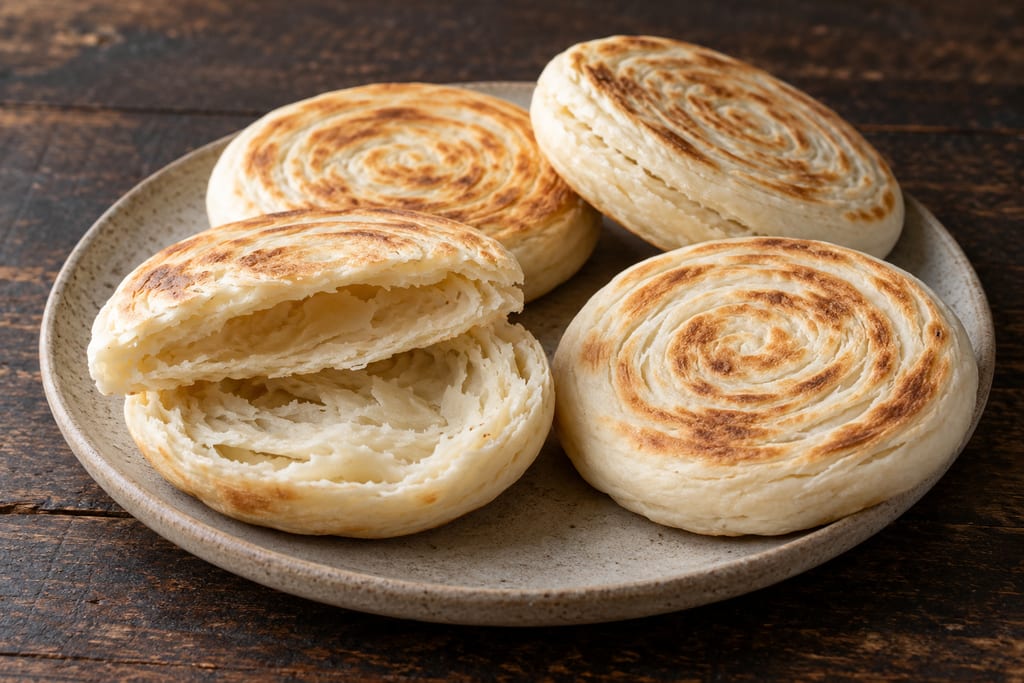
Baiji mo (Bai ji mo)
This Shaanxi-associated yeast flatbread uses a simple water dough, coiled shaping and a skillet bake. It is the bread used in roujiamo, not the filled meat dish.
 FermenteaWhere food goes to change
Modern adaptation
Hua juan (花卷) · Chinese flower rolls · steamed scallion buns
Hua juan are layered wheat rolls shaped into knots and steamed. This version folds scallions and five-spice between the dough layers and makes eight savory buns.
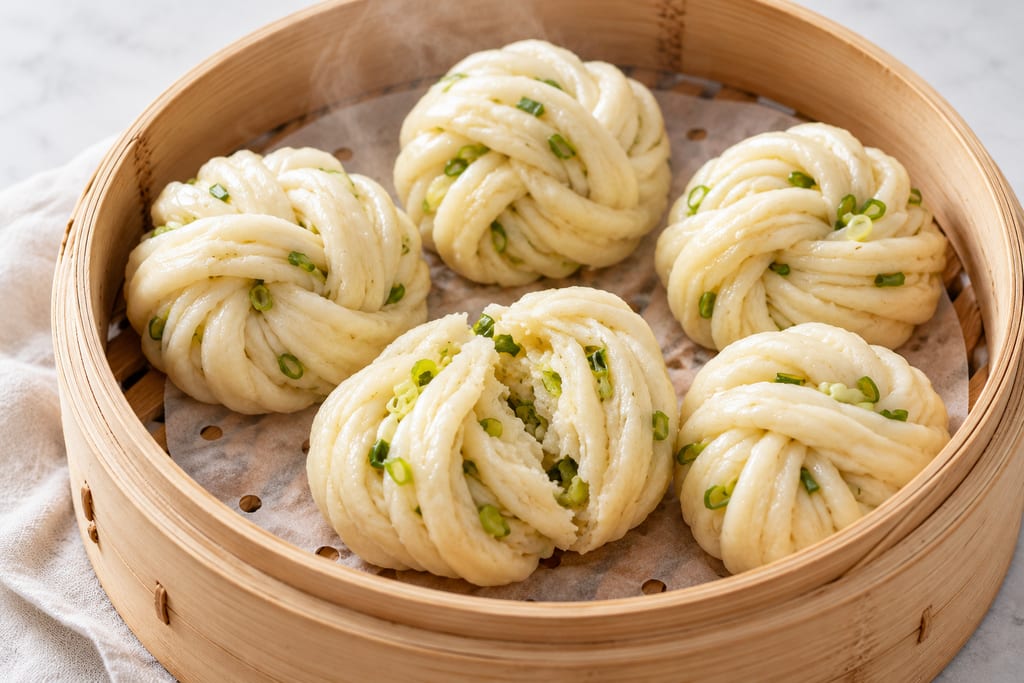
Hua juan are Chinese steamed wheat-flour rolls whose layered, twisted shapes resemble flowers.
The name is written 花卷 in simplified Chinese and is commonly romanised as huājuǎn in Hanyu Pinyin.
The word combines the ideas of a flower and a rolled or curled form.
The defining feature is the structure of the dough.
Rather than enclosing a filling inside a sealed bun, hua juan display layers of dough wrapped around seasonings. When the dough is twisted and steamed, those layers remain visible.
The result is soft, elastic and fragrant.
This particular version contains finely chopped scallions, five-spice powder, salt and oil.
It can be served directly from the steamer or finished by browning its base in a frying pan.
The recipe makes eight rolls and was published in March 2022 by Kaitlin Leung of The Woks of Life.
It is a contemporary family-recipe development within a much older Chinese steamed-bread tradition.
Wheat-based breads and dumplings have long histories in northern Chinese food cultures.
Steaming is an important cooking technique because it allows dough to cook in a humid environment without developing the same browned crust as oven baking.
The wider family includes mantou—plain steamed buns—and baozi, which commonly contain enclosed fillings.
Hua juan occupy another position in the family.
Their seasoning is layered into the dough rather than sealed within a central cavity.
Their shapes may be simple spirals, twisted knots or more intricate floral forms.
The current source documents a modern family method and describes an earlier scallion-roll recipe published in 2014.
It does not establish the exact century when flower rolls first appeared.
Nor does it identify one exclusive Chinese province of origin.
The bread should therefore be associated broadly with Chinese steamed-wheat traditions, with regional and historical claims attached only when independently documented.
Lukewarm water — Scant ¾ cup
Active dry yeast — 1 teaspoon
Sugar — 1 tablespoon
All-purpose flour — 2 cups
Baking powder — 1 teaspoon
Salt — ¼ teaspoon
Chinese five-spice powder — ½ teaspoon
Salt — ½ teaspoon
Neutral oil — 2 tablespoons, plus additional brushing oil
Scallions — 2 medium, about ½ cup finely chopped
Extra flour — Up to 2 tablespoons, only if needed
The total salt measured for the recipe is ¾ teaspoon, divided between the dough and filling.
The original formulation distinguishes these two additions.
Additional oil for brushing and optional frying is not quantified.
The water is slightly less than a full three-quarter cup rather than a precise mass.
Wheat flour supplies the gluten-forming proteins needed to stretch and retain gas.
Water hydrates the flour and allows gluten development.
Yeast produces carbon dioxide during proofing.
Sugar provides a readily accessible carbohydrate and adds a slight sweetness.
Baking powder contributes chemical leavening.
Salt seasons the dough and influences gluten and yeast behaviour.
Five-spice provides a distinctive aromatic mixture.
Its composition varies commercially, but common components include star anise, fennel, clove, cinnamon or cassia, and Sichuan pepper.
Scallions contribute the principal fresh vegetable flavour.
Oil is especially important because it separates the folded dough layers.
Without it, surfaces may stick together during proofing and steaming, making the intended flower structure less pronounced.
Hua juan depend on visible, separable layers.
Wheat dough surfaces are naturally adhesive when moist.
If layers are folded together without a barrier, their gluten networks can bond during subsequent proofing and cooking.
Brushing with oil reduces direct adhesion.
It allows adjacent surfaces to remain distinct as the roll expands.
This is why the preparation uses oil more than once: initially on the rolled rectangle, then again between folded and stacked strips.
The amount and placement affect the final geometry.
An even thin coating is more useful for layer separation than large pools of oil.
The exact extra brushing quantity is not specified.
Place the scant ¾ cup lukewarm water in a measuring cup.
Add 1 teaspoon active dry yeast and 1 tablespoon sugar.
Stir.
Leave for 15–20 minutes, until foamy.
Colder conditions may require longer.
The water temperature is not stated numerically.
Place 2 cups all-purpose flour, 1 teaspoon baking powder and ¼ teaspoon salt in the mixing bowl.
Combine the dry ingredients.
This helps distribute the baking powder and salt throughout the flour.
Gradually add the activated yeast liquid.
Mix until the flour is hydrated and the dough begins to come together.
A stand mixer with a dough hook is convenient, but the original method also permits hand mixing and kneading.
Knead for 20 minutes using the specified stand-mixer method.
The dough should become smooth.
It should release from the bowl rather than remain heavily sticky.
If necessary, add additional flour 1 tablespoon at a time, up to 2 tablespoons.
The extra flour is corrective, not an automatic ingredient addition.
Mix ½ teaspoon five-spice powder with ½ teaspoon salt.
Wash and thoroughly dry the scallions.
Chop finely.
Drying the scallions matters because excessive surface water can interfere with layer formation and create wet patches in the dough.
Line two levels of a bamboo steamer with perforated parchment or damp cheesecloth.
The lining helps prevent sticking while allowing steam circulation.
The source's batch places four rolls on each level.
Roll the dough into a rectangle approximately 9 × 18 inches, reported as about 20 × 45 cm in the method.
The objective is an even sheet that can be folded into multiple layers.
The dough should be sufficiently elastic to roll without tearing.
Brush the entire surface with a thin layer of neutral oil.
Sprinkle evenly with the five-spice and salt mixture.
Distribute the chopped scallions across the dough.
Try to prevent large clumps of scallion from collecting in one area.
Fold one long third of the rectangle over the centre.
Brush the newly exposed dough surface with oil.
Fold the opposite long third over it.
This creates a layered strip of dough with seasoning between the layers.
Divide the folded strip into 16 narrower strips.
The exact width depends on how evenly the dough was rolled and folded.
The number matters because two strips will be paired to make each roll.
Brush one strip lightly with oil.
Place a second strip on top.
Repeat to create eight pairs.
Place a chopstick along the length of one stacked pair.
Press down to create a central indentation.
This shapes the layered strip and helps define the folds that become visible after twisting.
Hold one end in each hand.
Gently stretch the strip.
Twist several times.
Tie into a loose knot.
The dough should retain some freedom to expand during proofing and steaming.
An excessively tight knot may compress the centre and distort the layers.
Place four rolls on each steamer tier.
Cover.
Leave in a warm place for 30 minutes.
No numerical proofing temperature is specified.
The rolls should become noticeably more expanded.
Place the bamboo steamer over water in a wok.
The water should not reach more than ½ inch up the sides of the bamboo steamer.
This figure does not specify the total water depth in the wok.
Turn the heat to medium-high.
Start a 15-minute timer when the heat is switched on.
Steam should become visible around the lid near the 10-minute mark.
After 15 minutes, turn off the heat.
Leave the lid closed for another 10 minutes.
Opening immediately can produce a sudden change in steam and temperature conditions, increasing the risk that the buns shrink or collapse.
Heat a nonstick or cast-iron pan with additional oil.
Place the steamed buns in the hot pan.
Cook until their bottoms become golden and crisp.
The source does not give an exact finishing duration.
Serve warm.
The Woks of Life
The yeast uses fermentable sugars in the dough to produce carbon dioxide and ethanol.
The carbon dioxide becomes trapped in the gluten network.
As the dough proofs, small gas cells expand.
The baking powder offers a second leavening mechanism.
Depending on its formulation, chemical leavening releases carbon dioxide through reactions involving bicarbonate and acidic components.
The two forms of gas production complement one another, although the recipe does not quantify their relative contributions.
Hua juan are therefore yeast-fermented bread with additional chemical leavening, not a non-fermented quick bread.
Steaming heats the dough through contact with hot water vapour and condensation.
The moist environment prevents the surface from drying as rapidly as it would in a conventional oven.
As temperature increases, starch gelatinises.
Gluten proteins set.
Gas cells expand and then become stabilised within the cooked crumb.
Because the surface remains moist, the rolls do not develop the characteristic dry browned crust of baked bread.
Their white, soft appearance is therefore a direct consequence of the cooking method.
Several conditions affect steamed dough stability.
Insufficient gluten development may leave the structure too weak to retain gas.
Overproofing can weaken the dough before cooking.
Uneven steaming may prevent the centre from setting properly.
Sudden cooling or condensation can contribute to shrinking and surface defects.
The original method addresses one of these risks by requiring a covered rest after heat is turned off.
That does not mean every collapsed bun was caused by premature lid opening.
The full sequence of mixing, proofing and steaming must be considered.
Scallions belong to the genus Allium, associated with sulphur-containing aroma compounds.
Chopping damages the tissues and releases characteristic fresh onion aromas.
Five-spice contributes compounds from several dried spices.
Star anise, for example, contains anethole, which produces an anise-like aroma.
Clove contains eugenol, associated with its distinctive warm, pungent character.
The final mixture combines these strong aromatic compounds with the relatively mild flavour of steamed wheat dough.
Oil also carries fat-soluble flavour components, helping distribute some aromatic compounds between the layers.
Hua juan can be made with different seasonings.
Scallion and salt are a familiar combination.
Some versions use sesame seeds, sesame oil or other spices.
Shapes vary widely, from loose coils to intricate twists.
The same family has previously published a related scallion roll with bacon, but that is an adaptation rather than a standard component of all hua juan.
The principal dough and shaping technique remain recognisable across these variants.
A change in spice quantity alone does not require a separate article.
A substantial change in dough, cooking method or filling could justify a linked variation.
Another documented method uses a covered skillet instead of a bamboo steamer.
Oil is heated in the pan.
The rolls are arranged with space between them.
They begin browning on the bottom.
Then ⅔ cup water is added and the pan is covered.
The buns steam while the water evaporates.
After the water disappears, the lid is removed and the bottoms can brown further.
This produces a combination of steamed softness and crisp pan contact.
The method is similar in principle to some pan-steamed dumplings, though hua juan remain bread rolls rather than filled dumplings.
Hua juan can be eaten as a bread accompaniment to Chinese meals.
Their mild wheat flavour and savoury seasoning work alongside vegetable dishes, tofu and meat preparations.
They can also be eaten as a snack.
The twist allows pieces to be pulled apart, exposing the scallion-filled layers.
A crisp-bottom version offers another texture.
The steamed version remains uniformly soft, while pan-frying provides a browned surface.
Both are legitimate serving choices for this recipe.
The layers fuse together: Insufficient oil between folded surfaces may be responsible.
The dough tears while twisting: Gluten development or resting may be inadequate.
The rolls lose their shape: They may have been twisted too loosely or overproofed.
The buns collapse after steaming: Check proofing, steaming and the covered resting stage.
The scallions create wet patches: Dry the chopped scallions thoroughly.
The bottoms stick: Check the liner and cooking surface.
The buns are dense: Yeast condition, kneading and proofing may require attention.
Hua juan contain wheat and therefore gluten.
They are cooked through steaming, not eaten as raw fermented dough.
Take care when removing the lid because steam can cause severe burns.
The original recipe does not provide a validated finished-product storage period.
Cool leftovers appropriately and refrigerate or freeze according to normal cooked-bread handling.
The author describes family recipe development and passing dough-making knowledge to a next generation. That contemporary account does not document an earliest attestation or origin chronology.
Yield 8 rolls · Scaling: source batch only
The dough is uncooked during mixing, proofing and shaping; raw flour can carry germs.
Hazard sourceThe rolls cook in a covered bamboo steamer set in a wok over medium-high heat; visible steam rises around the lid.
Hazard sourceDo not taste the raw dough. Cook the rolls according to the recipe before eating; wash hands, bowls, utensils and work surfaces after handling flour or dough.
Control sourceKeep hands and face clear of escaping steam and use heat protection when lifting the bamboo steamer or lid.
Control sourceDo not taste raw dough. The bamboo steamer, wok water and escaping steam are hot; use care when uncovering or removing the steamer.
The inspected page identifies the food as Chinese hua juan; it does not name a birthplace.
This Shaanxi-associated yeast flatbread uses a simple water dough, coiled shaping and a skillet bake. It is the bread used in roujiamo, not the filled meat dish.
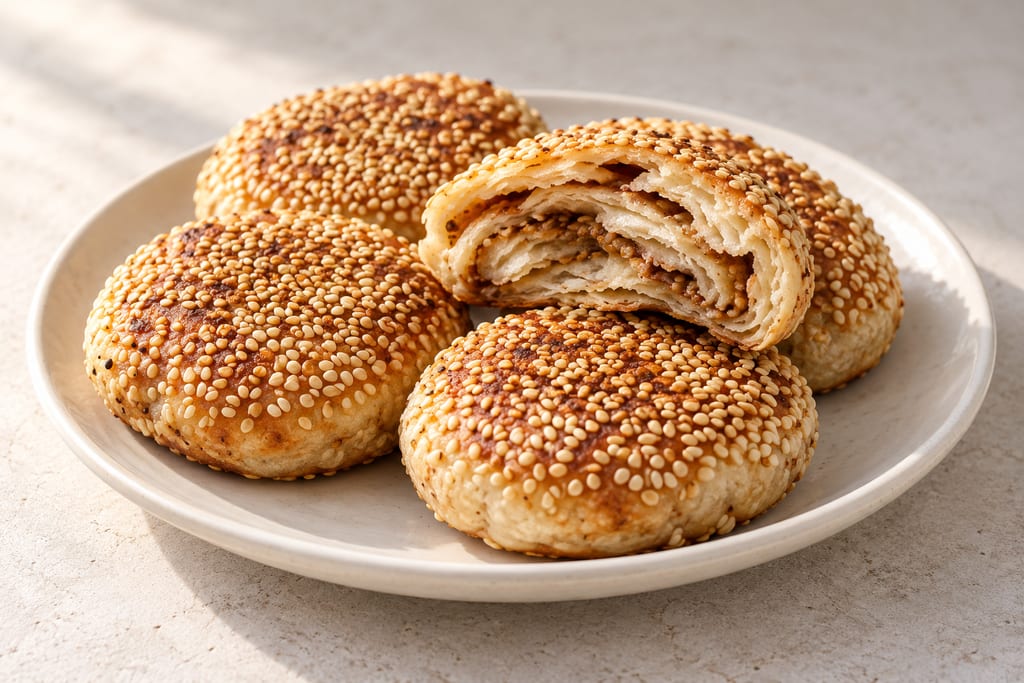
A Beijing-style yeast dough is layered with seasoned sesame paste, sealed into small buns, briefly pan-fried, seeded, and baked.
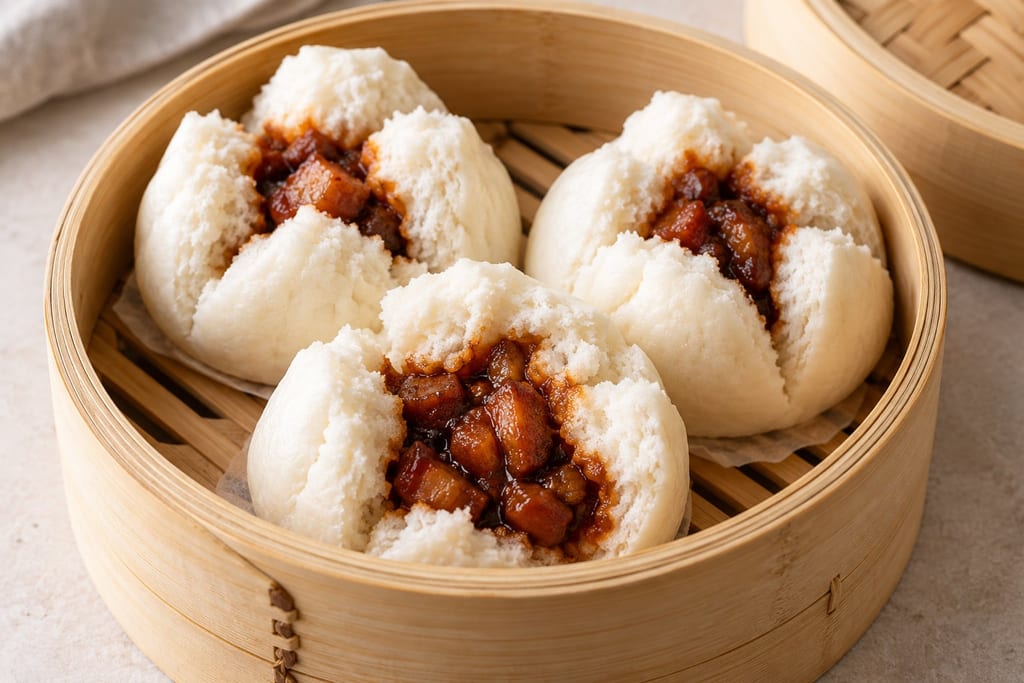
Fourteen fluffy steamed buns filled with cooked char siu and a thickened oyster-soy sauce.
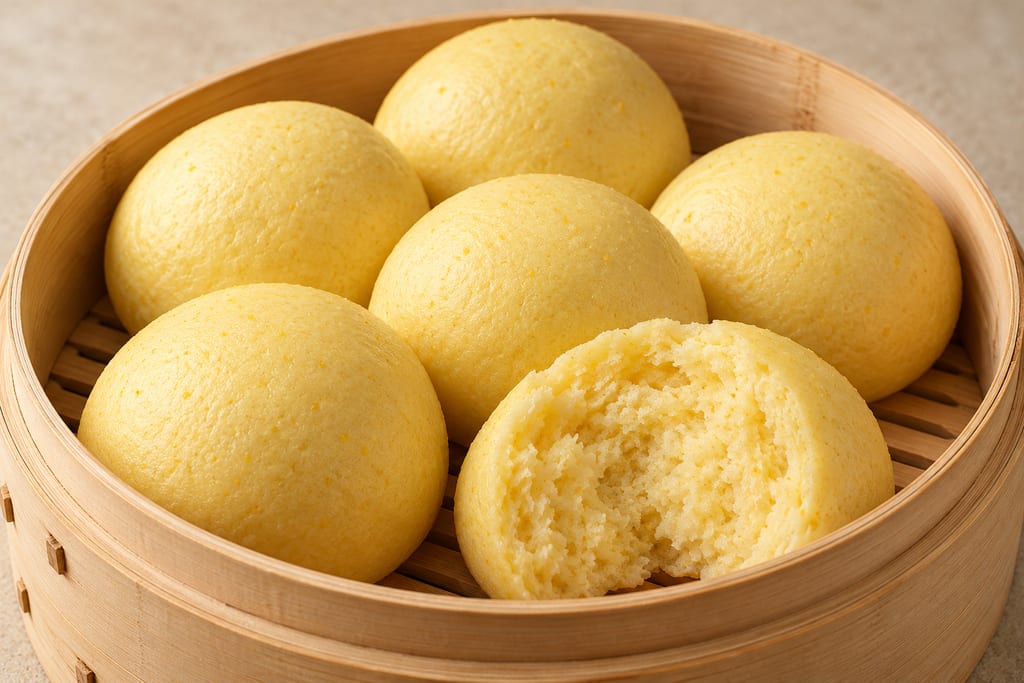
A Chinese cornmeal mantou made with wheat flour, cornmeal, water and yeast. The dough rises until doubled, is shaped into ten rounds, proofed briefly and steamed.
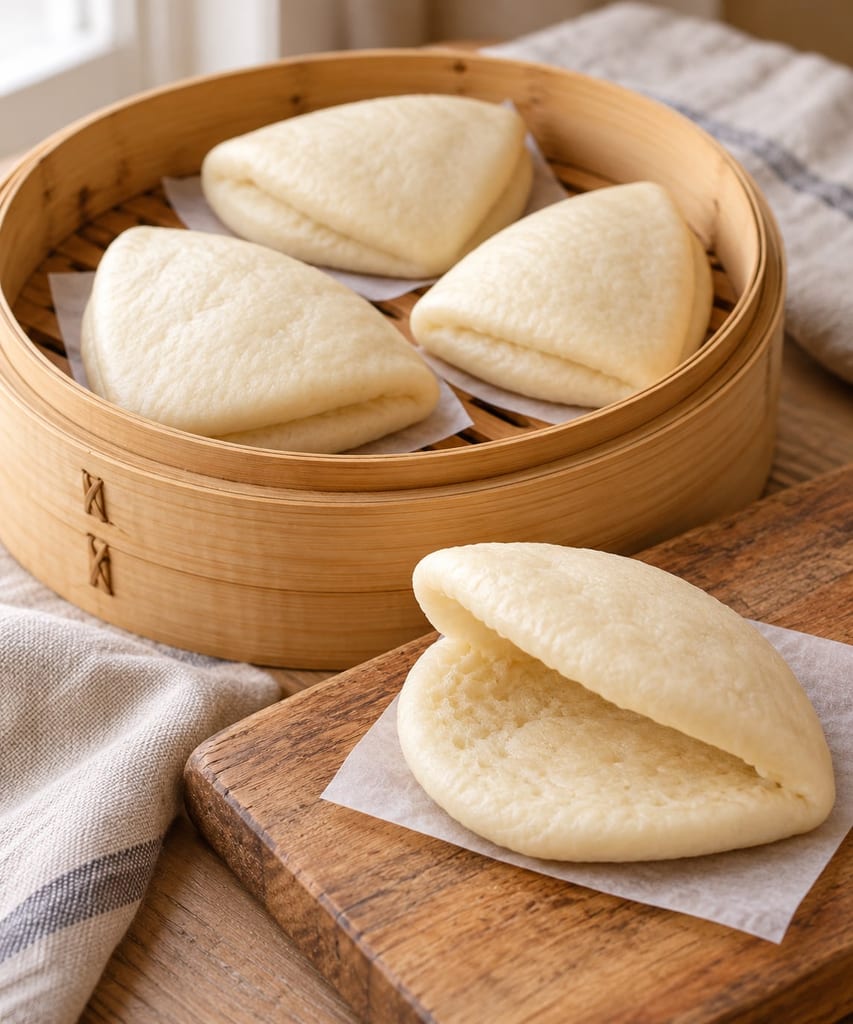
These twelve Chinese lotus-leaf buns are folded wheat-dough pockets steamed empty for filling after cooking. The recipe uses yeast, a little baking soda and cornstarch; it does not include the assembled gua bao sandwich or its fillings.
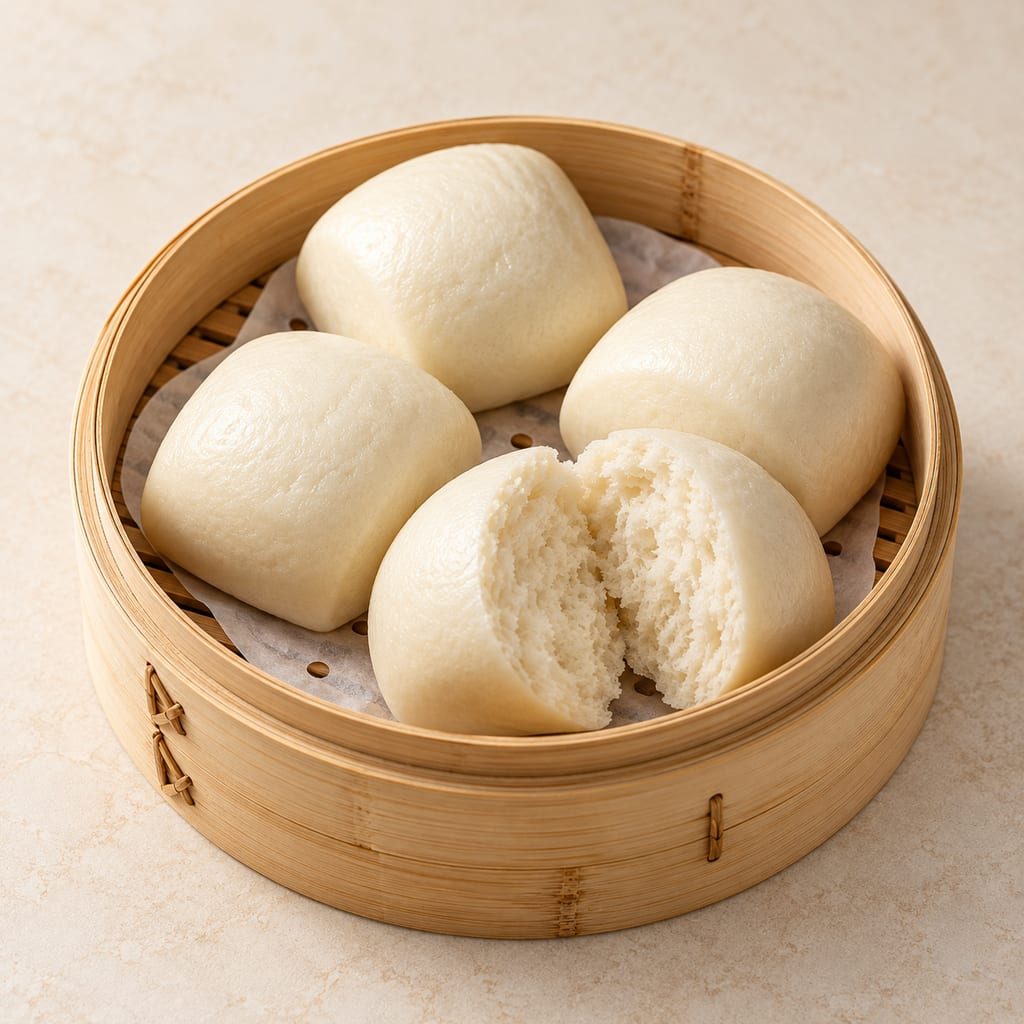
Plain wheat mantou made with yeast and baking powder, then proofed and steamed in a lined basket.
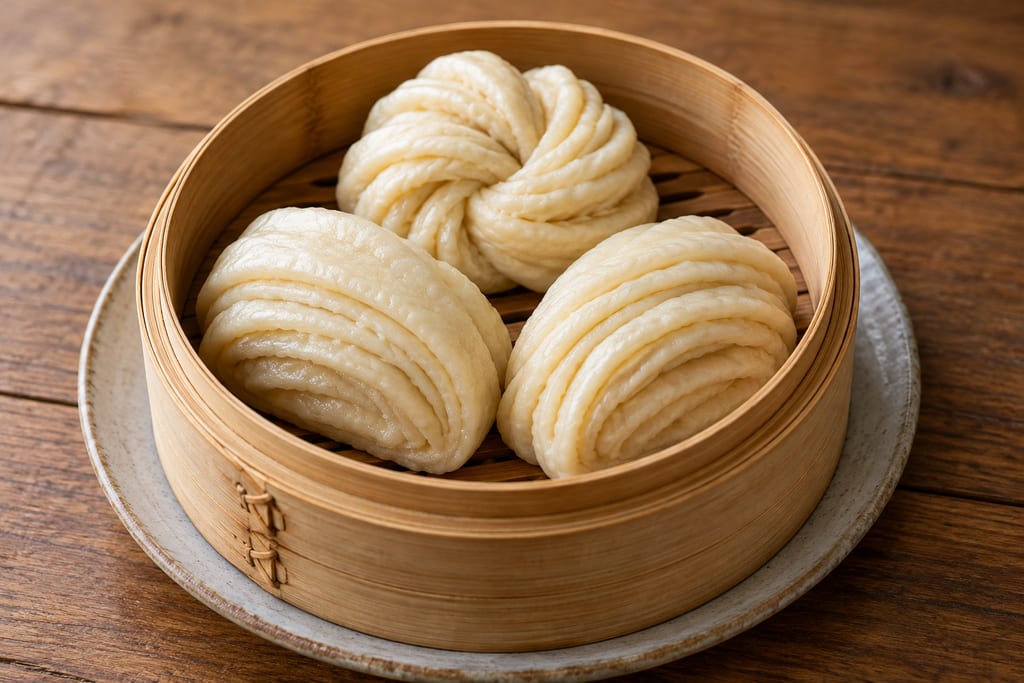
A Tibetan steamed bread made from rolled layers of yeast dough. This egg-free version follows the Taste Tibet method.
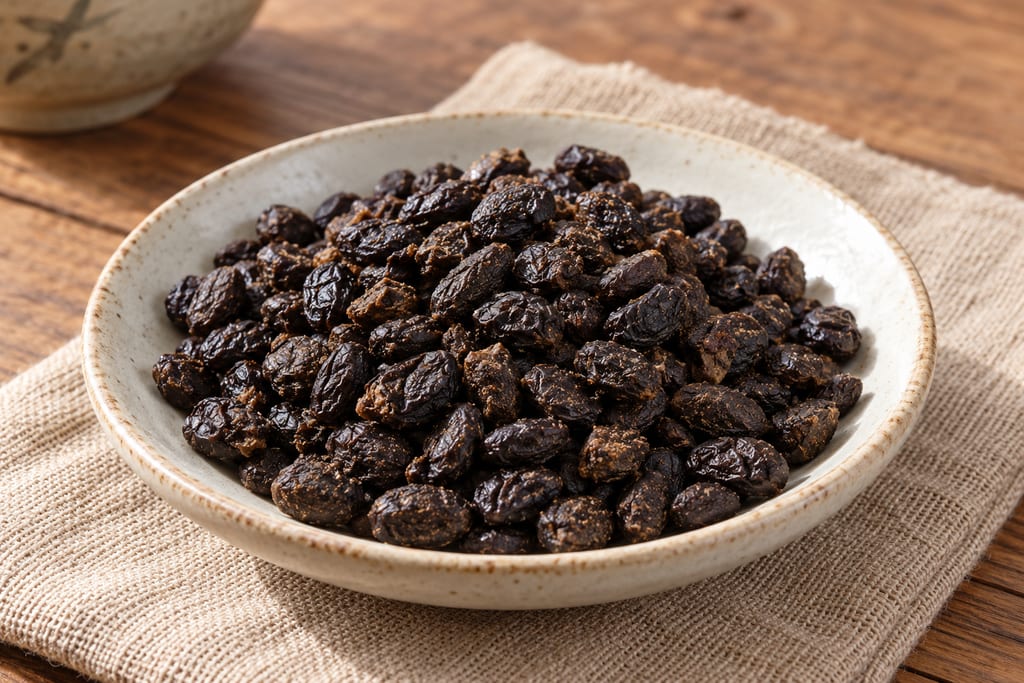
A Chinese fermented soybean condiment in which Bacillus-led bacteria, not moulds, drive the fermentation. Documented in Zunyi, Guizhou, and kept separate from mould-led douchi.
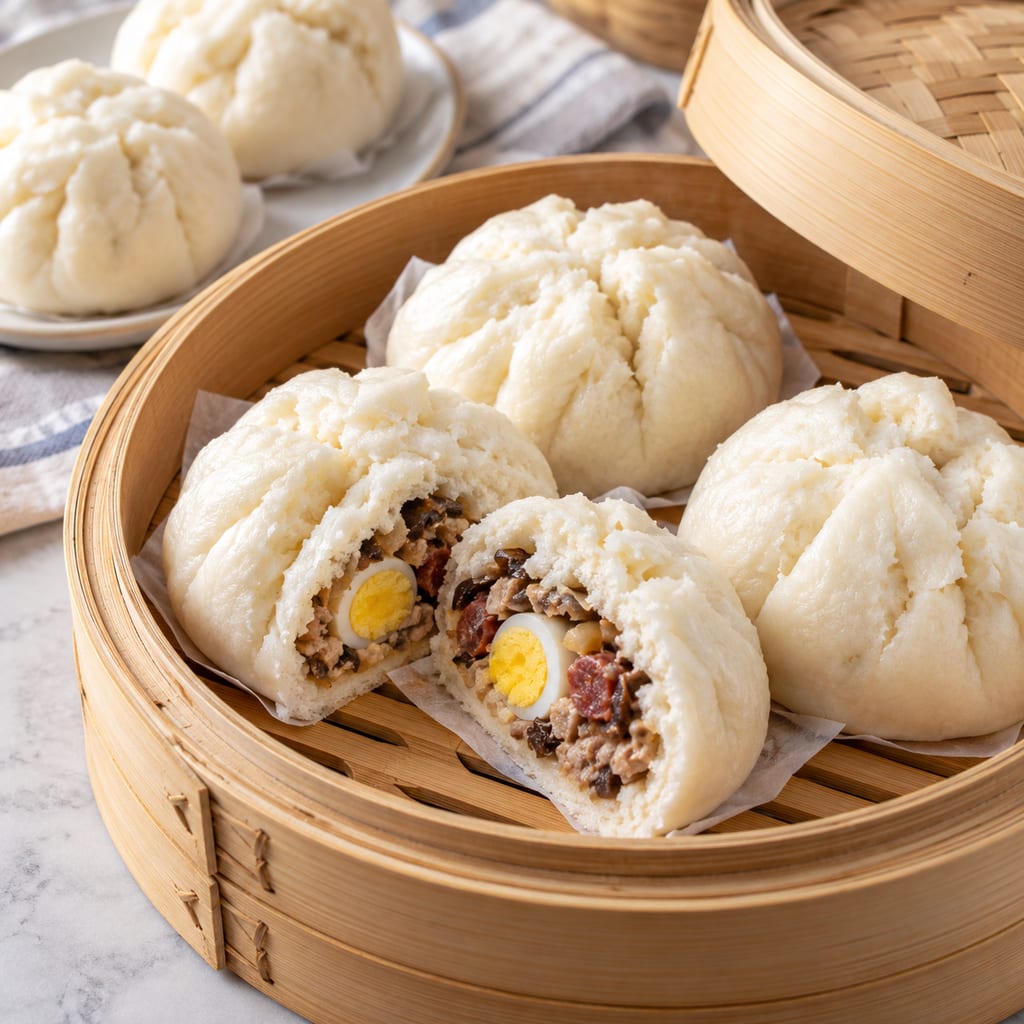
Vietnamese steamed wheat buns wrapped around seasoned pork, mushrooms, Chinese sausage and hard-boiled quail eggs. This from-scratch version uses yeast and self-rising flour.
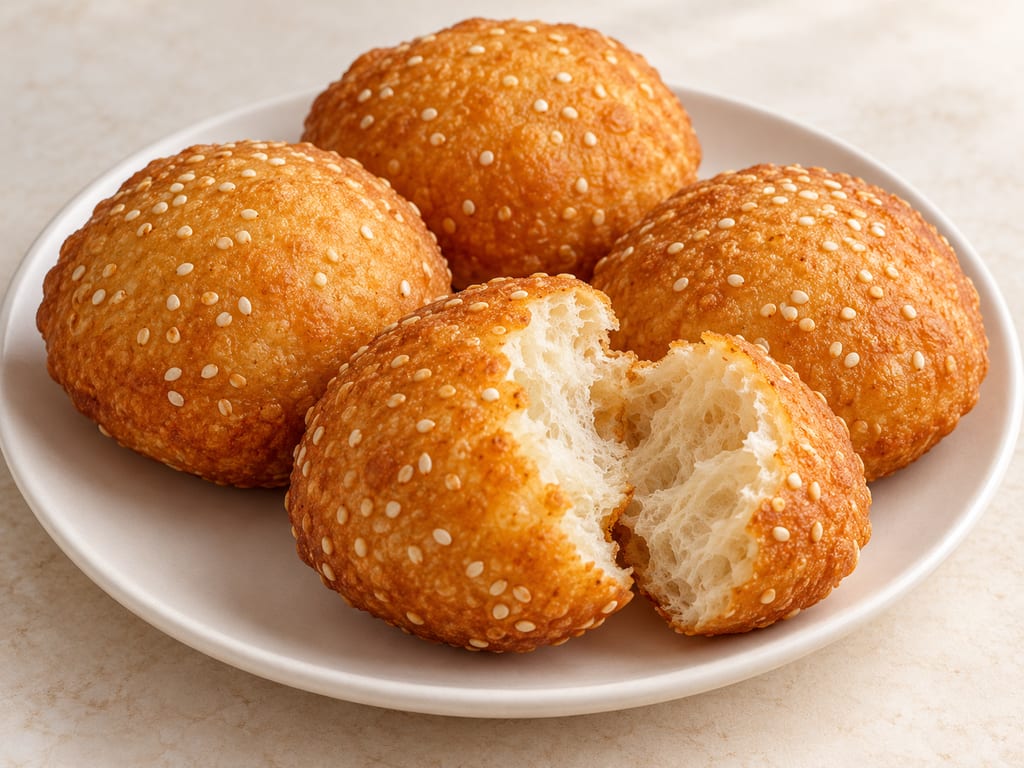
Bánh tiêu is a lightly sweet Vietnamese fried bread coated with sesame. A yeast-raised dough with baking powder is rolled into small rounds and fried until puffed and golden.
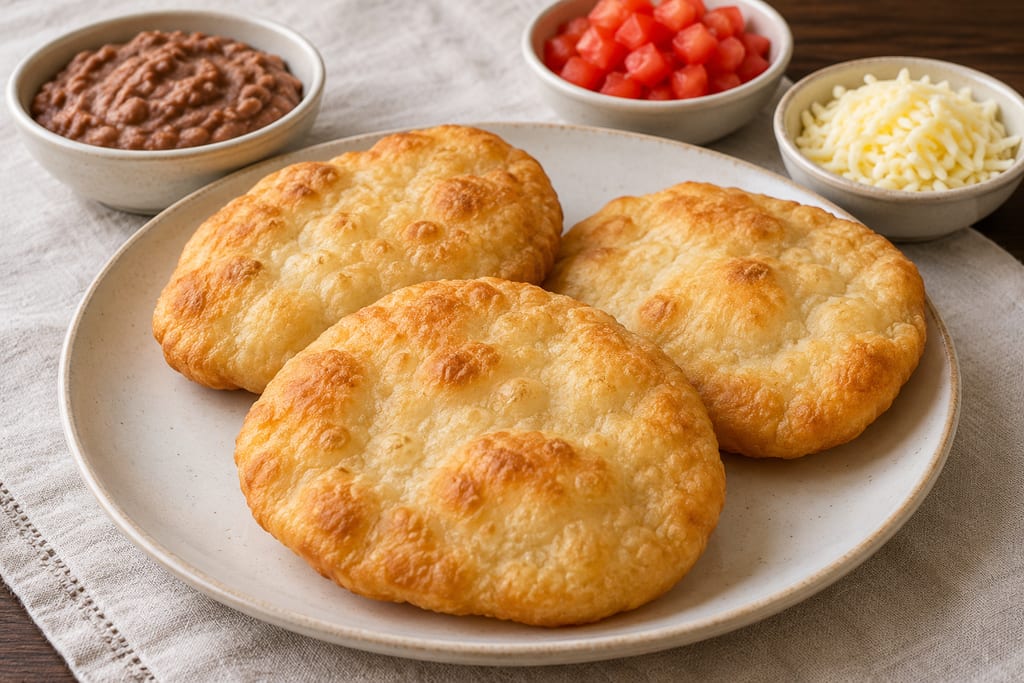
A Belizean fried breakfast bread made from baking-powder dough with evaporated milk, shaped into rounds and fried until golden.
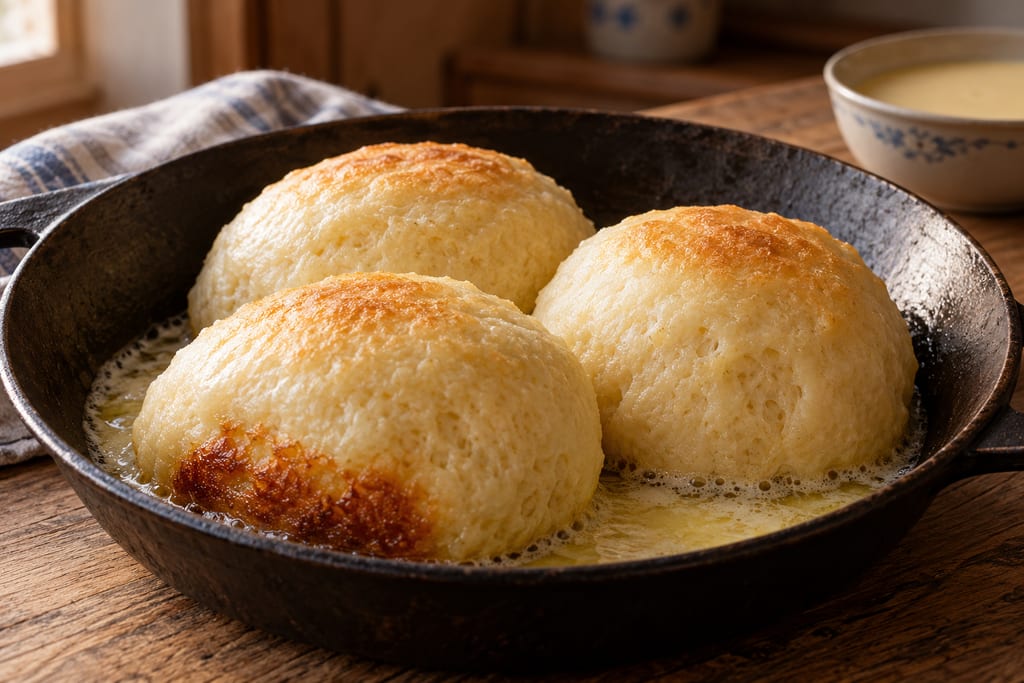
Allgäu Dampfnudeln are enriched wheat buns proofed in a covered casserole and cooked in milk and butter until the liquid nearly cooks away.
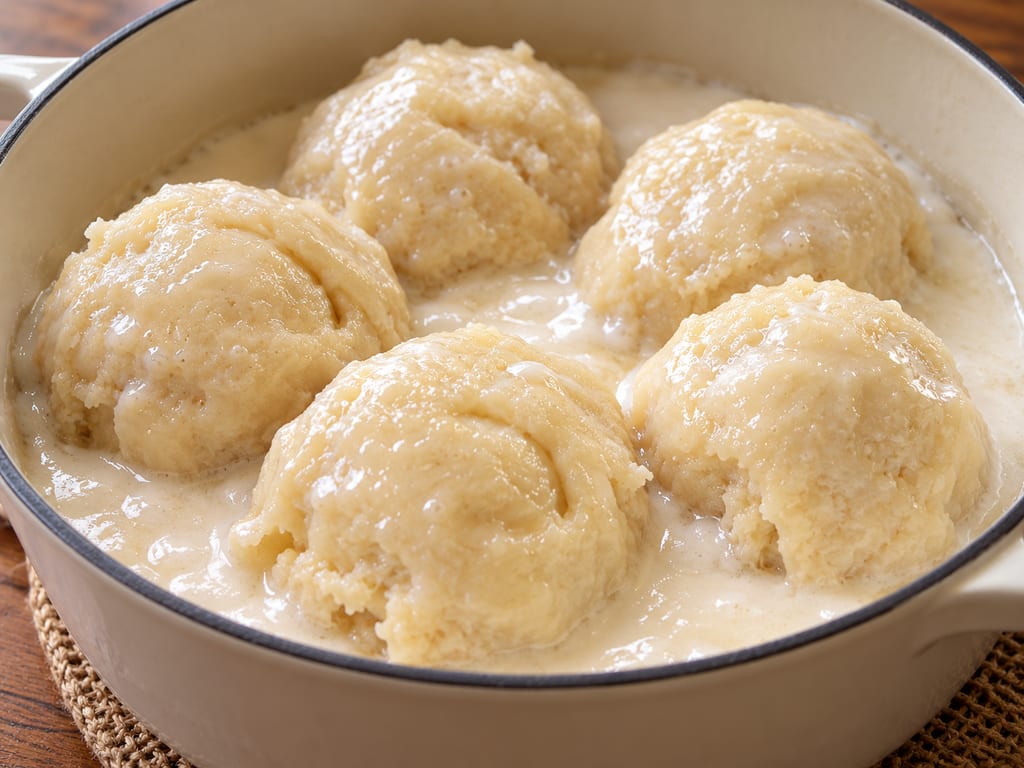
Soft yeast buns shaped by hand and simmered covered in coconut cream diluted with water in a deep pot. This Fijian home version uses a clean knife or fork inserted into the center as its doneness cue.
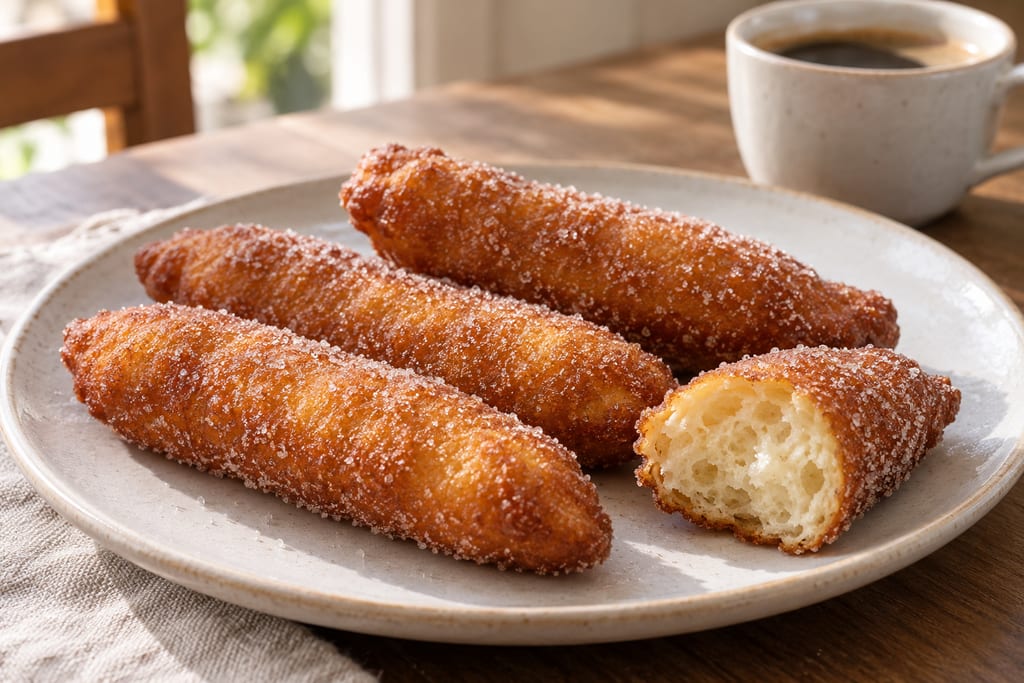
Firi firi is a yeast-raised coconut doughnut piped into long pieces and deep-fried at 170°C, traditionally eaten for breakfast or dessert in Tahiti.
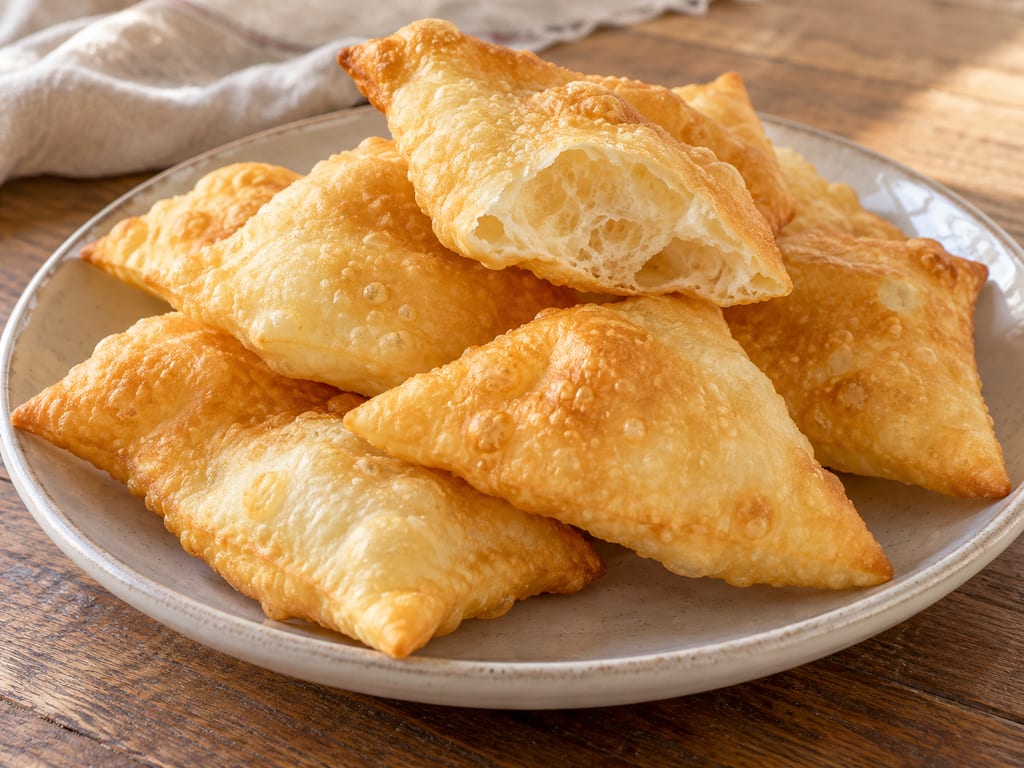
This Emilia-Romagna home version uses a measured flour-and-milk dough with yeast, shapes it into small diamonds or squares, and fries them in peanut oil.
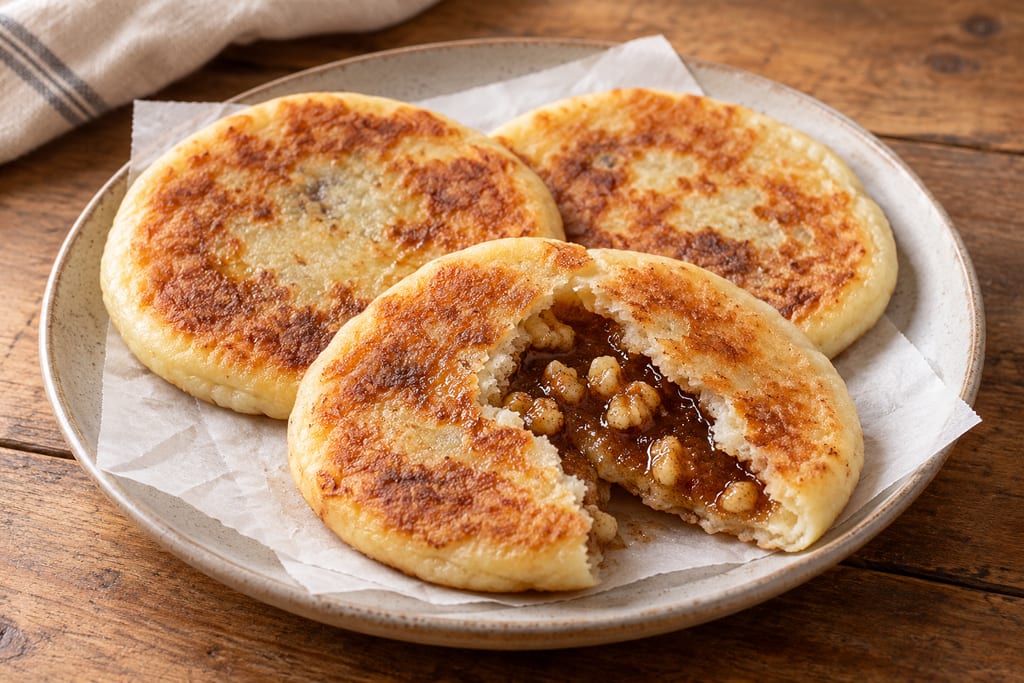
Maangchi’s eight-piece hotteok wraps a brown-sugar, cinnamon and walnut filling in yeast dough, then fries and presses the parcels in a pan.
No community contributions have been published for this entry yet.
Sign in to contribute. Published comments and photos are free to read.
The Woks of LifeInspiration · Recipe · Identity · History
Hua Juan (Chinese Flower Rolls/Steamed Scallion Buns)Article identity and family recipe-development context, lines 34–71.
Recipe card ingredients and method, lines 153–202; alternate skillet route in the same card.
Cited in: What are hua juan?; Hua juan and the history of Chinese steamed bread; Dough; Seasoning and shaping; The role of each ingredient; Why the oil matters so much; Stage 1 — Activate the yeast; Stage 2 — Prepare the dry mixture; Stage 3 — Form the dough; Stage 4 — Knead; Stage 5 — Prepare the filling; Stage 6 — Prepare the steamer; Stage 7 — Roll the dough; Stage 8 — Season; Stage 9 — Fold; Stage 10 — Cut; Stage 11 — Stack pairs; Stage 12 — Press with a chopstick; Stage 13 — Twist and knot; Stage 14 — Proof; Stage 15 — Steam; Stage 16 — Rest covered; Stage 17 — Optional crisp base; Fermentation and gas production; The chemistry of steaming; Why steamed bread can collapse; Five-spice and scallion flavour; Regional and household variations; Pan-steaming as an alternative; How hua juan are served; Troubleshooting; Safety and storage
The Woks of LifeVariation · History
Chinese Scallion RollsThe earlier 2014 scallion-roll recipe the current method develops from
Household and regional variation in shaping and seasoning
Cited in: Hua juan and the history of Chinese steamed bread; Regional and household variations; Pan-steaming as an alternative
Centers for Disease Control and PreventionSafety
Raw Flour and DoughUncooked flour and dough can carry harmful germs; cook before eating and wash hands, utensils and surfaces after handling raw flour or dough.