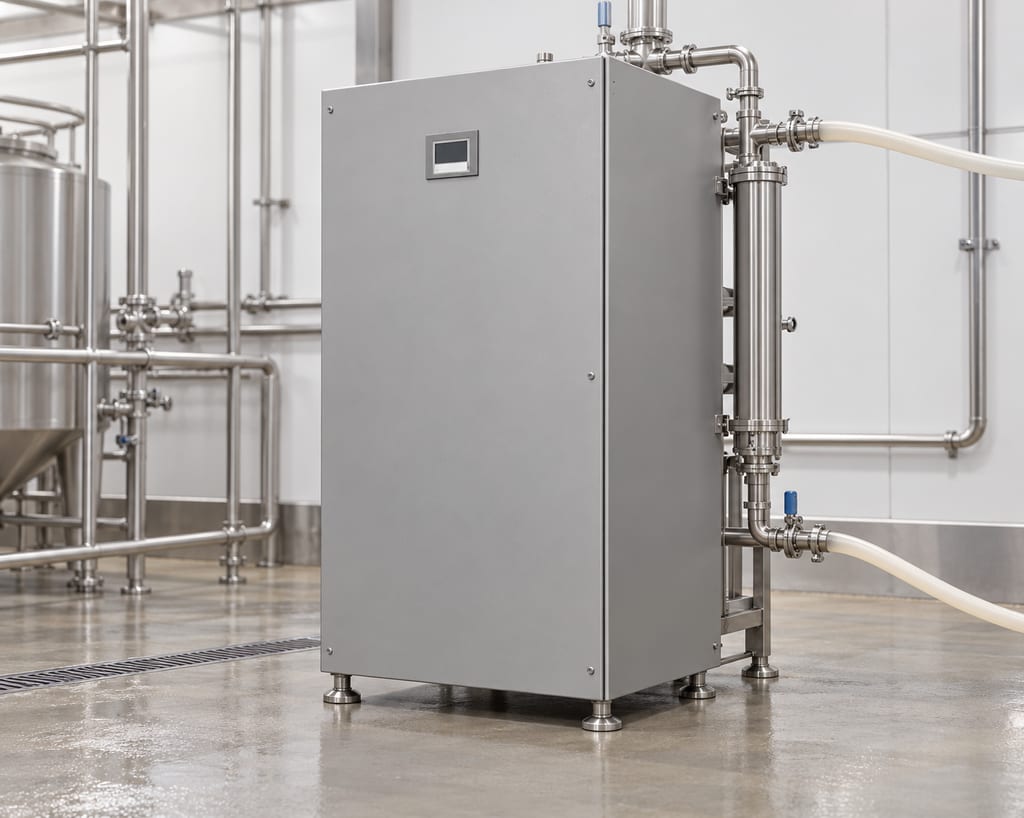
UV-C treatment unit
UV-C food-treatment equipment uses germicidal ultraviolet light; the documented CiderSure example processes apple juice as a flowing thin film.
 FermenteaWhere food goes to change
Substrates
Apple juice without added preservatives, used as a drink, a cooking ingredient and a substrate for cider. Its cultivar, clarity, concentration and treatment history depend on the actual product.
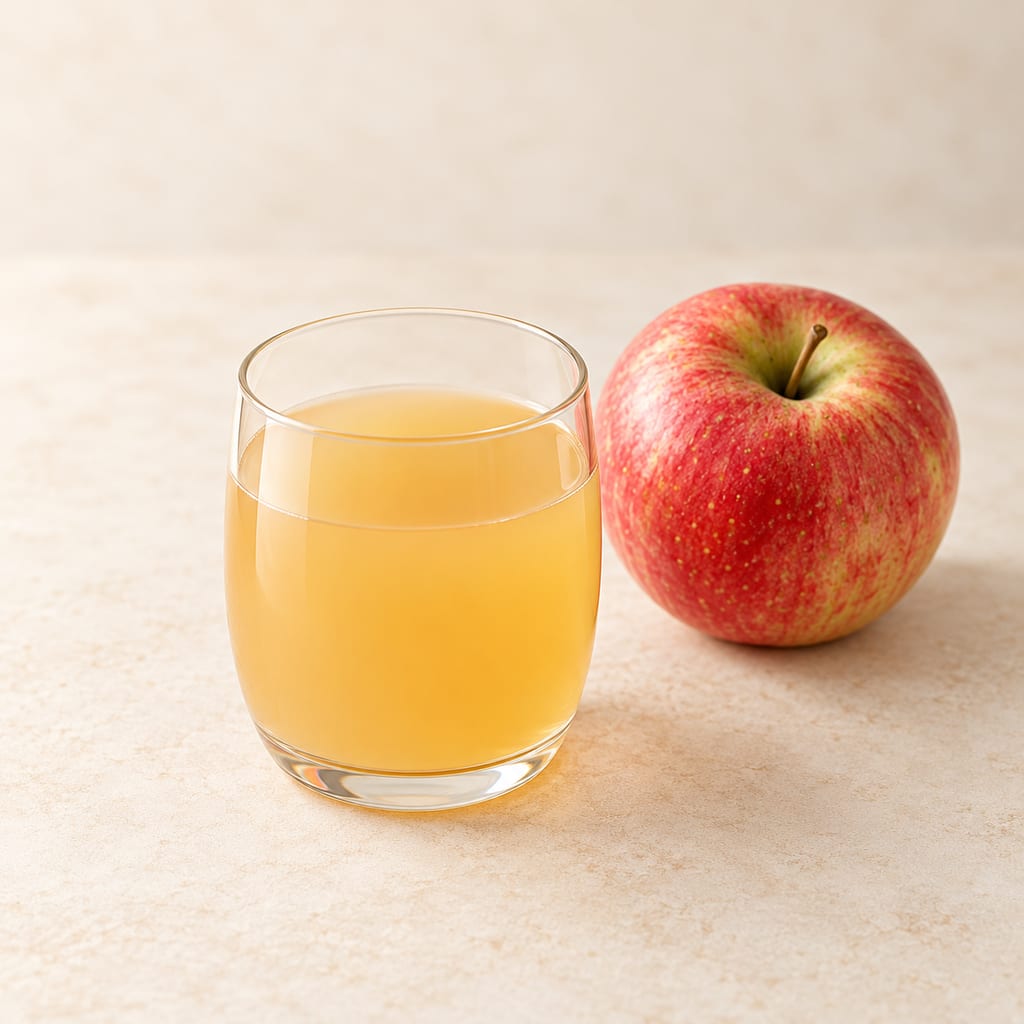
Apple juice, pressed from the fruit of the domesticated apple tree (*Malus domestica*), brings the apple's water, sugars, acidity and aroma into a pourable ingredient. It may be clear and bright or cloudy with suspended fruit material; its sweetness and sharpness depend on the fruit and processing. Preservative-free describes a qualification on that juice. It does not identify one cultivar, blend, colour or flavour, and it does not turn the juice into a fermented drink.
The distinction matters in the kitchen and fermenter. Pressed juice is an ingredient; dry cider is a preparation made through fermentation. A recipe that starts with juice and one that uses finished cider start with different materials. A recipe that calls only for apple juice names no brand or cultivar. The preservative qualification should travel with that input rather than becoming an invented description of a particular orchard product.
Preservative-free also answers a narrower question than some labels beside it. It does not by itself mean raw, unpasteurized, organic, unfiltered or made without concentration. A treated juice can have no added preservative, while a cloudy appearance does not reveal how the juice was treated. These properties need to be read separately.
For small apple growers, juice offered a way to sell fruit beyond the fresh-fruit market. The bulletin Farm Manufacture of Unfermented Apple Juice, first issued by the United States Department of Agriculture in 1922, addressed that practical problem. The bulletin described juice making as a widespread farm industry, with production varying as the apple crop varied. The point was to find an outlet for surplus fruit, rather than to reserve every apple for the most attractive display on a fruit stand.
The booklet also described a problem of time. Sweet juice was plentiful during the pressing season and difficult to find afterwards. The bulletin aimed to help growers make a product that could be sold beyond that short period. The account connected the orchard with a processing room, equipment, containers and a market for a drink available through more of the year. Preservation changed when the crop could be consumed as well as how it was sold.
Selecting and blending fruit received attention alongside the machinery. The introductory pages argued for matching maturity and varieties to a balanced, palatable juice. The contents then separated sorting and washing, grinding and pressing, juice handling, clarification and packing. Those distinctions remain useful for understanding the product: choosing fruit, extracting liquid and preparing that liquid for sale are different decisions, even when they happen in one small business.
The booklet's terminology also records a historical difference. It used sweet cider and unfermented apple juice for the non-fermented drink, while explaining that cider in England and France generally meant a fermented product. Those are observations from that publication, not a promise that every modern shop uses the words alike. Reading the ingredient list and product description is more reliable than assuming that cider on a label always means the same thing.
This historical handbook is evidence of how growers understood their business and product. Its preservation procedures and old regulatory statements are not a current home-processing method. What carries forward here is the story of an orchard crop becoming a bottled ingredient, with flavour, timing and distribution all part of the work.
Juice is mostly a liquid medium carrying several kinds of material from the fruit. Its sugars and organic acids shape sweetness and tartness. Pectin and other polysaccharides influence the suspended material and consistency. Phenolic compounds, nitrogenous components, minerals and aroma compounds also belong to the mixture. A sweet taste does not describe all of those components, and a single sugar reading does not measure them all.
Cultivar and fruit condition change that mixture. A primary composition study comparing several apple cultivars found differences among them, especially in phenolic composition. Other work on apple juice has examined sugar, acid and phenolic profiles across samples and found that processing such as fining can affect the profile retained in the liquid. These studies help explain why two apple juices need not behave or taste alike; their sample measurements do not become a standard composition for an unidentified bottle.
Maturity and storage of the apples matter too. In a study of water-cored Fuji apples, researchers followed changes in the fruit before it was processed and measured the resulting cloudy juice. The juice's cloud stability changed with those specific storage treatments. The practical lesson is about the raw material: processing begins with fruit in a particular condition, rather than with an abstract apple whose properties stay fixed after picking. The experiment does not provide a universal storage schedule for every apple or juice.
A press works on disrupted fruit, not on an intact apple in the same way. Grinding or milling opens the fruit into a mash from which liquid can be separated. The character of that mash affects how it moves through the equipment and how readily juice can be recovered. Pressing then separates a liquid fraction from much of the solid fruit material. This is a physical operation; it does not require yeast to turn sugar into alcohol.
The old farm handbook treated grinding, pressing and subsequent handling as connected parts of a production line. Its separate handling sections reflect a simple fact: juice must be moved and managed after it leaves the fruit. Extraction does not finish every task that determines the product's appearance, flavour, preservation or packaging.
Modern commercial systems can also use enzymes to help release juice or alter the mash. That is different from the force exerted by a press. An enzyme acts on particular material in the fruit, while the equipment separates and moves material. Different combinations of milling, pressing and later treatment can therefore produce distinct juice forms without making them different fermented foods.
Cloudy apple juice contains small suspended particles and larger material that may settle. Pectin, starch, proteins and phenolic compounds can participate in the cloud and its behaviour. Cloudiness is therefore more than a colour description: it concerns material dispersed in the liquid. It is not a test for the absence of additives, and a clear juice is not necessarily a juice with its aroma removed.
Clarification can include enzymatic treatment, settling, fining or filtration. These are different operations. Pectolytic enzymes act on pectic substances; amylases act on starch. A study using partially purified polygalacturonase and alpha-amylase showed how those enzyme activities could be combined in an experimental apple-juice clarification process. Its particular enzyme sources and treatment conditions belong to that experiment, not to an instruction for treating any purchased juice.
A separate pilot-process study used Raman spectroscopy, a method that reads how light interacts with molecules, to follow clarified juices. It detected a pectin-associated signal in crushed-fruit apple samples that disappeared after depectinization, while also identifying fructose-related signals. The study is a useful illustration of what a processor can measure: the change is in the material present, not merely a new name applied to the same liquid.
For a cook or cider maker, the useful question is which form a recipe actually specifies. A cloudy juice with suspended solids and a clarified juice are not identical starting materials. Where a recipe does not say which form it means, the form is not known, and the properties of one form should not be attributed to the preparation.
Concentration removes some of the water from juice. A processor can transport or store a smaller volume and later add water to make a drink at single strength. Juice made from concentrate and juice that has not been concentrated therefore have different processing histories, even when both are sold as apple juice. The distinction does not on its own identify preservatives or microbial treatment.
Concentrate also has uses as an ingredient in other products. It brings more juice solids in a smaller volume than an ordinary drinking juice. Replacing one with the other by volume would change what enters a recipe. The word juice should be read alongside the product's form, directions and ingredient list, rather than used as permission to treat a bottle of concentrate as a bottle ready to drink.
The same care applies to blends. A product may combine apple juice with another fruit or contain flavouring ingredients. Preservative-free does not rule out those additions. When an existing method calls for apple juice, the apple input and its qualification should remain explicit instead of being replaced by a broadly similar-looking beverage.
In cider making, juice becomes a medium for yeast activity. Fermentable sugars supply carbon and energy, but the cells also require other materials to grow and function. Yeast-assimilable nitrogen is the name used for nitrogen compounds that the yeast can take up, including ammonium and the free amino-nitrogen fraction. It describes a measured part of the juice, not the name of a nutrient powder.
Research on apple juice examined that nitrogen composition across cultivars and seasons. The investigators found that free amino nitrogen made up much of the measured total and cautioned that a minimum requirement for cider had not been established. That work explains why grape-wine recommendations cannot simply be imposed on every apple juice. A juice's sugar content does not disclose its nitrogen composition, and neither is fixed by a preservative-free claim.
Separate cider research has also shown that nutrient-related aroma outcomes depend on the yeast and the surrounding conditions. In work comparing EC1118 and UCD522, responses to methionine additions were not the same across the tested treatments. That is a reason to keep a fermentation recipe and its named culture together, rather than assume that one adjustment will give every juice the same result. It is not a nutrient addition schedule for these recipes.
Preservation is an aim; an added preservative is one possible tool. The FDA's ingredient guide describes antimicrobial preservatives as ingredients used to inhibit spoilage organisms, including yeasts and moulds, and gives examples of such compounds. Other additives can serve different functions, and some substances have more than one technical role. An ingredient list provides more information than a broad claim on the front of a bottle.
Treatment history is a separate safety question. Bacteria from raw produce can enter freshly squeezed juice. FDA consumer guidance advises choosing pasteurized or otherwise treated juice and asking the seller when the treatment or labelling is unclear. Treatment is not restricted to a product displayed on a particular shelf: treated products can be refrigerated, frozen or sold in non-refrigerated containers. Refrigeration alone does not tell a buyer whether treatment occurred.
The words preservative-free do not tell you a juice's brand, measured composition or treatment history, and they do not validate a later home fermentation. Check the actual product's label and producer information, and follow its storage instructions after opening. No single shelf life applies to every juice covered by this name.
Apple juice can be chosen for flavour as well as fermentation. Yorkshire Wolds Apple Juice Co., for example, describes a cloudy juice from Cox's Orange Pippin, a sharper Bramley juice to drink with food such as cheese, and a sweeter blend containing Gala and Braeburn for serving with sparkling water. These are examples from one producer's range, rather than promised properties of the unspecified juice used here.
The same producer sells a spiced apple juice with added spices for warming as a winter drink. Its added ingredients make it a particular product, not an automatic replacement for plain juice in a cider formula. Historically, the bulletin also recorded apple butter and jelly among uses for sweet cider. The role changes with the preparation: a drink, a fruit input for a preserve and a substrate for cider do not ask the juice to do the same job.
Choose the form and flavour that the actual recipe names. The juice's cultivar or blend, clarity, concentration and treatment can matter for different reasons; the absence of an added preservative is one qualification among them.
No maker, orchard, cultivar blend or production location applies to the unnamed juice. Historical US processing and named producer examples do not locate it.
UV-C food-treatment equipment uses germicidal ultraviolet light; the documented CiderSure example processes apple juice as a flowing thin film.

Soft, spreadable Calabrian pork sausage made with a great deal of red chilli and fatty pork, stuffed into natural casings, sometimes smoked and matured while staying soft.

A way to add independent temperature logging to an existing food dehydrator without changing its built-in controls or protections. It is a monitoring method, not a rewiring plan.

Pleurotus cystidiosus is the abalone mushroom, a cultivated oyster-type fungus with dark brown caps that grows more slowly and is more demanding than other Pleurotus species.

A dark, balanced vinegar from Emilia-Romagna made by combining cooked or concentrated grape must with wine vinegar, then acetifying and refining it in wood under a protected specification.

A living dairy inoculum that starts controlled cream fermentation, developing acidity and aroma before sour cream or cultured butter is finished.

A small electric incubator holds jars at a selected temperature for yogurt and other documented warm food preparations. Controls, capacity and vessel arrangement vary by model.

Adygean salt is a seasoned table salt associated with Adygea and the wider North Caucasian culinary tradition. Salt is blended with garlic and a variable selection of herbs and spices; the exact mix depends on the named style and maker.

The African Caesar-group mushroom, Amanita masasiensis, is a wild ectomycorrhizal species of central and southern African woodlands, eaten locally. The genus contains deadly poisonous species, so identification needs care.
No community contributions have been published for this entry yet.
Sign in to contribute. Published comments and photos are free to read.
United States Department of Agriculture, Farmers’ Bulletin 1264; UNT Digital Library
Farm Manufacture of Unfermented Apple JuiceUSDA Farmers’ Bulletin 1264 (printed pp. II, 1-4): farm production of apple juice, seasonality, surplus fruit, blending, terminology and historical uses. No historic safety procedures or legal limits are carried over.
Cited in: The juice before it becomes cider; An orchard drink beyond the harvest; Grinding and pressing; At the table and in another recipe
Food Chemistry 103(1):88–93
Chemical compositional characterization of some apple cultivarsSugar and acid constituents of apple juice and cultivar variability, especially in phenolics; no sample values or health claims are used.
Cited in: What the apple contributes
Journal - Association of Official Analytical Chemists 71(4):789–794
Apple juice composition: sugar, nonvolatile acid, and phenolic profilesSampled juices and the influence of gelatin fining on phenolic profiles; no numeric composition specifications are used.
Cited in: What the apple contributes
Foods
Effects of Fruit Storage Temperature and Time on Cloud Stability of Not from Concentrated Apple JuiceA storage experiment on water-cored Fuji fruit and the resulting cloud stability of the juice; no treatment timings, temperatures or broad health claims are used.
Cited in: What the apple contributes; Clear juice and a stable cloud
Brazilian Journal of Microbiology
Application of decolourized and partially purified polygalacturonase and α-amylase in apple juice clarificationPectin and starch in juice cloud, the distinct enzyme activities involved, and experimental clarification of apple juice; no enzyme recipe or conditions are used.
Cited in: Grinding and pressing; Clear juice and a stable cloud
Sensors (Basel, Switzerland)
Investigation on Clarified Fruit Juice Composition by Using Visible Light Micro-Raman SpectroscopySpectroscopic pectin signal in apple juice before and after depectinization in a pilot process, and fructose signals; no quantitative monitoring guarantee.
Cited in: Clear juice and a stable cloud
Food Science & Nutrition
Free amino nitrogen concentration correlates to total yeast assimilable nitrogen concentration in apple juiceYeast-assimilable nitrogen, free amino nitrogen and ammonium in apple juice across cultivars and seasons, and the uncertainty about cider-specific requirements; no grape-wine nutrient targets are used.
Cited in: Sugar for yeast, and more than sugar
Journal of the Institute of Brewing 123(4):553–561
Hydrogen sulphide production during cider fermentation is moderated by pre-fermentation methionine additionYeast strains EC1118 and UCD522 and the dependence of hydrogen-sulfide formation on methionine and yeast-assimilable nitrogen; no general nutrient remedy is given.
Cited in: Sugar for yeast, and more than sugar
Food and Agriculture Organization of the United Nations
Principles and practices of small- and medium-scale fruit juice processing: Chapter 13, Tree fruitProduct forms and extraction of apple juice; concentration and reconstitution as processing histories. Old processing safety parameters and market figures are excluded.
Cited in: The juice before it becomes cider; Water removed, then restored
U.S. Food and Drug Administration
Types of Food IngredientsAntimicrobial preservatives and examples, and the distinct functions of other additives; United States label context only.
Cited in: Water removed, then restored; Preservative and preservation
U.S. Food and Drug Administration
What You Need to Know About Juice SafetyConsumer guidance: bacteria on raw produce, pasteurized or otherwise treated juice, where juice is shelved, and questions to ask when treatment is unclear. It does not validate any home fermentation.
Cited in: The juice before it becomes cider; Preservative and preservation
Yorkshire Wolds Apple Juice Co.
Our ProductsProducer examples: Cox’s Orange Pippin juice, Bramley with cheese, a Gala and Braeburn blend with sparkling water, and spiced juice. No product shelf life or quality claim is applied to unnamed juice.
Cited in: At the table and in another recipe