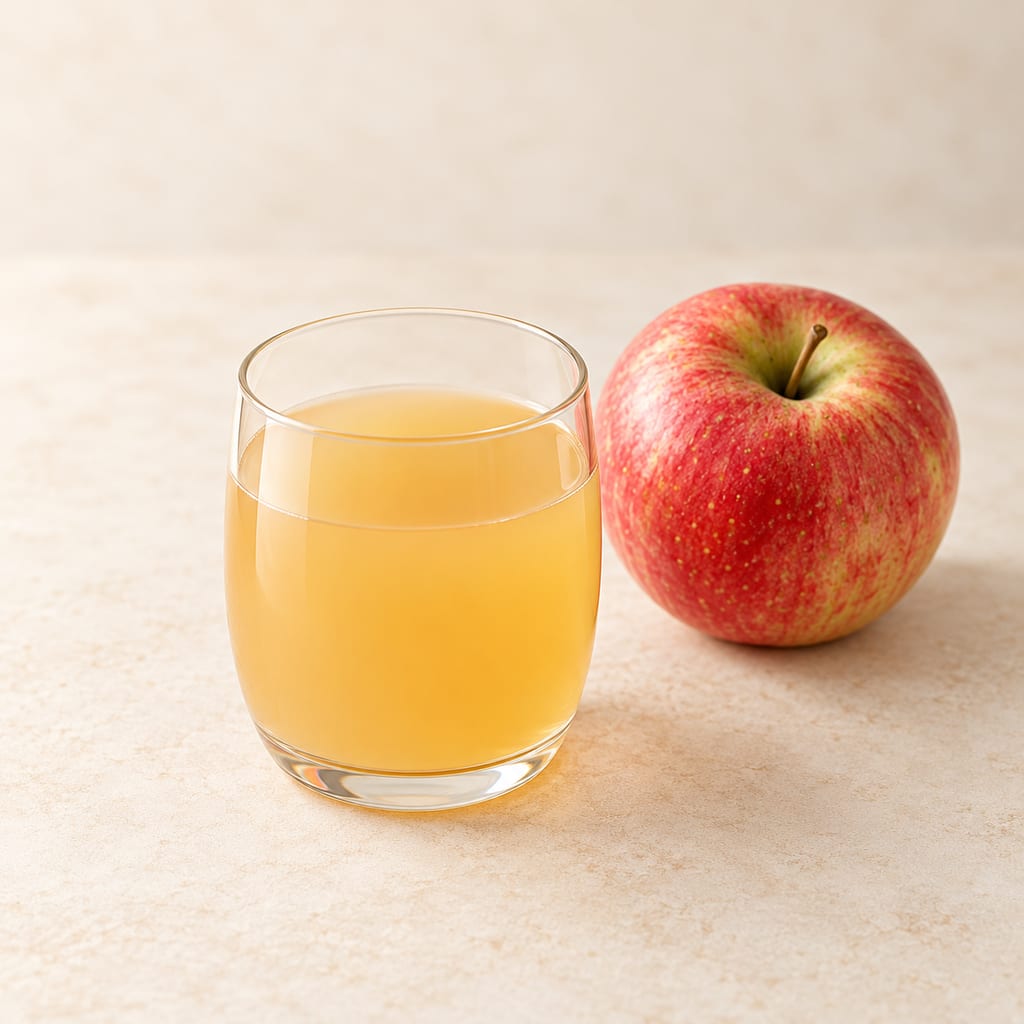
Preservative-free apple juice
Apple juice without added preservatives, used as a drink, a cooking ingredient and a substrate for cider. Its cultivar, clarity, concentration and treatment history depend on the actual product.
 FermenteaWhere food goes to change
Equipment · Industrial and laboratory plant
ultraviolet food-treatment unit · UV treatment unit
UV-C food-treatment equipment uses germicidal ultraviolet light; the documented CiderSure example processes apple juice as a flowing thin film.
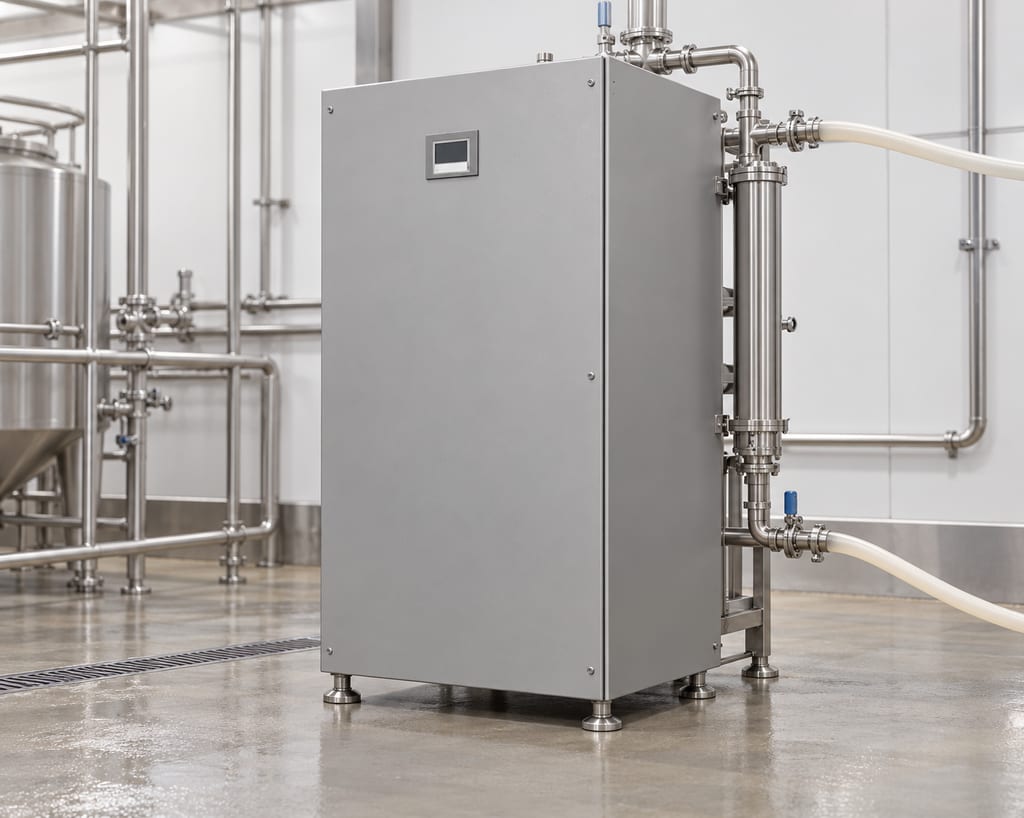
UV-C treatment equipment is built around a germicidal light source and a way to expose food to it. In the best-documented example for this page, the CiderSure 3500, apple juice or cider travels as a thin film through tubes under turbulent flow. Sensors monitor the UV energy reaching the liquid, while a computer interface uses penetration data to determine an appropriate flow rate. It is a continuously flowing process rather than a bulk vat illuminated from the outside.
The machine has a visible industrial cabinet form. FPE describes the CiderSure 3500 as a rolling floor cabinet with flow-rate controls; its smaller 2500 is a bench unit, and larger listed models have higher manufacturer-stated throughputs. The product family is one specific commercial example, not a universal design for all UV-C treatment equipment. The linked manufacturer photograph is included as an attributed reference, not as a freely reusable image.
Ultraviolet light must reach the microorganisms for the treatment to work. In a cloudy or highly coloured liquid, material between the lamp and a microbe can reduce the light that penetrates. Health Canada's assessment says increased total solids and darker colour in stored-apple cider can reduce penetration. The CiderSure system therefore monitors exposure and uses penetration information to set flow rate for the juice being treated; its lamp dose is not simply a fixed setting that means the same thing for every product.
The physics also distinguishes this equipment from industrial microwave-assisted thermal sterilisation and pulsed-electric-field units. UV-C is optical exposure: it works only where light reaches. MATS applies electromagnetic energy to heat a packaged product, while PEF uses brief electrical pulses in a treatment zone. They are separate process families with different equipment and limits; no one method's validation transfers to another.
A Virginia Tech food-science dissertation dated 2004 documents experiments using a CiderSure 3500 apparatus. Those experiments explored UV treatment in milk, but their results are specific to the products and conditions studied; they do not establish a standard milk-treatment process or universal operating schedule. FPE's current product page lists CiderSure models for apple-cider processing. The available records establish a modern equipment example, not the invention date of UV-C food treatment.
FPE Manufacturing lists an office in Ontario, New York. That identifies a manufacturer location only. It does not establish where UV-C treatment was invented, and Health Canada's assessment of the CiderSure 3500 is a regulatory review of a particular apple-juice/cider use in Canada rather than proof that this equipment originated there.
Health Canada's published assessment reports that CiderSure 3500 testing achieved at least a five-log reduction of E. coli O157:H7 in raw apple cider inoculated and run according to the manufacturer's instructions. That is evidence for the evaluated unit, product and test conditions, not a promise that UV-C eliminates pathogens in every juice or food. The same assessment explicitly says reduction is not elimination, particularly when the initial microbial load is extremely high, and calls for continued steps to limit contamination.
The distinction matters in practice: equipment is only one part of process control. Product composition, solids, colour, light penetration, flow, monitoring and clean handling all affect whether the validated process is being reproduced. The page therefore gives no general treatment time or setpoint. FPE's throughput values are model-specific manufacturer specifications, not a safety limit or an efficacy measure for a different machine.
Apple juice is a documented substrate for the CiderSure 3500 assessment. Health Canada reviewed the sale of unpasteurized and unfermented apple juice and cider treated with that unit and concluded there were no food-safety concerns associated with the assessed products, while retaining the limits above. This equipment link identifies a documented use; it does not imply that every apple juice needs UV treatment, is treated this way, or is suitable for a particular unit.
The CiderSure manufacturer calls its process UV pasteurization in its product information. Health Canada's assessment describes the treatment as reducing microbial levels and carefully distinguishes reduction from elimination. Readers should understand any such term within the specific equipment, food and regulatory assessment, and consult current requirements and the manufacturer's validated instructions for actual processing.
UV treatment needs a suitable optical path. In the documented CiderSure process, more solids and darker colour reduce penetration; the unit adjusts flow based on measured UV penetration rather than treating every juice as equivalent.
Source →The Health Canada assessment reports pathogen reduction, not elimination, and applies to CiderSure-treated apple juice/cider as assessed. It warns that especially high initial contamination can leave pathogens after treatment and says manufacturers must continue to limit contamination.
Source →Do not transfer CiderSure's apple-cider results or the manufacturer's model throughput figures to another UV-C machine, food, line configuration or operating condition.
Source →FPE Manufacturing lists its office in Ontario, New York; this identifies the manufacturer location, not the invention of UV-C treatment technology.
Apple juice without added preservatives, used as a drink, a cooking ingredient and a substrate for cider. Its cultivar, clarity, concentration and treatment history depend on the actual product.
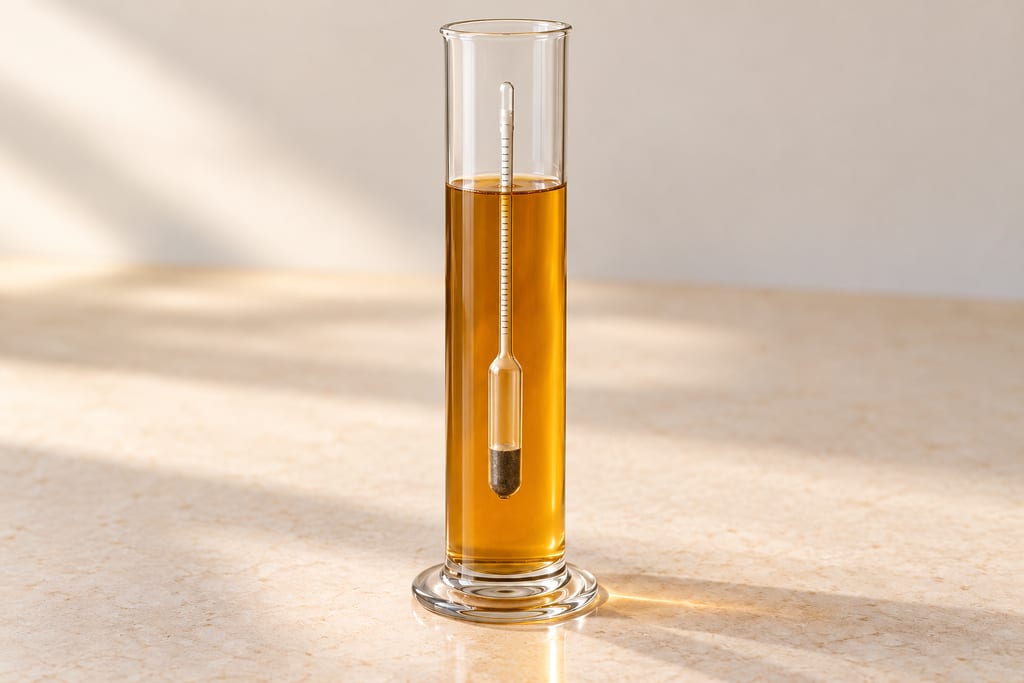
A hydrometer floats in liquid and uses its weighted body's depth to indicate density. In brewing, readings track changing gravity, not every dissolved substance or kombucha alcohol.

Soft, spreadable Calabrian pork sausage made with a great deal of red chilli and fatty pork, stuffed into natural casings, sometimes smoked and matured while staying soft.

A way to add independent temperature logging to an existing food dehydrator without changing its built-in controls or protections. It is a monitoring method, not a rewiring plan.

Pleurotus cystidiosus is the abalone mushroom, a cultivated oyster-type fungus with dark brown caps that grows more slowly and is more demanding than other Pleurotus species.

A dark, balanced vinegar from Emilia-Romagna made by combining cooked or concentrated grape must with wine vinegar, then acetifying and refining it in wood under a protected specification.

A living dairy inoculum that starts controlled cream fermentation, developing acidity and aroma before sour cream or cultured butter is finished.

A small electric incubator holds jars at a selected temperature for yogurt and other documented warm food preparations. Controls, capacity and vessel arrangement vary by model.

Adygean salt is a seasoned table salt associated with Adygea and the wider North Caucasian culinary tradition. Salt is blended with garlic and a variable selection of herbs and spices; the exact mix depends on the named style and maker.

The African Caesar-group mushroom, Amanita masasiensis, is a wild ectomycorrhizal species of central and southern African woodlands, eaten locally. The genus contains deadly poisonous species, so identification needs care.
No community contributions have been published for this entry yet.
Sign in to contribute. Published comments and photos are free to read.
Health CanadaEquipment operation · Food safety · Process limits
Novel food information: Ultraviolet light treatment of apple juice/cider using the CiderSure 3500CiderSure 3500 exposes a thin film of apple juice/cider flowing through tubes under turbulent conditions; UV sensors and a computer interface use penetration data to determine flow rate.
The assessment reports at least a five-log reduction of E. coli O157:H7 in tested raw apple cider run according to manufacturer instructions; this is a tested-unit result, not a guarantee for other products or conditions.
More solids and darker colour can reduce UV penetration; Health Canada says microbial reduction does not mean pathogen elimination and contamination-control measures remain necessary.
Cited in: A documented food-processing form; Why thin films and flow control matter; A modern example and its geography; Validation is specific to the food and unit; Use with apple juice
FPE / Headwater Food Processing EquipmentEquipment form · Manufacturer specifications · Visual reference
CiderSureManufacturer lists bench CiderSure 2500 at up to 30 gallons per hour, floor-cabinet 3500 at up to 100 gallons per hour, 5500 at up to 300 gallons per hour and 6500 at up to 600 gallons per hour.
Manufacturer says the 6500 configuration has two UV process tubes; model specifications are manufacturer claims and should not be generalized to other UV-C units.
The 3500 is described as a rolling floor cabinet with flow-rate controls; the page displays a photograph used as an attributed, linked-only subject reference.
Cited in: A documented food-processing form; A modern example and its geography; Validation is specific to the food and unit; Use with apple juice
FPE Manufacturing / Headwater Food Processing EquipmentGeography · Manufacturer
ContactFPE Manufacturing lists its office at 6318 Ontario Center Road, Ontario, New York 14519; this supports a manufacturer location, not an invention claim.
Cited in: A modern example and its geography
Virginia Polytechnic Institute and State UniversityHistory · Research context · Process limits
Effects of UV Irradiation on the Reduction of Bacterial Pathogens and Chemical Indicators of MilkThe dissertation was submitted on 22 November 2004 in Blacksburg, Virginia, and documents experiments using a CiderSure 3500 apparatus.
Its milk experiments found greater reduction in skim than higher-fat milk under studied conditions, with milk solids affecting bacterial reduction; these experimental findings do not establish a general operating schedule or approval for milk treatment.
Cited in: A modern example and its geography