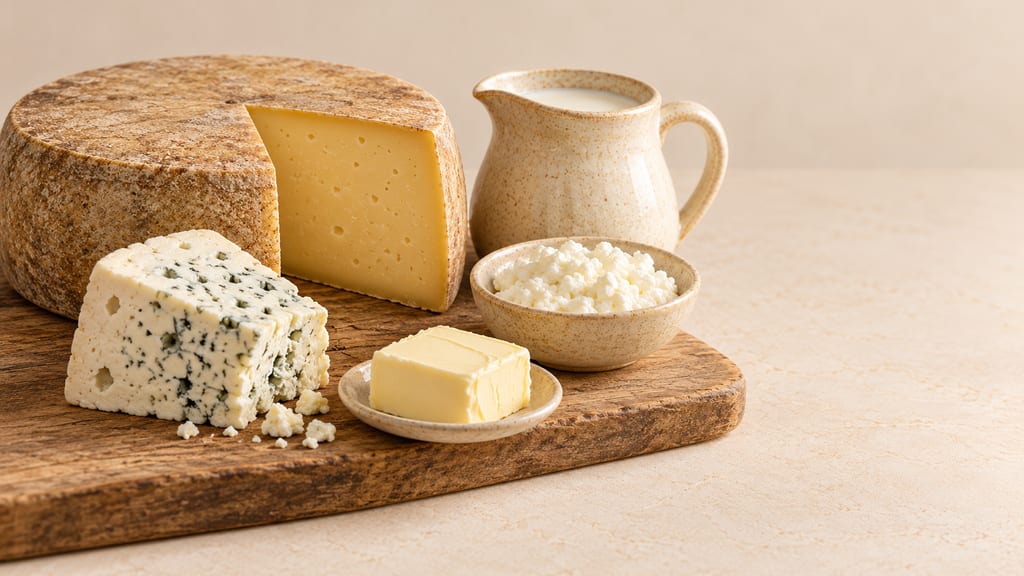
Milk, curd and the world's dairy stores
Follow milk into cheese, cultured drinks, butter, dried curds and sweets: a journey through the animals, seasons and household decisions behind the world's dairy foods.
 FermenteaWhere food goes to change
Substrates
Reindeer milk is milk from female reindeer (Rangifer tarandus). Sámi sources document its former use in cheese and stored foods in parts of Sápmi; one source says reindeer milking no longer occurs in its described context.
Reindeer milk is the mammary milk of a female reindeer, Rangifer tarandus. Reindeer are also called caribou in North America, but this record concerns historical northern Eurasian dairy practices described in Sámi sources. The ingredient name identifies the animal; it does not state whether milk is raw or pasteurized, or how it was handled.
Reindeer milk is not a standard retail milk in the sources consulted. Samer.se says reindeer milking no longer occurs in the community context it describes. Research on composition is limited to particular animals and study settings, so it cannot serve as a general commercial specification.
Sámi sources describe reindeer milk as part of historical foodways in particular communities. Samer.se records cheese made in low molds. It also describes chopped mountain sorrel and/or angelica shoots cooked into a mash, then warmed with reindeer milk until the mixture thickened; the food could be stored in a cask over winter. This is a historical account, not a tested modern recipe or evidence that the food was fermented.
A study of early modern household economies in northern Sweden reports summer and autumn milking, labor-intensive handling of reindeer in pens, and cheese production. Some milk was drunk and most was made into cheese. Its account distinguishes small-scale production among Forest Sámi from cheese traded by Mountain Sámi. This evidence concerns those communities and period, not every Sámi group.
A separate study of early modern Sápmi discusses Linnaeus's 1732 description of summer cheese and autumn milk stored with berries to freeze. The authors note that the animal species in that milk account is uncertain. The sources do not prove a first date for reindeer milking or a single continuous tradition. Detailed recipes and safe home processing instructions are not established.
A study of captive nursing reindeer across two successive lactations found milk yield and major components changed with the individual animal and stage of lactation. In that sample, mean fat was 15.5%, protein 9.9% and lactose 2.5%; fat and protein increased during lactation while lactose decreased slightly. These are study results, not fixed values for all reindeer milk or a nutritional label for a historical food.
A study of grazing Alaskan reindeer also reported high solids and changes through lactation. Differences among studies underline that animal population, feed, lactation stage and methods matter. Neither study supports substituting reindeer milk in an ordinary recipe without a method developed for it.
Historical use does not establish modern food safety. The composition and handling history of a purported reindeer-milk product would need to be verified. The sources consulted do not provide a validated home method, pasteurization schedule, fermentation endpoint or storage limit for reindeer milk; this page therefore gives no preparation directions.
CDC guidance says raw milk, meaning milk that has not been pasteurized, can carry disease-causing germs and recommends choosing pasteurized milk and dairy products. This is general milk-safety guidance, not a reindeer-specific risk study. Historical cooling, freezing or preserving does not show that pathogens are reliably controlled.
The historical milk supply described by the sources was tied to a seasonal herding life. A study of early modern Sámi households in northern Sweden says reindeer provided milk in summer and autumn, alongside transport, meat, hides and other materials. Such a calendar was not a controlled dairy schedule: herds moved among grazing areas, and families coordinated milking with the animals, their calves and other work.
The same chapter stresses the labor involved. The herd was gathered into pens and females separated and tethered in groups for milking. Milking was described as work shared across household members and repeated twice daily. This gives context for why milk was limited and why much of it might be preserved instead of treated like an abundant modern supply. It should not be read as a recommendation to handle animals this way today.
Historical production was not uniform. The authors distinguish Forest Sámi, for whom dairy making and trade were more limited, from Mountain Sámi, for whom reindeer cheese is described as a commodity sold or bartered. The account concerns particular northern Swedish households and historical sources; it does not establish how common the practice was across all communities or eras. Modern reindeer husbandry should not be assumed to include milking.
Sources name several uses that should not be collapsed into one recipe. Samer.se describes cheese shaped in low molds. It separately describes milk warmed with a cooked herb mash until it thickened and says the food could be put away for winter. That account does not establish a starter culture, fermentation, pH, preservation mechanism or modern shelf life.
The early modern household study says most milk was turned into cheese and reports that milk from at least ten reindeer was needed for a plate-sized cheese. That figure belongs to the historical account and is not a universal production ratio. It may depend on animals, season, cheese size and the meaning of the historical measure; the source is not a modern yield study.
Food historians also discuss keeping seasonal foods for winter. In the discussion of Linnaeus's 1732 passage, milk with berries is said to have been left to freeze. The authors explicitly note that the species of milk is uncertain there. The account offers no controlled safety data or household directions. Freezing or storage in a historical account should not be turned into a present-day preservation method.
Milk composition depends on the animals sampled and when. One Norwegian study monitored captive nursing reindeer over two successive lactations. It reports mean values of 15.5 percent fat, 9.9 percent protein and 2.5 percent lactose, with fat and protein rising and lactose declining slightly as lactation progressed. Individual reindeer also differed. This study quantifies change, but its population is not a label for every population or season.
A separate study tested pooled milk from grazing Alaskan reindeer at five points during lactation and reported mid-lactation averages of 15.5 percent fat, 8.6 percent casein, 1.5 percent whey protein and 3.1 percent lactose, among other components. It found increases in most major constituents through lactation. Differences in study values should remain attached to population, sampling and methods; neither is a universal specification.
High solids in these studied samples help explain why historical descriptions associate the milk with concentrated foods and curds. Composition alone cannot tell us the texture of a particular old cheese, how it was made, or whether a present-day milk would coagulate the same way. Feed, season, animal and lactation stage can shift a sample. These data do not establish general nutrition or health claims.
Unlike common supermarket milks, reindeer milk is not documented by these sources as a widely traded contemporary ingredient. Samer.se explicitly says reindeer milking has ended in the community setting it describes. The scientific papers studied milk under research conditions; they do not document a modern retail supply chain. A current product claim would need a named producer, location, processing status and independent evidence.
This scarcity matters for recipe interpretation. A historical recipe, if encountered, may use words such as reindeer milk, cheese or a local food name without modern units, equipment or controls. Transcribing an old description as a practical home method would hide gaps in the evidence. These accounts are valuable for food history, but they do not provide a reproducible technical specification.
The ingredient is also distinct from reindeer cheese. Cheese results from processing milk and has different properties and controls; an ingredient page can describe the relationship but should not merge the products. An account of reindeer milk does not establish that today's commercially available northern cheeses use it. Historical reindeer-milk cheese should not be equated with current kaffeost, which is commonly made from cow milk.
The strongest specified regional evidence concerns Sámi households in northern Sweden. A historical-economic study describes Mountain and Forest Sámi and discusses different production and trade patterns. Samer.se provides a Sámi food account in Swedish that describes former reindeer milking and milk foods. These are grounded regional associations; they do not mark a single point of origin.
Sápmi spans a large northern region and has never represented one homogeneous food culture. The food-history article notes the wide territory and differences in livelihood and environment among Sámi communities. Its evidence ranges across northern Fennoscandia and historical archives, not one standardized cuisine. Therefore, a record can associate the milk with documented Sámi dairy practice while preserving uncertainty about which groups practiced it, how widely it spread and when it began.
Historical evidence is shaped by its sources. Tax records, travel accounts, later community memory and scholarship answer different questions. A sixteenth-century outsider's description may reflect the author's observations and inherited ideas; it does not capture every household practice. A later community account can document remembered food knowledge without proving that the exact practice existed unchanged from an earlier date. Date and geography must stay attached to each evidence type.
These historical descriptions are not instructions for making reindeer-milk cheese at home. They do not specify standardized quantities, heat treatment, starter culture, coagulant, acidity, handling conditions or validated storage. A short account of using low molds does not reveal the full process. Warming milk with herbs until it thickens does not establish how to reproduce or safely preserve the food.
A modern method would need to identify the milk source and its treatment, then validate each preservation and storage step for the specific product. That evidence is absent from the sources used here. Replacing another animal's milk in a recipe is not justified by the composition studies. Differences in proteins, fat, solids and treatment can change coagulation and yield.
For these reasons this page gives no quantities, timings or temperatures. It does not recommend collecting milk from wild animals or attempting to milk reindeer. Historical descriptions are for cultural and food-history understanding; animal handling and contemporary production need appropriate expertise and locally applicable guidance.
Milk can carry pathogens if it has not been pasteurized. CDC defines raw milk as milk that has not been pasteurized and warns that even good farm practices cannot guarantee it is free of harmful germs. It recommends choosing pasteurized milk and dairy products. This is general guidance, not a reindeer-specific study.
Nothing in the historical sources proves that milk stored in a cool place, frozen outdoors or put into cheese is pathogen-free. Traditional storage accounts describe practices and context, not microbiological tests. The same applies to foods that thicken, acidify or mature: without a validated method and product-specific controls, those changes do not demonstrate safety.
Because reindeer milk is not a common retail ingredient in the cited evidence, anyone encountering a product should verify its source, pasteurization status and handling with the producer and relevant food-safety authority. Do not infer safety from appearance, smell, taste or a traditional name. Children, pregnant people, older adults and people with weakened immune systems are especially vulnerable to serious illness from raw milk, according to CDC.
Together these sources support a careful account: reindeer milk was used in particular Sámi foodways, especially for cheese and some stored foods; production was seasonal and labor-intensive in the northern Swedish households described; and measured composition varies through lactation. They also establish a present-day limit: one Sámi community information source says reindeer milking no longer occurs in the setting it describes.
The sources do not show an exact date when reindeer milking began, how widespread it was in all Sámi groups, or whether it continued unchanged. They do not support a universal recipe, current commercial composition standard or safe home processing advice. Even the historical account of milk with berries leaves the animal source uncertain.
These limits belong in the record instead of a plausible reconstruction. Reindeer milk is a specific ingredient with a historically significant but bounded source trail. Its documented place in Sámi history deserves careful attribution and geographic precision, while the sources assembled here do not establish modern production or practical use.
Milk proteins, Lactose
The source describes milk use by Mountain and Forest Sámi households in northern Sweden; this does not represent every Sámi community.
The article discusses Sámi foodways across a diverse region. The animal species of milk is uncertain in the Linnaeus passage, so this is context rather than a claim of reindeer milking throughout Sápmi.
Follow milk into cheese, cultured drinks, butter, dried curds and sweets: a journey through the animals, seasons and household decisions behind the world's dairy foods.

A gelling polysaccharide extracted from red seaweeds, sold as kanten strips or powder; it sets firm at a low concentration and stays solid until about 85 °C.

A Dominican table and seasoning condiment of sour orange juice, mixed with lime and salt and bottled raw; garlic, oregano or a hot pepper may be added for meat or a spicier bottle.

Cicerbita alpina is an alpine perennial whose tender shoots and leaves have been eaten raw or cooked. Sámi milk preparations and modern Carnian dishes are distinct uses, with serious identification and preservation limits.

Japanese skipjack tuna cooked, then repeatedly smoked and dried over a wood fire by the hand-fired tebiyama method into a hard block for shaving into dashi: the first stage of katsuobushi.

A Swedish-style spirit vinegar made by fermenting neutral alcohol with live vinegar bacteria, with a separate guide to commercial ättika strengths.

A yeast-raised wheat ring shaped from a firm dough, briefly boiled and baked. This source-batch formula gives a gently malted crust and a chewy crumb.

A warm dip of garlic, anchovy and olive oil, often enriched with butter, that Piedmont serves over a flame with raw and cooked vegetables and bread.

Bechamel is a white sauce of milk thickened with a butter and flour roux, one of the French mother sauces, and the base from which Mornay and other cheese and cream sauces are made.
No community contributions have been published for this entry yet.
Sign in to contribute. Published comments and photos are free to read.
NCBI TaxonomyIdentity
Rangifer tarandus (Taxonomy ID: 9871)NCBI Taxonomy identifies Rangifer tarandus as reindeer/caribou.
Cited in: A milk from female reindeer
Samiskt informationscentrum (Samer.se)History · Uses · Preparation
MatThe page says reindeer were formerly milked and cheese was made in low molds; it says milking no longer occurs in the community context described.
It records a thickened food made with cooked mountain sorrel and/or angelica and says it could be stored over winter.
Cited in: A milk from female reindeer; Historical Sámi dairy uses; Herding and seasonal production; What historical accounts say about processing; A historically limited ingredient; Geography and community context; No validated home preparation method; What is known, and what remains uncertain
University of Primorska PressHistory · Production · Uses · Geography
Livelihood diversification in early modern Sami households in northern SwedenThe chapter describes reindeer milk use during summer and autumn in northern Swedish Mountain and Forest Sámi households.
It reports that some milk was consumed and most turned into cheese, with production and trade differing between communities.
Cited in: Historical Sámi dairy uses; Herding and seasonal production; What historical accounts say about processing; A historically limited ingredient; Geography and community context; No validated home preparation method; What is known, and what remains uncertain
University of OuluHistory · Geography · Uncertainty
Not on bread but on fish and by hunting: Food Culture in Early Modern SápmiThe authors use archaeological and written sources and emphasize diversity across Sámi regions and periods.
They discuss Linnaeus's 1732 account of summer cheese and autumn milk stored with berries; the species of milk is uncertain.
Cited in: Historical Sámi dairy uses; What historical accounts say about processing; Geography and community context; What is known, and what remains uncertain
Comparative Biochemistry and Physiology Part AComposition · Production
Milk production and composition in reindeer (Rangifer tarandus): effect of lactational stageA study of captive nursing reindeer found milk yield and composition varied with individual and lactation stage; sample means were 15.5% fat, 9.9% protein and 2.5% lactose.
Cited in: A milk from female reindeer; Composition varies; Composition is not one fixed number; No validated home preparation method; What is known, and what remains uncertain
Journal of Dairy ScienceComposition
Compositional Changes in the Milk Secreted by Grazing Reindeer I. Gross Composition and AshA study of pooled grazing Alaskan reindeer milk measured composition at five lactation intervals and found most major components increased while lactose did not.
Cited in: Composition varies; Composition is not one fixed number; No validated home preparation method; What is known, and what remains uncertain
Centers for Disease Control and PreventionSafety
Raw MilkCDC says raw milk can carry disease-causing germs, farm practices cannot guarantee safety, and consumers should choose pasteurized milk and dairy products. This guidance is general, not reindeer-specific.
Cited in: Safety and limits; Raw milk and general dairy safety; What is known, and what remains uncertain