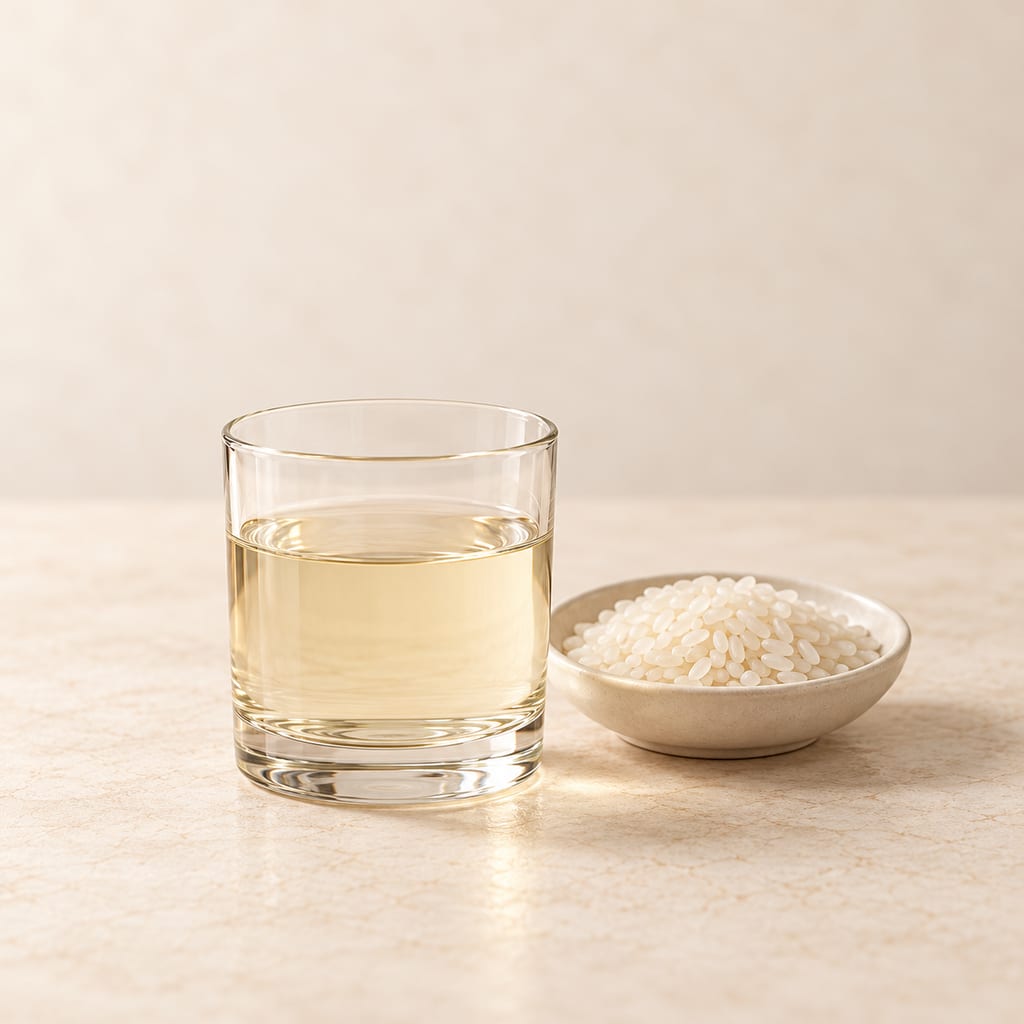
White-rice yakju with rice-flour nuruk
A 2021 study's white-rice yakju: steamed Hanareum rice ferments with rice-flour nuruk and takju yeast for 11 days, then the clear upper liquid is filtered and centrifuged.
 FermenteaWhere food goes to change
Cultures
A shaped, inoculated white-rice-flour starter prepared by Han and colleagues for a 2021 yakju comparison; the commercial baekguk strain was not identified.
The rice-flour nuruk in Han and colleagues' 2021 yakju study is a shaped, cultivated starter made from dry-milled white rice flour. It is one particular improved nuruk, not a name for all Korean brewing starters. The researchers prepared a white-rice version to compare with a version made from pigmented rice. Both began as flour, hot water and a commercial inoculum called baekguk, then spent days in controlled warm, humid conditions before drying. The white-rice product is the ingredient used in the linked white-rice yakju account. The finished clear drink and the starter that helped make it are different foods, although the study's Figure 2 places their photographs together.
Nuruk is a broad Korean word with a long and varied history. The Academy of Korean Studies describes grain-based fermentation starters made from wheat, rice, barley, mung bean and mixtures, formed and matured in different ways. Those starters may be cakes or looser preparations and may carry more than one kind of microorganism. The 2021 paper calls its flour product an “improved” nuruk because the experiment uses a measured commercial inoculum and set cultivation stages. Its identity is defined by the researchers' white rice, flour preparation and process, not by every traditional feature associated with the wider word. A packet marked simply “nuruk” cannot be assumed to reproduce this study's product.
The inoculum is another ingredient within the ingredient. Han's methods name a commercially sold white starter, baekguk, from Chungmoo Fermentation. They do not state the biological species or strain in that starter. The name “white” describes the material used by the authors, not an identification of a particular Aspergillus species. Nor does it make the molded rice-flour nuruk identical to Japanese rice koji. A related 2019 experiment compared rice-flour nuruk made with several named fungi against a steamed-rice koji control, which shows how many preparations can sit near one another without becoming the same thing. In this page, “rice-flour nuruk” means the white-rice version actually made and measured by Han's team.
The researchers dry-milled white rice through a pin mill fitted with a 100-mesh screen. Milling matters because it changes whole grains into a flour that can be mixed and shaped; it is also one of the defining differences between this starter and koji grown directly on intact steamed rice. The reported mill feed rate is 500 grams per minute, which describes the equipment rather than a necessary property of the ingredient. The white rice acquired for the experiment was 2018 Hanareum rice. These details let a reader see that “white rice flour” was an actual prepared material in a comparative experiment, not an unspecified powder bought under a generic name.
The process figure begins with one kilogram of flour. The methods add 400 millilitres of water heated to 100°C and call the addition 40 percent. The hot water is mixed into the flour while hot, and the dough is allowed to cool to 30°C before the commercial baekguk is added and kneaded through it. The authors report 0.3 percent inoculum. They do not say explicitly whether that percentage is calculated against flour, dough or another base. Converting it into a confident gram weight would make the method more exact than the paper is. The use of hot water also does not mean the flour was steamed: the authors distinguish this flour method from a steamed-rice process. They did not measure how much starch, if any, gelatinized during mixing or claim that the water sterilized the flour.
After the second kneading, the dough was put in a mold, shaped and placed in a nuruk box. It spent 48 hours at 30°C and 85 percent relative humidity. For a second stage, the lid was removed and the shaped nuruk was leaned against the box while it remained for seven days at 25°C and the same stated humidity. The authors then dried the cultivated material to around 10 percent moisture. These are a laboratory production record for this particular starter. They explain why a shaped block has a history of mixing, growth and drying before it enters the yakju mash. They do not specify the mold's dimensions, each block's weight, the drying temperature or a storage life.
Each stage has a different purpose in the account. Milling and mixing prepare a uniform flour-based mass. Cooling precedes the inoculation, so the commercial starter is not stirred into the just-heated dough. Shaping makes a handled piece rather than a loose slurry. The warm, humid intervals are the period of cultivation; drying follows that growth. This is an explanation of the sequence the authors chose, not proof that every parameter is optimal for other rice, starter or equipment. A reader should not treat the published incubator settings as a home production instruction stripped of the study's controlled surroundings and missing hygiene specifications.
The point of a cultivated grain starter in rice alcohol is to help turn materials in grain into forms that other microbes can use. Han's group measured three enzyme activities in the prepared nuruk: saccharogenic, dextrinogenic and proteolytic activity. The first two concern starch breakdown and sugar production; the third concerns protein breakdown. These are laboratory assays on the nuruk, reported in the paper's own units. They show that the cultivated white-rice material had measurable biochemical activity. They do not show how much sugar any different batch will release in a kitchen jar, how fast an unspecified fermentation will proceed or what this starter tastes like when eaten alone.
For the white-rice nuruk, Table 1 gives saccharogenic activity as 1,160.00 ± 20.00 SP per gram, dextrinogenic activity as 280.00 ± 34.64 A.U. and proteolytic activity as 316.08 ± 0.89 tyrosine milligrams per minute. Those figures are measurements of this experimental material, not a specification for every rice-flour nuruk sold later. The pigmented-rice counterpart gave a slightly higher saccharogenic reading, a lower dextrinogenic reading and a higher proteolytic reading. In the table, the reported comparison p values are 0.561 and 0.242 for the two starch-related assays, and 0.042 for proteolytic activity. The protein-related difference is the one marked significant there. Keeping the three measurements separate is more informative than saying vaguely that pigmented rice “had better enzymes.”
The paper also measured the drink produced with the starter. Its reducing-sugar curve rose early and then fell as fermentation advanced; the authors connect this with sugar released by saccharification being used by yeast for alcohol production. That trend shows the starter participating in a system, not working alone. Separately pitched yeast was present in the yakju comparison, and the mash contained much more steamed rice than nuruk. The controlled laboratory results support the ingredient's role, but the resulting alcohol, acid and sensory scores belong to the whole beverage, including its rice, water, yeast and handling. They cannot be converted into tasting notes for a dry nuruk block.
The related 2019 study is useful precisely because its results differ when the fungus changes. It compared rice-flour nuruk prepared with distinct named fungi and a steamed-rice koji control. The tested variants gave different enzyme profiles. That confirms that a flour substrate alone does not determine activity, and that one cannot substitute a species name from another paper for Han's unnamed baekguk. The 2019 makers and 2021 makers share a line of process research, but the exact cultures in their comparisons are not documented as the same.
Han's white-rice yakju comparison shows how the prepared nuruk was actually used. The researchers washed two kilograms of white rice, soaked it for five hours, drained it for two and steamed it for one hour. They cooled the cooked rice to 30°C, then added 200 grams of their white-rice-flour nuruk, six grams of a commercial takju yeast and three litres of brewing water. Fermentation ran for 11 days at 23–25°C. The clear upper liquid was filtered and centrifuged to make the experimental yakju. This is the particular use behind the ingredient link, not a general ratio for all Korean rice wine.
The separately added yeast is crucial to understanding the starter. The nuruk's cultivated enzymes help make sugars available from rice starch while the yeast ferments available sugars into alcohol. Both processes can overlap in the mash. A reader who interprets “nuruk” as the only microbe in the vessel would miss the six grams of commercial yeast in the actual study. Equally, a reader who thinks yeast alone performed the starch conversion would miss why the authors produced and assayed a flour-based starter before brewing. The white-rice batch's fermentation results arise from this joint process under the reported conditions.
The study's comparison was designed around white and pigmented rice. The white-rice-flour nuruk was paired with white rice; the pigmented-rice-flour nuruk with pigmented rice. That means a later difference between the finished drinks cannot be assigned to the starter alone: the primary grain also changed. At day 11, the final ethanol readings were 13.5 percent for the white-rice yakju and 14.6 percent for the pigmented-rice yakju. The comparison also covers acids, color, antioxidant assays and a small sensory panel for the beverages. Those are outcomes of paired formulations, not evidence that the white starter itself has a particular color, taste, health effect or ability to produce exactly 13.5 percent alcohol in another mash.
An exact image in Figure 2 reinforces this separation. Panel A is captioned white-rice-flour nuruk; panel C is the yakju made with it. The pictured dry ingredient and the filtered beverage are different subjects. This page can use panel A as a visual reference after its pixels and use rights are checked, but panel C cannot stand in as evidence of the starter's form or of how clear all white-rice yakju becomes. The article supplies one research preparation, not a retail standard for every product bearing the name.
The Academy of Korean Studies describes nuruk from several cereals and legumes and records regional differences in shape and making. Its historical survey identifies early written mention in the Goryeo-period text Goryeo Dogyeong and notes Joseon-era manuals that discuss ingredients and methods. It infers earlier existence from older records of alcohol; that is an inference, not a surviving recipe for this white-rice-flour starter. The encyclopedia also describes household seasonal making, a later group of nuruk manufacturers from 1927 and twentieth-century efforts to make production more regular. These details explain how a traditional category can include both household forms and manufactured descendants without turning one laboratory method into an ancient continuous formula.
Han's 2021 paper belongs to that modern strand. The authors adapted an earlier non-steamed rice-flour nuruk process to compare white and pigmented rice for yakju. The 2019 experiment had already tested how named fungi changed a flour-based starter used for makgeolli. The publications are related research, yet the white-rice product in the 2021 yakju comparison is still defined by its own commercial baekguk, shaping, controlled cultivation and drying. It is not interchangeable with a wheat cake gathered from the ambient air, a whole-grain Japanese rice koji or a laboratory variant inoculated with one of the species named in the 2019 paper.
The distinction is practical for a reader choosing an ingredient. The label should tell the grain base, whether it is flour or whole grain, the culture supplied, and the maker's handling directions. The study does not provide a retail label, shelf life, safe storage interval, acceptable appearance or identity test for its finished block. Its reported dryness of about 10 percent is an experimental endpoint, not a promise that any dry-looking block is the same starter. The researched ingredient is a specific prepared material in a documented beverage trial. Its value in the food account lies in making that material's stages and function visible while preserving the limits of what the authors actually measured.
The paper gives Korean author affiliations and suppliers but does not identify the exact preparation site or origin of this subtype.
A 2021 study's white-rice yakju: steamed Hanareum rice ferments with rice-flour nuruk and takju yeast for 11 days, then the clear upper liquid is filtered and centrifuged.

Soft, spreadable Calabrian pork sausage made with a great deal of red chilli and fatty pork, stuffed into natural casings, sometimes smoked and matured while staying soft.

A way to add independent temperature logging to an existing food dehydrator without changing its built-in controls or protections. It is a monitoring method, not a rewiring plan.

Pleurotus cystidiosus is the abalone mushroom, a cultivated oyster-type fungus with dark brown caps that grows more slowly and is more demanding than other Pleurotus species.

A dark, balanced vinegar from Emilia-Romagna made by combining cooked or concentrated grape must with wine vinegar, then acetifying and refining it in wood under a protected specification.

A living dairy inoculum that starts controlled cream fermentation, developing acidity and aroma before sour cream or cultured butter is finished.

A small electric incubator holds jars at a selected temperature for yogurt and other documented warm food preparations. Controls, capacity and vessel arrangement vary by model.

Adygean salt is a seasoned table salt associated with Adygea and the wider North Caucasian culinary tradition. Salt is blended with garlic and a variable selection of herbs and spices; the exact mix depends on the named style and maker.

The African Caesar-group mushroom, Amanita masasiensis, is a wild ectomycorrhizal species of central and southern African woodlands, eaten locally. The genus contains deadly poisonous species, so identification needs care.
No community contributions have been published for this entry yet.
Sign in to contribute. Published comments and photos are free to read.
Korean Journal of Food PreservationIdentity · Ingredient · Process · Science
Quality and antioxidant characteristics of Yakju prepared with pigmented rice flour Nuruk2021 methods and Fig. 1/2: white-rice-flour improved nuruk; measured culture and drying stages; Table 1 enzyme assays; its white-rice yakju use.
Cited in: The starter made from flour; Flour, water, inoculum and time; What its enzymes can and cannot tell us; Its role in one white-rice yakju; A modern branch of a broad Korean tradition
Korean Journal of Food PreservationHistory · Science
Quality analysis of Makgeolli made with non-steamed rice flour Nuruk by various fungal strains2019 modern flour starter comparison with named strains and steamed-rice koji control; not the 2021 culture identity.
Cited in: What its enzymes can and cannot tell us; A modern branch of a broad Korean tradition
Academy of Korean StudiesHistory · Culture
NurukKorean starter grain, form and process diversity; historical documentary scope and later industrial making.
Cited in: The starter made from flour; A modern branch of a broad Korean tradition