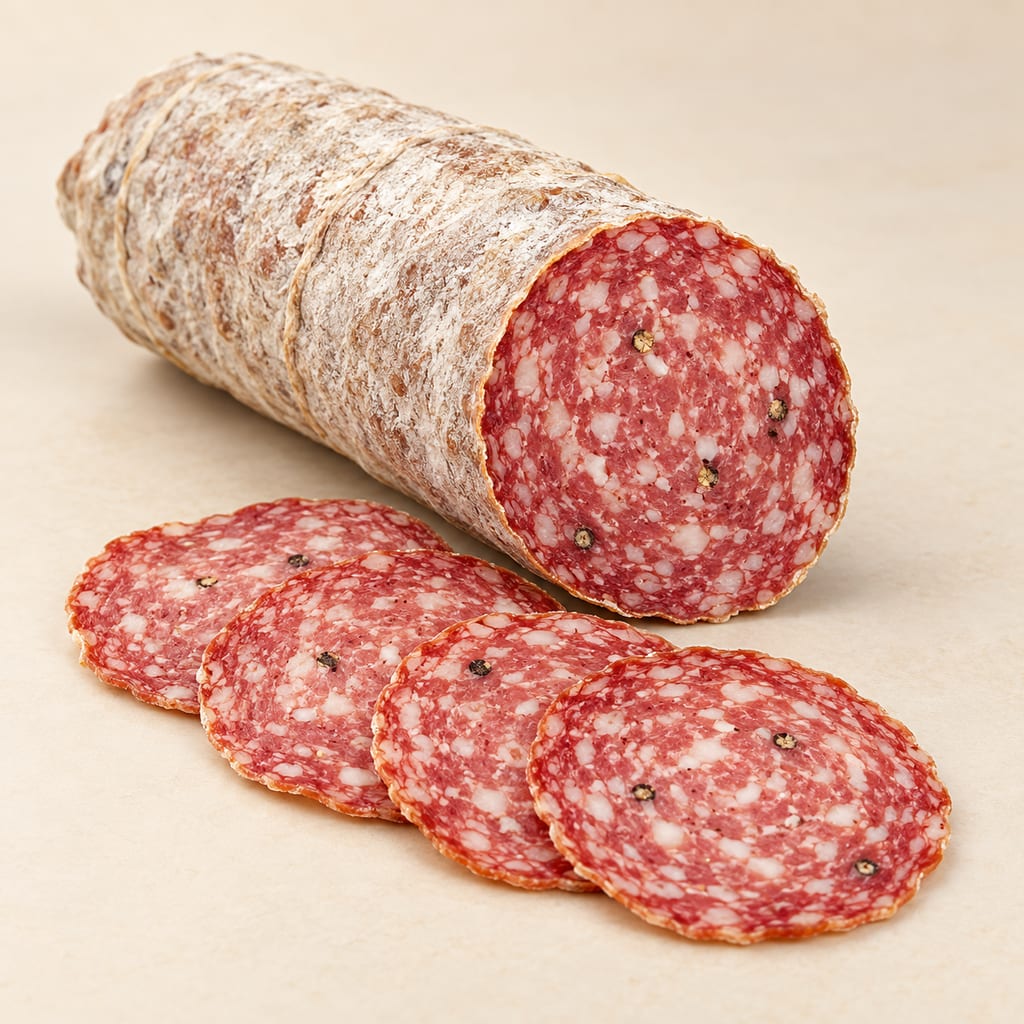
Genoa-style salami, red-wine method
Pork, beef and back fat ferment with a named starter, cure and red wine before the sausages dry in casings. This contemporary formula uses no wood-smoke stage.
 FermenteaWhere food goes to change
Cultures
SM-194 is a freeze-dried, five-species culture for fermented sausage; its manufacturer and the linked Genoa-style recipe give different addition directions.
Bactoferm® SM-194 is a freeze-dried starter culture: a measured blend of microorganisms added to sausage meat so that fermentation begins with selected organisms rather than relying only on whatever microbes happen to be present. Its manufacturer describes it for traditionally fermented sausages made on a short production schedule. The powder is off-white to brownish and contains sucrose, the culture itself, and manganese sulfate. It is sold as a mixed culture, not as one single “sausage bacterium.”
That distinction matters. A starter is not a seasoning, a preservative salt, or a complete sausage-making method. It contributes a chosen microbial community to a particular meat mixture and process. The final sausage still depends on its ingredients, the amount and kind of fermentable sugar, the conditions in which it ferments and dries, and the producer’s measurements and controls. The package does not make two recipes interchangeable simply because both use SM-194.
The blend brings together five named species: the lactic acid bacteria *Lactobacillus sakei* and *Pediococcus pentosaceus*; the coagulase-negative staphylococci *Staphylococcus carnosus* and *Staphylococcus xylosus*; and the yeast *Debaryomyces hansenii*. The public product information identifies species, but does not give the strain identifiers, proportions, or viable count of each member. Those missing details matter because members of one species can behave differently, and organisms also affect one another when they grow together. It is safest to describe this as a five-species blend with undisclosed individual strains, rather than assign it precise strain-level behavior.
Lactic acid bacteria use available carbohydrates and produce acids, especially lactic acid. In sausage batter, that acid production lowers pH and contributes a tangy note. A lower pH also changes the conditions in which other microbes grow and affects the meat proteins and the way the finished sausage holds together. SM-194’s manufacturer says that the final pH can be influenced by adjusting the amount of fermentable sugar added to the meat. This is a relationship between formulation and fermentation, not a promise that the culture will reach one fixed pH in every sausage.
The two lactic acid bacteria in this blend are not redundant labels for the same organism. *L. sakei* is strongly associated with meat environments and fermented sausages. It can use several nutrients found in meat, while the sugars readily available in meat are limited; the added carbohydrate in a sausage formula can therefore matter to its fermentation. Research on *L. sakei* also shows substantial variation among strains in growth, stress tolerance, acidification and interactions with other microbes. Some strains have served as starters, some have been studied as protective cultures, and the species can also occur in spoiled meat products. Species identity alone does not predict the performance of an undisclosed commercial strain.
*P. pentosaceus* is another lactic acid bacterium used in fermented sausage cultures. Studies that tested named *Pediococcus* strains have found differences in acidification and in finished sausage properties. For example, one dry-sausage study compared *P. pentosaceus* strain KC-13100 with two *Lactobacillus plantarum* strains in one defined pork formulation and process. The treatments differed in pH, water activity, texture and sensory scores. In that experiment, the *P. pentosaceus* batch ended at pH 4.91 and water activity 0.83; the two *L. plantarum* batches ended at pH 5.23/0.78 and 5.05/0.74. The study reported no significant relationship between pH and water activity across those treatments. Those values describe that formula and process, not targets for another salami. They illustrate why culture selection matters, but do not reveal the behavior of SM-194’s undisclosed *P. pentosaceus* strain or predict a different recipe’s results.
The two staphylococci belong to the group often called coagulase-negative cocci. In fermented meats, members of this group are associated with cured-color development and flavor chemistry, including enzyme activities that can affect proteins and fats. SM-194’s manufacturer describes the blend as producing a strong, stable cured color and an aromatic flavor. The current product page also describes a mild “Mediterranean” aroma and says the selected combination supports texture development. These are product-level descriptions. The public sheet does not assign one named task to each staphylococcal species or disclose the strains that produce those effects.
The yeast *D. hansenii* is singled out in the producer’s product information for contributing to flavor development. The current manufacturer page describes the overall flavor as mild and “Mediterranean.” That phrase names a sensory style, not a geographic origin: it does not establish that the product was developed in Genoa, Italy, or any other particular place. Nor does it mean the yeast alone produces a complete regional flavor. Aroma in a sausage emerges from the culture in combination with meat, fat, sugar, salt, spices, fermentation and ripening conditions.
The long history of fermented sausage and the history of a particular commercial starter are different stories. Meat has been fermented through the activity of naturally present microorganisms, and selected starter cultures became a deliberate industrial tool much later. A scientific study on dry-fermented sausage notes that starter-culture application to the category was introduced in the 1940s. SM-194 itself is a branded, formulated product from Chr. Hansen, now part of Novonesis. The public product documents consulted here do not give an invention date, a strain-collection history or a place of origin for the blend.
So the useful history is restrained: SM-194 is a modern way of making fermentation more directed and repeatable in short-cycle sausage production. It is not evidence that historic Genoese sausage makers used this product, or that five named species define all Mediterranean salami. Traditional recipes and fermentations vary, and starter cultures are only one part of that diversity.
The 2020 producer information gives a dosage of 25 g for 200 kg of meat, equivalent to 0.125 g per kilogram. It directs the user to add the pouch contents dry, early in the process, during grinding, cutting or blending alongside the other dry ingredients so that the culture distributes evenly. The sheet describes a powder that forms a water-soluble suspension, but does not require rehydration in its listed direction. Sugar is not a decorative addition in this context. The lactic acid bacteria need fermentable carbohydrate, and the manufacturer explicitly connects the amount of fermentable sugar in the mince with the final pH. In the example Genoa formula, dextrose is one of the listed ingredients at 2 g per 1 kg batch. That figure describes the published recipe only; it should not be copied into another formulation as a universal requirement. Meat itself contains less readily available sugar than amino acids and peptides, and studies of *L. sakei* show that strains differ in the carbohydrates and other nutrients they can use. A recipe’s sugar choice and quantity therefore interact with the culture and process. The product sheet offers the direction that sugar amount can regulate pH, but does not provide a universal sugar dose, endpoint, or schedule for every sausage.
A published Genoa salami recipe uses another method for its own formula: it directs the cook to rehydrate 1/8 teaspoon of SM-194 in 1/4 cup of distilled water per kilogram of meat and fat, then leave the mixture for 30 minutes at room temperature before adding it. That is a recipe-specific instruction. Teaspoons measure volume, while the producer’s direction gives mass; these quantities should not be converted or treated as equivalents without a reliable product-specific basis. The recipe and the producer also describe different ways to introduce the culture. Follow the directions appropriate to the actual recipe and product label rather than combine them into a newly invented method.
The Genoa recipe illustrates how the culture fits into a broader sequence: chilled meat and fat are ground, the culture and other ingredients are mixed in, the mince is stuffed into casings, and the sausages ferment before drying. The recipe describes checking pH before moving to the drying stage and gives its own target and timing. Those numbers belong to that recipe’s formulation and conditions, not to SM-194 as a stand-alone guarantee. The culture manufacturer says sugar adjustments can influence final pH; it does not specify one universal sugar amount or fermentation schedule for every sausage. Fermentation and drying are related steps, but they are not the same change. During fermentation, the selected bacteria grow and convert some available sugars into acids; pH is a way of tracking the acidity of the meat mixture. Drying then removes moisture over time, changing the concentration and texture of the sausage. The recipe’s sequence makes this distinction visible: it waits for its pH target before moving the links to the drying chamber, and then uses a separate weight-loss target to judge the drying stage. A lower pH does not tell a cook how much moisture has left the sausage, and weight loss does not identify which microbes grew during fermentation. The blend can influence one part of this chain, but it does not replace the other ingredients, measurements, or process stages. The manufacturer describes faster pH drop at higher temperatures and associates that blend behavior with firmer texture; it does not publish a universal temperature-and-time schedule in the product sheet. This is why the culture should be understood as an ingredient whose effects depend on the recipe and conditions, rather than a self-contained shortcut to a finished salami.
The producer’s 2020 product information describes SM-194 as freeze-dried and says to store it dry below −17 °C (below 1 °F). It gives a shelf life of at least 18 months for freeze-dried cultures stored according to its recommendations, and a maximum of six weeks when held at +5 °C (41 °F). It lists shipment at ambient temperature. These are product-sheet values, not a general shelf-life rule for every meat culture or a promise about an opened pouch. Check the date and instructions on the specific package in hand, and keep the powder dry as directed.
The current manufacturer page also cautions that microbial powders should be handled so workers do not inhale dust or get it in their eyes, on skin or clothing. It advises keeping the product dry and in a closed container and following local disposal rules. This is a practical handling note for a microbial powder; it is separate from the controls needed for the sausage itself.
A starter culture helps shape fermentation, but its presence does not certify a sausage as safe to eat. The producer states that food safety of the finished product remains the food manufacturer’s responsibility, calls for continuous control, and recommends safety studies for the specific application under applicable local guidance. That boundary is important for home and commercial use alike. Published research on other strains, other formulations, or laboratory models cannot validate a different sausage process.
In one study, researchers used SM-194 in meat-based and salami-model media to test its effect on aflatoxin production by *Aspergillus parasiticus*. The effect varied with the medium and incubation conditions: although the culture reduced aflatoxin B1 formation in salami-model media, fungal colony growth was higher in some of the model treatments. The authors called for further research in actual salami. These results do not establish pathogen control or ready-to-eat safety for a household Genoa salami. Likewise, fermentation progress should be assessed with the measurements and controls specified for the recipe and jurisdiction, not by smell, taste, appearance or the fact that a starter was added.
The consulted producer and recipe records do not establish a manufacturing origin or strain-source location for this product.
Pork, beef and back fat ferment with a named starter, cure and red wine before the sausages dry in casings. This contemporary formula uses no wood-smoke stage.

Soft, spreadable Calabrian pork sausage made with a great deal of red chilli and fatty pork, stuffed into natural casings, sometimes smoked and matured while staying soft.

A way to add independent temperature logging to an existing food dehydrator without changing its built-in controls or protections. It is a monitoring method, not a rewiring plan.

Pleurotus cystidiosus is the abalone mushroom, a cultivated oyster-type fungus with dark brown caps that grows more slowly and is more demanding than other Pleurotus species.

A dark, balanced vinegar from Emilia-Romagna made by combining cooked or concentrated grape must with wine vinegar, then acetifying and refining it in wood under a protected specification.

A living dairy inoculum that starts controlled cream fermentation, developing acidity and aroma before sour cream or cultured butter is finished.

A small electric incubator holds jars at a selected temperature for yogurt and other documented warm food preparations. Controls, capacity and vessel arrangement vary by model.

Adygean salt is a seasoned table salt associated with Adygea and the wider North Caucasian culinary tradition. Salt is blended with garlic and a variable selection of herbs and spices; the exact mix depends on the named style and maker.

The African Caesar-group mushroom, Amanita masasiensis, is a wild ectomycorrhizal species of central and southern African woodlands, eaten locally. The genus contains deadly poisonous species, so identification needs care.
No community contributions have been published for this entry yet.
Sign in to contribute. Published comments and photos are free to read.
Chr. Hansen A/SIngredient context · Process
Bactoferm SM-194 Product Information, version 7Five listed species, product form, 25 g per 200 kg producer dose, dry addition, storage and final-food safety caveat.
Cited in: A culture built for quick traditional-style sausage; What the members contribute; A commercial culture, not an old regional tradition; Use in a sausage formula; Keeping the culture in good condition; A starter is one part of process control
NovonesisIngredient context · Process
Bactoferm SM-194Current manufacturer description of culture format, sensory profile and powder handling.
Cited in: A culture built for quick traditional-style sausage; Use in a sausage formula; Keeping the culture in good condition
2 Guys & A CoolerIngredient context · Process
Genoa SalamiPublished 1 kg formula and distinct 1/8 tsp per kg rehydration method.
Cited in: Use in a sausage formula
MicroorganismsIngredient context · Process
Lactobacillus sakei: A Starter for Sausage Fermentation, a Protective Culture for Meat ProductsSpecies-level meat adaptation and strain variability; not the undisclosed SM-194 strains.
Cited in: What the members contribute; Use in a sausage formula
Food Science of Animal ResourcesIngredient context · Process
Effect of Different Pediococcus pentosaceus and Lactobacillus plantarum Strains on Quality Characteristics of Dry Fermented SausageSpecific experimental strains gave different product results; not SM-194.
Cited in: What the members contribute
ToxinsIngredient context · Process
Meat Starter Culture Reduces Aspergillus parasiticus Production of Aflatoxins on Meat-Based and Salami Model MediaModel-media SM-194 results do not validate real salami safety.
Cited in: A starter is one part of process control
American Meat Science Association / J.C. ActonIngredient context · Process
The Chemistry of Dry SausagesHistorical context: starter cultures introduced for sausage fermentation around 1940; general fermentation principles.
Cited in: A commercial culture, not an old regional tradition