A grass with a sweet, jointed stem
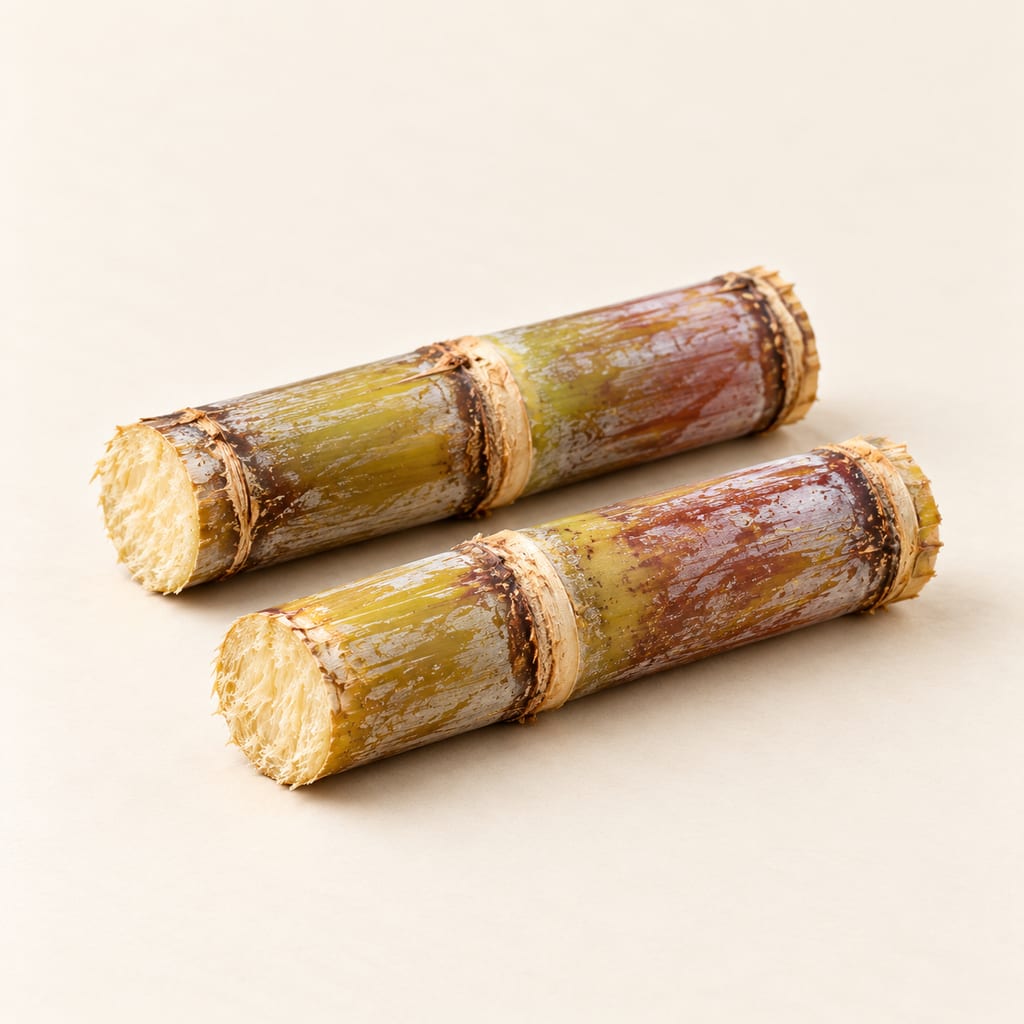
Sugarcane is a tall perennial grass cultivated for the sweet juice held in its thick stems. Botanists call the stem a culm. Its regularly spaced nodes divide it into internodes; the nodes carry buds and leaf bases, while the solid internodes store sucrose-rich juice. This structure is easy to see on a cut stalk: pale fibrous tissue at the end, glossy or waxy outer rind, and rings where the joints sit. The color varies between cultivars and growing conditions, from green and yellow to purple or red. The stalk, rather than its leaves or a processed sugar, is the raw ingredient meant by sugarcane here.
Saccharum officinarum is an accepted cultivated species in the grass genus Saccharum. The name describes a botanical species, not necessarily every commercial cane stalk sold without a cultivar label. UF/IFAS notes that joint length, diameter and rind color vary with variety and growing conditions. A market stalk can therefore be identified as sugarcane without assigning it a cultivar or species pedigree that its seller has not supplied. The cane's familiar sweetness comes from soluble sugars in the stem. Once pressed, the juice is a separate ingredient with its own perishability and regional uses; it should not be treated as another name for the intact stalk.
Farmers can also plant cane as seed cane: a cut stalk section with buds at its nodes sprouts into a new shoot. UF/IFAS explains that buds, root primordia and nodes are part of this propagation system. The same jointed stalk may be planted for the next crop or cut for food and pressing, but those are distinct uses of the plant. Knowing the difference helps explain why cane is sold as planting material in agricultural settings and as a raw ingredient in food markets.
Sources for this section
Native range and a worldwide crop
Kew's Plants of the World Online records New Guinea as the native range of Saccharum officinarum and describes the species as widely cultivated today. A botanical range is not a dated record of human domestication, chewing, trade or fermentation, and it does not identify the origins of a particular cane drink. The evidence here supports the plant's native-range statement and its present worldwide cultivation, while leaving the first human uses undated.
In the warm regions where it grows, cane is valued as a fresh stalk and as a crop from which juice, crystalline sugar, syrups and other products are made. Those forms behave differently in a ferment. Intact cane brings fibrous tissue and juice held inside the stem; pressed juice brings water and soluble sugars directly to microbes; refined sugar supplies concentrated carbohydrate with much of the original plant material removed. A fermented drink described as cane-juice wine is not automatically made from refined sugar, and a cane spirit may begin with juice, syrup or molasses depending on its own documented method.
Sources for this section
Growing and harvesting the crop
Sugarcane is propagated commercially from pieces of stem that carry viable buds. When a bud sprouts, it sends up shoots and roots; as the plant grows, new stalks form in a clump. Leaves wrap around the culm and spread outward to intercept sunlight. The harvested stalk is therefore both crop and planting material. A cut piece used to establish the next stand is not the same thing as a piece sold for chewing or pressing, even though both come from the same plant.
Growth and harvest timing respond to local conditions. UF/IFAS describes moisture, temperature, light, soil and nutrition as factors in cane growth; in the Bacsil case, MMSU reports that cane was harvested eight to twelve months after planting. That interval belongs to one locality and producer, not a universal calendar. The same report records a ratoon crop from the farmer's field after an earlier harvest, showing regrowth in that case without setting a standard number of cuts. These agricultural choices set the starting material for juice and fermentation, but they do not supply a universal maturity test for every household recipe.
Sources for this section
From stalk to fermentable juice
Pressing breaks open the stalk's fibrous internodes and releases a sweet liquid. Sugarcane juice contains water and dissolved sugars, with sucrose prominent in the mature stem; the balance shifts with variety, ripeness and field conditions. This distinction matters when reading a recipe: a fermenter receives the liquid after extraction, not the intact stalk, unless the method specifically says otherwise. The recipe must explain how it obtains and handles the juice rather than leaving the reader to infer that cane segments will behave like sugar.
Microorganisms can use the sugars in cane juice as substrate. In alcoholic fermentation, yeasts convert available sugars into ethanol and carbon dioxide while producing other aroma compounds. Other microbes and enzymes may also change fresh juice, especially after pressing. A laboratory study of fresh sugarcane juice measures microbial and enzymatic changes over time and under different treatments; it does not establish a fixed safe holding period for every climate or setup. This page sets no storage deadline or fermentation ratio because neither follows from a plant's botanical identity. The recipe-specific source needs to establish its starter, vessel, duration and handling.
Sucrose does not accumulate evenly at every joint throughout a plant's life. UF/IFAS describes ripening as a joint-to-joint process: in young cane, sucrose can peak near soil level and decline toward the top; with maturity it becomes more uniform except near the top and underground stool. That account explains why cane maturity and stalk position matter to sugar recovery, but it is not a household ripeness test. A fermenter receives juice from a crop with its own variety and harvest history, so process-specific sources should identify the raw material they actually use.
Sources for this section
Basi and the Ilocos burnay tradition
In Northern Luzon, basi is an Ilocano alcoholic drink made from sugarcane juice. The MMSU account documents a Bacsil farmer producing basi and vinegar from cane grown on his farm. A 2020 Philippine Journal of Science study measured ethanol and several volatile compounds in sampled basi; one reported mean for the study's sampled basi was 11.06% v/v ethanol; those measurements describe its samples, not a standard strength or universal recipe. The authors note that measured beverage values can vary with sampling site, raw material and manufacturing process. Sugarcane enters these examples as expressed juice; the particular source must establish its own extraction, heat treatment, starter, vessel and timing.
The MMSU account is useful as a local producer case rather than a regional rule. It describes one farm divided between the grower's traditional practice and an enhanced practice, with differences in cane varieties, crushing equipment and additions during fermentation. The article reports that the basi was ready to harvest after six months under the enhanced practice and seven months under the traditional one. This is the timing of the fermented drink in that farmer's comparison, not the time needed to grow the cane and not a typical basi duration. The case shows producers adapting methods while keeping distinct preparations visible; it cannot establish a universal improvement for a different variety, jar or season.
The MMSU report gives a concrete example of how the juice is handled in that farm's method: a carabao-driven wooden dadapilan crushed cane in the traditional practice, while a machine was used in the enhanced practice; the extracted juice was boiled before it went into burnay. Those steps describe this producer's comparison, not a required basi sequence. They show why the preparation and process belong to the named drink's own source rather than being inferred from sugarcane alone.
Sources for this section
Burnay as vessel and local history
Burnay is the name used for sturdy stoneware jars made in Vigan, Ilocos. The National Museum describes broad rounded bodies, narrower mouths and flat bases, and associates local manufacture with Chinese migrant potters in the late eighteenth and nineteenth centuries. That is a specific history of Vigan pottery, not a claim that all Philippine fermentation jars began there. The museum discusses burnay as food and water containers and records their uses for basi, vinegar and fermented condiments. The exact use depends on the producer and stage, so the word burnay alone does not tell a reader whether a jar contains wine, vinegar or something stored.
A jar's narrow mouth and durable ceramic body suit handling of stored foods, but material alone does not determine fermentation. Producers may use different closures, starter practices and timings, and oxygen exposure changes as a ferment moves from alcoholic production toward vinegar. The supplied dossier emphasizes that these are separate stages. This context helps explain why an ingredient page for cane should lead into several preparations rather than collapse them into a single generalized sugarcane fermentation. Basi's regional identity belongs to its own method, while cane remains the raw crop used in multiple drinks and sweeteners.
Sources for this section
Choosing cane and keeping its forms distinct
The inspected Commons photograph shows cut, harvested cane stalks, while UF/IFAS describes the joints and color differences that mark the plant. Stalk color, diameter and joint length vary with cultivar and growing conditions, so color alone does not identify a named variety or measure fermentable sugar. The cited sources do not establish a retail grade or a household storage standard. If a recipe calls for cane juice, it needs to say how the stalk is pressed or name another juice source; if it names a refined sugar, follow that ingredient's own description.
Freshly expressed sugarcane juice is subject to enzymatic and microbial change. Chauhan and colleagues studied these spoilage factors under controlled preservation treatments; their findings describe laboratory samples, not a universal home shelf life. They do not justify one room-temperature or refrigerated storage deadline. Cane intended for a ferment should be processed in line with that ferment's documented instructions, with cleanliness and timing handled as its producer or recipe specifies. Do not infer safety from sweetness, smell or the absence of visible change. Where a source gives no validated holding time, leave the duration open rather than invent one.
The reference photo shows stalks after cutting, but it does not establish a retail grade or a safety test. The botany source explains that sugar storage varies along the stalk and with maturity; a buyer cannot read an exact sucrose concentration from rind color. Nor do the cited sources set a household storage period for whole cane. A source-specific fermentation method should say whether it takes whole stalks, pressed juice or another cane product and how its producer handles that material.
Sources for this section
Beyond fermentation
Kew describes sugarcane as a food plant and source of sugar; the MMSU Bacsil account documents pressed cane juice used to make basi and vinegar. These examples begin from distinct material forms: the stalk is raw plant matter, while juice has already been expressed from it. In fermented recipes, the ingredient named by the source determines which preparation the reader should follow. A stalk, juice and refined sugar should not be treated as interchangeable without a documented method.
On Fermentea, sugarcane is already named as a base material for several cane-based drinks, from regional aguardientes and rums to cane-juice beverages. Each preparation should keep its own region, raw form and sequence of processing. This ingredient page provides the shared botanical starting point, not a substitute for those recipes. Expressed sugarcane juice used for basi is a distinct ingredient form from the stalk itself, with its own handling and fermentation questions.
Sources for this section
Places
New Guinea
Historical attestation · Region evidenceKew records New Guinea as the native range of S. officinarum; this is botanical distribution evidence, not a dated domestication or fermentation-origin claim.
Ilocos Region
Documented use · Region evidenceThe sources document sugarcane juice used for basi in Northern Luzon; this is a regional use, not sugarcane's origin.