
Acadian boucanière
A Cap-Pelé boucanière is an Acadian herring-smoking building. The documented Willie Niles example is a one-storey wood-frame structure with a ridge smoke vent and interior bays for hanging fish-bearing cannes.
 FermenteaWhere food goes to change
Mushrooms
The winter truffle, Tuber brumale, is a dark, aromatic truffle of southern Europe, also called the Muscat truffle. It is sold as a cheaper relative of the Périgord truffle and is kept separate from Tuber melanosporum in records.
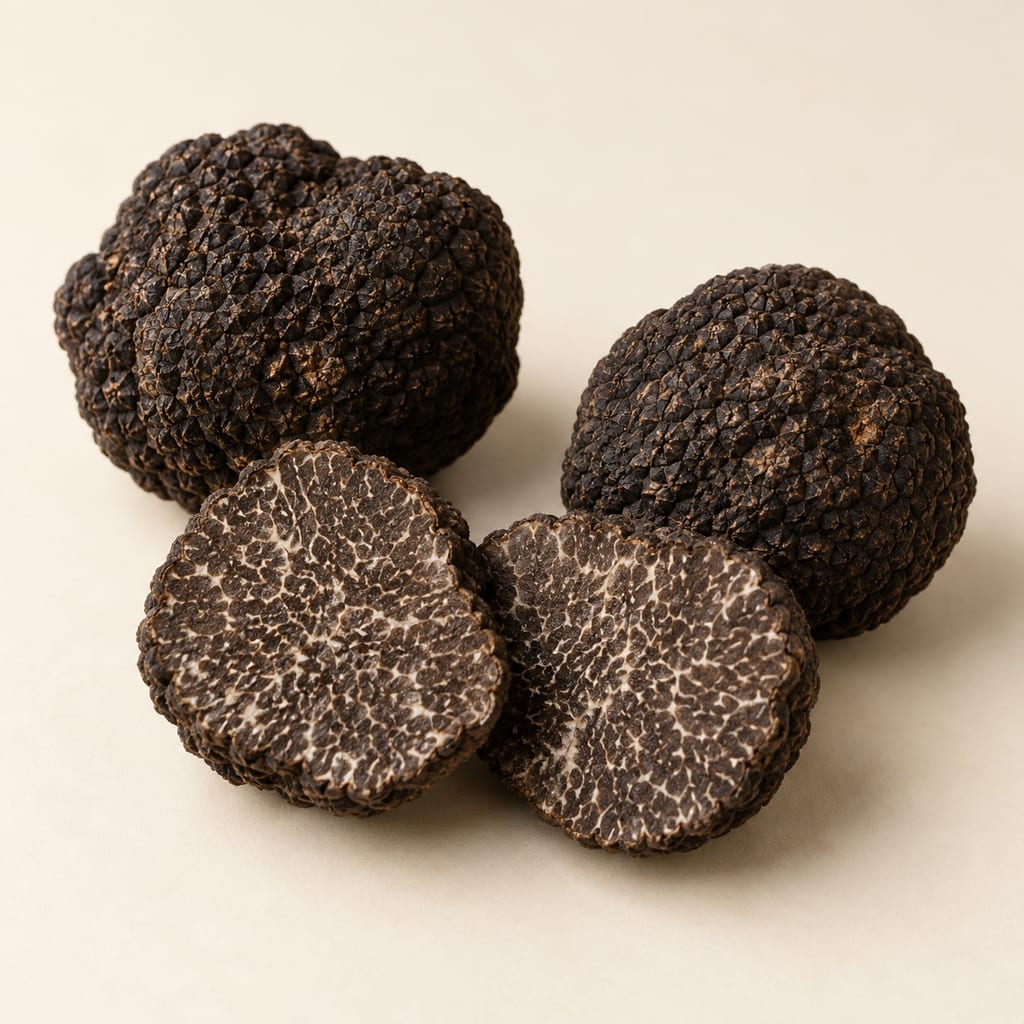
The winter truffle is the fruiting body of an underground fungus that grows in partnership with tree roots. It is known as the Muscat truffle, and in some Italian and French market usage as the winter black truffle, a name it shares with the Périgord truffle, Tuber melanosporum. Its flesh is dark and its smell is strong and musky, with a peaty note. Those qualities are close to those of the Périgord truffle, but less intense.
Compared with the Périgord truffle the winter truffle is usually described as smaller, about the size of a walnut against the larger, sometimes apple-sized Périgord. Its surface has flat, angular warts rather than the raised, tightly packed warts of the Périgord. Those characters overlap enough that field identification alone is unreliable; the catalogue asks that the two species be kept apart in records.
The species was published by Vittadini in 1831 and placed in the Melanosporum clade. The name brumale, with its link to winter, and the name Muscat truffle, which refers to the aroma, are both in use. A musky form has been recognised as a variety, Tuber brumale var. moschatum, sometimes called the musky truffle.
The most important complication is that specimens called T. brumale do not all belong to one species. Multilocus phylogenetic work shows that the material given that name contains two species, and related taxa named T. cryptobrumale and T. petrophilum are recognised with a further proposed species, T. thracicum. Older market and literature records of winter truffle may therefore refer to a mixture, and a record that names only the common name should not be assumed to fix the species.
The species is native to southern Europe. It is a mycorrhizal truffle, living with tree roots in the soil and fruiting underground. Sources differ on its ecology. Some describe it as a weedy invader of Périgord truffle orchards. Others note that it is already present in the soils of many truffle orchards, and that the relation between the two species is more complex than an invasion.
A 1993 study cited by the encyclopedia examined how T. melanosporum competes with other ectomycorrhizal fungi under different irrigation regimes. That work concerns the Périgord truffle and does not by itself describe the winter truffle's habitat.
The winter truffle is valued for its aroma in dishes where heat is used. The Périgord truffle loses part of its aroma when cooked, and it is usually shaved over a finished dish. The winter truffle keeps more of its character under heat, which is why the food industry uses it in sauces, pâtés and other cooked products.
Because it is cheaper than the Périgord truffle, it is also used where a truffle flavour is wanted in larger quantity, as the sources' comparison of price and use suggests.
The species is sold at about a third to a half of the price of Périgord truffles, according to one dealer's comparison. Sellers sometimes market it under names that also belong to the Périgord truffle, so the label, the species and the price should be checked together.
The catalogue requires records to separate T. brumale from T. melanosporum in ingredient and provenance records, so a recipe line that says only truffle does not establish which species was used.
Open points: the field characters that reliably separate the cryptic species, the current names of the species that have been called winter truffle, and the historical record of how the truffle was traded before the modern market are not settled by the sources reviewed here.
Native range as the encyclopedia gives it; the market record is a regional food association, not a precise origin.
Supplied catalogue record for food, market and specialist use across Europe.
A Cap-Pelé boucanière is an Acadian herring-smoking building. The documented Willie Niles example is a one-storey wood-frame structure with a ridge smoke vent and interior bays for hanging fish-bearing cannes.

Achcharu is a family of Sri Lankan vinegar pickles made with mixed vegetables or seasonal fruit and a piquant spice dressing. This version is a quick, refrigerated, non-fermented mixed-vegetable pickle.

The acocote is a long, hollowed and dried gourd used to draw aguamiel from a mature maguey. It is a harvesting tool: the sap is transferred to a separate vessel before it ferments into pulque.

Adrak murabba preserves young ginger in sugar syrup, a sweet South Asian preparation recorded in Indian cookery and food-processing sources.

Parkia biglobosa seeds are fermented into regional West African seasonings, including nététou, iru, dawadawa and soumbala. The yellow fruit pulp is a separate food, and names and methods vary by place.

Japanese reddish-brown vinegar from sake lees matured about three years, turned to vinegar by acetic bacteria; the vinegar of Handa and Edomae sushi rice.

A refined common-wheat flour blended for a broad range of baking; its protein and behavior vary with wheat, milling and market.

The almond mushroom, Agaricus subrufescens, was cultivated in eastern North America in the 1800s, lost its market, and returned as a cultivated mushroom from Brazil, where it is grown under several names.
No community contributions have been published for this entry yet.
Sign in to contribute. Published comments and photos are free to read.
WikipediaIdentity · History
Tuber brumaleNative to Southern Europe; also called Muscat truffle or winter truffle; present in the soils of many truffle orchards; published by Vittadini in 1831; cites Mamoun and Olivier (1993) on competition with T. melanosporum.
Cited in: Names and the cryptic species problem; Where it grows; Notes
English TrufflesIdentity · Method · Use
Melanosporum GroupBoth species sit in the Melanosporum clade; T. brumale has a peaty, musky aroma, present to a lesser degree in T. melanosporum; T. brumale is used by the food industry in sauces and pates, where T. melanosporum loses part of its aroma to cooking; the species is sold at about a third to a half of the price of Perigord truffles.
Cited in: What it is; Use in cooking; Market and substitution
Forager ChefIdentity · Taxonomy
Winter black trufflesSeveral names, including winter black truffle, are applied to more than one species; multilocus phylogenetic analyses show that specimens called T. brumale belong to two species, with related taxa T. cryptobrumale and T. petrophilum and a proposed species T. thracicum.
Cited in: What it is; Names and the cryptic species problem; Where it grows; Notes
Boletin Oficial del EstadoFood · Market
Supplied catalogue record (BOE-A-2009-1110)Supplied catalogue source for a dark aromatic seasoning truffle with food and market evidence; keep separate from T. melanosporum in ingredient and provenance records.
Cited in: Market and substitution