
Meat
What's left in the pan: how cooks turn pig fat into cracklings
Škvarky, skwarki, tepertő, chicharrón, gratons. How cooks render pig fat, dry and fry skin, press and wring the pieces, and bake with them, from the Czech pig-killing to Mexico and Soria.
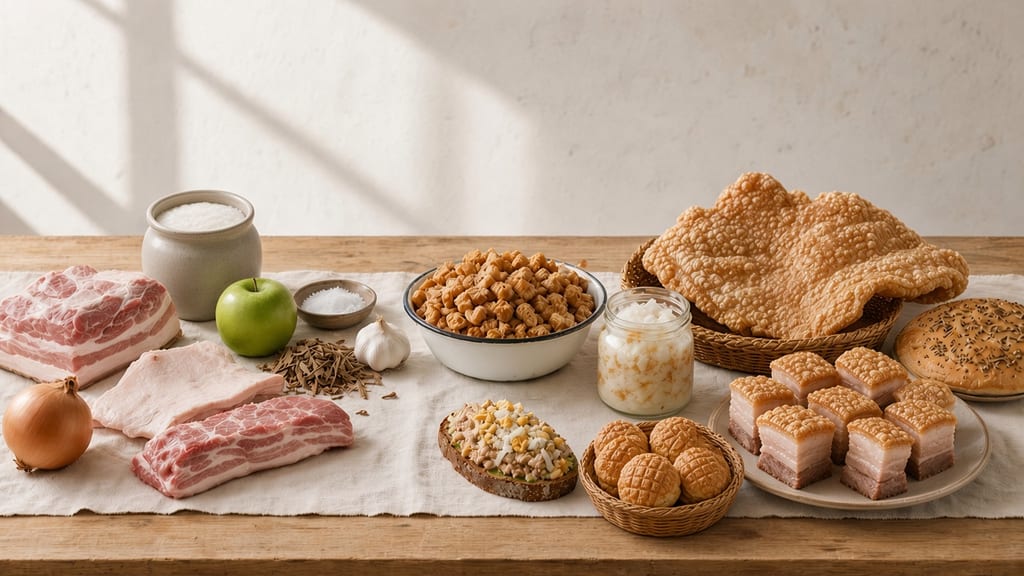
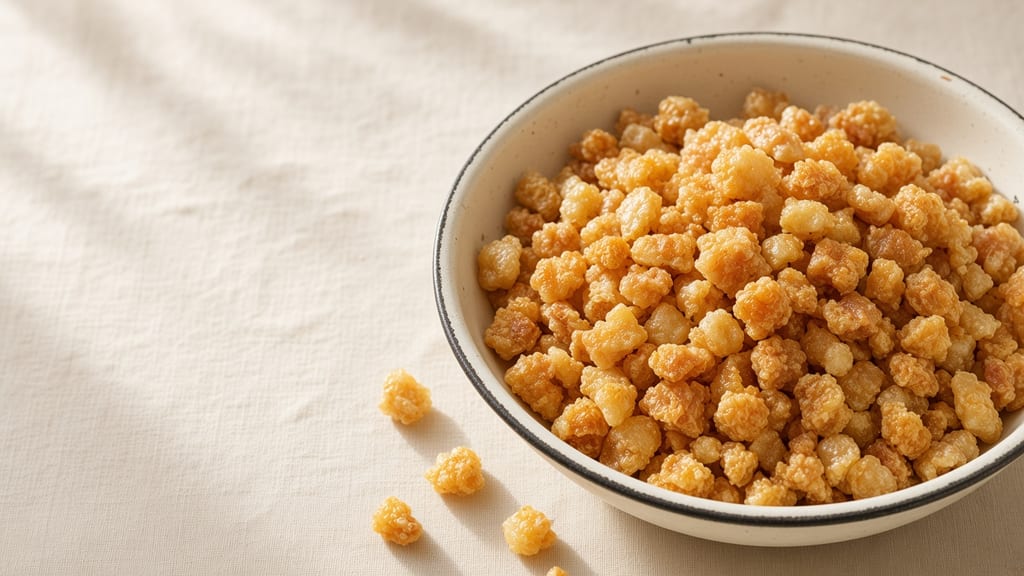
Cracklings from several kitchens beside the raw back fat, belly and skin they start from.
The pan at the pig-killing
In a Czech village before freezers, the pig died in winter. The national ethnographic encyclopedia places the zabijačka before Christmas or in the carnival weeks of masopust, and gives it one purpose, to put meat and fat by until spring. It even records a custom in which the pig was put on trial and had a sentence read to it before the knife.
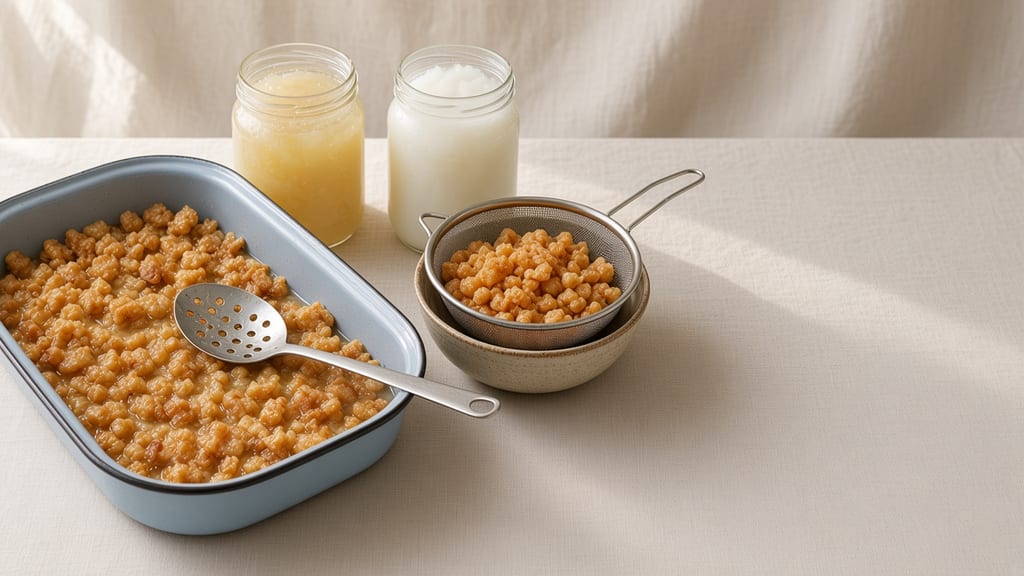
Then came the fat. The inner leaf fat and the outer back fat came off first. Some was salted for smoking as slanina. The rest was cut into cubes and put over a slow fire in a wide pan, where it melted into sádlo, lard, and left behind small golden pieces called škvarky. In 1658 Comenius wrote in Orbis pictus that fat and tallow are let out or fried out, and the encyclopedia quotes the line in its entry on the pig-killing.
Both products went into stoneware. The lard was spread on bread, used for baking and frying and stirred into potatoes, porridge, dumplings, pulses and cabbage. The škvarky were eaten warm with bread and salt, ground into a spread or kept for the oven. Freezers reached village households only in the 1970s and 1980s, so for most of that history the crock in the pantry was the store.
Fat first, skin first
Many cuisines that keep pigs have a word for those crisp pieces. Czech has škvarky, Polish skwarki, Hungarian tepertő, Austrian German Grammeln, Serbian čvarci, Italian ciccioli and cicoli, Lyon gratons and Vietnamese tóp mỡ. English has cracklings and, in Britain, pork scratchings.
The words hide two different ideas. In most of Central Europe the crackling is what is left when lard is made. There, škvarky and sádlo come out of the same pan, and the lard matters as much as the crunch. In Mexico the order is reversed. Chicharrón de cuero starts with the skin, the fat is cut away, and the skin is salted, dried, half-cooked and fried until it puffs. The crackle is the whole point.
Between the two sit the belly cuts, where fat, lean and skin come out of the pan together. Spain's torrezno de Soria is cured belly with the rind on. Hungary's bőrös tepertő is belly scored and fried skin and all. Lyon's gratons come from the rigon, a twisted muscle under the belly with fat around it.
November is the season for many of them. The Czech pig-killing belonged to winter, and Le Progrès reported in November 2014 that a Lyon charcutier's busiest weeks for gratons came with Beaujolais nouveau, when they are eaten with the first glass.
What goes into the pan
The fat decides the result. The Czech encyclopedia separates the soft inner fat, plsní sádlo, from the firm back fat, řemenové sádlo, and has the fat around the gut washed and rendered by itself. J. W. Cole of the University of Tennessee, writing on lard for American meat scientists in 1949, gave the same rule for intestinal fat. He also asked for the skin and every scrap of lean to come off first, because skin makes the lard less white and firm and lean browns early.
Austria writes the choice into law. Its food code reserves Hausschmalz, the best grade of lard, for fresh back fat or Bauchfilz, the fat inside the belly, melted in small amounts in open vessels over direct heat. In Kujawy, in central Poland, the traditional products list recalls pigs fattened to about 200 kg, with słonina, back fat, as thick as a brick.
Other kitchens go elsewhere on the animal. Vietnamese tóp mỡ in the An Ninh Thủ Đô column is cut from belly, cheek and neck, in strips nearly a hand-span long. Torrezno de Soria comes from belly with three layers of fat, lean and fat under the rind. For chicharrón de cuero, Larousse Cocina describes the skin scraped clean with two tools, the curved campana and the straight raspa. In Jewish Eastern Europe, the YIVO encyclopedia records goose fat and thick goose skins rendered before Hanukkah, with the cracklings, grivn, kept apart as a delicacy.
Low and slow
The simplest road to the crunch is cubes of fat in a dry pan over a gentle heat. A Kashubian account on Poland's list of traditional products describes słonina cut very fine and melted in a pan over a small fire, so that, in the cook's words, there was foam and the little pieces cooked through evenly. Onion went in, garlic if wanted, and when the skwarki were golden the pan came off the heat for marjoram, pepper and salt.
Cole put numbers to the same patience. He told his audience that rendering fat should never pass 116 to 121 °C, about 116 to 121 °C. More heat raises the free fatty acids, darkens the lard and shortens its life. Over an open fire he wanted frequent stirring and the steady heat of hardwood.
His signs of a finished pan are ones any cook can use. The cracklings turn amber. If any rind was left on, small white blisters form on it. And the water is gone, which he checked by holding a cold lid over the pan and looking for condensation. When nothing gathers on the lid, the fat is done.
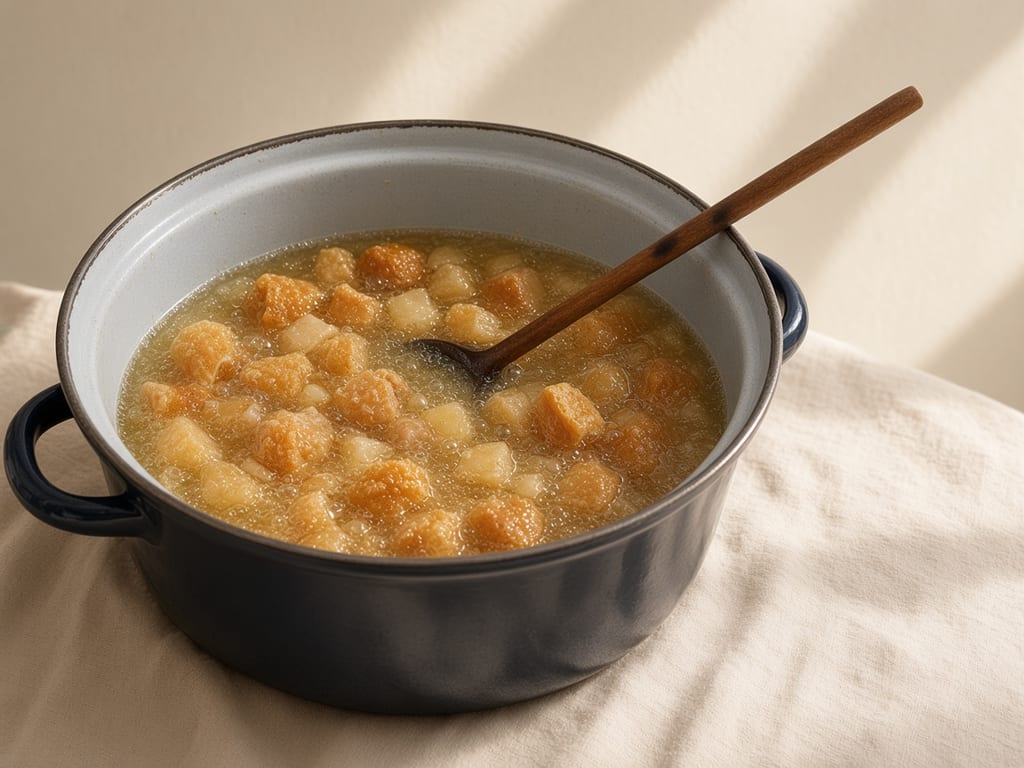
The Czech, Polish, Slovak and Austrian versions all follow this road. The fat is strained into crocks or jars, and the cracklings are eaten, ground or kept. The Škvarky and sádlo page on this site describes the method with its regional variants.
Small additions change the pan. The Kashubian cooks stirred the smalec as it cooled so the skwarki would not sink, and some strained off part of the cracklings, ground them and kept them as a cooking fat. In 2016 Radio Katowice printed a Silesian recipe from the kitchen dresser of Stefania Dyduch: 1 kg of słonina cut in fine cubes and fried golden with a wooden spoon, a grated sour apple added near the end, five chopped prunes if you like, about three more minutes on the heat and then into a stone pot. Hungarian cooks in the west of the country, by contrast, start in water, as the next section shows.
Water in the pot
Some cooks start with water. The Magyar Néprajzi Lexikon records that in the western part of the Hungarian language area the pieces of fat were first thrown briefly into boiling water, a step called köpesztés or abárolás, before the skin was pulled off and the fat cubed and melted. In Hanoi, the An Ninh Thủ Đô column describes belly for tóp mỡ blanched in boiling water with ginger and shallot before frying. In Campania, the regional list of traditional products describes cicoli made from fat parts of the pig boiled in a big pot.
Not everyone agrees. The Colombian chef Álvaro Molina of Casa Molina told El Colombiano in 2025 that boiling pork belly in water first is a mistake that takes away flavour. He prefers to cook it slowly in fat below 95 °C for about an hour and then raise the heat. That is his view; the Hungarian lexicon and the Hanoi column describe the water step as ordinary practice, and no comparison of the two methods was found.
Dried, then fried
The skin-first road takes days. Larousse Cocina describes Mexican chicharrón de cuero scored in a grid, salted and aired for two to three days. The skin is then half-cooked in lard that is not very hot, a step called sancochado, and dried for another day until it is hard, reddish-brown and translucent, like plastic. In that state it is sold as monguis. The last fry in very hot lard takes only seconds, and the skin puffs to several times its size.
El Universal's home version cuts the drying to 24 to 36 hours in the sun and gives about an hour and a half for the half-cooking. It warns that the skin at least doubles in the final fry, so the pieces should be cut to fit the pot first.
Britain makes its scratchings from skin too. BBC News described them in 2015 as pig skin cut in strips and cooked, with a crusty layer of fat under the rind. It set that traditional kind, cooked once, beside lighter crackling cooked twice or three times and the puffed, airy pork crunch.
Hungary's two tepertő
Hungarian has several regional words for cracklings. The Magyar Néprajzi Lexikon gives töpörtyű and tepertő as the general names, csörge in western Transdanubia, pörc in central and eastern Transdanubia and kurcina between the Danube and the Tisza. Its entry on the pig-killing lists fat rendering, zsírsütés, as women's work, alongside cleaning the guts and making sausage.
The lexicon also records a change in the 20th century. A second kind spread among the peasants of the Great Plain, especially east of the Tisza. Bőrös tepertő is cut from the fleshy belly with the skin on, in pieces half a palm to a palm across, scored and fried skin and all. It was made to be eaten, not as a by-product of lard, and east of the Tisza the word pörc means this large skin-on kind.
That shift moves the Hungarian pan from the fat-first family toward the belly cuts of Soria and Lyon. The torrezno takes the belly cut further. Its PGI specification describes a cured belly piece at most 6 cm thick, with skin and three layers of fat, lean and fat, sold only to be fried. In the old Soria pig-killing, Pedro Iglesia Hernández wrote in 1991, households opened the pig from the chest to take out a spindle-shaped piece of streaky fat called the íntima or alma, and the torreznos from it were eaten on the first day.
Pressed and wrung
A crackling still holds a lot of fat, and some traditions squeeze it out. The Slovak encyclopedia of traditional culture says oškvarky hold more than half fat and were pressed again to win more lard. The Austrian code allows settling, pressing or centrifuging to part the fat from the Grammeln, and nothing else.
In Emilia-Romagna, the regional list describes ciccioli cooked from fat cuts and rind in a caldaia at about 120 °C for about four hours, then pressed to part them from the strutto, the lard. In Campania, the solid blocks left after squeezing are the cicoli. In Puebla, Mexico's Secretaría de Cultura recorded Don Felipe Silva González of Zacatlán frying fat in a 100 kg pan for three to four hours, with salt and a little honey for colour, then pressing the result in woven palm baskets called tenates with a stick and a tourniquet press. About 100 kg of fat gave about 12 kg of chicharrón prensado.
In Valjevo, in western Serbia, the local press describes duvan čvarci, tobacco cracklings, rendered for hours and wrung through clean cloth until the pieces come apart into golden threads. The organisers of the town's festival, held every autumn since 2006, claim a crowd of more than 100,000; no independent count is available. In Triều Khúc village, south of Hanoi, the An Ninh Thủ Đô column describes tóp mỡ pressed into discs.
Around the table
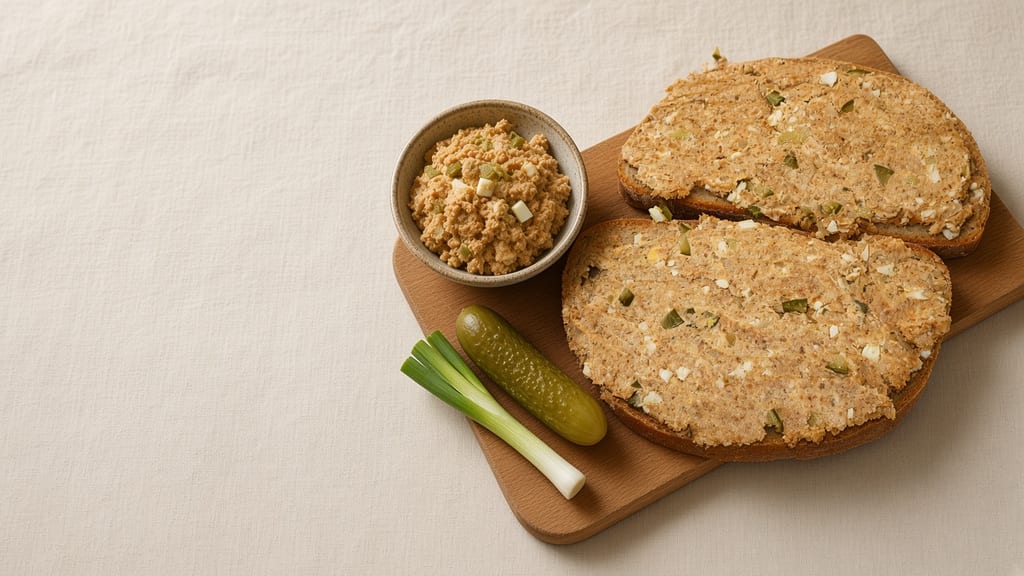
The cracklings that leave the pan end up in very different dishes. In Czech pubs, Radio Prague reported in 2022, škvarková pomazánka is a staple: ground cracklings, lard and onion spread on bread and eaten with beer. The chef Roman Paulus adds mustard and hard-boiled egg, and a listener recipe from Ostrava adds garlic and pepper too.
Poland keeps the cracklings in the lard. Smalec ze skwarkami is rendered with onion, often apple and marjoram, and poured into crocks with the skwarki left in. Kujawy goes further with szary smalec, grey lard made only from ground skwarki and eaten with sour pickled cucumbers.
In Hungary tepertő from the pig-killing was a breakfast or supper in itself, the Magyar Néprajzi Lexikon says, and corn flatbreads were often baked with it. Austria sells Grammelschmalz, lard with the cracklings left in, and its food code allows it no more than 2 % water. In Eastern European Jewish kitchens, YIVO records bread rubbed with garlic and goose fat, with grivn on top and a glass of tea, as a meal.
Lyon eats gratons with wine. In Soria the torrezno is fried from cured belly, and the old pig-killings ate torreznos del alma on the first day. In Vietnam, tóp mỡ goes on bún riêu and into dưa xào tóp mỡ, sour pickled mustard greens stir-fried with cracklings. In Mexico chicharrón is eaten in tacos, broken into salsa verde or bought pressed in blocks.
The crock and the jar
Before refrigerators, rendering was a way to keep food. The Czech encyclopedia records sádlo and škvarky stored in stoneware. The Slovak encyclopedia describes ground oškvarky covered with lard in glass jars as a bread spread. In Kociewie, in Pomerania, households rendered twice a year at the pig-killing, before Easter and before Christmas.
Hanoi did the same. Before the 1990s, the An Ninh Thủ Đô column says, every family kept bowls of white lard, because vegetable oil was scarce, and tóp mỡ lasted for weeks when it was poured into a bowl with its fat.
Many of these fats sit next to sour, fermented food. Szary smalec goes with pickled cucumbers. Dưa xào tóp mỡ pairs cracklings with fermented mustard greens, and in the Vietnamese highlands the column describes tóp mỡ eaten with tomato and a dip of nước mẻ, fermented rice.
Baking with cracklings
Because a crackling is mostly fat, it can take the place of lard in a savoury dough. The EU specification for tepertős pogácsa, a Traditional Speciality Guaranteed, gives crackling at 12 to 13 % protein and 82 to 84 % fat. On those figures, about 120 g of crackling carries about 100 g of fat. That figure is a calculation from the specification, not a rule in it, and home cracklings vary.
The Hungarian specification turns the idea into a recipe. Its crackling cream is 70 to 75 % skinless crackling and 25 to 30 % lard, crushed with a rolling pin or minced on the smallest plate. Short pogácsa takes 250 to 400 g of that cream per kilogram of flour, and at least 60 % of all the fat in the scone must come from crackling. The dough is rested cold, rolled a finger thick, scored in a fine grid, cut small and baked at 220 to 240 °C until reddish brown.
The flaky version laminates the cream. It is spread on a thin sheet of dough, which is rolled up or folded at least three times. A Slovak reader recipe for oškvarkové pagáče on Varecha uses the same fold, with ground cracklings spread on a cream and yeast dough. The Slovak encyclopedia lists oškvarkové pagáčiky among the old uses of cracklings.
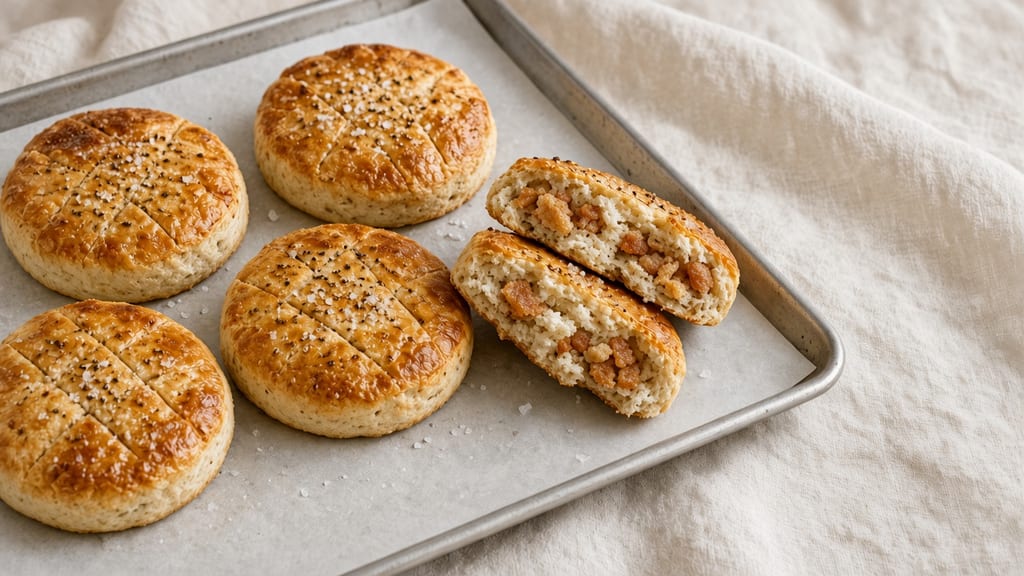
Czech škvarkové placky keep the pieces whole. In a family recipe printed by Vlasta.cz in November 2026, chopped škvarky are scattered over a risen yeast dough made with lard, rolled up and kneaded through, then shaped into small placky, scored, brushed with egg and baked at 190 °C. The magazine says these were baked in the cold season, at pig-killing time. The Czech encyclopedia confirms cracklings in older potato cookery, where potato placky with škvarky counted as a treat.
Cracklings also work without any other fat. Housekeeping in Old Virginia, published in 1879, prints a cracklin bread that rubs a teacup of cracklings into a quart of cornmeal with salt and warm water, shaped into pones and eaten hot. In Italy, Emilia-Romagna's list names focaccia ai ciccioli and polenta with ciccioli, and Campania's cicoli go into savoury pizze and torte rustiche as a filling. In Kociewie, the Polish list says, lard with its cracklings was used for baking in place of other fats.
Salt needs attention. Radio Prague notes that Czech cracklings are usually left unsalted so they stay crisp. The Hungarian specification puts 2.5 % salt in the short dough and 1.5 % in the flaky cream. If the cracklings were salted at the pan, the dough needs less.
Rendering safely at home
Cole's 1949 paper still reads as a home method. Use fresh fat, because fat held near freezing for more than five to seven days already shows rising free fatty acids. Cut it in cubes of about 2.5 cm or grind it. Avoid copper and rusty iron, which can make the fat less stable; stainless steel, rust-free iron and aluminium are fine.
Keep the fat at or below about 116 to 121 °C, and stop when the cracklings are amber and a cold lid shows no moisture. Strain hot through muslin. Cool the lard fast and stir it while it sets, without whipping air in, or it can turn grainy.
Store it in small containers filled to the top, sealed, in the dark and cold, at about 4 °C and not above about 16 °C. Cole quoted the US Department of Agriculture on rancidity: air, heat, light and metal speed it, and once lard is rancid it cannot be repaired. Hot fat burns, so keep children away from the pan and never add anything wet to hot lard.
From soap to snack
Cracklings were not always food. The Hungarian application for tepertős pogácsa cites oral evidence from the turn of the 19th and 20th centuries that peasant households in the central Tisza region used crackling to make soap, and says eating it developed only gradually. It ties the rise of crackling scones to rendering becoming an ordinary household job, first in noble kitchens of the 18th century and among the peasants of the Danube–Tisza region from the 1850s.
The yields are small. The Lyon charcutier told Le Progrès that 150 kg of fresh rigon cooked in 100 kg of lard gives about 20 kg of gratons, because the meat loses 87 % of its weight. A Hanoi column puts the ratio for tóp mỡ at more than 3 kg of meat for 1 kg of cracklings.
A crock of lard and a bowl of škvarky took a lot of fat, a long cold day and a slow fire. The linked recipes cover the Czech pan, the Polish crock, the Hungarian and Slovak scones, the Czech placky, Mexican chicharrón and the torrezno of Soria.
Related
Discussed in this article
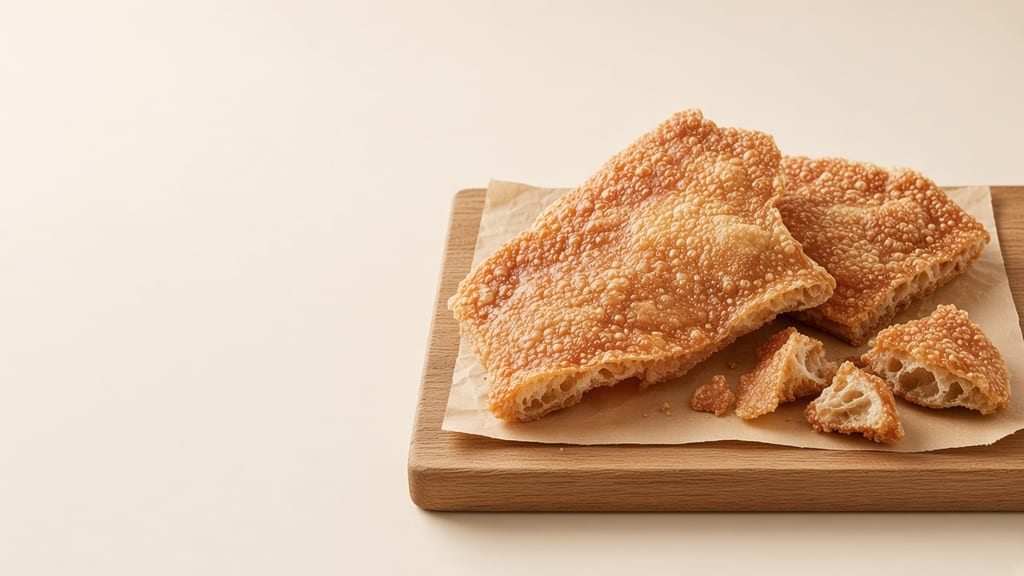
Chicharrón de cuero
Mexican pork skin, scored, salted and dried, half-cooked in warm lard until it turns glassy, then dropped into very hot lard where it puffs to an airy, crackling sheet.
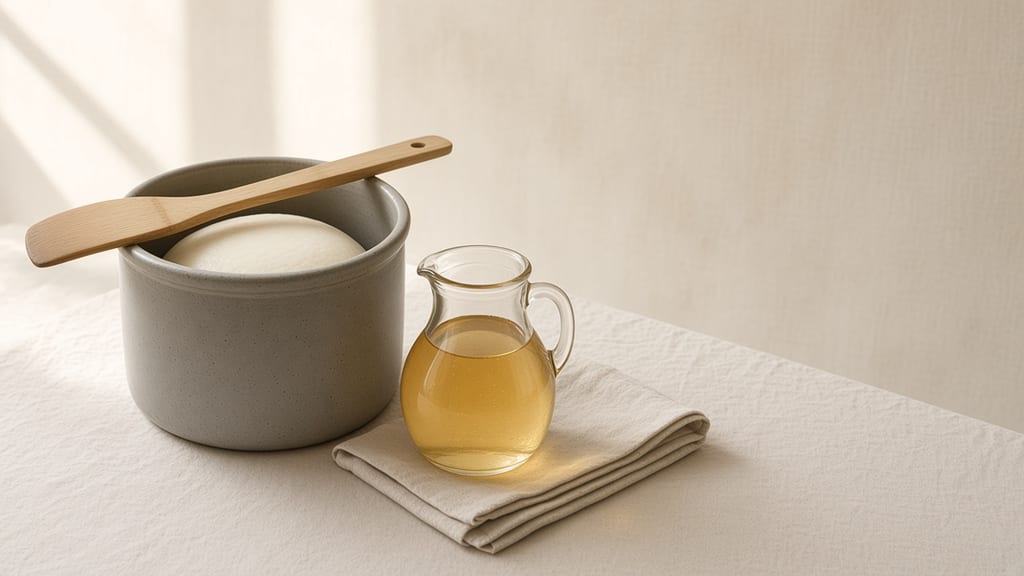
Lard
Pig fat melted out of its tissue and strained. Austrian food law grades it as plain lard, house lard and lard with cracklings, and a 1949 lard study sets the heat limit at 116–121 °C.
Pork cracklings
The crisp pieces left when pig fat is rendered into lard: škvarky, skwarki, tepertő, Grammeln. Still mostly fat, they are eaten on bread, ground into spreads and worked into savoury dough.
Škvarková pomazánka: Czech crackling spread
Ground or roughly chopped škvarky bound with a little lard, onion, mustard and hard-boiled egg, spread on fresh bread. A zabijačka leftover that became a pub staple.
Škvarkové placky: Czech crackling flatbreads
Small yeast flatbreads from Czech home baking, made with lard and chopped škvarky worked into the dough, scored in a grid, brushed with egg and scattered with coarse salt and caraway.
Škvarky and sádlo: home-rendered lard and cracklings
Cubed pig fat rendered slowly until the cracklings turn amber, then strained into lard. The Czech zabijačka method, with its Polish, Hungarian, Slovak, Austrian and Serbian relatives.
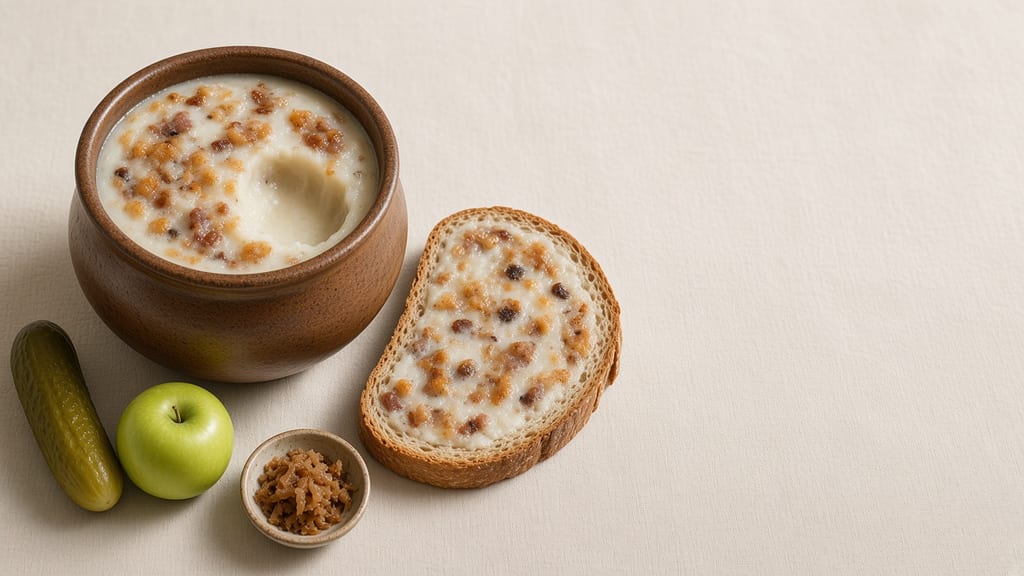
Smalec ze skwarkami: Polish lard with cracklings, onion and apple
Finely cubed słonina rendered golden with apple and onion, seasoned with marjoram and poured into a crock with the skwarki left in. Includes szary smalec, the grey Kujawy lard made from ground cracklings.
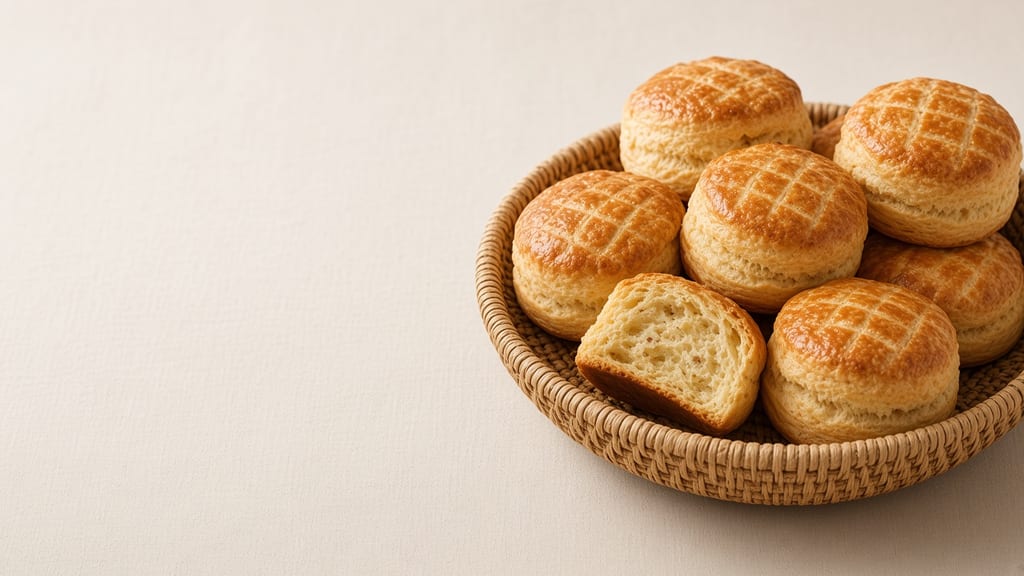
Tepertős pogácsa: Hungarian crackling scones
Small round yeast scones made with crackling cream, scored in a fine grid and baked hot until reddish brown. A Traditional Speciality Guaranteed in the EU, made short or flaky.
Community
No community contributions have been published for this entry yet.
Share what you made
Sign in to contribute. Published comments and photos are free to read.
Sources
Etnologický ústav AV ČR / Mladá fronta, 2007
Národopisná encyklopedie Čech, Moravy a Slezska, entries "zabijačka" and food storage (volume Z)Cited in: The pan at the pig-killing; Fat first, skin first; What goes into the pan; The crock and the jar
Reciprocal Meat Conference Proceedings, American Meat Science Association, 1949
Processing and storage problems of lardCited in: What goes into the pan; Low and slow; Rendering safely at home
Ministerstwo Rolnictwa i Rozwoju Wsi, gov.pl
Smalec ze skwarkami (Smôłt ze szpérkama), Lista produktów tradycyjnychCited in: Fat first, skin first; Low and slow; Around the table
Ministerstwo Rolnictwa i Rozwoju Wsi, gov.pl
Szmalec kociewski ze skrzeczkami, Lista produktów tradycyjnychCited in: Around the table; The crock and the jar; Baking with cracklings
Ministerstwo Rolnictwa i Rozwoju Wsi, gov.pl
Szary smalec po kujawsku, Lista produktów tradycyjnychCited in: What goes into the pan; Around the table; The crock and the jar
Magyar Néprajzi Lexikon, Akadémiai Kiadó, via Magyar Elektronikus Könyvtár
töpörtyűCited in: Fat first, skin first; Water in the pot; Hungary's two tepertő; Around the table
Magyar Néprajzi Lexikon, Akadémiai Kiadó, via Magyar Elektronikus Könyvtár
disznóölésCited in: Hungary's two tepertő
Official Journal of the European Union C 94, 10 March 2016
Publication of an application for registration of a name pursuant to Article 50(2)(b) of Regulation (EU) No 1151/2012: Tepertős pogácsa (TSG)Cited in: Baking with cracklings; From soap to snack
Centrum pre tradičnú ľudovú kultúru, encyclopedia of Slovak folk culture
OškvarkyCited in: Pressed and wrung; The crock and the jar; Baking with cracklings
Österreichisches Lebensmittelbuch (Codex Alimentarius Austriacus)
Österreichisches Lebensmittelbuch B 30, 1.5.1 Speisefette von LandtierenCited in: What goes into the pan; Around the table
Österreichisches Lebensmittelbuch (Codex Alimentarius Austriacus)
Österreichisches Lebensmittelbuch B 30, 1.5.3 Grammeln (Grieben)Cited in: Fat first, skin first; Pressed and wrung; Around the table
VA Media, Valjevo, 16 September 2026
Najavljen 20. festival duvan čvarakaCited in: Fat first, skin first; Pressed and wrung
Radio Prague International, 31 August 2022
Czech Food Classics: Pork crackling spreadCited in: Around the table; Baking with cracklings
Vlasta.cz, 5 November 2026
Škvarkové placky podle rodinného receptu prababičky Laďky NěrgešovéCited in: Baking with cracklings
Larousse Cocina, Diccionario enciclopédico de la gastronomía mexicana
ChicharrónCited in: Fat first, skin first; What goes into the pan; Dried, then fried; Around the table
Secretaría de Cultura, Unidad Regional Puebla, via Google Arts & Culture
How do I prepare chicharrón prensado?Cited in: Pressed and wrung
El Colombiano, 3 May 2025
Todo lo que quería saber de los chicharrones (y cómo prepararlo mejor)Cited in: Water in the pot
Instituto Tecnológico Agrario de Castilla y León (ITACyL)
Pliego de condiciones de la Indicación Geográfica Protegida "Torrezno de Soria"Cited in: Fat first, skin first; What goes into the pan; Hungary's two tepertő; Around the table
Asociación de Fabricantes de Torrezno de Soria
¿Cómo freírlo?BBC News, 20 June 2015
Are pork scratchings going posh?Cited in: Fat first, skin first; Dried, then fried
The YIVO Encyclopedia of Jews in Eastern Europe
GeeseCited in: What goes into the pan; Around the table
An Ninh Thủ Đô, 17 September 2023
Khi tóp mỡ lên đờiCited in: Fat first, skin first; What goes into the pan; Water in the pot; Pressed and wrung; Around the table; The crock and the jar; From soap to snack
Regione Emilia-Romagna
Ciccioli, prodotti agroalimentari tradizionaliCited in: Fat first, skin first; Pressed and wrung; Baking with cracklings
Regione Campania
Cicoli, prodotti tradizionaliCited in: Fat first, skin first; Water in the pot; Pressed and wrung; Baking with cracklings
Le Progrès, 20 November 2014
Le graton lyonnais, l'ancêtre du biscuit apéritifCited in: Fat first, skin first; Around the table; From soap to snack
Historical Foodie, transcription of Marion Cabell Tyree, Housekeeping in Old Virginia
Cracklin bread, from Housekeeping in Old Virginia, 1879Cited in: Baking with cracklings
Etnologický ústav AV ČR / Mladá fronta, 2007
Národopisná encyklopedie Čech, Moravy a Slezska, entry "brambory" (volume B)Cited in: Baking with cracklings
Varecha.sk (Pravda), reader recipe, 2 January 2025
Oškvarkové pagáče - klasika (fotorecept)Cited in: Baking with cracklings
Gaps
- No ethnographic source describes Czech wheat yeast placky with cracklings; the baking section relies on a 2026 magazine recipe for them.
- No measured comparison of water-start and dry rendering was found.
- The Valjevo festival crowd figure is the organisers' claim.
- The fat-to-crackling arithmetic in the baking section is a calculation from the Hungarian figures, not a sourced rule.
Updated 2026-11-12