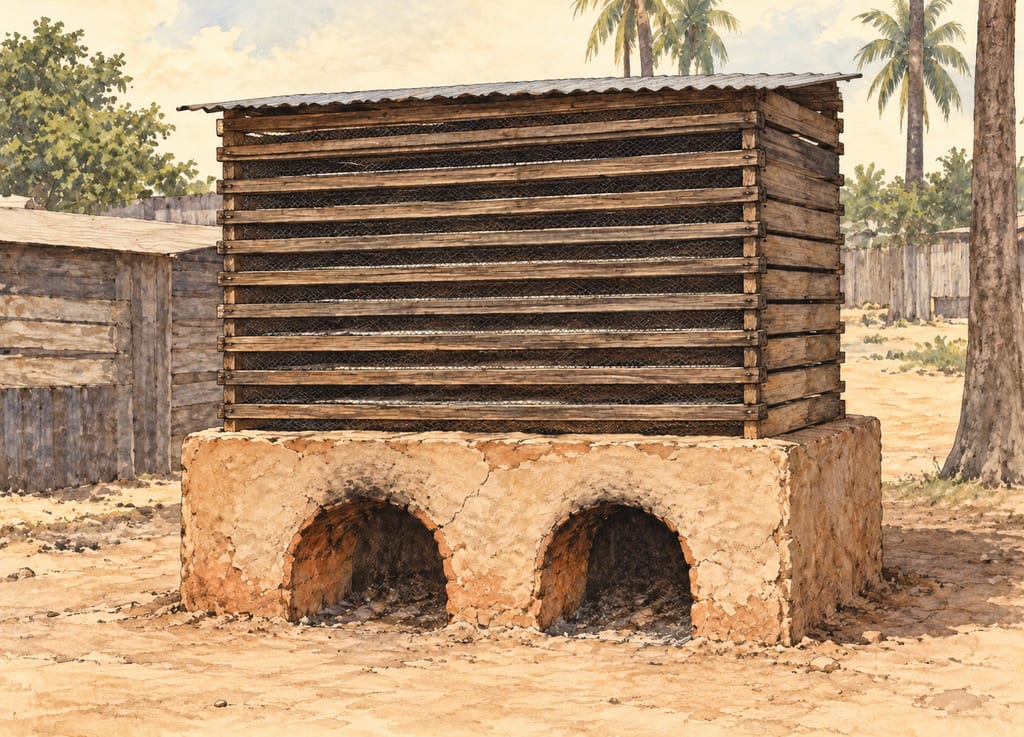
Chorkor smoker
The Chorkor, also called the Kagan smoker in early FAO documentation, pairs a low rectangular mud/clay oven with stacked removable wooden-frame, wire-mesh trays. FAO records its use at Chorkor, Ghana, from 1971.
 FermenteaWhere food goes to change
Built structures · Masonry smoking ovens
The Ahotor is a modern fixed masonry fish-smoking oven developed in Ghana as an improved alternative to traditional smokers such as the Chorkor.
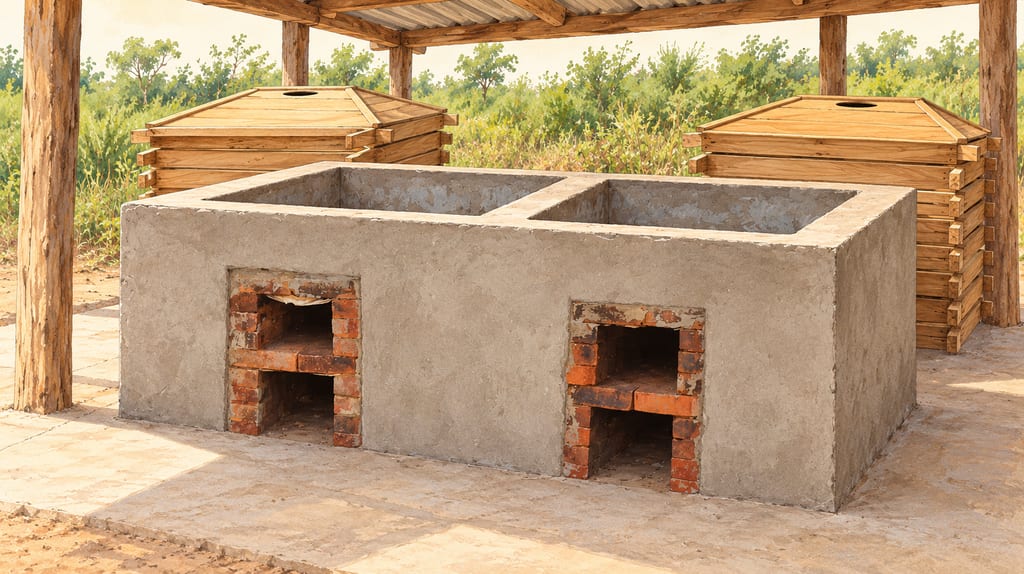
Ahotor is a modern improved fish-smoking oven, not the name of an ancient or unchanged traditional structure. The Sustainable Fisheries Management Project introduced it in 2016 with work involving Ghanaian research and fisheries institutions. SNV described a pilot stove built by trained local masons in the Volta Region in 2017. Later programme reports describe the design as an improvement on traditional methods such as the Chorkor, rather than as a replacement for every local smoking practice.
The fixed masonry body distinguishes it from portable metal drums and tray assemblies. Its open top receives removable wooden trays, while brick-lined combustion chambers sit within a cement-based outer body. The publicly accessible test description says the trays stack at the top and fit together at their edges. The Association’s photograph also documents a broad cement body, paired fire openings and tray stacks at the processing site.
The 2016 technical report describes two partitioned combustion chambers and a grate inside the chamber. It presents the grate as a route for air to reach the wood fire. The tray stack above forms the smoking space. These components make the Ahotor a designed system of combustion and food-holding parts, rather than simply a raised rack over an open fire.
The second notable component is the fat collector. Fish fats, juices and blood that drip into a fire can contribute to polycyclic aromatic hydrocarbons, or PAHs, in smoke and food. SNV describes the collector as routing those liquids away from the fire. That design purpose should not be confused with a guarantee that a given batch meets a food-safety standard: the reports measure particular ovens and trials, and do not validate every installation or use.
The 2017 performance evaluation reports tests at sites in Ghana’s Central and Western regions, including Elmina, Apam, Winneba, Mumford, Moree, Anlo Beach, Takoradi and Sekondi. SNV’s earlier pilot demonstrations took place in the Volta Region. These records document project activity and installations; they do not establish that every Ghanaian fish-smoking community adopted the oven.
The evaluation reported a fuel-efficiency advantage over the Chorkor under its test conditions. That is a measured comparison, not a universal result for all fuels, operators, maintenance states or oven builds. A later 2025 account describes a 2022 modified version and reports user concerns about heat distribution, time and capacity in earlier units. The modified design should not be confused with the original Ahotor.
The official 2015 construction manual is cited by project material, but its drawings could not be inspected for this record. A third-party transcription of dimensions is not an adequate substitute for checking the primary manual. For that reason this page omits measurements and does not prescribe a foundation, mortar mix, hot-zone material grade, lintel, combustion path, collector clearance or tray load.
The sourced description identifies the oven and explains the relationship among its main parts. It is not a build-ready plan. A qualified local designer and the original construction documentation are needed to specify and assess any new installation; performance figures from a report should not be read as approval of an unreviewed build.
The SNV event photograph in the gallery is retained as context, not as the design reference: a visible campaign shirt names another oven, and the model in that scene cannot be confirmed from the photograph alone. The generated illustration is grounded instead in the National Fish Processors and Traders Association photograph, which identifies the Ahotor and shows its paired chambers.
Project and research sources describe the Ahotor as an improved design introduced through Ghana’s Sustainable Fisheries Management Project, distinct from traditional smokers such as the Chorkor.
A build is made where it stands: moving it means building it again.
Country-level development and test evidence; not a claim that every fish-processing community uses the oven.
SNV documents pilot stove demonstrations and a constructed pilot installation in this region.
Reported test sites in this region; not an adoption estimate.
Reported test sites in this region; not an adoption estimate.
The Chorkor, also called the Kagan smoker in early FAO documentation, pairs a low rectangular mud/clay oven with stacked removable wooden-frame, wire-mesh trays. FAO records its use at Chorkor, Ghana, from 1971.
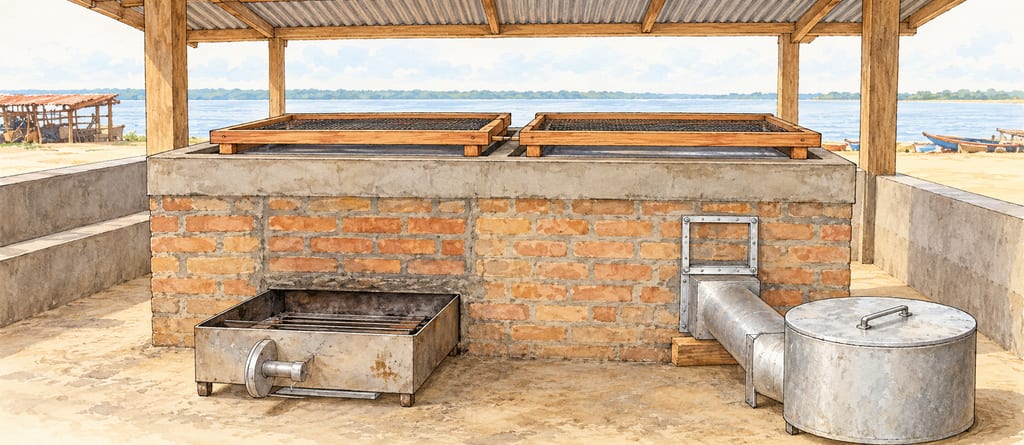
The FAO-Thiaroye Processing Technique separates fish cooking from smoke flavouring. A heat-retaining cooking unit, fat collector, filtered smoke generator and smoking chamber reduce direct smoke and fat contact; installations vary by place.

Soft, spreadable Calabrian pork sausage made with a great deal of red chilli and fatty pork, stuffed into natural casings, sometimes smoked and matured while staying soft.

A way to add independent temperature logging to an existing food dehydrator without changing its built-in controls or protections. It is a monitoring method, not a rewiring plan.

Pleurotus cystidiosus is the abalone mushroom, a cultivated oyster-type fungus with dark brown caps that grows more slowly and is more demanding than other Pleurotus species.

A dark, balanced vinegar from Emilia-Romagna made by combining cooked or concentrated grape must with wine vinegar, then acetifying and refining it in wood under a protected specification.

A living dairy inoculum that starts controlled cream fermentation, developing acidity and aroma before sour cream or cultured butter is finished.

A small electric incubator holds jars at a selected temperature for yogurt and other documented warm food preparations. Controls, capacity and vessel arrangement vary by model.

Adygean salt is a seasoned table salt associated with Adygea and the wider North Caucasian culinary tradition. Salt is blended with garlic and a variable selection of herbs and spices; the exact mix depends on the named style and maker.

The African Caesar-group mushroom, Amanita masasiensis, is a wild ectomycorrhizal species of central and southern African woodlands, eaten locally. The genus contains deadly poisonous species, so identification needs care.
No community contributions have been published for this entry yet.
Sign in to contribute. Published comments and photos are free to read.
USAID Ghana Sustainable Fisheries Management Project; CSIR Institute of Industrial ResearchDesign · Materials · Operation
Testing of Low PAH Improved Fish Smoking Stove (Ahotor Oven)Technical description: sandcrete blocks and Portland cement form most of the body; burnt bricks partition the combustion chambers; a grate sits inside; wooden trays stack on top; a collector routes drippings away.
Cited in: A modern Ghanaian smoking oven; Fire, airflow and the collector; What the available plans do not establish
USAID Ghana Sustainable Fisheries Management ProjectTesting · Geography
Performance Evaluation of the Ahotor OvenEvaluation sites in Central and Western Ghana; comparative fuel-efficiency findings are specific to the reported tests.
Cited in: Where it was tested and introduced; What the available plans do not establish
SNVHistory · Geography · Design
Introducing the Ahotor oven in the Volta Region of GhanaThe Ahotor was introduced under the USAID-funded Sustainable Fisheries Management Project; a pilot installation was built in the Volta Region; the collector directs fish drippings away from the fire; trained local masons built pilot stoves.
Cited in: A modern Ghanaian smoking oven; Fire, airflow and the collector; Where it was tested and introduced
Ghana National Fish Processors and Traders AssociationForm · Image
The Ahotor OvenThe page identifies its photograph as an Ahotor oven; the photograph shows a cement exterior, paired brick-lined openings and wooden smoking trays.
Cited in: A modern Ghanaian smoking oven
HealthyFoodAfricaDevelopment · Limits
Improving Smoked Fish Safety in Ghana: Food System Lab Accra pilots modified ovens for healthier processingThe original oven was developed under the Sustainable Fisheries Management Project in 2016; the account distinguishes a 2022 modification and reports user feedback on performance limitations.
Cited in: Where it was tested and introduced
USAID Ghana Sustainable Fisheries Management ProjectFood safety context
Microbiological and PAH Profile of Smoked Sardinella in GhanaThe report studies PAH results for particular smoked-fish samples and ovens; it does not validate all Ahotor installations or batches.
Cited in: Fire, airflow and the collector