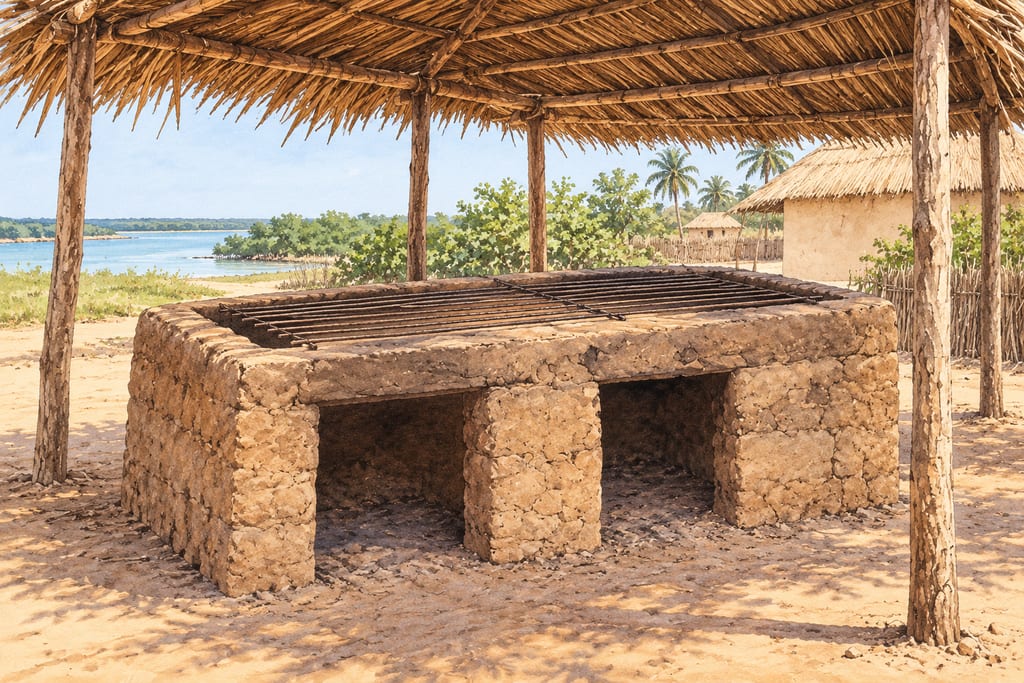
Closed Banda oven
A closed Banda is a fixed fish-smoking oven with enclosing mud-block or compacted-clay walls around a rectangular fire and a grill or wire-mesh platform. Its regional forms are not one standardized plan.
 FermenteaWhere food goes to change
Built structures · Masonry smoking ovens
The FAO-Thiaroye Processing Technique separates fish cooking from smoke flavouring. A heat-retaining cooking unit, fat collector, filtered smoke generator and smoking chamber reduce direct smoke and fat contact; installations vary by place.
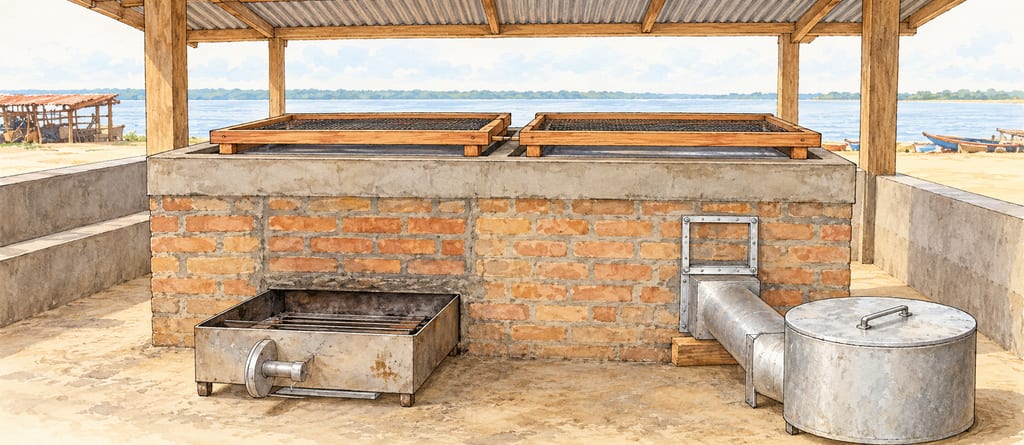
The FAO-Thiaroye Processing Technique (FTT) is a fish-smoking system developed by FAO with Senegal’s National Training Centre for Fisheries and Aquaculture Technicians. Work began in 2008. It builds on existing fish-smoking practice but separates cooking from smoke flavouring: fish receives heat in one unit, then filtered smoke in another. That division is the defining design idea, not one fixed kiln shape or a single set of dimensions.
The FAO schematic identifies a cooking compartment, smoking compartment, furnace, ash tray, rack hood, chimney, smoke-generating chamber and filter. A fat-collecting plate sits between fish and heat source. FAO describes FTT accessories that can adapt to existing ovens, while construction and maintenance training has involved local fabricators. Those accounts describe a family of installations shaped by local facilities, not a universal blueprint.
In a conventional direct-smoking kiln, heat and unfiltered smoke can reach the fish together, while fat may drip onto the fire. The FTT design changes those paths. Its cooking compartment uses indirect heat; the fat collector intercepts drippings; and a separate smoke generator sends filtered smoke to the smoking unit. In the Ghana study, fish was cooked with fully lit charcoal and heat-retention stones, then exposed to filtered smoke generated from moistened plant material. A moistened luffa fibre filter traps tar particles and may reduce PAH deposits.
The purpose of these components is not merely to change flavour. The design targets polycyclic aromatic hydrocarbons (PAHs), contaminants that can form during smoking. In the Ghana comparisons, the tested FTT products had lower measured benzo(a)pyrene and PAH4 than the tested Chorkor and metal-drum kiln products, and wood fuel produced higher contamination than fully lit charcoal. Those findings apply to the study’s particular fish, fuels and equipment. They do not certify every FTT unit or product.
The system’s history and its installations are best kept distinct. Senegal is the documented development setting. Ghana is the setting for the published comparison of kiln design and fuel. In 2023, FAO reported training Liberia’s fisheries officers and local fabricators in construction and maintenance, including components, technical drawings, assembly and maintenance. These records show the technology travelling through collaboration and adaptation; they do not establish one standardized building material, footprint or site layout.
The available sources name important parts and explain how they work, but they do not provide a universal construction schedule or complete engineering specification. Masonry, metal fittings, filters and accessory arrangements can differ by installation. This page describes the documented principle and components, not a do-it-yourself fire plan. The PAH results are a reason to understand the design, not a substitute for inspecting a kiln or validating a batch.
FAO records collaboration with Senegal's National Training Centre for Fisheries and Aquaculture Technicians beginning in 2008. Later FAO material documents development, local fabrication and training in Ghana and Liberia; these are separate deployment contexts, not a single standard installation.
A build is made where it stands: moving it means building it again.
A Ghana study measured different PAH levels across FTT and traditional kilns and found fuel type affected results; the name of the technology alone does not validate a batch.
Hazard sourceFAO describes local fabrication and training rather than a universal dimensioned plan; this record is not a construction or fire-safety specification.
Hazard sourceDo not treat this historical and technical account as a construction drawing or food-safety validation.
The reported PAH results apply to the Ghana study’s tested fish, fuels and kilns; they do not certify every FTT installation or product.
FAO identifies Senegal as the development setting; this country-level evidence does not identify one original kiln site.
The research tested FTT products and design features in Ghana; it does not define every installation.
The source documents training local fabricators and fisheries officers; it does not specify the number or exact locations of installed kilns.
A closed Banda is a fixed fish-smoking oven with enclosing mud-block or compacted-clay walls around a rectangular fire and a grill or wire-mesh platform. Its regional forms are not one standardized plan.
A concrete fermentation tank installed below ground at a Senegalese fish-processing site was documented as an adaptation that emulated the older practice of burying fish during fermentation.

Soft, spreadable Calabrian pork sausage made with a great deal of red chilli and fatty pork, stuffed into natural casings, sometimes smoked and matured while staying soft.

A way to add independent temperature logging to an existing food dehydrator without changing its built-in controls or protections. It is a monitoring method, not a rewiring plan.

Pleurotus cystidiosus is the abalone mushroom, a cultivated oyster-type fungus with dark brown caps that grows more slowly and is more demanding than other Pleurotus species.

A dark, balanced vinegar from Emilia-Romagna made by combining cooked or concentrated grape must with wine vinegar, then acetifying and refining it in wood under a protected specification.

A living dairy inoculum that starts controlled cream fermentation, developing acidity and aroma before sour cream or cultured butter is finished.

A small electric incubator holds jars at a selected temperature for yogurt and other documented warm food preparations. Controls, capacity and vessel arrangement vary by model.

Adygean salt is a seasoned table salt associated with Adygea and the wider North Caucasian culinary tradition. Salt is blended with garlic and a variable selection of herbs and spices; the exact mix depends on the named style and maker.

The African Caesar-group mushroom, Amanita masasiensis, is a wild ectomycorrhizal species of central and southern African woodlands, eaten locally. The genus contains deadly poisonous species, so identification needs care.
No community contributions have been published for this entry yet.
Sign in to contribute. Published comments and photos are free to read.
Food and Agriculture Organization of the United NationsDesign · Components
Thiaroye Processing TechniqueThe illustrated prototype labels the cooking and smoking compartments, fat-collecting plate, furnace for embers, metal barrel, pipe and casing containing a smoke filter.
Cited in: A system built around two separate jobs
Food and Agriculture Organization of the United NationsHistory · Geography · Use
FTT-Thiaroye Ovens: Clearing the air for women fish processors in Côte d'Ivoire, and beyondFAO says collaboration with Senegal's CNFTPA began in 2008 and produced a dual-function oven and mechanical drier/storage unit for small-scale fish processors.
Cited in: A system built around two separate jobs; A technology carried across local installations
Food and Agriculture Organization of the United NationsConstruction · Maintenance · Geography
Liberia's Fishery Officers and Local Fabricators Learn How to Build Effective Fish Processing Facilities, FTTFAO describes the FTT as adaptable to most ovens and records 2023 training for fishery officers, fabricators and constructors on its components, drawings, construction, assembly and maintenance.
Cited in: A system built around two separate jobs; A technology carried across local installations
Bomfeh et al., Journal of the Science of Food and Agriculture 99(12), 2019; full text hosted by University of GhanaDesign · Process · Safety · Geography
Reducing polycyclic aromatic hydrocarbon contamination in smoked fish in the Global South: a case study of an improved kiln in GhanaThe study describes a cooking unit and smoking unit, fish hood/racks, fat-collector tray, chimney, furnace, ash tray, smoke-generating chamber and smoke filter.
Its Ghana trials describe fully lit charcoal and heat-retention stones for cooking, followed by filtered smoke flavouring; it reports lower PAH levels in tested FTT products than tested traditional kilns.
The study reports that wood fuels produced higher PAH contamination than fully lit charcoal across the tested kilns.
Cited in: Why separate heat, fat and smoke; A technology carried across local installations
Food and Agriculture Organization of the United Nations, GhanaGeography · Design · Use
Reducing Post-Harvest Losses and Ensuring Food Safety in Small-scale Fisheries Through the FAO-Thiaroye Smoking Technology (FTT)FAO describes the FTT as an improved processing technology developed to address concerns around PAHs and notes that accessories can be installed on Chorkor and Banda kilns.