A closed form within a varied regional family
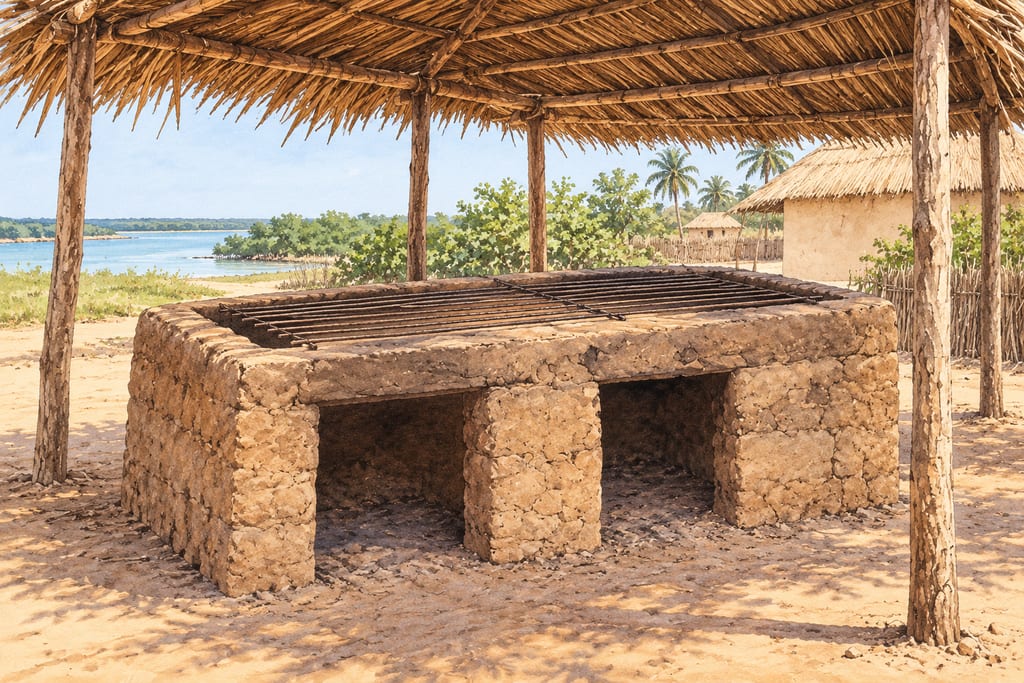
Banda is not one standardized oven. FAO's field account separates open bandas from closed ones and records substantial differences in construction material, size and operation across West Africa. This entry is deliberately limited to the closed mud-block or compacted-clay form documented in Senegal and The Gambia. It does not describe the open version, where a mesh table is carried on forked poles, or the closed variant whose walls are made from flattened barrel metal.
In the closed Banda, walls enclose a rectangular fire space and support a grill or wire-mesh platform for fish. The report gives a wall-height range of 50–80 cm, but does not present one universal plan. A field photograph in the same FAO report shows a home-style mud-block Fante oven in Guinea-Bissau. FAO says comparable mud-block and compacted-clay closed ovens were also used in Senegal and The Gambia, though there they were not called Fante; the photograph is a regional structural reference, not a Senegalese or Gambian specimen.
Sources for this section
Fire space, walls and working platform
The enclosing walls make the fire space more contained than the open Banda's exposed underside. The FAO account says fuelwood and energy wastage is higher with the open design. It does not provide a controlled numerical comparison for all closed Banda variants, so that observation should not be turned into a fixed efficiency claim for a particular oven.
The grill or wire mesh holds fish above the fire. A stoke opening provides access for fuel and fire control; its location, number and size vary. In some closed designs, the wall material is compacted clay or mud block, while flattened barrel sheets make another distinct wall form. These are local variants, not interchangeable material specifications.
Sources for this section
Keep neighboring ovens distinct
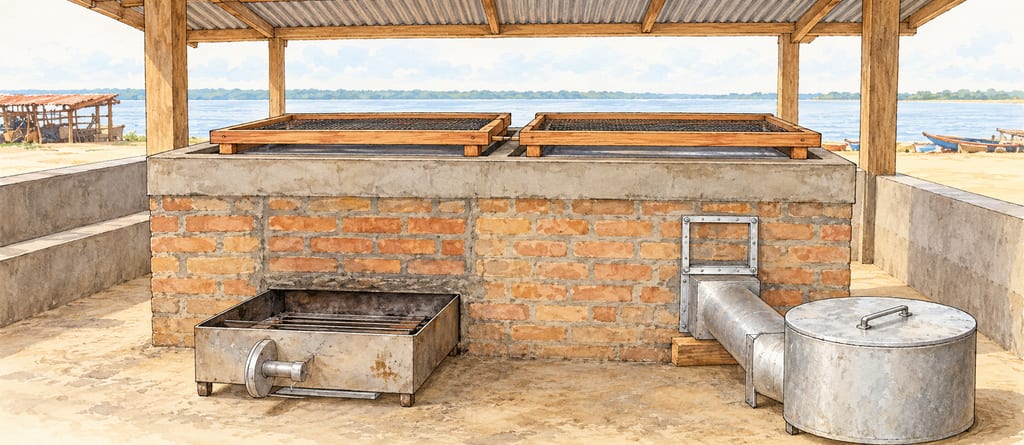
The Gambian report's partitioned closed Banda is called the Improved Chorkor oven. It is a specific development with internal dividing walls, described separately from the more general closed Banda. It should not be treated as the sole meaning of Banda or as an ordinary stacked-tray Chorkor.
The Senegalese parpaing oven is also a separate design. A 2001 FAO consultation describes it as an improved covered oven used for smoking and roasting fish, with a hood, metal doors at fire openings and side ventilation. FAO's 1994 report discusses parpaing in connection with roasting bonga for kétiakh; that roasting, peeling, salting and drying sequence is different from the broader Banda smoking systems.
Sources for this section
Fish smoking and its limits
The 1994 report documents bonga (Ethmalosa fimbriata) smoked in Banda ovens as one West African preservation practice. The oven is the fixed structure; the fish and its processing sequence belong to the preparation page. Some bonga is hot-smoked, while other local products involve roasting, salting, drying or fermentation before sun-drying. The name of the oven alone does not determine a single recipe or storage outcome.
The available field descriptions do not give a verified foundation, wall thickness, mortar recipe, structural load, grill fixing or fire-clearance plan for a new build. They identify forms and regional use rather than certify a construction method. No dimensions or instructions beyond the reported 50–80 cm wall-height range are supplied here.
Sources for this section
History
FAO's 1994 field account distinguishes open and closed Banda ovens, and records mud-block or compacted-clay closed forms in Senegal and The Gambia. It does not establish their origin date or a continuous use history.
Site
SettingFixed fish-processing site; surveyed Banda ovens could be placed in a dwelling house or simple shelter, though arrangements varied.
GroundNo footing or soil requirements are specified in the source.
ClimateNo climate specification for the oven structure is given; materials and operation vary by region.
NotesThe source describes a family of regional forms, not one build-ready plan.
A build is made where it stands: moving it means building it again.
Places
Senegal
Documented use · Country evidenceFAO reports closed mud-block/compacted-clay Banda forms in Senegal; it does not name one local standardized plan.
The Gambia
Documented use · Country evidenceFAO reports closed mud-block/compacted-clay Banda forms in The Gambia; a partitioned improved Chorkor variant is described separately.