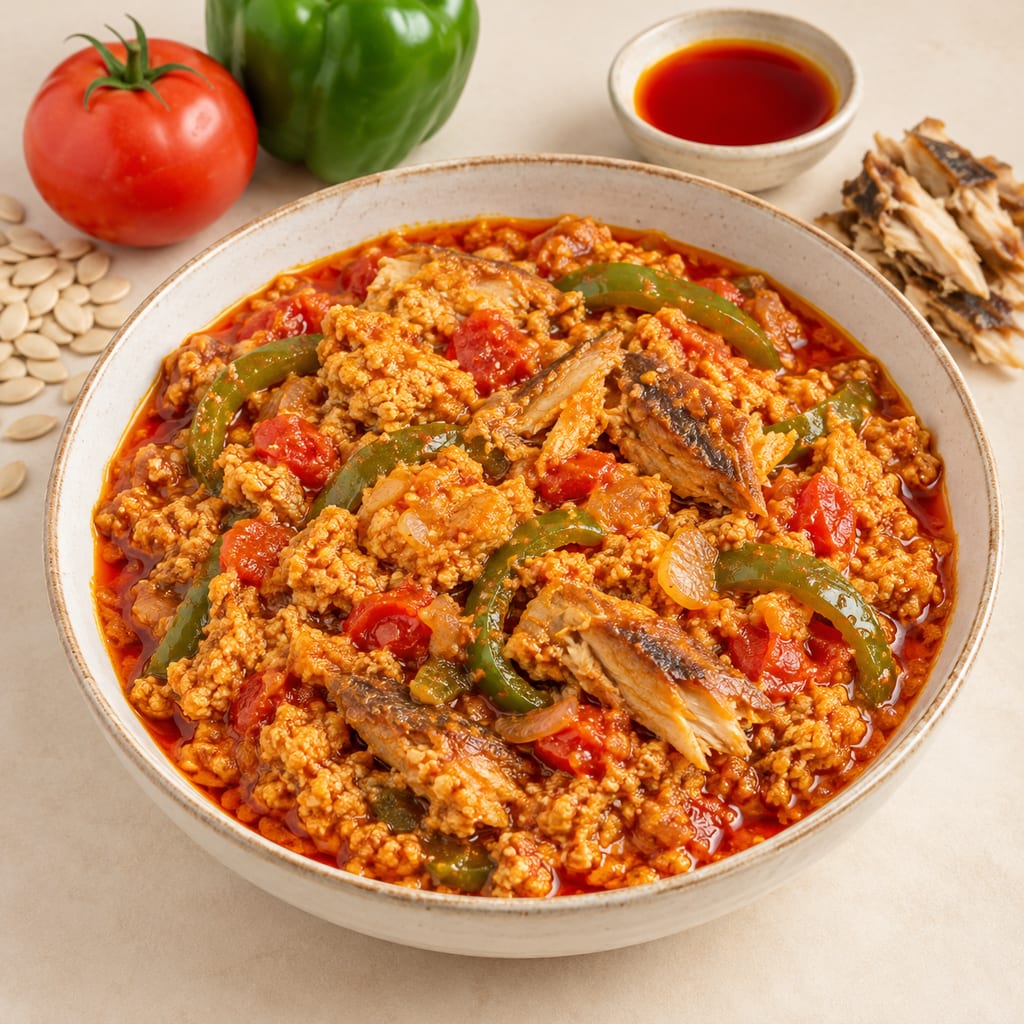
Smoked fish and agushie stew
Ghanaian agushie stew combines melon-seed paste with tomatoes, peppers, palm oil and smoked fish, and is served with rice, yam or plantain.
 FermenteaWhere food goes to change
Built structures · Masonry smoking ovens
Kagan smoker · Chorkor oven
The Chorkor, also called the Kagan smoker in early FAO documentation, pairs a low rectangular mud/clay oven with stacked removable wooden-frame, wire-mesh trays. FAO records its use at Chorkor, Ghana, from 1971.
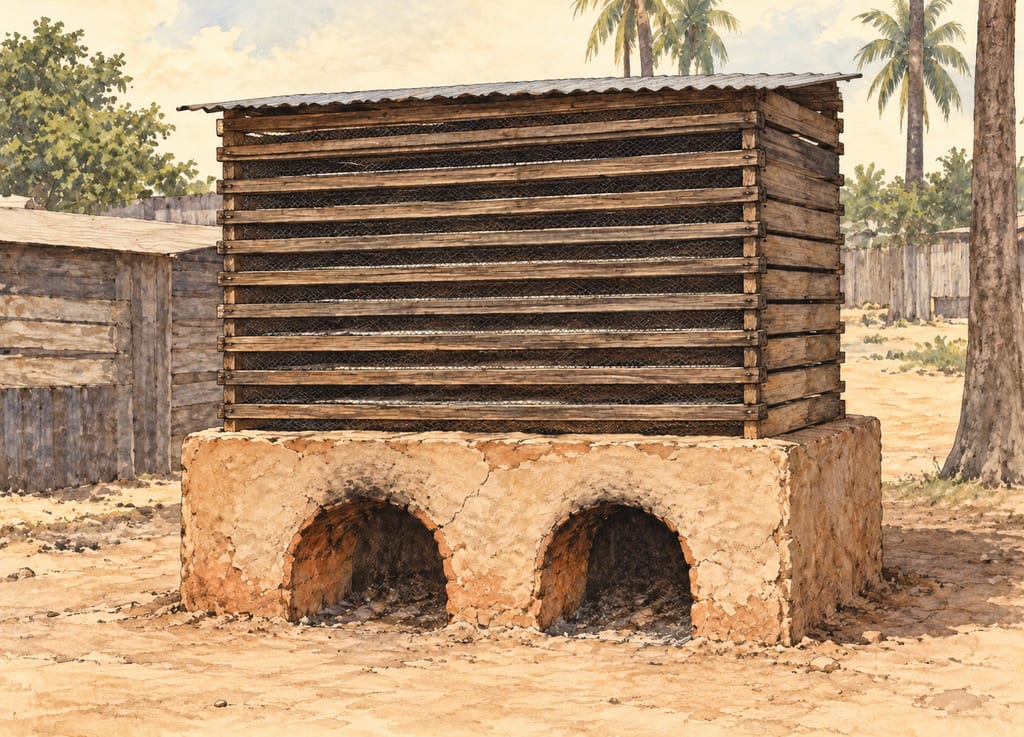
The Chorkor smoker—called the Kagan smoker in the FAO report’s technical discussion—is a fixed mud/clay-brick oven paired with removable trays. Brownell’s 1982 report says it had been used at Chorkor, Ghana, since 1971. It describes the design as a rectangular adaptation of older West African cylindrical mud/clay ovens, made principally to carry wooden frames with wire-mesh bottoms. The account identifies a change in the oven and fish-support system; it does not claim that fish smoking itself began with the Chorkor.
The report gives a construction time of about three days for a local mason, allowing the first and second levels time to set. It supplies no measured plan, wall thickness, foundation design or universal material recipe. A thin cement surface layer is described as one option for extending the oven’s life, not an essential finish.
The 1982 report gives average tray dimensions of 98 by 200 centimetres and describes an installation using as many as 15 trays. These are source-era figures for the example, not a standard that every Chorkor oven must follow. The tray frames are wood, with mesh forming the bottom. The top tray can be covered with plywood or corrugated metal; the report says the cover keeps out rain and holds smoke in, while gaps around it allow a natural draught.
The FAO account describes ovens placed close together, with one team of women able to work several at once. It also explains that trays are rearranged during a run to even out exposure. These notes describe the historical work setting and operation rather than a validated production schedule.
A 2002 study interviewed 51 fish processors in three southern Ghanaian communities where the Chorkor smoker had been introduced. It reports several practical changes: smaller trays for easier handling, brick in place of clay, internal compartments and sticks placed above the mesh to reduce impressions on larger fish. This evidence makes the Chorkor better understood as a family of adapted ovens than as a single fixed drawing.
A 2024 study of Ghana’s marine-fish supply chains names Chorkor among Accra’s coastal fishing communities and includes photographs captioned as Chorkor ovens with stacked trays, showing mud and concrete examples. It documents current processing context but does not establish that every present oven is built to the 1971 form or that the same design has remained unchanged.
The Chorkor smoker is documented here as a Ghanaian fixed smoking structure, especially associated with Chorkor in Accra. It is related to the wider West African history of cylindrical mud/clay ovens, but the sources do not justify treating every West African smoking kiln as a Chorkor. The cited capacity and time figures belong to the FAO report’s 1982 account; they are not current guarantees, universal specifications or food-safety validation.
The 1982 FAO report says the Kagan smoker was used at Chorkor, Ghana, since 1971 and describes it as a rectangular adaptation of older West African cylindrical mud/clay ovens. Later studies document local modifications and continued Chorkor use, without implying that every community uses one fixed design.
A build is made where it stands: moving it means building it again.
The FAO report names Chorkor, Ghana; the 2024 study places Chorkor among Accra's coastal fishing communities.
Ghanaian agushie stew combines melon-seed paste with tomatoes, peppers, palm oil and smoked fish, and is served with rice, yam or plantain.
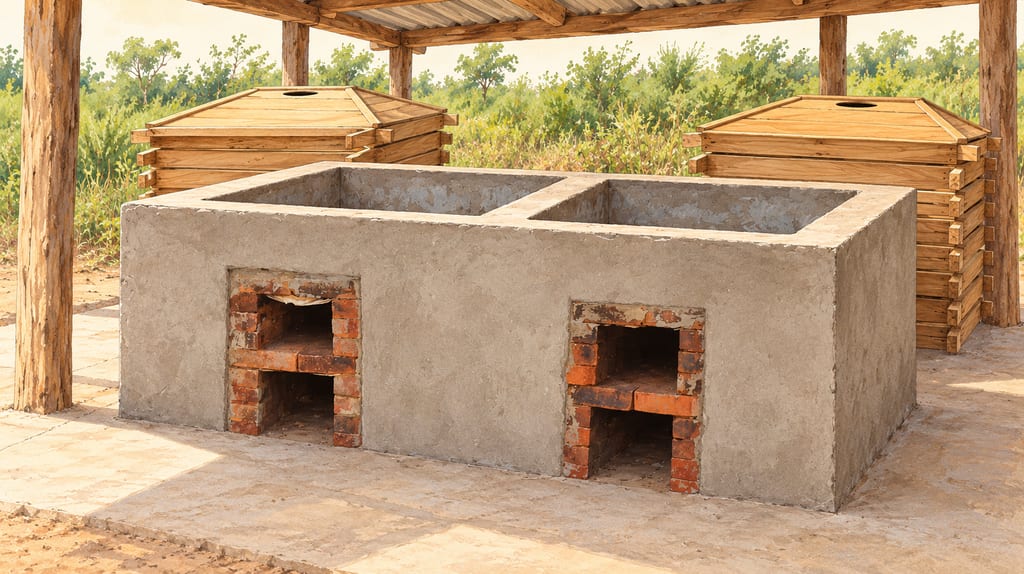
The Ahotor is a modern fixed masonry fish-smoking oven developed in Ghana as an improved alternative to traditional smokers such as the Chorkor.
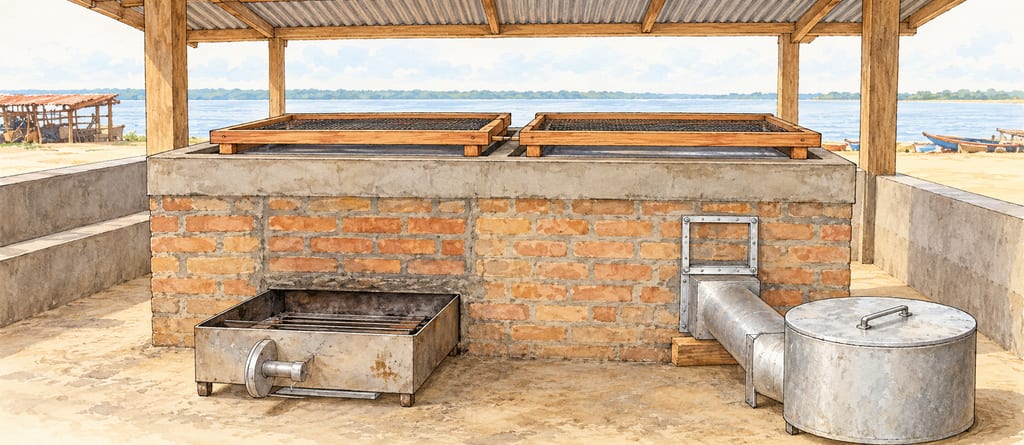
The FAO-Thiaroye Processing Technique separates fish cooking from smoke flavouring. A heat-retaining cooking unit, fat collector, filtered smoke generator and smoking chamber reduce direct smoke and fat contact; installations vary by place.

Soft, spreadable Calabrian pork sausage made with a great deal of red chilli and fatty pork, stuffed into natural casings, sometimes smoked and matured while staying soft.

A way to add independent temperature logging to an existing food dehydrator without changing its built-in controls or protections. It is a monitoring method, not a rewiring plan.

Pleurotus cystidiosus is the abalone mushroom, a cultivated oyster-type fungus with dark brown caps that grows more slowly and is more demanding than other Pleurotus species.

A dark, balanced vinegar from Emilia-Romagna made by combining cooked or concentrated grape must with wine vinegar, then acetifying and refining it in wood under a protected specification.

A living dairy inoculum that starts controlled cream fermentation, developing acidity and aroma before sour cream or cultured butter is finished.

A small electric incubator holds jars at a selected temperature for yogurt and other documented warm food preparations. Controls, capacity and vessel arrangement vary by model.

Adygean salt is a seasoned table salt associated with Adygea and the wider North Caucasian culinary tradition. Salt is blended with garlic and a variable selection of herbs and spices; the exact mix depends on the named style and maker.

The African Caesar-group mushroom, Amanita masasiensis, is a wild ectomycorrhizal species of central and southern African woodlands, eaten locally. The genus contains deadly poisonous species, so identification needs care.
No community contributions have been published for this entry yet.
Sign in to contribute. Published comments and photos are free to read.
Food and Agriculture Organization of the United NationsForm · Materials · Construction · Use · History · Geography
SWIOP/WP/5 Final Report of the Workshop on Traditional Fisheries Development, Appendix I: An Example of a Successful Artisanal Fish-Smoking System in Coastal West AfricaThe report says the Kagan smoker was used at Chorkor, Ghana, since 1971, and describes it as a rectangular modification of traditional West African cylindrical mud/clay ovens to support wooden-frame, wire-mesh trays.
It says a local mason could build the oven in about three days, allowing the first and second levels to set; it does not provide a measured plan or foundation detail.
Trays averaged 98 × 200 cm and the report describes up to 15 trays in a run; these are reported figures, not a universal specification.
The top tray could be covered with plywood or corrugated metal; the report says this helped keep out rain and retain smoke, with natural draught through gaps.
The report discusses the Chorkor system's use and market distinctions; its 1982 performance figures are historical observations, not current production or safety guidance.
Cited in: A rectangular oven for stacked trays; Trays, cover and working arrangement; Scope and limits of the record
CSIR Food Research Institute; Ghana Journal of Agricultural ScienceAdaptation · Use · Geography
Evaluation of determinants for effective adoption of an improved fish-processing technology in GhanaThe study interviewed 51 fish processors in three southern Ghanaian fishing communities where the Chorkor smoker had been introduced.
It reports processor adaptations including reducing tray dimensions for easier handling, using brick instead of clay, adding internal compartments, and adding sticks over mesh to reduce marks on larger fish.
These are local adaptations reported by respondents, not a single mandatory configuration.
Cited in: A design shaped by local adaptation
Tijdschrift voor Economische en Sociale GeografieContemporary use · Geography
Post-Harvest Travels of Marine Fish: How Small Fish Food Systems Variously Support Food Security and Nutrition in Coastal and Inland Cities in GhanaThe study names Chorkor and Jamestown among Accra's coastal fishing communities and documents contemporary smoked-fish processing in these communities.
Its Figure 3 caption identifies Chorkor ovens with stacked trays, showing both mud and concrete examples; the figure credits photographer Anderson Kwasi Ahwireng.
This source supports contemporary context and place, not uninterrupted use of a single construction form since 1971.
Cited in: A design shaped by local adaptation; Scope and limits of the record