A small closure with a one-way gas path
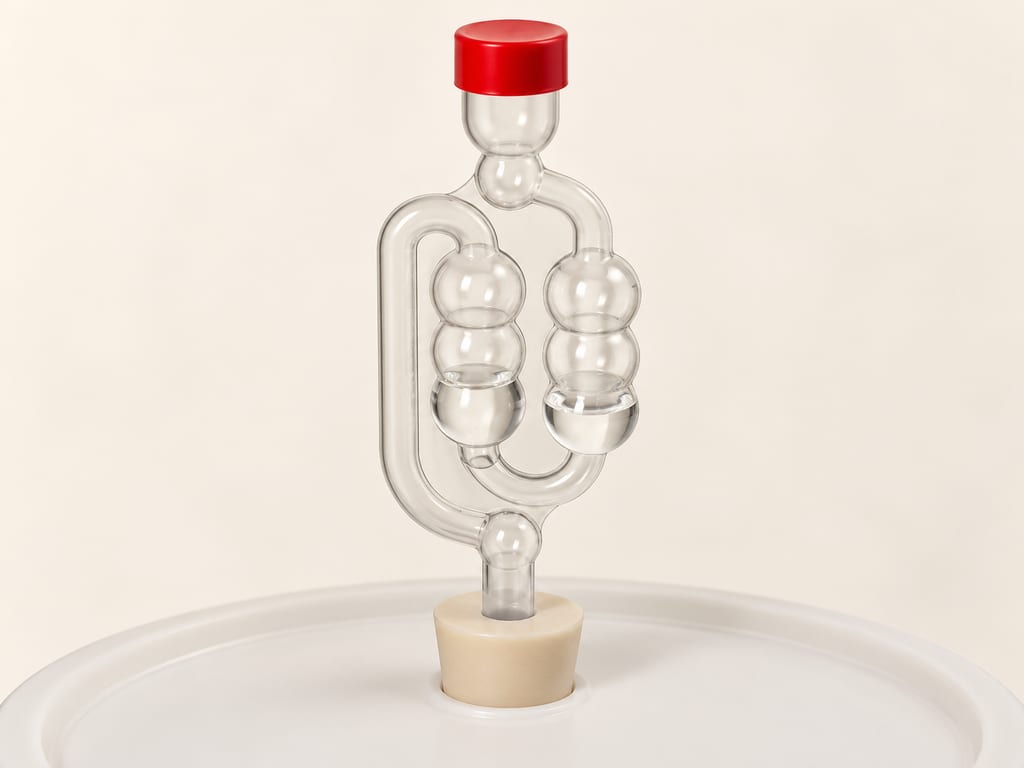
A fermentation airlock—also called a fermentation lock or bubbler—is fitted to the opening of a closed fermenter. The pictured moulded plastic bubbler sits through a stopper in a wine tank. Other setups use a stopper with glass tubing and a hose whose far end sits under water. These are different constructions of the same practical arrangement: gas can leave through a submerged outlet while the liquid seal resists air returning through that path.
The airlock is one part of a closure system. The stopper or lid must fit the vessel opening securely, and the lock must remain correctly assembled and filled according to its design. A loose stopper leaves a path around the device; an empty or unsuitable liquid seal changes how the fitting works. The University of Georgia describes a snug-fitting lock on the secondary fermenter and notes that exposed wine can oxidize or be contaminated by acetic acid bacteria. The equipment therefore helps manage gas exchange; it does not sterilize the contents or correct poor handling.
Sources for this section
Why the fermenting stage matters
Yeast fermentation produces gas. In wine making, the lock lets carbon dioxide leave while limiting incoming air, and fermentation activity can be seen as bubbles passing through the device. That movement is an observation of gas flow, not a measurement of fermentation completion or a safety test.
Vinegar makes the closure choice especially clear. FAO's home-processing method first ferments fruit juice with yeast in a closed vessel, using an airlock so gas escapes without admitting air. The liquid is then transferred to a wide, open vessel for the next stage. Acetic acid bacteria need oxygen to convert the alcohol into acetic acid, so that vessel is covered with clean cloth rather than sealed under an airlock. A lock suited to the alcoholic stage would obstruct the air contact needed in the following stage.
Sources for this section
Fits, materials and simple alternatives
Airlocks are small, unpowered fittings. The source photograph shows one white plastic form, while UGA Extension documents an alternative assembled from a one-hole stopper, glass tubing, flexible hose and a separate jar of water. The FAO manual describes narrow-necked glass or food-grade plastic vessels with a mouth that accepts an airlock. The opening, stopper and device must therefore be compatible; the term “airlock” does not specify a universal size or fit.
A homemade water-seal arrangement should follow the documented geometry: tubing passes through the stopper, and the free hose end remains submerged in water in a separate jar. This is a described construction, not a claim that every hose or stopper is suitable for food use. For a bought lock, use its own fitting and filling instructions rather than assuming all models share the same design.
Sources for this section
Care and limits
Keep the lock secured and follow its own filling and cleaning directions. UGA Extension stresses a snug fit: the device must vent fermentation gas without leaving a path for air to enter. Designs differ, so the source's water-seal arrangement should not be treated as a universal filling instruction.
An airlock is a venting closure, not a pressure gauge, pressure-rated valve or proof that a vessel can safely contain pressure. The cited guidance gives no pressure rating. Use a vessel and closure designed for the intended fermentation; do not infer pressure capability from the presence of a bubbler. For a process that depends on air, remove the lock only when the method calls for an open, protected surface and use the stated breathable cover.
Sources for this section
History
The inspected record supports current use in winemaking and home-based fruit processing but gives no dated origin for the device. Its birthplace and earliest attestation remain unknown.
Equipment details
PowerNo power The airlock works by the gas pressure produced during fermentation and the liquid seal; it has no powered parts.
How you get oneBought, manufactured Commercially made locks are available. UGA Extension also describes a simple tubing-and-water arrangement; fit the stopper and closure to the specific fermenter.
CareKeep the lock secured in a stopper or lid compatible with the vessel and follow the model's instructions for the liquid seal and cleaning. UGA Extension notes that the fit must be snug for carbon dioxide to escape without letting air in.
Made of
- Moulded plastic — Airlock body
The inspected Commons photograph documents a white plastic tank airlock; it does not identify the plastic resin. - Glass tubing — Alternative gas outlet
UGA Extension describes a simple lock assembled from a one-hole stopper, glass tubing and a hose whose free end stays submerged in a separate jar of water.
Limits
An airlock is suited to a closed, oxygen-limited fermentation stage; it is not the closure for an aerobic vinegar stage. FAO's two-stage vinegar method removes the lock for the second fermentation and covers the open vessel with clean cloth.
Source →An airlock is not a pressure-rated fitting. The cited guidance explains gas escape but specifies no pressure rating.
Source →Places
United States
Documented use · Country evidenceUniversity of Georgia Cooperative Extension documents the fermentation lock in home-winemaking guidance intended for Georgia readers; this is evidence of documented U.S. use, not an origin claim.
Unknown
Relationship not established · Place not establishedNo consulted source establishes where fermentation airlocks originated or their earliest date of use.