Beer
This is a process overview, not a complete batch recipe: key quantities, yield and packaging directions are absent. The AHA tutorial uses Hop Hammer Imperial IPA as an example; this page is not that full formulation.
 FermenteaWhere food goes to change
Equipment · Bottles, carboys and demijohns
dame-jeanne · demijohn · carboy · balon
A glass demijohn or carboy is a stout, usually rounded bottle with a narrow neck, used for beverage fermentation, maturation, storage or transport. Its glass body, closure and any protective carrier are distinct parts of the vessel system.
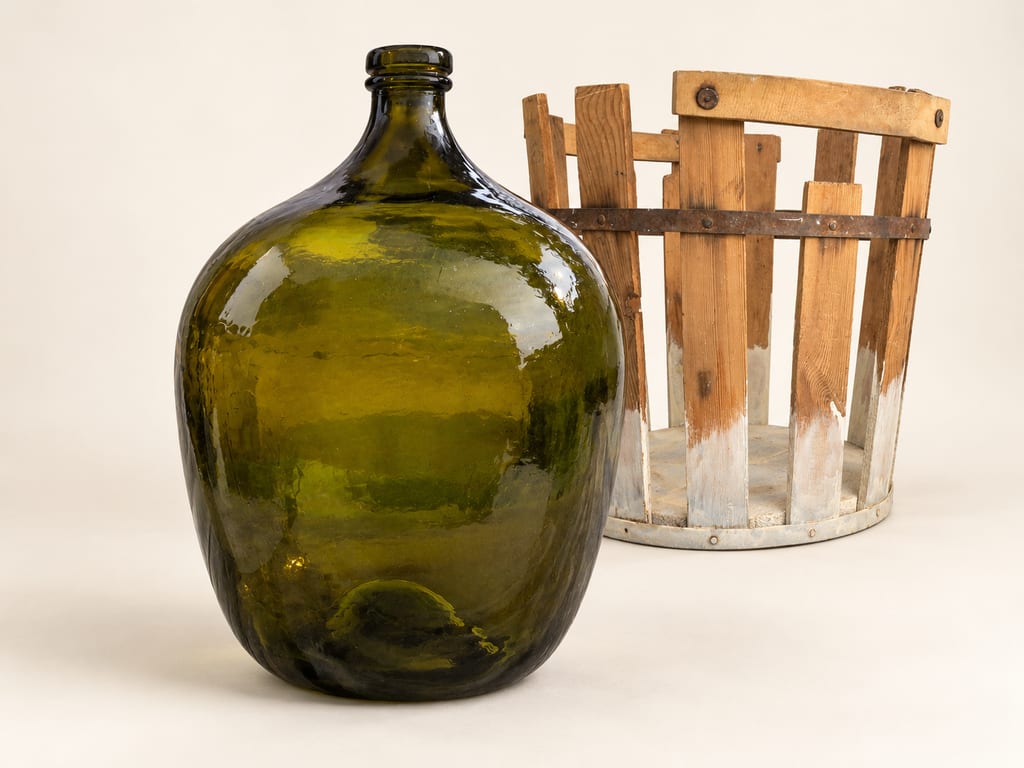
A demijohn is recognized by its swollen bottle body and comparatively narrow neck. Carboy is often used for a similar large glass vessel; the words overlap, and model names and size conventions vary between markets. The 1911 Encyclopaedia Britannica describes a rounded glass bottle or jar whose body sat inside wickerwork and whose carrier supplied handles. It also records that the term could be applied to a wicker-covered earthenware jar, so the name alone does not prove that every historical object was glass.
Protection and containment are separate jobs. The glass holds the liquid; a wicker basket, wooden frame or moulded carrier protects or supports the glass and can make a heavy vessel easier to move. The 1959 Swedish photograph shows a dark greenish-brown glass demijohn beside its wooden carrying frame. Contemporary catalogues show other combinations, including glass vessels without carriers and vessels in wicker or plastic baskets. Do not treat the basket as part of the bottle or assume one carrier material defines the whole family.
The shape appears in several stages of beverage work. The Smithsonian's National Museum of American History records one demijohn used at Stag’s Leap Wine Cellars in California’s Napa Valley during the 1990s to carry wine into a barrel room for topping up casks. That object's documented job was transport, not fermentation. The same museum notes that winemakers use carboys to ferment small research or experimental batches, while the Oxford Companion to Beer describes glass carboys in home brewing for fermentation and ageing. A community cider guide likewise names a five-litre glass demijohn among the small-scale fermenters it describes. These examples show why a surviving vessel should not be assigned a process solely from its shape.
A narrow neck can be closed with the stopper or bung intended for that particular opening. Current supplier kits pair selected models with a stopper and airlock; those modern fittings should not be projected onto an undated or older vessel. The vessel wall and its closure are different parts of the system: glass is largely gas-impermeable, but openings, closures and transfers still matter. A narrow opening limits access for loading and cleaning compared with a wide-mouth jar, and the exposed liquid area depends on the vessel's width at its fill level.
The word demijohn does not specify a standard volume. The 1911 entry gives two to twelve gallons and names five gallons as common in its period; Browin’s current catalogue spans models from 1.5 to 54 litres. Those measurements describe different sources and times, not one enduring standard. Select a model by its own stated capacity, opening, carrier and closure rather than by the family name.
The Britannica entry suggests that demijohn may adapt the French Dame Jeanne, but presents this as an etymological possibility. It does not establish where the bottle form began. The documented locations here are examples: a 25-litre glass vessel made at Surte in Sweden in 1959, and a later winery use in California. Neither example is a birthplace for a vessel family that the research atlas describes as widely distributed.
The eleventh-edition Encyclopaedia Britannica's 1911 entry records the rounded glass body, narrow neck, wicker carrier and handles, and offers Dame Jeanne as a possible source of the name. This is a dated written attestation, not an origin date. A 25-litre greenish-brown glass example is recorded as manufactured at Surte glasbruk in Ale municipality, Sweden, in 1959. Smithsonian records document later winery use in California, and current catalogues continue to offer glass demijohns in varied sizes and forms.
The Commons object caption identifies this specific 25-litre glass demijohn as made by Surte glasbruk in 1959; this is one specimen, not the type's origin.
The Smithsonian records one carboy used at Stag’s Leap Wine Cellars for carrying wine to top up barrels; it documents cellar transport, not fermentation in that particular vessel.
No single place of origin is established by the sources used here; the 1911 dictionary gives a qualified possible name derivation, not a proven origin for the vessel form.
This is a process overview, not a complete batch recipe: key quantities, yield and packaging directions are absent. The AHA tutorial uses Hop Hammer Imperial IPA as an example; this page is not that full formulation.
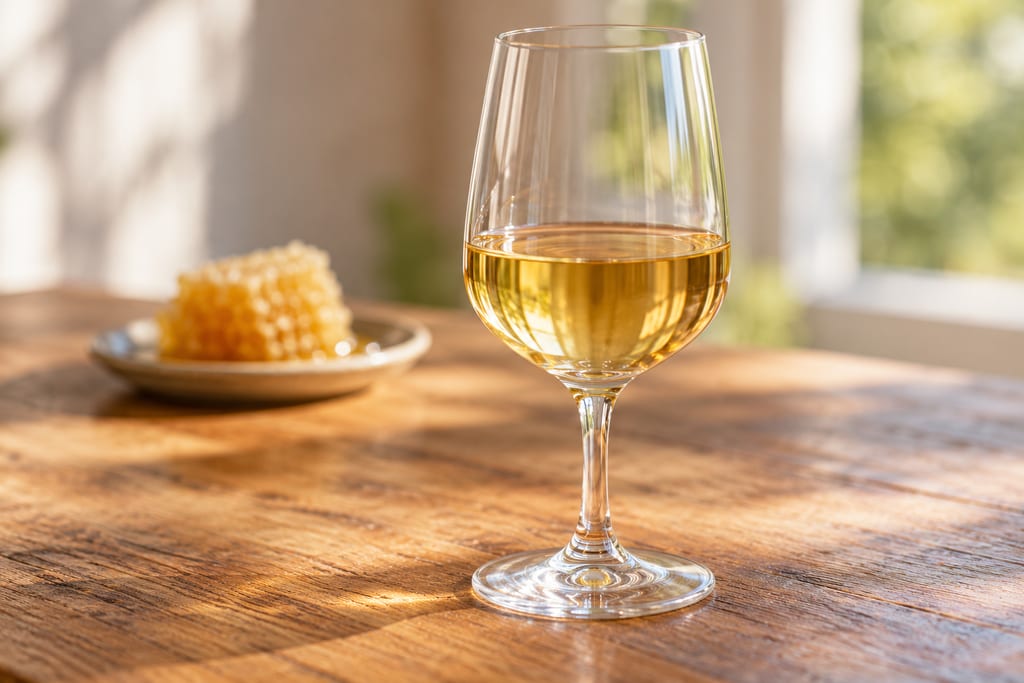
Mead is an alcoholic drink made by fermenting diluted honey with yeast, then racking and ageing it. The honey, not refined sugar, is what makes it mead.
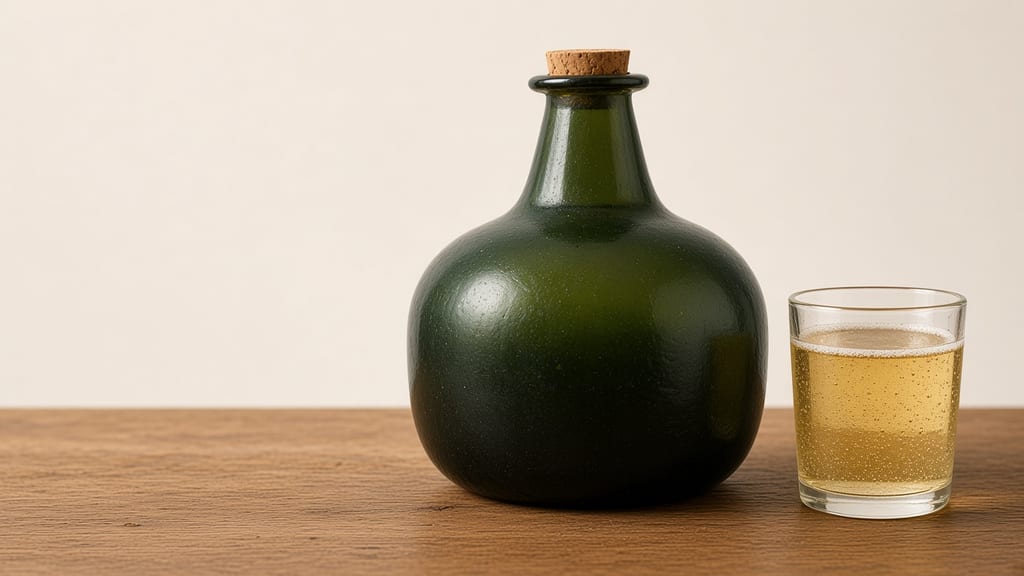
A lightly sparkling cider bottled before it had finished fermenting, as Sir Paul Neile described it in 1664, with a measured modern method for safe bottle conditioning.
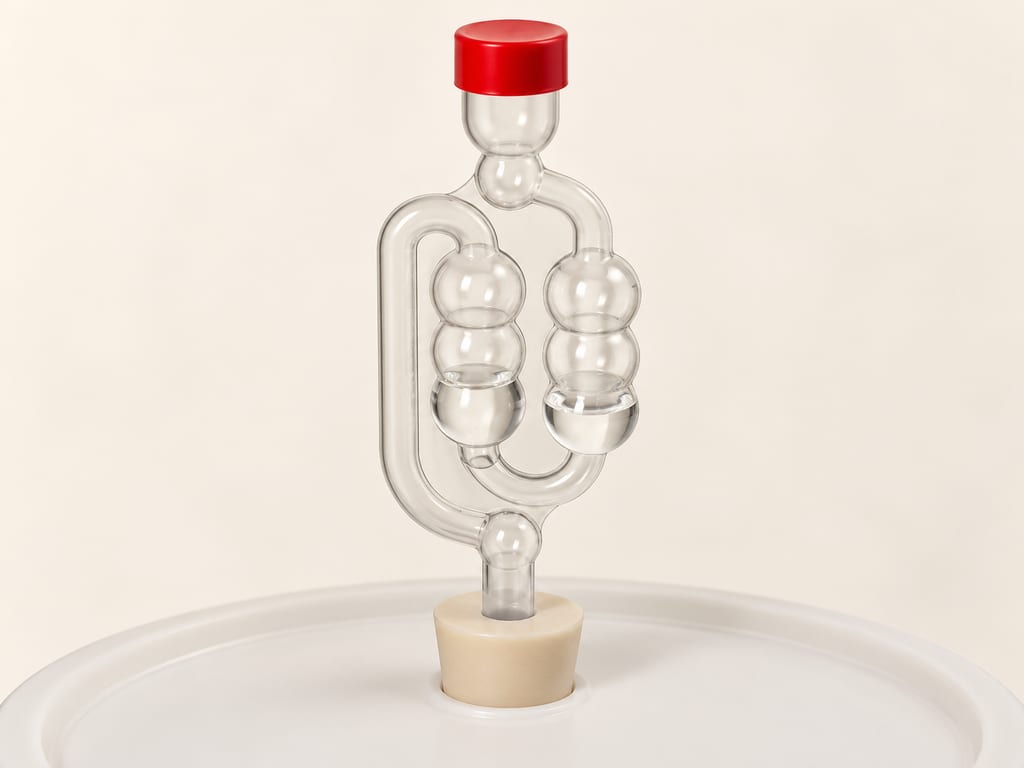
A fermentation airlock lets gas escape from a closed fermenter while its liquid seal limits air entering. It suits oxygen-limited stages, not the oxygen-dependent stage that turns alcohol into vinegar.
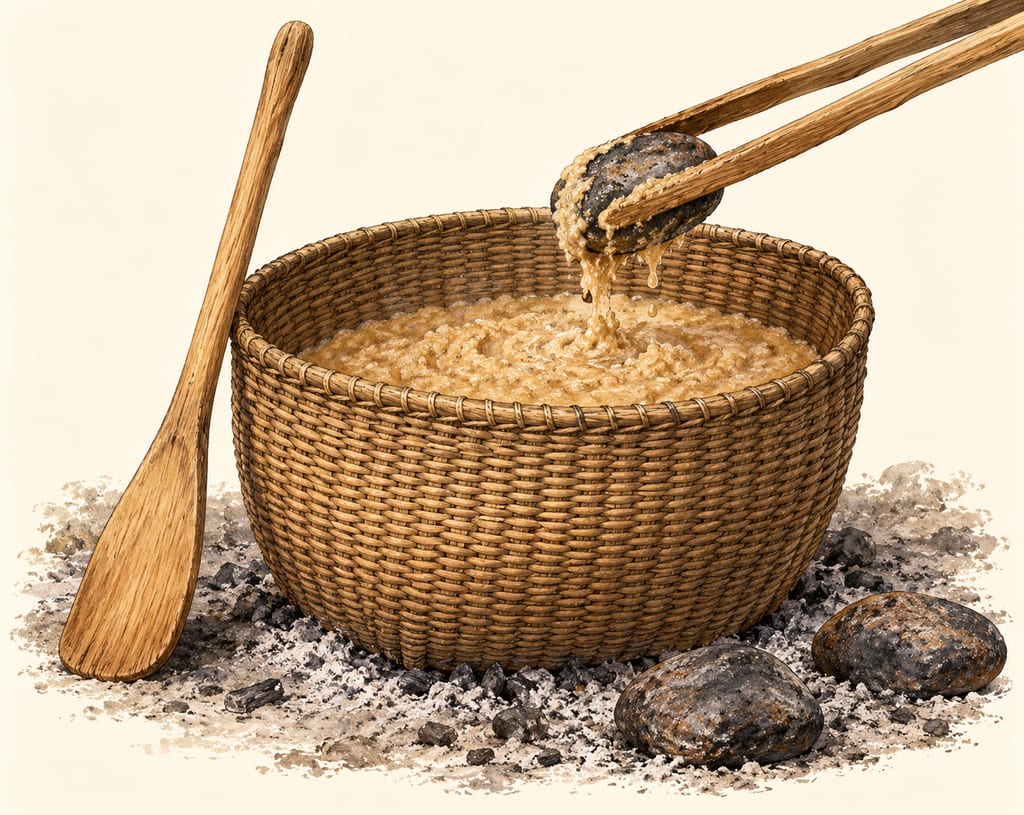
A closely woven, watertight basket used in Yosemite-area Miwok cooking to boil acorn mush with heated stones. The basket holds water and meal while stones transfer heat.
A Miwok parching basket is a shallow, broad coiled basket used to toss seeds with live coals. One documented plate-form example is 71 mm high; a Southern Miwok specimen is separately identified as a parching basket.

A Cap-Pelé boucanière is an Acadian herring-smoking building. The documented Willie Niles example is a one-storey wood-frame structure with a ridge smoke vent and interior bays for hanging fish-bearing cannes.

Achcharu is a family of Sri Lankan vinegar pickles made with mixed vegetables or seasonal fruit and a piquant spice dressing. This version is a quick, refrigerated, non-fermented mixed-vegetable pickle.

The acocote is a long, hollowed and dried gourd used to draw aguamiel from a mature maguey. It is a harvesting tool: the sap is transferred to a separate vessel before it ferments into pulque.

Adrak murabba preserves young ginger in sugar syrup, a sweet South Asian preparation recorded in Indian cookery and food-processing sources.

Parkia biglobosa seeds are fermented into regional West African seasonings, including nététou, iru, dawadawa and soumbala. The yellow fruit pulp is a separate food, and names and methods vary by place.

Japanese reddish-brown vinegar from sake lees matured about three years, turned to vinegar by acetic bacteria; the vinegar of Handa and Edomae sushi rice.

A refined common-wheat flour blended for a broad range of baking; its protein and behavior vary with wheat, milling and market.

The almond mushroom, Agaricus subrufescens, was cultivated in eastern North America in the 1800s, lost its market, and returned as a cultivated mushroom from Brazil, where it is grown under several names.
No community contributions have been published for this entry yet.
Sign in to contribute. Published comments and photos are free to read.
Project Gutenberg (digitized Encyclopaedia Britannica, 11th edition, 1911)Historical attestation · Form · Historical capacity range
Encyclopaedia Britannica, 11th Edition, “Demijohn” to “Destructors”The 1911 entry describes a demijohn as a glass bottle or jar with a large rounded body and narrow neck, encased in wickerwork and provided with handles.
The entry records a two-to-twelve-gallon range and five gallons as a common size at that time; this is not a modern universal capacity or proven origin date.
The entry offers a qualified etymology from French Dame Jeanne, not proof of the form's place of origin.
Cited in: A rounded bottle with a working neck; Glass, closure and access; A name without a proven birthplace
Smithsonian National Museum of American HistoryDocumented use · Form · Museum object
Carboy (Demijohn), NMAH 1300900A glass carboy/demijohn was used in the 1990s at Stag’s Leap Wine Cellars in Napa Valley to transport wine for topping up barrels.
The museum says winemakers also use carboys to ferment small wine batches for research and experimental purposes.
The object description characterizes it as a stout glass vessel with a narrow neck and identifies glass as its main material.
Cited in: From transport bottle to fermentation vessel; A name without a proven birthplace
Wikimedia CommonsDocumented manufacture · Reference photograph · Form
25 litre demijohn, Surte glasbruk, 1959, Ale municipality, SwedenThe uploader identifies the photographed 25-litre object as greenish-brown glass made by Surte glasbruk in 1959 in Ale municipality, Sweden.
The photograph shows the glass vessel and its wooden carrying/protective frame as separate parts.
The image author releases the photograph under Creative Commons Attribution 4.0 International.
Cited in: A rounded bottle with a working neck; A name without a proven birthplace
BrowinCurrent catalogue · Modern forms · Documented uses
Glass DemijohnsThe current supplier page lists narrow- and wide-neck glass demijohns, with examples both with and without baskets; basket types include wicker and plastic.
The catalogue lists model capacities from 1.5 L to 54 L and current kits with closures and fermentation airlocks; the offered range is supplier-specific.
Current product listings distinguish demijohn bodies from removable carrying baskets and closures.
Cited in: A rounded bottle with a working neck; Glass, closure and access
The Orchard ProjectDocumented use · Cider making
Community cider makingThe guide identifies a 5-litre glass demijohn as the smallest of its described home/community cider fermenters and distinguishes it from larger plastic bins and barrels.
Cited in: From transport bottle to fermentation vessel
Craft Beer & Brewing / Oxford University PressDocumented use · Form · Terminology
Carboy, The Oxford Companion to BeerThe Oxford Companion to Beer entry describes glass carboys as home-brewing fermentation and ageing vessels and discusses their neck, closures and size terminology.
The source warns through its description that names and capacity conventions differ by place; its size and naming comments are not treated as universal standards.
Cited in: From transport bottle to fermentation vessel
BrowinCurrent model · Documented uses · Closure
Demijohn for wine in plastic basket, 54 LThe manufacturer says this specific 54-litre glass demijohn is intended for fermenting wine, beer and mead; this does not make every model suitable for every stage.
This model is sold in a plastic protective basket and is compatible with a bung opening for an airlock.
The manufacturer says the glass vessel is handmade and model shape and neck dimensions can vary slightly.
LarousseTerminology · Original name
dame-jeanne — Dictionnaire de françaisDefines dame-jeanne as a large rounded stoneware or glass bottle used to transport liquids, and relates the term to the name Jeanne and the bottle's rounded form. This supports French usage of the term, not a place or date of origin for the vessel form.
Wielki słownik języka polskiego PANTerminology · Original name
balon (z winem) — Wielki słownik języka polskiego PANDefines balon “z winem” as a round vessel for storing liquids and gives collocations szklany balon and balon z winem; this supports Polish naming, not origin or universal form.